Digital Sales Room

By
Anuj

Where Are Your Enterprise Deals Losing Momentum?
Enterprise deals don't collapse overnight. They erode gradually, one missed alignment at a time.
You have done the hard work: prospected the account, navigated to the right stakeholders, and delivered a compelling demo. The buyer seems engaged. They are nodding, asking questions, and talking about timelines. You leave the call confident that this one's going to close.
Then the follow-up takes three days longer than expected. A new stakeholder appears who wasn't mentioned before. Someone asks for information you already sent. The enterprise deal that felt inevitable six weeks ago is now perpetually "in review."
What happened?
The answer isn't in your product positioning or pricing strategy. It's in the operational gaps between your conversations, the places where clarity should exist but doesn't, where coordination should happen but isn't, where deal momentum quietly drains away.
Related Blog: Humanize Client Onboarding: Best Practices to User Retention
The Five Questions That Reveal Where Enterprise Deals Lose Momentum
Review your current enterprise sales pipeline and answer these questions honestly:
After the first demo, do all stakeholders have shared visibility into next steps?
Is there a clearly identified buyer-owner responsible for internal coordination?
Are follow-ups consistent across deals or dependent on individual sales reps?
Do buyers frequently ask for the same information again?
Does your sales team have visibility into buyer engagement after key interactions?
If you answered "no" to two or more questions, deal momentum is at risk.
This does not mean deals are lost. It means friction is building quietly, the kind that transforms a promising pipeline into a stalled funnel.
Let's examine exactly where that friction lives and what it costs your sales organization.
Talk to our team and get your questions answered. Contact us today
Question 1: After the First Demo, Do All Multiple Stakeholders Have Shared Visibility into Next Steps?
The demo goes well. Really well. Your champion is excited, the technical lead seems satisfied, and everyone agrees on the value proposition. You end the call by confirming next steps: the champion will circulate the proposal internally, schedule a follow-up with the CFO, and get back to you by Friday.
Friday comes. No response. You follow up on Monday. "Sorry, still working on scheduling that meeting."
Here's what actually happened in this enterprise deal: your champion left the demo with good intentions, but no shared artifact that other stakeholders could reference. The technical lead remembers discussing integration timelines but can't recall the specific dates. The CFO wasn't on the call and is now hearing about your solution secondhand, through a hurried hallway conversation.
Without shared visibility, each stakeholder operates from their own incomplete understanding of what was discussed and what happens next. Your champion becomes a bottleneck, fielding questions and trying to reconstruct details from memory. Meanwhile, the CFO makes judgments based on partial information, and the technical lead moves on to other priorities because they're not sure when they're needed again.
Research shows that complex deals involving 6+ stakeholders take 37% longer to close when information isn't centralized. |
Shared visibility means everyone involved on both sides can see the same timeline, the same commitments, and the same open questions. It means when the CFO asks, "What did they say about data migration?" there's a single source of truth rather than conflicting recollections.
When this visibility doesn't exist, enterprise deals don't move forward decisively. They stall. And meandering kills momentum faster than any objection ever could.
Best Practices: Give Every Stakeholder Access to One Shared Space
With Projetly Digital Sales Room, every stakeholder gets access to a centralized digital workspace where next steps, timelines, and commitments are visible to everyone involved, no more information lost in email threads or your CRM history that buyers can't access.
Start a free trial and keep every deal moving forward.
Question 2: Is there a Clearly Identified Buyer-Owner Responsible for Moving Forward?
Your champion is enthusiastic about your solution. They believe in the value. They want this to happen. But they're a Director of Marketing Operations, and getting this enterprise deal across the line requires coordinating with IT, Finance, Legal, and Procurement departments, which they don't manage and people they email maybe twice a year.
This is where deals moving forward suddenly stall.
Without a clearly identified buyer-owner who has the authority and accountability to drive internal coordination, your deal becomes everyone's secondary priority.
Your champion does what they can, but they lack the organizational weight to move procurement faster or get the CTO to prioritize the technical review. This pain point affects whether an enterprise deal progresses at all.
The buyer-owner isn't just someone who likes your product. They're someone who can make internal things happen.
They can schedule the meetings that need to happen. They can escalate when stakeholders go silent. They have enough organizational capital to say "we need to decide on this by the end of the quarter" and have people actually respond, a critical factor in maintaining deal momentum.
When you're three months into an enterprise sale and still waiting for someone to "check with legal," you don't have a buyer-owner. You have a well-intentioned contact who's doing their best within constraints you can't control.
The question isn't whether your champion is engaged. It's whether they're empowered to align the buying committee and drive deal progress.
And if they're not, you need to either elevate the conversation to someone who is or accept that this deal will progress at the pace of organizational entropy, which is to say, barely at all.
Related Blog: Customer Onboarding Playbook for Customer Success Managers
Question 3: Are Follow-Ups Consistent Across Your Enterprise Sales Playbook?
Pull up three deals from your pipeline. Now look at the follow-up cadence and quality across them.
In Deal A, your top rep sends detailed recaps within two hours of every call, confirms next steps in writing, and maintains a consistent check-in schedule.
Deal B is managed by someone who's great at sales conversations but spotty on documentation. Follow-ups happen when they remember; action items exist in scattered emails.
Deal C has changed hands twice, and the current rep is still trying to piece together what was promised three months ago.
When follow-ups depend on individual rep discipline rather than a systematic sales process, you get unpredictable outcomes.
Your best deals get excellent treatment. Your average deals get inconsistent attention. And deals that hit a rough patch or change ownership often never recover momentum.
According to sales analytics data, 68% of enterprise deals stall because of inconsistent follow-up, not because of competitive losses or budget constraints. |
Consistent follow-ups aren't about pestering buyers. They're about creating reliable touchpoints that keep everyone aligned on deal progress, blockers, and next steps. They're about ensuring that when a stakeholder has a question two weeks after the demo, there's a clear trail they can reference rather than depending on someone's memory.
The best enterprise sales organizations treat follow-up consistency like a system, not a personality trait. Every deal gets the same foundational rigor: recap emails, confirmed next steps, documented action items, and scheduled check-ins. Enterprise sellers can still personalize their approach, but the baseline mechanics that preserve momentum aren't optional.
When follow-ups are inconsistent, buyers interpret silence as disinterest or disorganization. They assume that if you can't manage the sales process crisply, you probably can't deliver on implementation either. Fair or not, that perception kills deals moving forward.
Optimize Your Sales Cycle: Systematize What Top Performers Do Naturally
Projetly DSR automatically captures action items, sends reminders, and maintains a complete history of every interaction, so your follow-up quality doesn't depend on who's managing the deal. This sales enablement approach helps keep deals moving regardless of rep experience.
Talk to our team and get your questions answered. Contact us today
Question 4: Do Buyers Frequently Ask for the Same Information Again?
"Can you resend that security documentation?"
"What was the implementation timeline again?"
"Do you have case studies in our industry?"
You've sent all of this before. Multiple times. But here you are, sending it again, a metric of inefficiency that drags down velocity in every deal.
This isn't just annoying; it's a symptom of deeper dysfunction in your sales process. When buyers repeatedly ask for the same information, it means one of three things is happening:
First, the information isn't stored anywhere that the buying committee can reliably access it. Your champion has it buried in their inbox, but when the CISO asks for it, they can't find it quickly. So they ask you instead of searching, adding friction at every stage of the deal.
Second, the information exists but isn't organized in a way that matches how buyers actually consume it. You sent a comprehensive PDF, but the CFO just wants the pricing page. The IT director needs the API documentation, but it's embedded in slide 47 of your platform overview. Rather than dig through irrelevant content, they ask you to send "just the relevant part."
Third, stakeholders are joining the evaluation late and don't know what's already been shared. A new VP gets pulled into the decision process, asks basic questions, and nobody on the buyer side wants to admit they should already have those answers.
Sales teams spend an average of 21 hours per deal resending information that was already shared. Regardless of the reason, repeated information requests create a coordination tax on both sides.
Your team spends time re-sending materials instead of advancing the sales conversation. The buyer's team looks disorganized internally, which undermines confidence in their ability to manage the implementation, even if they buy.
Complex deals with high information re-request rates are deals where stakeholders aren't aligned, materials aren't accessible, and coordination is breaking down. That's not a sales problem. It's a buying process problem. And if you're not helping solve it, you're contributing to the friction that stalls your own enterprise deal.
Keep Enterprise Deals Moving: One Organized Space for All Deal Content
With Projetly, all your proposals, security docs, case studies, and technical specifications live in one organized space that any stakeholder can access anytime, ending the endless "can you resend that?" cycle and reducing your sales cycle length.
Related Blog: Customer Onboarding Metric 2025: Measuring Key Performance
Question 5: Does Your Sales Team Have Real-Time Visibility Into Buyer Engagement?
You send the proposal on Monday morning. What happens next?
If you're like most enterprise sales teams, you... wait. You follow up on Thursday. Maybe you get a response saying they're "still reviewing it." You follow up again the next week. Still reviewing. You have no idea if "reviewing" means five people are actively discussing it in meetings or if it's sitting unopened in someone's inbox.
This visibility gap creates two problems that directly impact your ability to forecast and keep deals moving.
First, you can't coach effectively. Your sales leader asks, "Why is this deal stuck?" and the honest answer is "I don't know." You can speculate that maybe the budget got pulled, maybe the champion lost interest, maybe procurement is slow, but you're guessing. Without engagement data, you can't distinguish between a deal that's progressing slowly versus one that's actually dead.
Second, you can't intervene at the right moments to maintain deal momentum. Maybe the CFO opened your business case deck but never made it past page three. That suggests the opening isn't compelling enough an early objection is forming.
Maybe the technical documentation has been viewed fourteen times by six different people, which indicates serious evaluation is happening, and you should probably schedule a technical deep-dive. Maybe nobody has looked at anything in twelve days, which means you need to re-engage urgently.
Organizations with buyer engagement visibility improve their forecast accuracy by 42% and reduce deal slippage by 35%.
Visibility into buyer engagement transforms forecasting from fiction into analysis. It helps you identify which enterprise deals need attention, which objections are forming before they're voiced, and which stakeholders are actually engaged versus just being polite.
When your team operates without this visibility, they're reacting to outcomes instead of shaping them. They find out deals are stuck only when buyers explicitly say so, usually weeks after momentum already stalled.
AI-Powered Insights: Know Exactly Who's Engaged and When
Projetly DSR shows you exactly who's viewing what content, when they're engaging, and which stakeholders are actively involved, so you can intervene at the right moment instead of flying blind. AI-powered analytics help you understand deal progress in real-time, not just when the buyer decides to tell you.
Try Projetly free and understand deal progress instantly
What This Means for Your Enterprise Pipeline
If you answered "no" to two or more of these questions, the enterprise deals in your pipeline right now are accumulating friction you can't see. Stakeholders are misaligned. Coordination is breaking down. Information is getting lost. Momentum is bleeding out in the gaps between your calls.
These deals aren't necessarily lost. But they're at risk. And every day that passes without addressing the underlying friction makes recovery harder, turning what should be a faster deal close into a prolonged negotiation.
The good news?
This is fixable. Momentum isn't mysterious; it's mechanical. It comes from clear next steps, empowered buyers, consistent processes, accessible information, and visible engagement. It's about qualification, buy-in, and equipping your champion to drive deal terms internally.
What is a Digital Sales Room (DSR)?
A Digital Sales Room is a dedicated, collaborative workspace where buyers and sellers work together throughout the enterprise sales cycle. Think of it as a modern alternative to scattered email threads, lost attachments, and the chaos of coordinating multiple stakeholders across different tools, a go-to-market approach that prioritizes buyer enablement over transactional exchanges.
Here's what makes a DSR different from traditional B2B sales approaches:
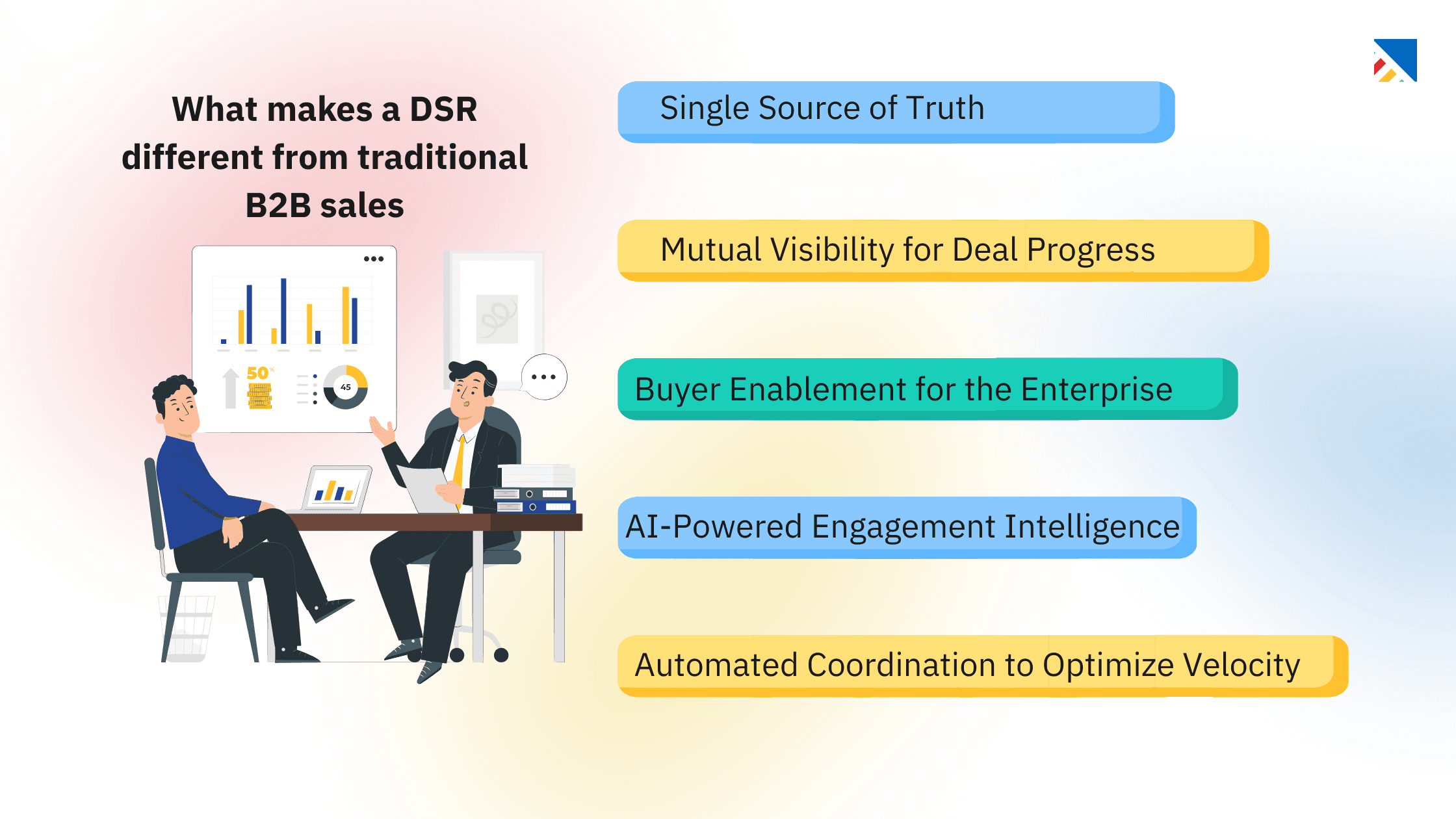
1. Single Source of Truth: Instead of proposals buried in email, security questionnaires in Dropbox, case studies on your website, and pricing in a separate PDF, everything lives in one organized, accessible space. This is particularly critical for large enterprise deals where information sprawl kills momentum.
2. Mutual Visibility for Deal Progress: Both your team and the buying committee can see the same information, track the same milestone achievements, and stay aligned on next steps. No more "I thought you were handling that" moments that derail deals moving forward.
3. Buyer Enablement for the Enterprise Customer: Your champion doesn't have to become a forwarding service. When the CFO asks a question at 10 PM, they can find the answer themselves instead of waiting for your champion to dig through their inbox, reducing the coordination burden that stalls enterprise-level deals.
4. AI-Powered Engagement Intelligence: You can see who's engaging with what content, which stakeholders are active, and where attention is dropping off, turning your forecast from guesswork into data. AI helps identify patterns across the stages of a deal, giving you predictive insights into which deals are truly moving forward.
5. Automated Coordination to Optimize Velocity: Reminders, follow-ups, and action items happen systematically, not based on whether your rep remembered to send that recap email. Automate the administrative work so enterprise sellers can focus on strategic sales conversations.
Related Blog: Self-Service Onboarding: The Ultimate Guide on Self-serve
How Does a DSR Fit Into Your Tech Stack?
A DSR doesn't replace your CRM, like Salesforce or a sales engagement platform. It complements them by creating a buyer-facing hub that makes the purchasing process easier for everyone involved, a critical integration for any sales organization serious about customer success. Your reps still work in their familiar tools. Your buyers just get a better experience, and you get deals that close faster with less friction.
Digital Sales Rooms like Projetly give you the infrastructure to systematize everything that preserves deal momentum, shared visibility, organized content, engagement tracking, and automated follow-ups without adding work for your reps or friction for your buyers. It's not just about structuring deals better; it's about creating a compelling offer of collaboration that makes your enterprise sales process a competitive advantage.
Whether you're working on effective lead generation, navigating complex qualification stages, or managing onboarding for a new enterprise customer, a DSR becomes the central hub that keeps every deal moving forward.
Book a personalized demo and see how Projetly keeps every deal moving
Stop Losing Enterprise Deal Momentum to Invisible Friction
The question is whether you're ready to systematize the things that make buying easier, or whether you'll keep hoping that your next demo will somehow be compelling enough to overcome broken coordination.
Because hope isn't a strategy. But operational clarity is, and it's what separates enterprise sales teams that consistently hit their numbers from those that watch deals stall in "verbal commit" for months.
Ready to see how Projetly DSR can accelerate your enterprise deals?
Stop losing deals to invisible friction. Start building systematic momentum today.
You may also like

A Guide to Project Management Professional Certification

Laugh Your Way to Productivity: 50 Workplace Quotes

50 Funny Workplace Memes That’ll Brighten Your Workday.
What Does a Customer-First Mindset Mean? Explained in 2025

What It Takes to be a Great Customer Success Manager in 2025