Enterprise Sales Cycle Deal Stages That Stall Deals

Digital Sales Room

Enterprise Sales Cycle Deal Stages That Stall Deals

Enterprise Sales Cycle Deal Stages That Stall Deals

Feb 3, 2026

By

Sammy Jones

The Five Critical Stages Where Enterprise Sales Cycles Commonly Stall (And How to Keep Them Moving)

Every enterprise sales rep has experienced it: an enterprise deal that seemed destined to close suddenly loses momentum. The champion stops responding. Decision-makers go silent. Weeks turn into months, and what looked like a sure thing quietly slips into the graveyard of "pipeline opportunities."

The frustrating reality is that enterprise sales cycles don't fail randomly. Unlike transactional sales, complex deals stall at predictable inflexion points where visibility drops, alignment breaks, or handoffs fumble.

Understanding these critical junctures and the specific failure patterns at each stage of the sales cycle is essential for any enterprise sales team serious about improving win rates and shortening the average sales cycle.

Research across thousands of enterprise sales reveals five stages of the sales cycle where momentum most commonly dies, along with the specific sales strategies that keep deals moving forward systematically.

This guide to enterprise sales will help your sales team identify friction points and implement proven tactics to close deals faster.

Related Blog: How to Reduce Customer Churn: Why Onboarding Isn't Enough

Understanding the Enterprise Sales Process

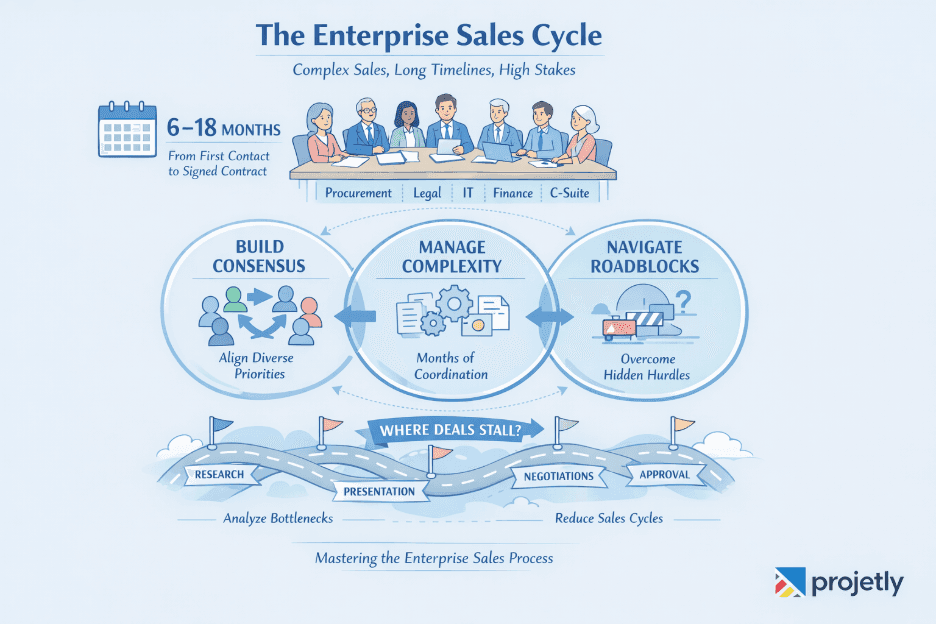
Enterprise sales refers to the process of selling to large organizations with complex buying committees, longer sales cycles, and higher deal sizes. The enterprise sales process typically involves 6-12 months from initial contact to contract signature, compared to transactional sales models that close in days or weeks.

The complexity of enterprise sales stems from multiple factors: enterprise deals involve numerous stakeholders across departments, require extensive due diligence, demand custom solutions, and navigate intricate approval chains. Enterprise sales often include legal reviews, security assessments, procurement negotiations, and executive sign-offs, which can considerably extend the sales cycle.

For enterprise sales teams, understanding where deals stall is crucial. The average sales cycle for enterprise software ranges from 4 to 18 months, depending on deal size and organizational complexity. SMB sales, by contrast, typically close in 1-3 months. This fundamental difference means enterprise sales reps must master skills different from those in B2B sales to smaller organisations.

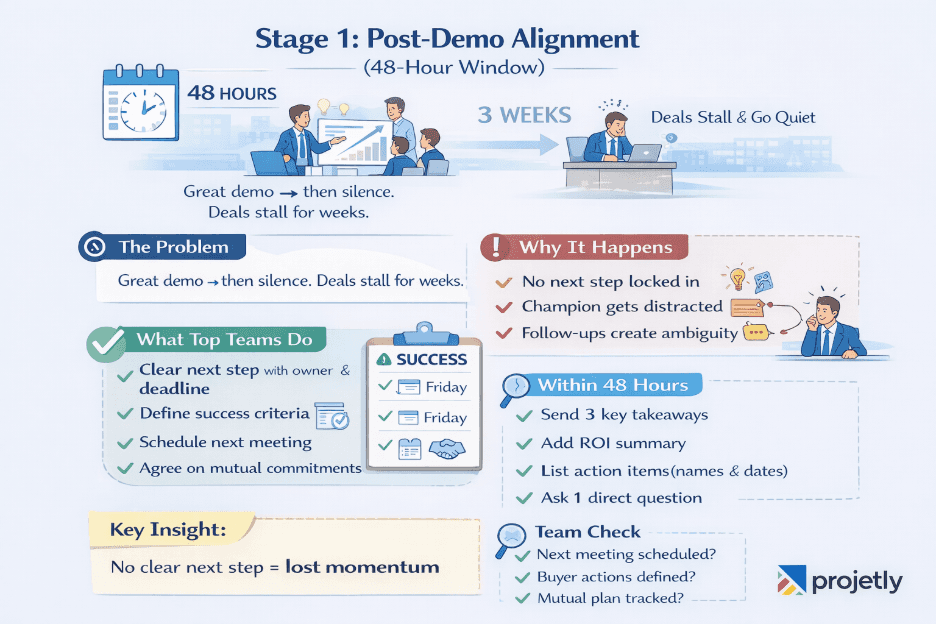
Stage 1: Post-Demo Alignment: The 48-Hour Window That Defines Your Sales Cycle

The demo concludes successfully. Stakeholders appear engaged. Technical questions indicate genuine interest. Then momentum evaporates, extending your sales cycle by weeks or months.

Why Enterprise Deals Stall Here

Champions return to competing priorities. The compelling vision presented during the demo fades against urgent operational demands. Without a clear path forward in your enterprise sales process, both parties fall into a coordination problem, each waiting for the other to act.

Many enterprise sales reps send follow-up emails with resources and meeting availability. However, without explicit agreement on next steps, these efforts create ambiguity rather than progress in the sales process. This is where the difference between successful enterprise sales and stalled deals becomes apparent.

The Playbook: Mutual Action Plans to Accelerate Your Sales Cycle

The Playbook: Mutual Action Plans to Accelerate Your Sales Cycle

Successful teams treat every interaction's conclusion as a negotiation point for concrete next steps. This sales approach transforms vague intentions into committed actions, directly impacting your ability to close deals efficiently.

Before the demo ends, establish:

  1. Specific next action - "You will share the ROI calculator with your VP by Thursday" rather than "let's reconnect next week"

  2. Success criteria - "What needs to happen in that meeting for you to feel confident moving to procurement?"

  3. Concrete next meeting - Scheduled on the calendar with appropriate stakeholders invited

  4. Mutual commitment - "We will deliver security documentation by Wednesday. You will provide IT feedback by Friday."

Within 48 hours, send a concise email containing:

  • Three key takeaways specific to their use case

  • One-sentence ROI summary with their numbers

  • Specific action items with owners and dates

  • A single clear question requiring a response

This structured sales engagement prevents the post-demo void that adds 2-4 weeks to the average sales cycle length.

Diagnostic questions for your team:

  • Do we end every demo with a scheduled next meeting?

  • Can we articulate the buyer's next three actions and deadlines?

  • Do we have documented mutual action plans that both sides agreed to?

Struggling with post-demo momentum? 

Book a demo to see how our sales software automatically generates mutual action plans and maintains accountability throughout long sales cycles.

Stage 2: Stakeholder Expansion: Navigating Complex Enterprise Sales Structures

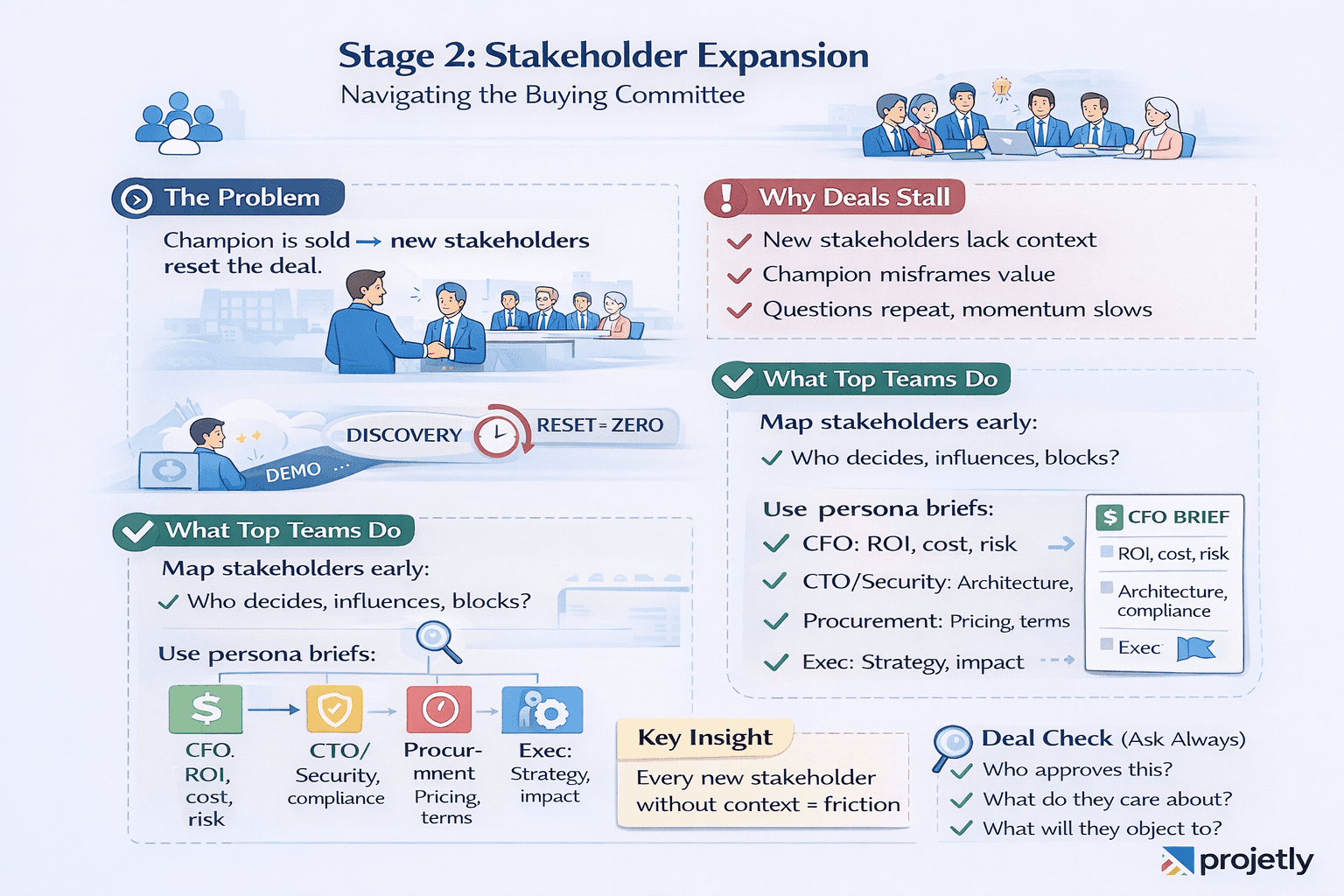
The champion understands the value proposition. However, when introducing procurement, security, compliance, or executive sponsors, conversations restart from zero. This is where sales cycles extend significantly and where many enterprise sales deals lose critical momentum.

Why Enterprise Deals Stall Here

Enterprise deals involve multiple decision-makers who enter without adequate background. They haven't experienced discovery or demonstrations. Champions provide incomplete summaries, emphasizing personally interesting features while neglecting strategic benefits relevant to CFOs or CTOs.

The result: New stakeholders raise previously addressed concerns, request already-shared information, and ask questions that feel like backtracking. Without a centralized Digital Sales Room, sales reps watch helplessly as the sales cycle extends by weeks. This complexity distinguishes enterprise selling from SMB sales, where decision-making authority is typically concentrated.

Related Blog: Humanize Client Onboarding: Best Practices to User Retention

The Playbook: Stakeholder Mapping & Context Packets

Effective enterprise sales management requires anticipating and orchestrating stakeholder expansion rather than reacting to it. Top-performing teams implement structured protocols using a centralized Deal Room to align stakeholders, control information flow, and maintain momentum:

1. Map early in your process - During discovery, ask: "Who else typically weighs in on decisions like this?" Build organizational charts identifying roles, priorities, and potential objections. Enterprise clients typically involve 6-10 stakeholders in purchasing decisions.

2. Create persona-specific briefs - Develop one-page executive summaries for each stakeholder type:

  • CFO Brief: ROI, payback period, budget impact, financial risk mitigation

  • CTO/Security Brief: Technical architecture, security protocols, integration complexity

  • Procurement Brief: Pricing structure, contract terms, vendor stability, reference customers

  • Executive Sponsor Brief: Strategic alignment, competitive advantage, organizational impact

3. Champion enablement sessions - Conduct 30-minute preparation calls before champions brief new stakeholders. This sales enablement approach ensures your champion can effectively advocate internally, keeping your sales cycle moving forward.

4. Multi-stakeholder sessions - Propose group calls where all parties hear consistent messaging: “Rather than sequential briefings, would a 30-minute overview call with you, Jennifer, and procurement together allow everyone to ask questions directly?” Supported by Deal Room Software, this sales strategy reduces back-and-forth, keeps stakeholders aligned, and prevents the delays that extend complex sales cycles.

The five-question stakeholder assessment:

  1. Who will influence or approve this decision?

  2. What does each person prioritize?

  3. What is each person's likely primary concern?

  4. Have you previously rejected similar decisions? Why?

  5. Should we present directly, or should you brief them first?

Enterprise sales often involve 8–12 stakeholder touchpoints before reaching consensus. A centralized Sales Enablement Room enables proactive stakeholder management, reducing this phase from 8 weeks to just 3 weeks by aligning stakeholders, centralizing information, and keeping momentum intact.

Managing complex stakeholders slowing down? Contact us Today

Stage 3: Internal Buyer Review: Eliminating the Black Box in Your Enterprise Sales Process
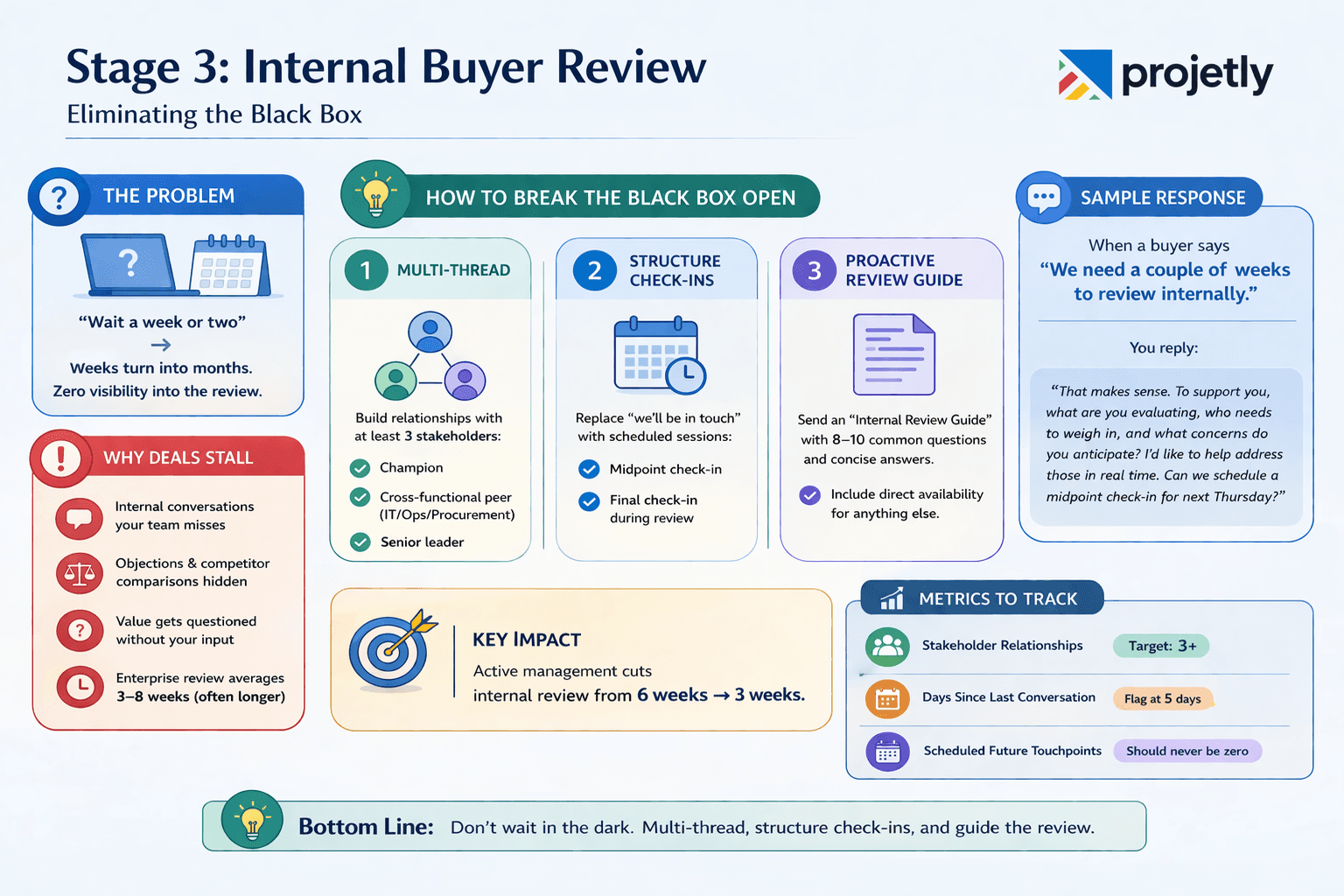
After weeks of alignment, champions take proposals to leadership for review. Sales reps are told to "wait a week or two" while internal processes unfold. Weeks become months with zero visibility, a common pattern in long sales cycles for enterprise software.

Why Complex Enterprise Deals Stall Here

Internal reviews involve conversations your sales team doesn’t participate in, objections you don’t hear, and comparison processes you can’t influence. Without Digital Sales Room Software, this information asymmetry becomes fatal, complex concerns remain unaddressed, confusion goes unclarified, and your value proposition gets questioned without representation.

For enterprise deals, this black box phase averages 3-8 weeks and represents one of the longest stages of the sales cycle. Without visibility, your sales forecast becomes unreliable, and your sales performance suffers.

The Playbook: Structured Review Participation to Accelerate Sales Cycles

The Playbook: Structured Review Participation to Accelerate Sales Cycles

Successful sales management refuses to accept the black box through these strategies:

1. Joint evaluation frameworks - Provide structured scorecards for internal use. Enterprise customers appreciate guidance in their evaluation process. This approach ensures assessment uses criteria highlighting factors critical for success.

2. Multi-threading insurance - Before review phases, your sales rep should establish relationships with at least three organizational contacts:

  • The champion

  • Someone in a different department (procurement, IT, operations)

  • Someone senior to the champion

This engagement strategy provides visibility even when your primary contact goes dark during longer sales cycles.

3. Scheduled check-in working sessions - Replace "we'll get back to you" with: "During your two-week review, can we schedule two 30-minute working sessions, one at the midpoint and one at the conclusion, to address any emerging questions? This ensures you have everything needed to move forward confidently."

This proactive strategy reduces the internal review phase from an average of 6 weeks to 3 weeks.

4. Review agenda document - Send one-pagers titled "Internal Review Agenda - Anticipated Questions" that list 8-10 questions typically arising during internal reviews with concise answers. Add: "If other questions emerge, I'm available at [specific times] to address them immediately."

5. Effective conversation framework: When buyers say, "We need a couple of weeks to review internally."

Respond with: "That makes sense for deals of this scope. Several questions will help me support this process: What specifically will you evaluate? Who needs to weigh in? What concerns or questions do you anticipate? I want to ensure I'm available to address those in real-time rather than creating delays. How about scheduling a mid-point check-in for next Thursday?"

Metrics to track:

  • Number of internal stakeholder relationships (target: 3+)

  • Days since last substantive conversation (flag at 5 days)

  • Scheduled future touchpoints (should never be zero)

Enterprise sales software that tracks these engagement metrics can alert your team when deals are at risk, improving overall sales performance.

Losing deals in the internal review black box? Start a free trial of our sales engagement platform that alerts you when buyer engagement drops and provides guided interventions to keep your sales cycle moving.

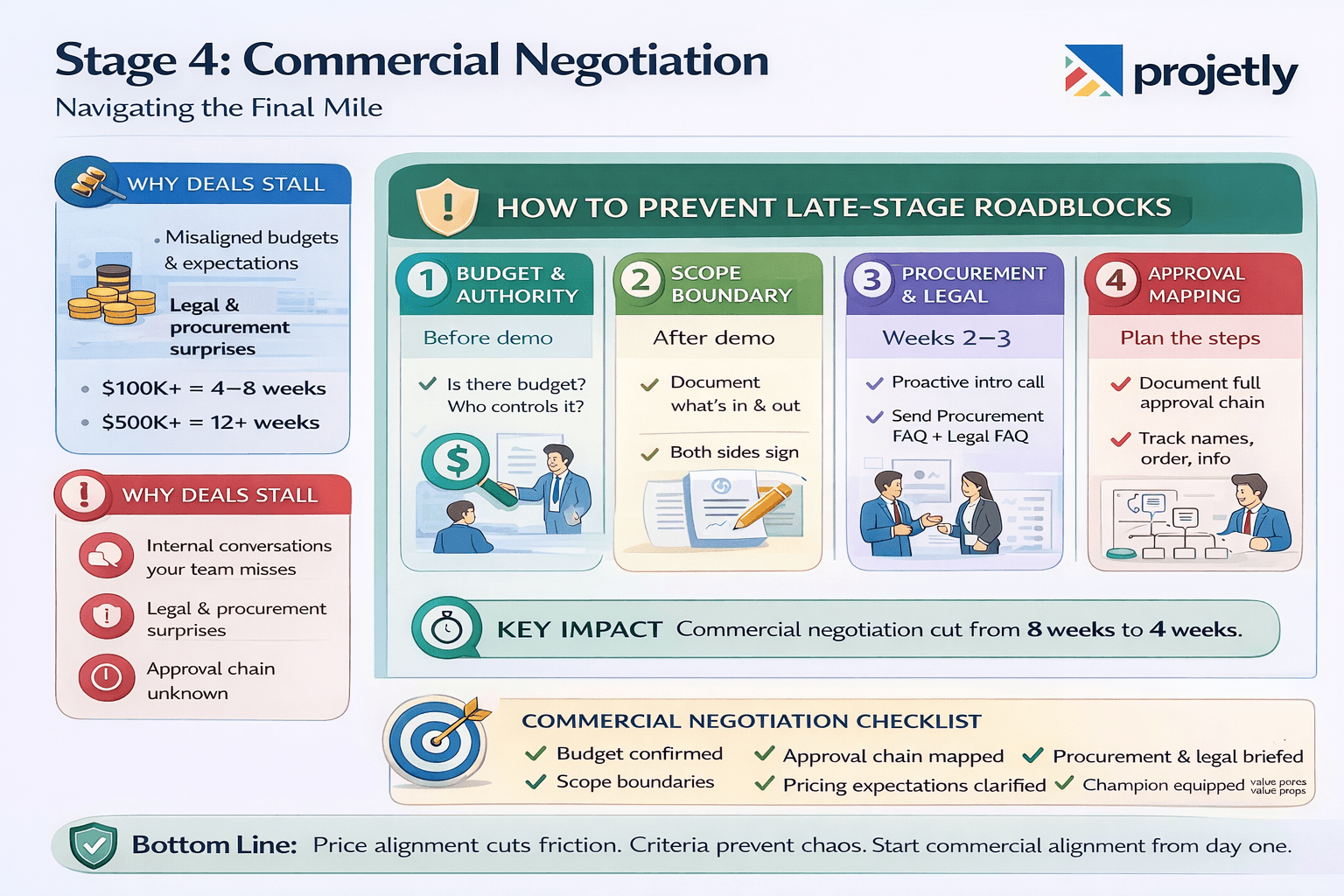
Stage 4: Commercial Negotiation: Managing the Longest Phase of Complex Sales Cycles

The decision to proceed has been made in principle. However, negotiating terms, pricing, and contract language proves anything but straightforward. This stage often represents 15-25% of the entire sales cycle.

Why Enterprise Sales Deals Stall Here

Commercial negotiations expose earlier unresolved misalignments:

  • Champions assumed budget approval at standard pricing

  • Procurement includes capabilities your team considered out of scope

  • Legal raises questions that champions cannot answer

  • Finance requires approval from previously uninvolved stakeholders

Each disconnect triggers multiple back-and-forth rounds. Questions route to people lacking context. Approvals flow through stakeholders absent from the evaluation. Scope gets relitigated due to differing understandings, a common challenge when enterprise deals are often negotiated across multiple departments.

The sales process can take 4-8 weeks in this phase alone for deals over $100K. For contracts over $500K, commercial negotiations can extend to 12+ weeks.

Related Blog: SMB vs Enterprise Customer Onboarding: Including Mid-Market

The Playbook: Front-Load Commercial Alignment in Your Enterprise Sales Strategy

Phase 1: Budget & Authority Discovery (Pre-Demo)

Smart reps address these questions early:

  1. "What budget range applies to this initiative?"

  2. "Is this budget already allocated, or does it require approval?"

  3. "Who ultimately signs contracts of this size?"

  4. "Walk me through your typical procurement process for software purchases."

  5. "Have you made similar purchases recently? What was the timeline from decision to signature?"

This approach reduces commercial surprises that extend the sales cycle by identifying budget constraints and approval requirements before investing months in the process.

Phase 2: Scope Boundary Documentation (Post-Demo, Pre-Proposal)

Create "Scope Definition Documents" requiring mutual sign-off:

  • Included in base proposal: Specific capabilities, user seats, support level

  • Explicitly excluded: Custom integrations, additional modules, professional services

  • Optional add-ons with pricing: Clear menus of extras

  • Success criteria: What "working" means at 30/60/90 days

This documentation prevents scope creep that derails sales deals and extends the cycle unnecessarily.

Phase 3: Early Commercial Stakeholder Introduction

Engage procurement and legal before negotiation begins, a critical best practice:

  • Week 2-3: "Can we schedule a 20-minute call with your procurement lead to review our standard process? This prevents surprises that extend the cycle later."

  • Provide "Procurement FAQ" and "Legal FAQ" documents proactively

  • Offer redlined MSAs and reference contracts: "Share this with legal now so they can flag concerns early."

Enterprise sales involve 4-6 weeks of legal review. Introducing legal early can reduce this to 2-3 weeks.

Phase 4: Approval Chain Mapping

Develop approval flowcharts with champions:

  1. Who must approve? (names and titles)

  2. In what sequence?

  3. What does each person need to review?

  4. How long does each approval typically require?

  5. What causes approvals to be rejected or delayed?

Understanding the approval chain is critical for accurate forecasting. Complex deal structures with large organizations require visibility into every approval gate.

Commercial negotiation checklist:

  • Budget range discussed and confirmed

  • Approval chain mapped with names and timelines

  • Procurement and legal introduced and briefed

  • Scope boundaries documented in writing

  • Pricing expectations aligned

  • Contract redlines addressed proactively

  • Champion equipped with internal selling materials

This systematic approach can reduce the commercial negotiation phase from an average of 8 weeks to 4 weeks in your sales cycle.

Deals stuck in commercial back-and-forth?

 Book a demo to see how our enterprise sales software provides guided negotiation playbooks that have reduced contracting time by 35%, helping teams close high-value deals faster.

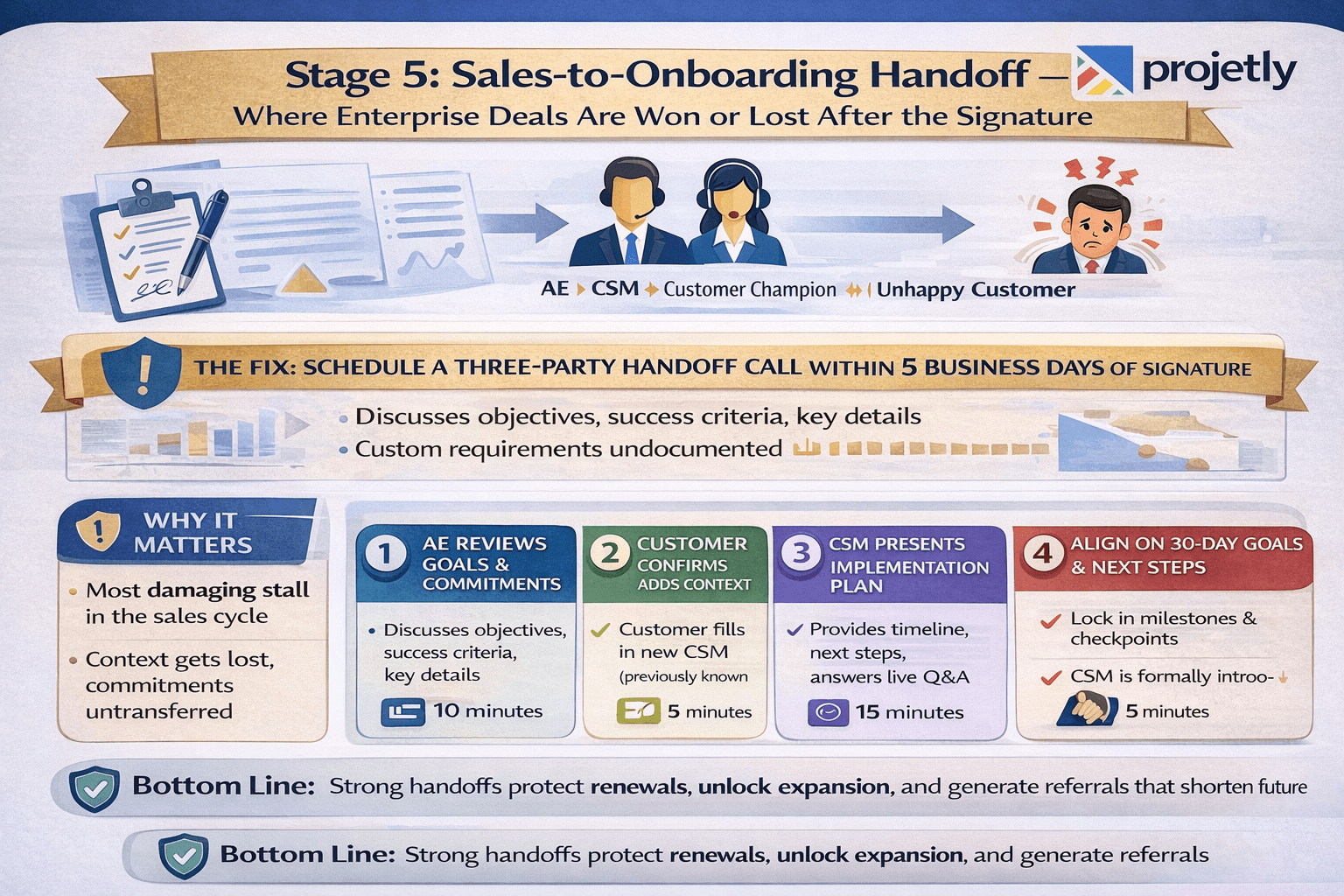
Stage 5: Sales-to-Onboarding Handoff: Where Enterprise Sales Performance is Truly Measured

The contract is signed. Your sales team moves to the next opportunities. Customer success makes contact, and enterprise customers express confusion, disappointment, or frustration about their purchase. This final stage can make or break performance and future sales deals.

Why Deals Stall Here (Post-Signature)

This represents the most damaging stall point in the entire sales cycle because it occurs after technical closure. Your team considers it a win. Customers expect immediate value. Instead, without DSR Software, momentum stalls, handoffs break down, context gets lost, and early confidence erodes.

  • Commitments made during the process weren't documented or transferred

  • Custom requirements from late-stage negotiations weren't captured

  • Specific use cases and success criteria weren't communicated to delivery teams

  • Implementation timelines exceed discussions

  • "Included" features require additional configuration or cost

Customer success managers ask customers to re-explain goals already articulated multiple times during the cycle. Customers perceive organizational ignorance of commitments made during the process of selling. Relationships begin with disappointment rather than delight, damaging future opportunities and referrals critical for growth.

The Playbook: Structured Handoff Protocols

The Three-Party Handoff Call (Non-Negotiable)

Within five business days of contract signature, schedule 45-minute calls, including:

  • Account Executive (sales rep)

  • Customer Success Manager (delivery)

  • Customer Champion and Key Stakeholder

Agenda:

  1. Representative reviews business objectives and success criteria (10 minutes)

  2. Customer confirms and adds context (5 minutes)

  3. CSM presents implementation plan and timeline (15 minutes)

  4. Group aligns on next steps and first 30-day goals (10 minutes)

  5. CSM becomes the primary contact moving forward (5 minutes)

This prevents "sales said" versus "delivery says" disconnects that damage customer relationships and impact performance metrics.

Implementation Kickoff Document (Week 1)

CSMs send one-pagers to clients containing:

  • "What we heard" summary from conversations

  • Proposed implementation plan with milestones

  • Success metrics for joint tracking

  • Weekly check-in schedule for first 60 days

  • "Is this aligned with your expectations? What needs adjustment?"

This documentation ensures commitments from the process carry forward into delivery.

The Sales-CS Alignment Meeting (Weekly)

Institute weekly 30-minute meetings where:

  • Reps review deals closing that week

  • CS asks clarifying questions about commitments made

  • Both teams identify patterns in promises, expectations, or concerns

  • CS provides feedback on handoff effectiveness

This ongoing practice improves the quality of handoffs and reduces customer dissatisfaction that impacts future opportunities.

Metrics to track:

  • Time from contract signature to first value delivery (target: <14 days)

  • Customer satisfaction score at day 30 (target: >8/10)

  • Percentage of customers confirming onboarding matched expectations (target: >90%)

Strong handoff processes improve performance by increasing renewal rates, expansion opportunities, and referrals, critical for long-term success.

Losing customers after the sale due to poor handoffs? Contact us to implement our proven sales-to-success handoff framework that increases day-30 satisfaction scores by 40%, protecting your deals and improving performance.

The Common Thread: Transition Points in Sales Cycle Stages

While each sales cycle stage has unique characteristics, they share a common failure mode: loss of alignment, visibility, or momentum at transition points. Sales cycles progress through multiple handoffs: discovery to demo, champion to broader stakeholders, evaluation to procurement, and sales to delivery. Without a centralized Deal Room, each handoff creates opportunities for critical information loss, energy dissipation, and misalignment to emerge.

The process requires deliberate management of these transition points. Long sales create more opportunities for deals to stall, making systematic processes essential.

Related Blog: Automate Client Onboarding That Saves Teams 10+ Hours

Streamline Your Enterprise Sales: A 30-Day Action Plan

Week 1: Diagnostic Phase

  • Audit your last 20 lost deals, identify stall stages

  • Calculate conversion rates between each stage

  • Identify your biggest bottleneck

  • Review sales data to understand average time-in-stage

Week 2: Process Design

  • Select the stage losing the most deals

  • Design specific playbooks for that stage using these strategies

  • Create templates (mutual action plans, stakeholder briefs, handoff documents)

  • Integrate new processes with existing sales automation tools

Week 3: Team Enablement

  • Train reps on new playbooks

  • Role-play key conversations and objection handling

  • Establish enterprise sales metrics to track improvement

  • Update materials to reflect new processes

Week 4: Execution & Iteration

  • Implement with all new deals entering that stage

  • Review results weekly using data

  • Refine based on effectiveness and performance

  • Adjust forecast models based on improved conversion rates

Examples of Enterprise Sales Success: The Bottom Line

Deals stall at predictable points in the sales cycle. The difference between top-performing teams and others isn’t talent, it’s process architecture around transition points, anchored by a centralized Deal Room. The diagnostic framework and tactical playbooks for all five critical sales cycle stages are now available.

The question for your team is: which stage is costing the most revenue right now, and what will be implemented this week to address it?

Success requires systematic approaches to each stage, proactive management of complex deal dynamics, and unwavering focus on maintaining momentum throughout long sales cycles. With enterprise sales often taking 6–12 months from initial contact to close, Deal Room Software becomes essential for improving efficiency at every stage—helping teams hit revenue targets and maintain healthy, predictable sales funnels.

By implementing these strategies, your team can reduce the length, improve win rates on complex enterprise deals, and close high-value deals more predictably. The complexity demands nothing less than systematic excellence at every transition point.


Table of content

Title
Title

Terms of Use

Privacy policy

Projetly © Copyright 2024. All Rights Reserved.

Terms of Use

Privacy policy

Projetly © Copyright 2024. All Rights Reserved.