NEW CLIENT ONBOARDING

By
Sammy Jones
A Guide on Customer Onboarding Playbooks
Maya, the Customer Onboarding Manager, is two weeks into a high-value implementation. The sales team celebrated the close, the contract was signed, but the new client hasn’t completed a single setup task.
Stakeholders are unresponsive. The data import failed. The onboarding team is still asking for status updates. Maya has three half-finished spreadsheets and a long Slack thread that no one reads.
Two months later, Sales hears the dreaded line: “We still aren’t seeing value. Let’s pause renewal discussions.”
This crisis happens when companies operate without a structured customer onboarding playbook, without a repeatable process, and without the right customer success playbooks guiding the onboarding journey.
The rest of this guide explains how to build an effective customer onboarding playbook without referencing Maya again.
Related Blog: A Blueprint for Seamless Remote Customer Onboarding
What are Customer Onboarding Playbooks?
A modern playbook becomes far more powerful when supported by dedicated customer onboarding software. The software transforms your playbook from a static document into an operational system, ensuring every new customer moves through a consistent, structured, and trackable process.
Successful customer onboarding software centralizes everything required for a successful onboarding journey, including playbooks, checklists, workflows, templates, customer data, status updates, onboarding phases, and customer success metrics. By bringing these elements together, the software ensures that every new customer experiences a guided, predictable, and measurable onboarding experience.
1. Orchestration
Customer onboarding software automatically creates onboarding projects, assigns owners, sets SLAs, and organizes each onboarding phase. This eliminates manual tracking and removes the chaos of scattered spreadsheets, ensuring a smooth and repeatable onboarding workflow.
2. Guidance
The software provides customers with structured checklists, in-app guided tours, automated onboarding emails, and learning resources. These tools walk a SaaS customer from “new user” to “activated user” through clear, step-by-step guidance.
3. Measurement
It tracks customer engagement, health scores, usage events, and activation milestones throughout the onboarding process. These insights help CS teams identify risks early and prevent onboarding churn.
Why This Matters
When your playbook is powered by onboarding software, onboarding becomes:
consistent across all customer segments
accountable, with clear owners and timelines
transparent for both customers and internal teams
faster, reducing time-to-value (TTV)
easier to measure using real onboarding metrics
less manual, allowing teams to focus on strategy and relationship-building
This combination ensures every new client experiences a predictable and high-quality onboarding journey.
Example
After a contract is signed, the onboarding software automatically creates a new onboarding project. A welcome email is sent to the customer, and a checklist is assigned to both internal and customer teams.
As the customer logs in, completes tasks, and moves through the onboarding phases, the system updates progress in real time and calculates a health score based on engagement and completion metrics. Once all key tasks and milestones are completed, the onboarding project transitions into the next success phase with full visibility for the CS team.
This structured, trackable flow forms the backbone of an effective customer onboarding playbook and strengthens long-term customer success.
Why is a Customer Onboarding Playbook important?
A structured playbook has a direct influence on customer experience, satisfaction, renewal probability, and long-term customer success.
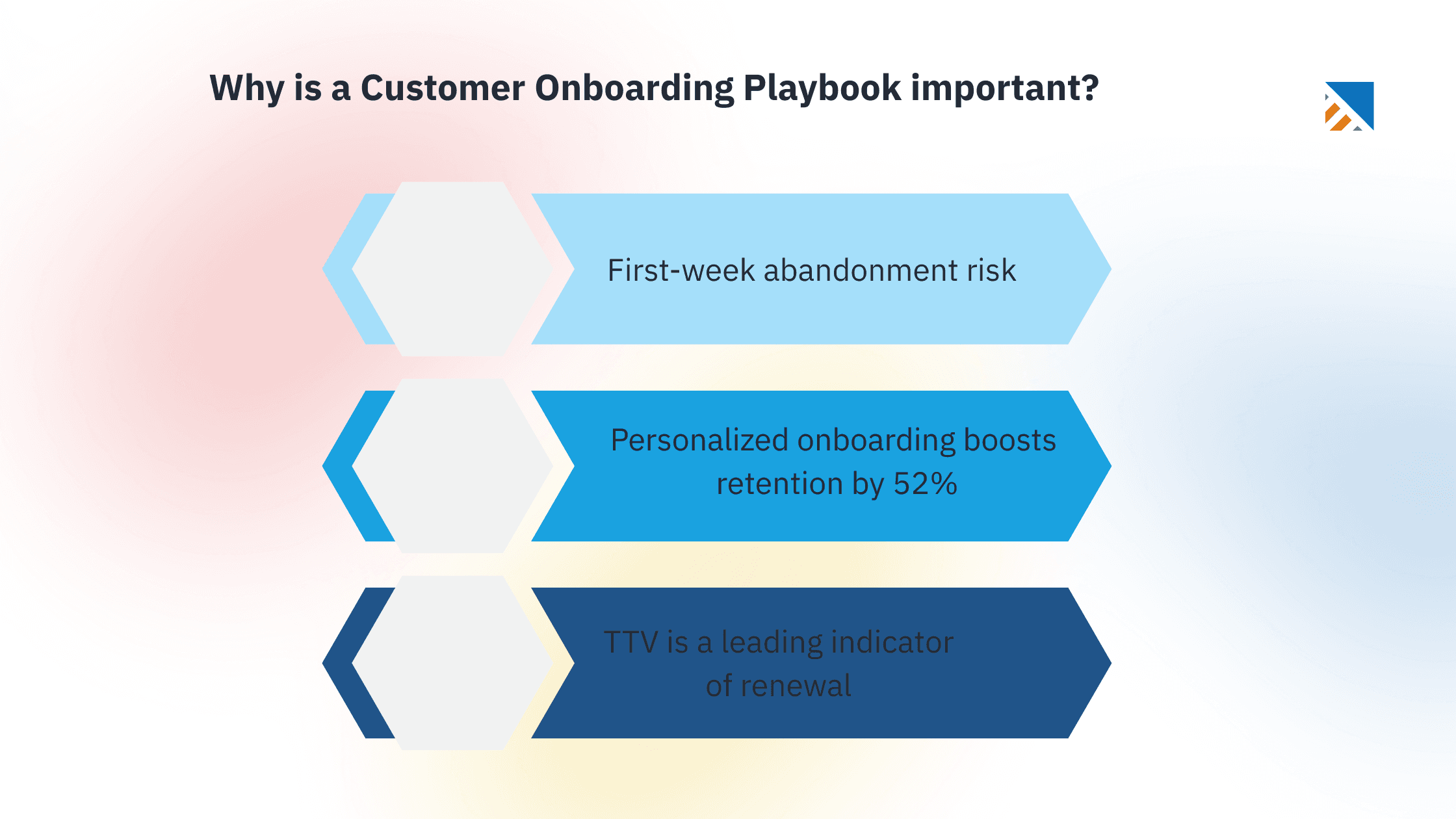
1. First-week abandonment risk (why it happens and how a playbook prevents it)
A confusing or unstructured b2b onboarding process is the single biggest trigger for early user abandonment.
Why does this happen:
New customers don’t understand what to do first
They don’t see immediate value
They feel lost without a clear checklist or guided pathway
There’s no visible progress or encouragement
They hit early friction, such as integrations, data import, or setup confusion
How an onboarding playbook solves this:
A strong playbook eliminates early friction by giving every new customer:
clear step-by-step guidance
a structured onboarding process
visible progress indicators
early “quick wins”
pre-built checklists
automated reminders and micro-nudges
resources mapped to every onboarding phase
This removes uncertainty and stops first-week abandonment from happening.
2. Personalized onboarding boosts retention by 52%
Not all customers are the same, and their onboarding shouldn’t be either. UserGuiding data shows that personalized, segmented playbooks increase Day-30 retention by about 52%.
Why personalization matters:
Different types of customers (Enterprise, SMB, PLG, technical, non-technical) have different goals, timelines, onboarding expectations, complexity levels, and resource needs
A one-size-fits-all onboarding program pushes them through irrelevant steps or misses critical requirements.
How segmented onboarding playbooks fix this:
A segmented customer success onboarding playbook ensures each customer follows a path tailored to their unique customer needs.
For playbook examples:
Enterprise: governance reviews, integration workshops, data readiness sessions
SMB: simplified checklist, faster kickoff, lighter configuration
Self-serve SaaS customer: in-app guides, automated onboarding, no live calls
Technical customers: API documentation, SSO setup, sandbox testing
Non-technical customers: video walkthroughs, simplified flows
Tailoring onboarding phases to different customer types improves activation, satisfaction, and long-term customer retention.
3. TTV is a leading indicator of renewal
Time-to-Value (TTV) measures how long it takes a new customer to reach their first meaningful outcome with your product. Multiple SaaS benchmarks show that shorter TTV strongly correlates with renewals, upsells, and overall customer success.
Why TTV matters:
Customers who feel valued early stay longer
Slow activation leads to onboarding churn
Faster value creates faster trust
Early results drive internal buy-in, especially with multiple stakeholders
Shorter TTV reduces support burden
Teams that reach value quickly expand usage faster
How your onboarding playbook shortens TTV:
A well-structured onboarding playbook:
Eliminates unnecessary steps
Provides a clear definition of “first value”
Automates setup and configuration
Reduces back-and-forthincludes a data readiness template
Assigns owners for every milestone
Moves customers through onboarding phases efficiently
Guides them directly to the “aha moment”
The shorter the TTV, the higher the renewal rate and the more predictable your customer lifecycle becomes.
How to Use These Stats in Your Customer Success Playbook
Automate welcome and micro-task nudges
Build role-based or segment-specific onboarding playbooks
Set TTV benchmarks for every type of customer
Track onboarding phases, drop-offs, and task completion
Use early signals to reduce customer churn
Strong onboarding playbooks turn these best practices into repeatable customer success strategies.
What should be included in a Customer Onboarding Playbook?
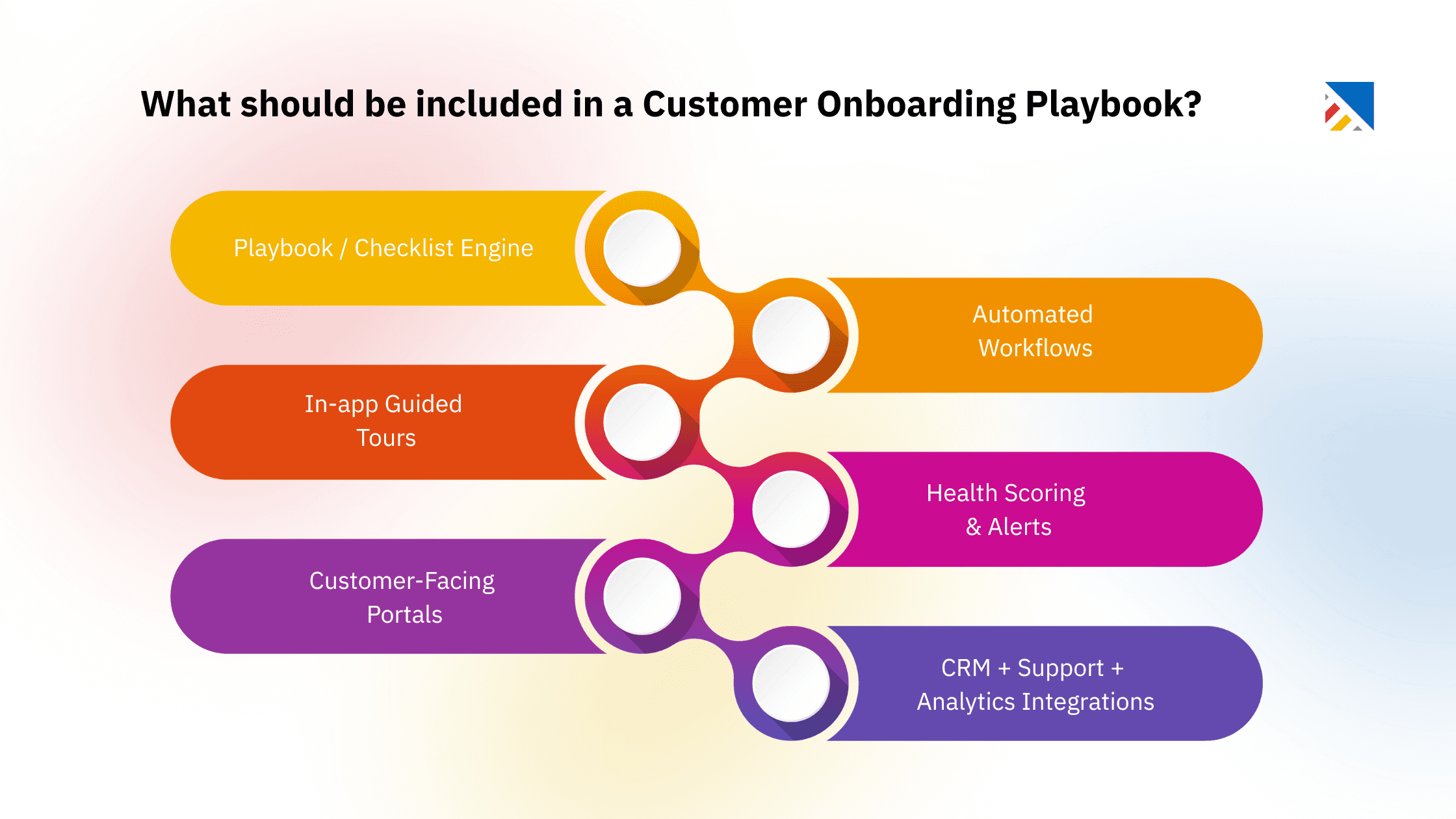
Checklist Engine
A strong customer onboarding playbook starts with a structured onboarding checklist that defines every task, owner, and timeline. It standardizes onboarding phases and removes ambiguity for the customer success team. This ensures every new customer follows the same consistent, repeatable onboarding framework.
Automated Workflows
Automated workflows keep the entire customer onboarding process moving without manual follow-up. They send reminders, schedule training, escalate missed tasks, and automatically update onboarding status. This reduces human error and frees customer success managers to focus on strategic activities.
In-app Guided Tours
In-app guided tours help customers learn the product directly inside the interface. They reduce customer support dependency by walking users through features and setup steps. This improves activation and gives every SaaS customer a smoother, self-serve onboarding experience.
Health Scoring & Alerts
Health scoring gives an early view of customer risk during onboarding. Scores based on usage, task completion, and engagement trigger alerts when issues arise. This lets customer success teams intervene early and prevent onboarding churn.
Customer-Facing Portals
Customer-facing portals provide transparency into tasks, progress, deadlines, and resources. They reduce back-and-forth communication and improve customer engagement. By centralizing everything in one place, the onboarding experience becomes clearer and more efficient.
CRM + Support + Analytics Integrations
Integrations sync customer data across CRM, support tools, analytics, and onboarding systems. They enable automated project creation, ticketing, and real-time usage updates.
This keeps the customer onboarding playbook accurate, connected, and always up to date.
Customer Onboarding Data Playbook
Stage Name
Defines the major phases of the onboarding journey, such as Kickoff, Setup, Configuration, Training, Adoption, Go-Live, and Handoff. Clear stage names help teams and customers understand where they are in the onboarding process at any moment.
Objective
Specifies the measurable outcome to be achieved in that phase. This ensures everyone knows what success looks like before moving to the next onboarding stage.
Key Tasks
Lists the detailed steps required to complete the phase, including both internal and customer actions. These tasks remove ambiguity and ensure all dependencies are clearly outlined.
Owner
Identifies who is responsible for each task or milestone, whether it’s the Implementation Manager, CSM, or Solutions Engineer. Assigning owners prevents delays and improves accountability across the onboarding process.
Timeline
Defines the expected duration or deadline for completing each onboarding phase. Clear timelines set customer expectations for both customers and internal teams and support SLA-driven onboarding.
Definition of Done (KPI)
Provides objective evidence that the phase is complete, such as admin login, data import, integration validation, or a customer satisfaction score. These KPIs ensure the onboarding team can verify completion based on measurable outcomes, not assumptions.
Resources
Includes support materials like links, tutorials, templates, documents, and training videos to help customers progress smoothly. Centralizing resources reduces friction and ensures customers always know where to find helpful information.
How To Build a Customer Onboarding Playbook (Step-by-Step)
A well-structured onboarding playbook ensures every customer follows a predictable, outcome-driven journey. These steps help you standardize the process while still adapting to different customer needs.
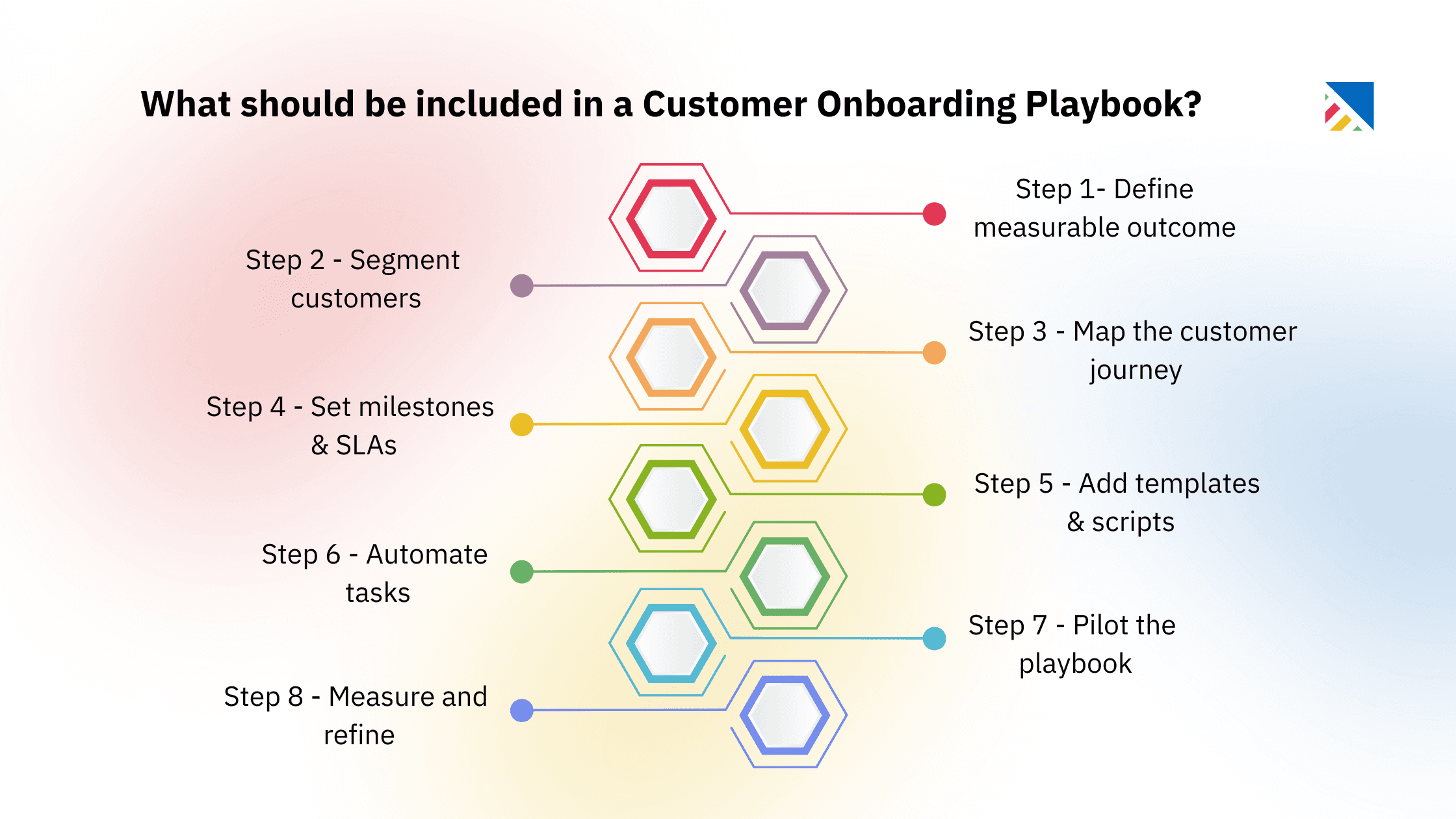
Step 1- Define measurable outcomes
Set clear onboarding goals such as activation milestones, TTV targets, or success criteria. This ensures every customer journey is guided by quantifiable, outcome-driven expectations.
Step 2 - Segment customers
Create separate playbooks for Enterprise, SMB, high-touch, low-touch, and self-serve onboarding. Segmentation ensures each type of customer receives a relevant, efficient onboarding experience.
Step 3 - Map the customer journey
Document every step of the onboarding process across customer and internal swimlanes. This creates clarity on responsibilities, reduces friction, and aligns teams across the lifecycle.
Step 4 - Set milestones & SLAs
Define time-bound checkpoints for tasks, deliverables, and customer actions. Clear SLAs create a predictable onboarding flow and reduce unnecessary delays.
Step 5 - Add templates & scripts
Prepare reusable resources such as kickoff agendas, status updates, and escalation messages. These templates keep your onboarding communication consistent and professional.
Step 6 - Automate tasks
Use automation to send reminders, assign follow-ups, update status, and escalate missed steps. Automation eliminates manual work and keeps the onboarding process moving without friction.
Step 7 - Pilot the playbook
Test your onboarding playbook with 5–10 customers to uncover bottlenecks. This allows you to validate the flow, gather feedback, and refine weak points before scaling.
Step 8 - Measure and refine
Review TTV, completion rates, drop-offs, and customer feedback to improve the playbook. A strong onboarding playbook evolves continuously based on data and real-world insights.
Related Blog: AI-Powered Customer Onboarding: How to Automate with AI
Common Mistakes in Customer Onboarding
Mistake 1: One playbook fits all
A generic onboarding flow fails because different customers have different needs and complexity levels.
Fix: Build multiple customer success playbooks tailored to each segment or onboarding model.
Mistake 2: Playbooks stored as PDFs
Static documents become outdated quickly and cannot drive consistent execution.
Fix: Move your onboarding playbook into software, so it becomes trackable, dynamic, and actionable.
Mistake 3: No measurable definitions of “done”
Without clear KPIs, teams disagree on whether onboarding was successful.
Fix: Add definitions of done using artifacts, logs, screenshots, activation events, or KPIs.
Mistake 4: Reactive onboarding
Chasing customers manually leads to delays, missed tasks, and a poor experience.
Fix: Automate reminders, escalations, onboarding checklists, and progress updates.
Mistake 5: Ignoring customer data
Teams miss early warning signs when usage and engagement aren’t monitored.
Fix: Track health scores, product activity, training attendance, and stage-level drop-offs to intervene early.
How Onboarding Playbooks Improve Every Team
A well-defined onboarding playbook removes ambiguity, aligns teams on responsibilities, and standardizes execution across the entire lifecycle. It ensures that Sales, Success, Product, and Support all operate from the same source of truth, improving collaboration and customer outcomes.
Customer Success
A well-structured onboarding playbook reduces administrative tasks and frees customer success managers to focus on strategic work. This leads to deeper customer relationships, stronger alignment, and higher long-term retention.
Product
Onboarding data highlights where users get stuck or confused during setup. These insights help product teams fix friction points and improve feature adoption.
Sales
A consistent onboarding playbook creates smoother, more predictable handoffs from sales to customer success. This enhances the customer experience and reduces the risk of misaligned expectations after the deal closes.
Support & Implementation
Clear onboarding workflows reduce repetitive support tickets and prevent avoidable issues. Implementation teams benefit from defined responsibilities, fewer escalations, and a more organized onboarding process.
Real-World Examples of Customer Onboarding Playbooks
Enterprise SaaS
A structured onboarding playbook helped reduce TTV from 60 days to 28, accelerating customer value realization. Stronger executive alignment and predictable onboarding phases improved customer satisfaction and retention.
PLG Analytics Tool
Segmented onboarding and in-app guidance increased Day-30 retention by 52%.
Automated assistance and clearer onboarding flows significantly reduced support tickets and improved overall product adoption.
Critical Metrics for Every Customer Success Onboarding Playbook
Tracking the right metrics ensures your onboarding process is measurable, predictable, and aligned with real customer outcomes. These metrics help teams identify friction early, improve TTV, and create a consistently high-quality experience for every customer.
1. Time-to-Value (TTV)
TTV measures how quickly a new customer reaches their first meaningful outcome.
Shorter TTV improves activation, accelerates adoption, and strongly predicts renewal likelihood.
2. Onboarding Completion Rate
This metric shows the percentage of customers who complete all key onboarding milestones. A high completion rate indicates a smooth, well-structured onboarding process aligned with the playbook.
3. Stage-Level Drop-Off
Stage-level drop-off identifies where customers disengage or get stuck during onboarding. These insights help customer success teams pinpoint friction points and optimize specific onboarding phases.
4. Product Adoption Rate
Product adoption rate measures how frequently new customers use core features during onboarding. Higher adoption signals stronger engagement and early product value, reducing the risk of onboarding churn.
5. Early Customer Health Score
This score combines usage, engagement, task completion, sentiment, and support activity into one risk indicator. It helps teams proactively identify at-risk customers and intervene before issues escalate.
Related Blog: Personalized Client Onboarding: What Clients Expect
Final Customer Onboarding Checklist
Create a single onboarding project and share a customer-facing portal link.
Run an immediate “pre-flight” audit of customer data readiness.
Schedule a 60-minute kickoff and send a standard agenda
Assign a single owner (Implementation Manager) and confirm RACI.
Create three must-do tasks for the customer (SSO, sample data, admin list) with 3-day SLAs.
Add a training session and share short micro-learning videos.
Set up at least two automated reminders for missed tasks.
Instrument usage events so product activity updates the project automatically.
Define a short-term health score and set an escalation rule below the threshold.
Document the outcome and iterate on the playbook once the project closes.
Your customer onboarding playbook ensures a structured, predictable onboarding experience for every new customer.
Frequently Asked Questions
1. What is an onboarding playbook?
An onboarding playbook is a structured guide that outlines each step, task, owner, communication template, milestone, and success metric required to onboard a customer effectively. It standardizes the process, eliminates guesswork, and ensures every customer receives a consistent, high-quality onboarding experience.
2. What are the 5 C’s of onboarding?
The widely used 5 C’s of onboarding are:
Compliance: Ensuring the customer meets required setup or configuration standards.
Clarification: Communicating expectations, timelines, and responsibilities.
Culture: Introducing customers to your product philosophy and best practices.
Connection: Building strong relationships between teams and stakeholders.
Check-ins: Continuous follow-ups to monitor progress and resolve blockers.
3. What are the 5 pillars of customer success?
The five pillars most commonly used in customer success include:
Onboarding: Helping customers activate and realize initial value.
Adoption: Driving deeper usage of key features.
Support: Providing help, troubleshooting, and timely resolutions.
Retention: Preventing churn and maintaining long-term usage.
Expansion: Identifying upsell or cross-sell opportunities based on customer maturity.
4. What are the 5 pillars of onboarding?
The five core pillars of a strong onboarding framework are:
Planning: Defining goals, success criteria, and timelines.
Setup: Technical configuration, integrations, and initial environment setup.
Training: Educating users on workflows, features, and best practices.
Go-Live: Activating the customer and validating the initial use case.
Handoff: Transitioning from onboarding to long-term Customer Success.
5. What are the 4 C’s for onboarding?
A streamlined version of the onboarding framework includes:
Compliance
Clarification
Culture
Connection
This is a simplified model used when teams want a quicker, more focused onboarding structure.
6. What are the three steps in a playbook?
A typical onboarding playbook can be broken into three core steps:
Define the process: Map phases, tasks, owners, and SLAs.
Document workflows: Create templates, checklists, scripts, and definitions of done.
Automate and optimize: Use tools like Projetly to automate tasks, track milestones, and improve the customer lifecycle.
You may also like

A Guide to Project Management Professional Certification

Laugh Your Way to Productivity: 50 Workplace Quotes

50 Funny Workplace Memes That’ll Brighten Your Workday.
What Does a Customer-First Mindset Mean? Explained in 2025

What It Takes to be a Great Customer Success Manager in 2025