Customer onboarding toolkit

By
Sam
How Do You Build a Scalable Customer Onboarding Playbook for a Growing Service Firm?
A scalable customer onboarding playbook is a documented, repeatable framework of tasks, templates, timelines, and responsibilities that delivers a consistent client experience regardless of who's running it or how many clients are onboarding simultaneously.
The seven steps to build one: map the full client journey, standardize with templates, automate communications, assign clear roles, build a client welcome kit, track key metrics, and integrate with your broader customer success strategy.
Service firms that build a scalable customer onboarding playbook reduce time-to-value by up to 40%, cut early churn by 20–30%, and onboard 10x the clients without adding headcount. Here's the step-by-step framework to build one.
Why does a scalable customer onboarding playbook matter for service firms?

A scalable customer onboarding playbook matters because manual onboarding breaks down the moment you grow.
Without one, 20–30% of clients churn within the first 90 days due to subpar onboarding alone, not because your service is weak, but because the experience is inconsistent, slow, and dependent on a handful of people who know how to navigate the chaos.
The pattern is predictable: sales close faster than operations can onboard. Onboarding specialists juggle too many accounts. Some clients get a polished experience; others get a fragmented one full of missed follow-ups and missing context. The firm becomes dependent on "hero" CSMs who know how to make things work, until they don't.
A scalable playbook fixes this at the root. It turns onboarding from a bottleneck into a competitive advantage, consistent, predictable, and repeatable at any volume.
Where Projetly fits: Projetly automatically generates entire onboarding playbooks from deal details, creates tasks and timelines instantly, and provides branded client portals, helping service firms cut time-to-value from 60 to 25 days without adding headcount.
What does a scalable customer onboarding playbook actually include?
The eight components every playbook needs
Component | What it covers | Why it matters |
|---|---|---|
Purpose and scope | Why the playbook exists and what it does/doesn't cover | Aligns every team member around a shared outcome |
Journey map | Every touchpoint from contract signing to value delivery | The blueprint everything else is built on |
SOPs | Step-by-step task documentation with owners, SLAs, and KPIs | Eliminates guesswork; reduces errors by up to 60% |
Template library | Kickoff decks, checklists, email sequences, status updates | Ensures uniform experience regardless of who runs it |
RACI matrix | Who is Responsible, Accountable, Consulted, Informed at each stage | Cuts handoff errors by up to 90% |
Client welcome kit | Timeline, responsibilities, CSM intro, portal access | Sets expectations from Day 1; reduces back-and-forth |
KPI dashboard | TTV, completion rate, CSAT, churn signals | Identifies where clients get stuck and why |
Escalation paths | Tiered steps for at-risk accounts | Ensures issues are resolved before they become churn |
How do you map the customer onboarding journey and define milestones?
Mapping the customer onboarding journey means diagramming every touchpoint from contract signature to full activation, and assigning a measurable milestone to each stage. Skip this, and you're building templates for a process you don't fully understand.
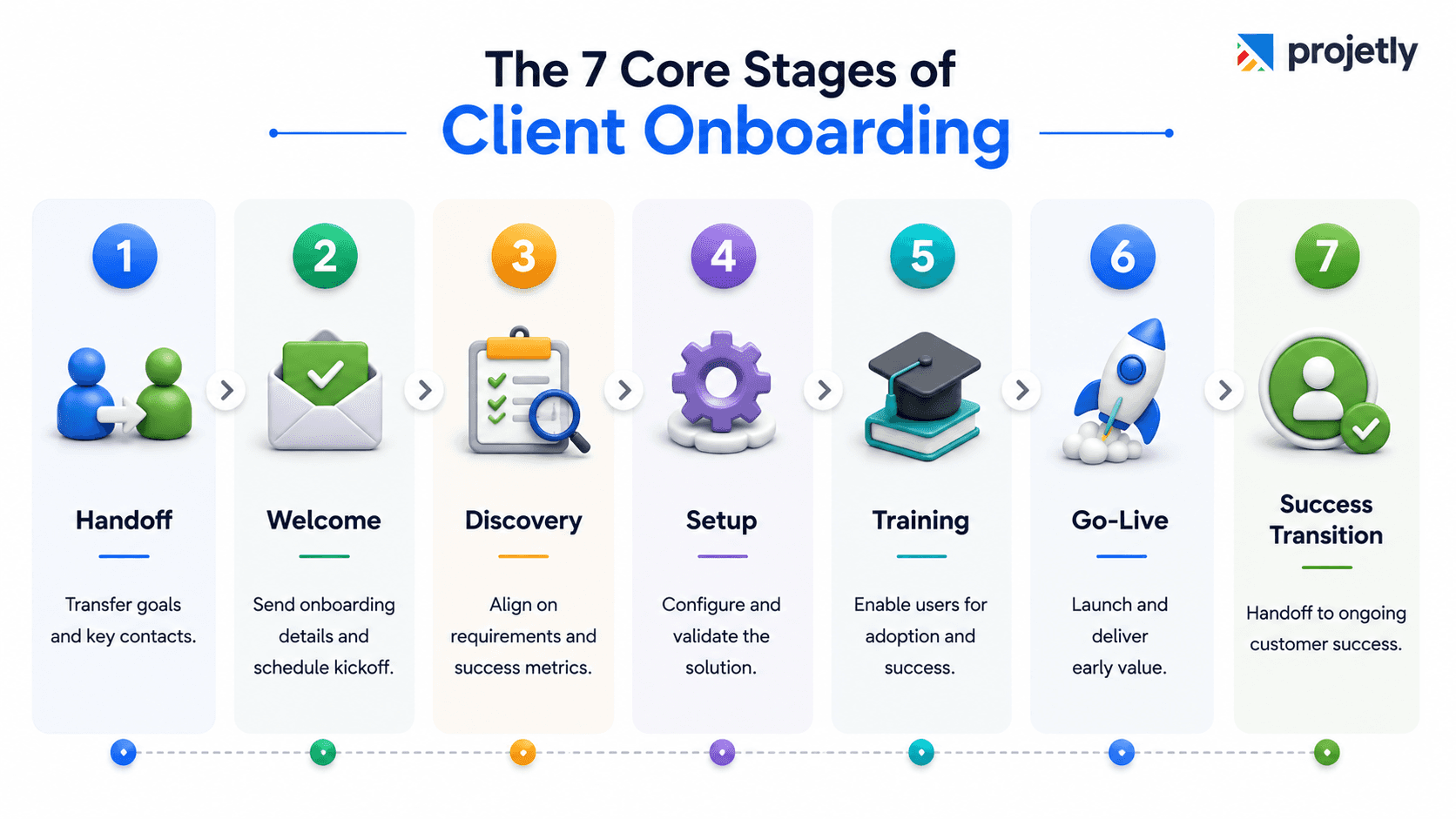
The 7 core stages of a client onboarding journey
1. Sales-to-CS handoff: Structured debrief covering win themes, pain points, decision-maker contacts, and success criteria. Must happen within 24 hours of contract signing.
2. Client welcome and kickoff scheduling: Personalized welcome email with next steps, portal invite, and kickoff call scheduled within 48 hours of contract.
3. Kickoff meeting and requirements gathering: 60-minute session covering goals, scope, and timelines. Followed by a requirements survey capturing workflows, integrations, and KPIs.
4. Configuration and setup: Technical implementation customized to the client's environment, validated by QA checklists before handoff.
5. Training and enablement: Role-segmented learning paths: live sessions for enterprise stakeholders, on-demand videos for SMB end-users. Target 90%+ completion rate.
6. Go-live and first value delivery: Full rollout with 48-hour monitoring and a quantifiable first win celebrated in a joint review.
7. Handoff to ongoing customer success: Formal transition meeting with health scores, success plan, and next-quarter goals documented.
Milestone targets to build into your playbook
Kickoff completed: within 48 hours of contract
Access provisioned: Day 3
Configuration complete: Week 2
Training finished: Week 4 (90%+ completion)
First value delivered: Month 1
CS handoff complete: Month 2
For SMBs, target full activation in 30 days. For enterprise clients, 60–90 days is standard. Firms that hit these milestones consistently report 40% faster time-to-value than those without defined checkpoints.
How do you standardize onboarding with templates and SOPs?
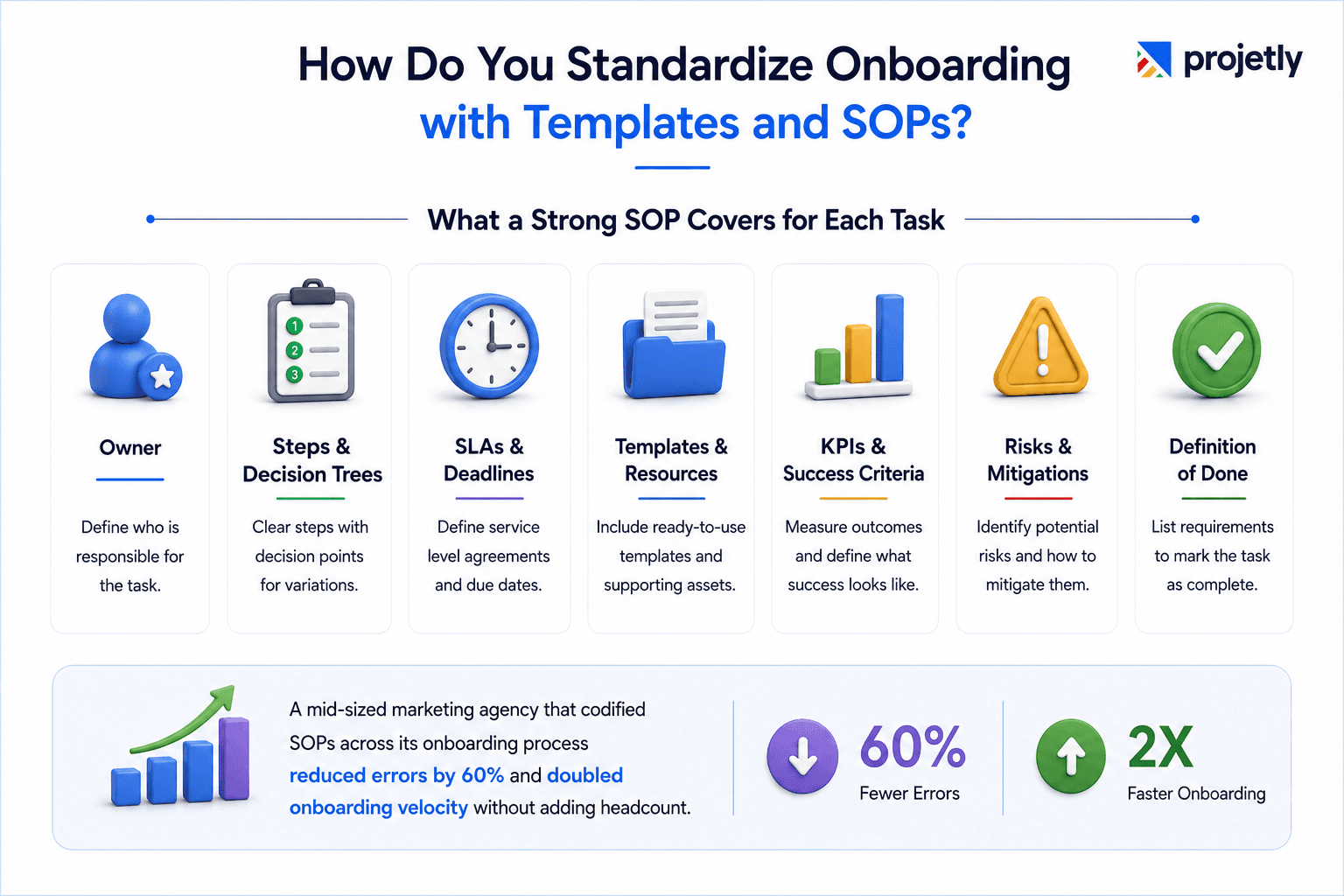
Standardizing your B2B onboarding playbook means documenting every task in enough detail that a new hire can execute it to the same standard as your most experienced CSM, on day one.
What a strong SOP covers for each task
Every SOP in your playbook should define: the owner (CSM, implementation lead, or support), numbered steps with decision trees for variations, SLA deadlines, embedded templates, KPIs, potential risks and mitigations, and a clear definition of done.
A mid-sized marketing agency that codified SOPs across its onboarding process reduced errors by 60% and doubled onboarding velocity without adding headcount.
Your core template library
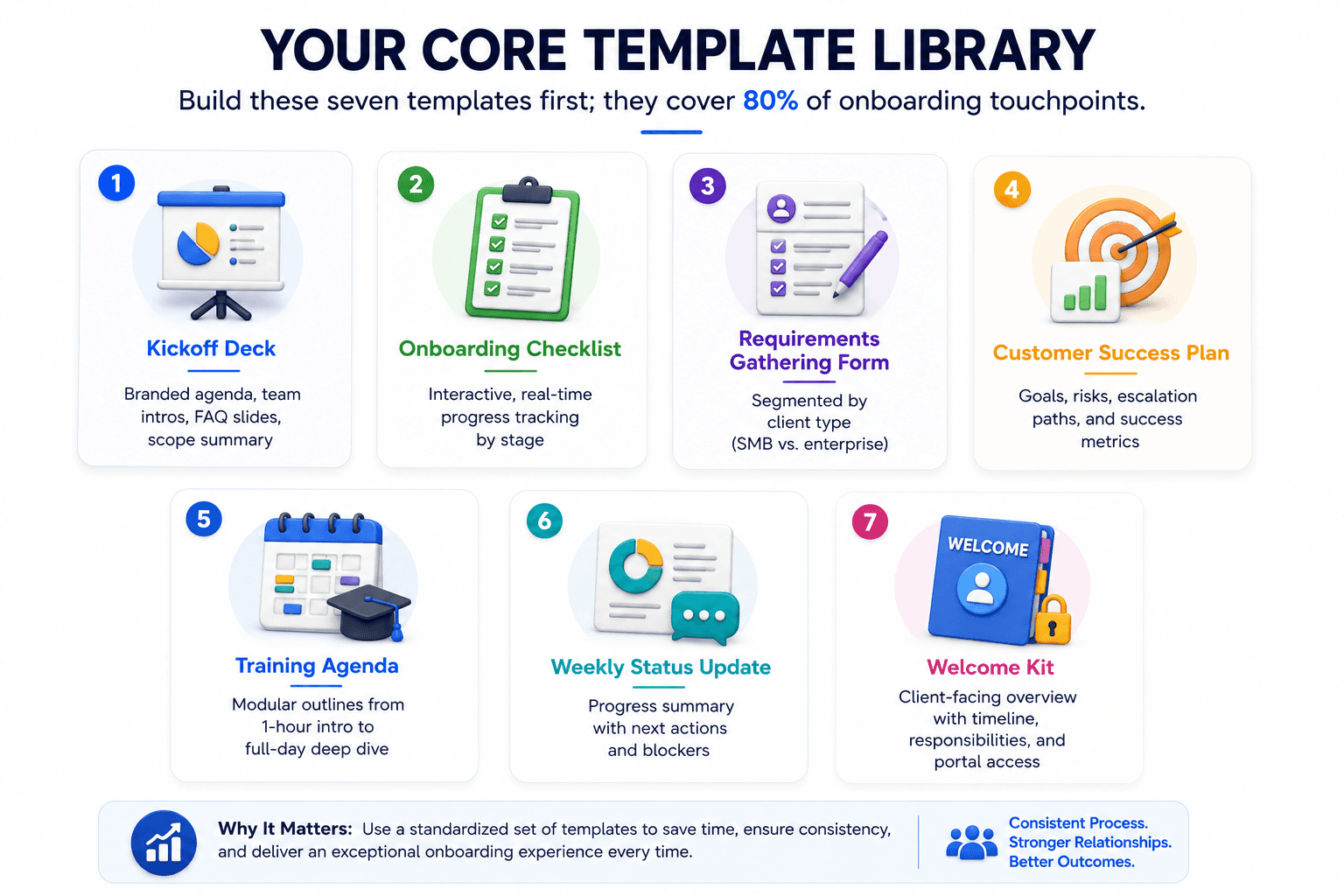
Build these seven templates first; they cover 80% of onboarding touchpoints:
Kickoff Deck: Branded agenda, team intros, FAQ slides, scope summary
Onboarding Checklist: Interactive, real-time progress tracking by stage
Requirements Gathering form — Segmented by client type (SMB vs. enterprise)
Customer Success Plan: Goals, risks, escalation paths, and success metrics
Training Agenda: Modular outlines from 1-hour intro to full-day deep dive
Weekly Status Update: Progress summary with next actions and blockers
Welcome Kit: Client-facing overview with timeline, responsibilities, and portal access
Store everything in a single source of truth, a shared knowledge base with version control. Centralized documentation cuts internal search time by 70% and accelerates new hire ramp-up from weeks to days.
Which tools and automation make onboarding scalable?
The right tools reduce manual follow-up by 80% and let your team handle 10x the client volume without proportional headcount growth.
Automation touchpoints to build into your playbook
Trigger | Automated action | Tool |
|---|---|---|
Contract signed | Welcome email + portal invite fires | CRM workflow |
Kickoff scheduled | Pre-kickoff checklist sent to client | Calendly + HubSpot |
Data submission overdue | Escalating reminder sequence (Days 1, 3, 5) | Projetly / Zapier |
Training session attended | Resource pack delivered automatically | Projetly |
Milestone missed | CSM alert + client nudge triggered | Projetly |
Go-live completed | CSAT survey sent + CS handoff initiated | CRM workflow |
How Projetly handles scalable onboarding
Projetly is purpose-built for service firms running high-volume onboarding. It automatically generates playbooks from deal details, creates tasks and subtasks with Gantt timelines, provides branded client portals for self-serve access, and connects onboarding directly to customer success and delivery, all in one workspace.
An IT consultancy using Projetly cut time-to-value from 60 to 25 days, freeing CSMs to focus on strategic upsells instead of administrative follow-up.
See how Projetly runs scalable onboarding →
How do you assign roles and responsibilities without creating bottlenecks? {#roles}
Clear ownership is the difference between an onboarding playbook that works and one that sits in a shared drive. Ambiguity is the number one cause of handoff errors.
The RACI model for onboarding teams
Team | Responsible for | Accountable to | Consulted on | Informed of |
|---|---|---|---|---|
Sales | Handoff documentation | CS lead | Upsell opportunities | Risk flags |
CSM | Client milestones | Onboarding director | Success plan | All blockers |
Implementation | Configuration and setup | CSM | Technical requirements | Go-live date |
Product | Feature roadmap clarity | CSM | Integration questions | Bug escalations |
Support | Ticket resolution | CSM | Escalation thresholds | SLA breaches |
A consulting firm that implemented a RACI matrix across its onboarding function saw handoff errors drop by 90% within one quarter. Review the RACI model quarterly; roles shift as your team and client base evolve.
Each client should also have a single primary point of contact (POC), ; the onboarding specialist who owns all client communication, updates, escalations, and success plan adjustments.
This person is the client's onboarding concierge: personalizing the experience while keeping it within the playbook structure.
What metrics prove your onboarding playbook is working?
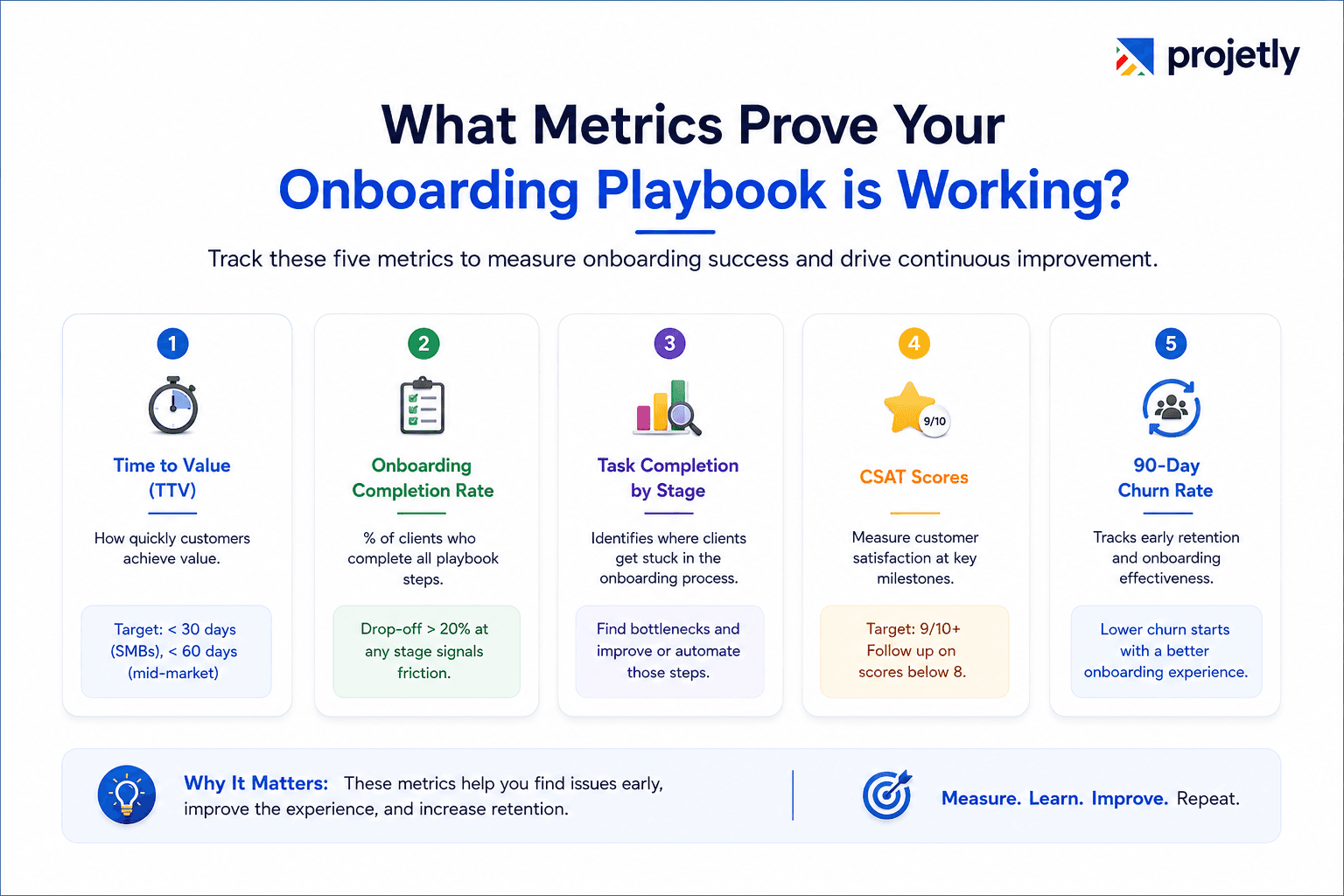
Track these five metrics. Each one points to a specific part of your playbook to investigate if performance dips.
Time to Value (TTV): The most critical onboarding metric. Target under 30 days for SMBs, under 60 for mid-market. Every day of delay increases the 90-day churn risk.
Onboarding completion rate: What percentage of clients complete all playbook steps? A drop-off above 20% at any single stage signals a friction point worth fixing immediately.
Task completion rate by stage: Identifies exactly where clients get stuck. a 70% drop-off at data collection, for example, is a signal to automate that step rather than chase it manually.
CSAT at key milestones: Pulse surveys at kickoff, go-live, and Month 1 tell you whether the experience feels as good as your data says it should. Target 9/10+; follow up on anything below 8.
90-day churn rate: Early churn is almost always an onboarding problem. One agency that iterated its playbook three times in a year cut 90-day churn by 25%. Track it, root-cause it, fix it.
How do you connect onboarding to long-term customer success?
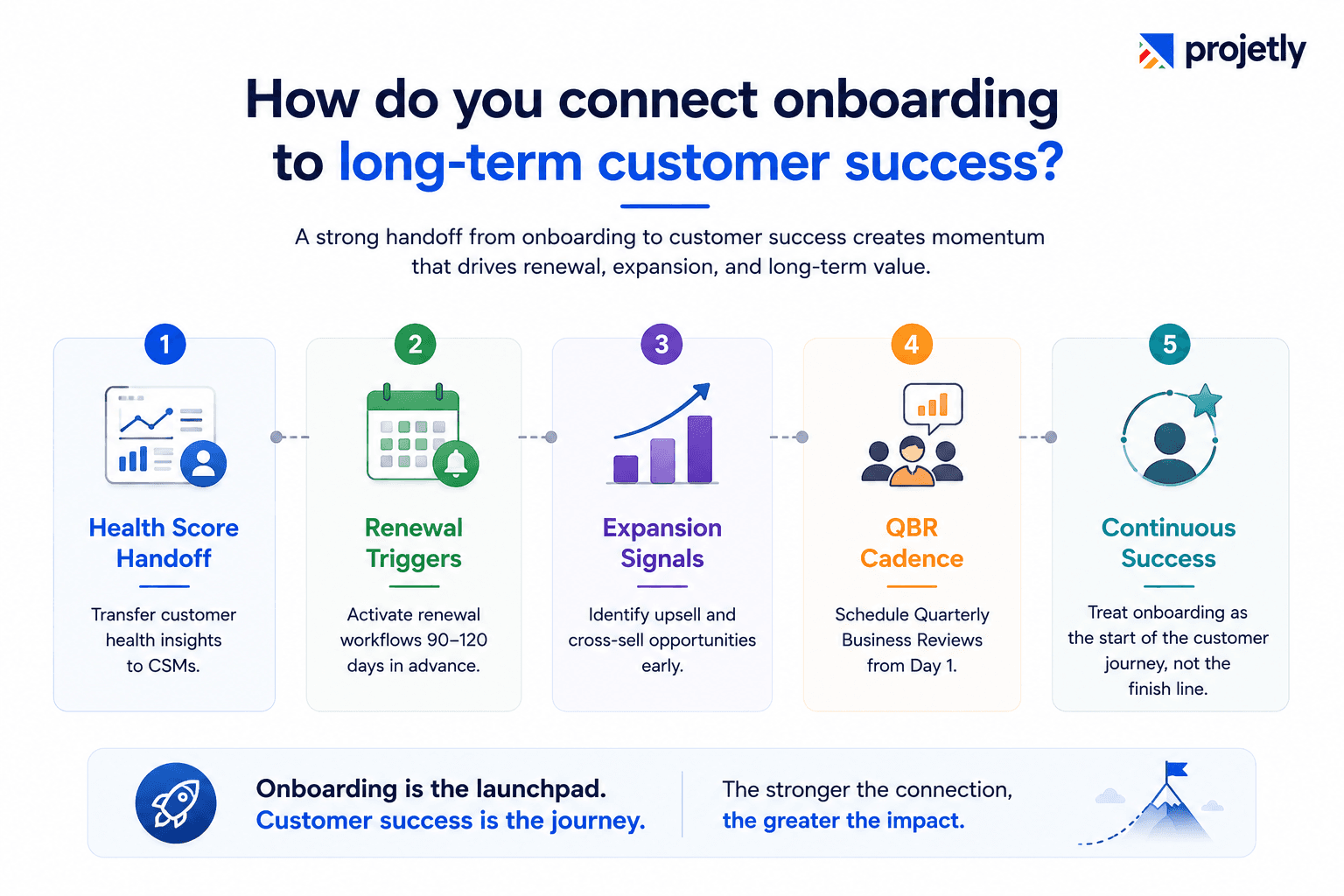
A scalable customer onboarding playbook doesn't end at go-live; it hands off directly to a customer success playbook that maintains momentum through renewal and expansion.
The connection points that matter most:
Health score handoff: Pass a unified customer health score, built from product usage, sentiment signals, support volume, and engagement, from the onboarding team to the CSM at the Month 2 handoff. This gives CS a starting line, not a blank slate.
Renewal triggers: Set automated workflows that activate 90–120 days before renewal, including health checks, stakeholder alignment sessions, and commercial discussions. Early engagement increases renewal confidence and reduces last-minute surprises.
Expansion signals: Monitor product usage data post-onboarding for signals that indicate readiness for upsell or cross-sell. Teams that embed expansion triggers into their playbook from Day 1 report 20–30% higher NRR than those who treat expansion as a separate motion.
QBR cadence: Schedule quarterly business reviews at the point of CS handoff, not three months later. The agenda: performance against success criteria, product roadmap alignment, and next-quarter priorities.
The firms that treat onboarding as the launchpad for customer success, not the finish line, are the ones that convert clients into advocates.
Frequently Asked Questions
What is a customer onboarding playbook?
A customer onboarding playbook is a structured framework of tasks, timelines, templates, and responsibilities that standardizes the onboarding process. It ensures every client receives a consistent experience while enabling teams to scale efficiently without adding proportional headcount.How long does it take to build?
Most service firms can build an initial onboarding playbook in 4–6 weeks by documenting existing processes and creating reusable templates. It should be reviewed and updated quarterly to reflect customer feedback, product changes, and evolving business needs.How does it reduce churn?
A structured onboarding playbook accelerates time-to-value and eliminates inconsistent handoffs that frustrate customers. By identifying risks early and ensuring proactive engagement, it helps reduce early-stage customer churn.Should SMB and enterprise playbooks differ?
Yes. SMB onboarding should prioritize speed, automation, and self-service experiences. Enterprise onboarding typically requires tailored workflows, stakeholder coordination, and more hands-on support.What tools support scalable onboarding?
Projetly centralizes onboarding playbooks, task management, and client collaboration in one workspace. CRM systems, knowledge bases, and automation platforms further streamline communication and operational efficiency.How often should it be updated?
Customer onboarding playbooks should be reviewed and updated quarterly to remain effective. Regular updates ensure processes align with customer expectations, product enhancements, and performance insights.How is it different from a customer success playbook?
An onboarding playbook guides customers from contract signing to activation and initial value realization. A customer success playbook takes over afterwards, focusing on adoption, renewals, expansion opportunities, and long-term growth.
TL;DR
20–30% of B2B clients churn within the first 90 days due to poor onboarding. A scalable playbook is the most direct fix.
A complete onboarding playbook has eight components: journey map, SOPs, template library, RACI matrix, welcome kit, KPI dashboard, escalation paths, and a CS handoff protocol.
Firms that hit defined onboarding milestones report 40% faster time-to-value than those without structured checkpoints.
Automating six onboarding touchpoints, welcome email, kickoff scheduling, data reminders, training delivery, milestone nudges, and CSAT surveys reduces manual follow-up by 80%.
A RACI matrix across sales, CSM, implementation, product, and support cuts handoff errors by up to 90%.
Connecting your onboarding playbook to renewal triggers (90–120 days pre-renewal) and expansion signals drives 20–30% higher NRR than treating them as separate motions.
You may also like

A Guide to Project Management Professional Certification

Laugh Your Way to Productivity: 50 Workplace Quotes

50 Funny Workplace Memes That’ll Brighten Your Workday.
What Does a Customer-First Mindset Mean? Explained in 2025

What It Takes to be a Great Customer Success Manager in 2025