NEW CLIENT ONBOARDING

By
Sam
SMB vs. Enterprise Onboarding: Key Differences Across SMB, Mid-Market, and Enterprise Markets
90% of customers believe companies could do better at onboarding. 69% want it personalized.
86% say a positive onboarding experience makes them more likely to stay long-term. In 2026, the companies winning on retention are the ones treating onboarding as a growth strategy, not an afterthought.
In SaaS, B2B onboarding is no longer a box to check after the deal closes. It shapes product adoption, renewal likelihood, expansion revenue, and customer satisfaction from day one. And yet, most SaaS teams still apply the same onboarding playbook whether they're serving a 10-person startup or a 10,000-person enterprise.
That mismatch is expensive. SMB customers churn when customer onboarding is too complex. Enterprise customers disengage when it is too light. The fix is not working harder; it is working smarter by building onboarding that matches how each customer segment actually buys, adopts, and grows.
This guide breaks down the real differences between SMB, mid-market, and enterprise onboarding in 2026: what drives them, what each segment needs, where most teams go wrong, and how to build onboarding systems that scale.
See how Projetly transforms onboarding end-to-end
What Do SMB, Mid-Market, and Enterprise Actually Mean?
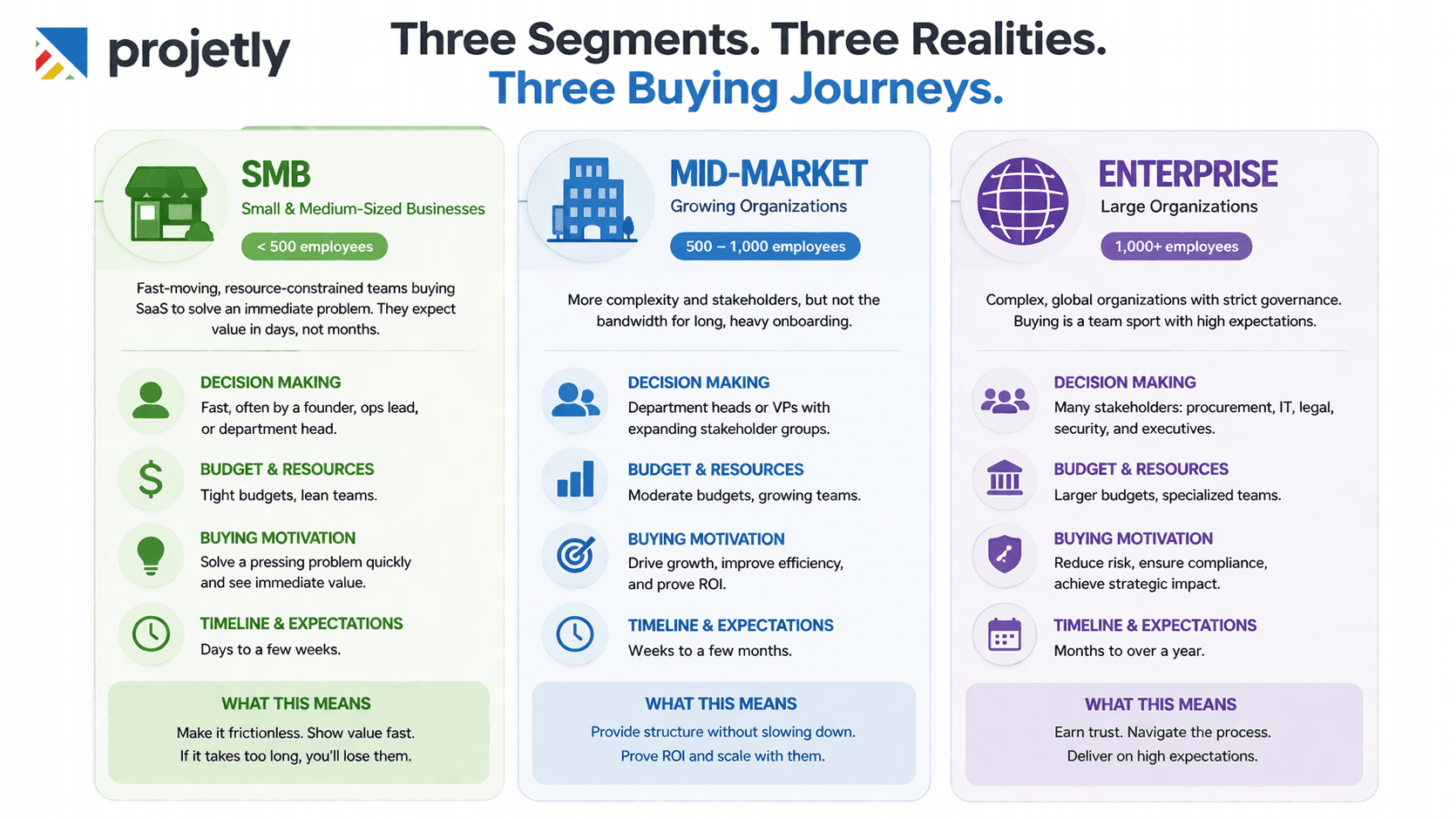
Segmentation in B2B is often oversimplified to headcount or revenue. In practice, the differences run deeper, into organisational structure, buying behaviour, risk tolerance, and internal complexity.
SMB (Small and Medium-Sized Businesses): Typically fewer than 500 employees. Decisions are fast, often made by a founder, operations lead, or department head. Budgets are tight, teams are lean, and patience for friction is low. SMBs buy SaaS to solve an immediate problem, and they expect to see value within days, not months.
Mid-Market: Companies with 500–1,000 employees occupying a genuinely different space from SMBs and enterprises. They have enough internal complexity to need structure but not enough resources to absorb a six-month onboarding engagement. Mid-market buyers are often department heads or VPs with growing stakeholder circles.
Enterprise: Organizations with 1,000+ employees, often with global operations, layered governance, and strict compliance requirements. Enterprise deals involve procurement teams, IT security reviews, legal sign-offs, and executive alignment. The buying process is long, and the expectations that follow are proportionally high.
Understanding this spectrum clearly, not just as labels, but as genuinely different buying and adoption contexts, is the foundation of everything that follows.
Schedule a Demo – Walk through your onboarding use case
The Full Comparison: SMB vs. Mid-Market vs. Enterprise Onboarding
Criteria | SMB | Mid-Market | Enterprise |
|---|---|---|---|
Team Size | < 500 employees | 500–1,000 employees | 1,000+ employees |
Onboarding Timeline | 1–4 weeks | 4–12 weeks | 3–12+ months |
Decision Makers | 1–2 (founder/dept head) | 3–5 stakeholders | 6–12+ (IT, legal, finance, ops) |
Customization Need | Low – standardized | Medium – configurable | High – fully custom |
Support Model | Self-serve + automation | Hybrid guided | Dedicated CSM + team |
Key Success Metric | Activation rate, churn | Adoption depth, expansion | ROI milestones, renewal |
Compliance/Security | Minimal | Moderate | SOC 2, SSO, legal review |
Integration Complexity | Low | Medium | High – ERP, HRIS, SSO |
SMB Onboarding: Speed, Simplicity, and Self-Serve
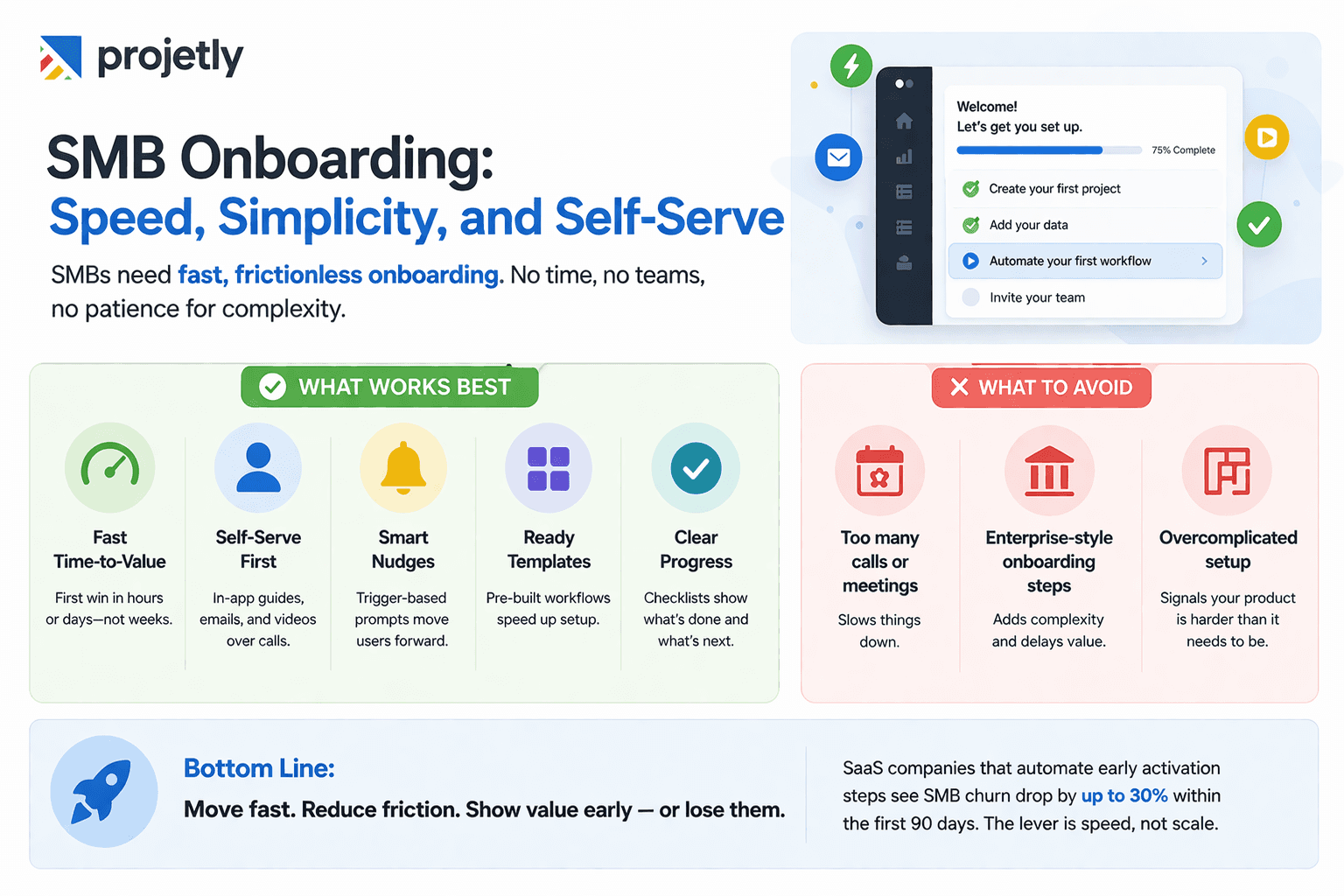
SMB onboarding succeeds when it removes friction and delivers value fast. SMBs do not have dedicated project managers, IT teams, or implementation budgets. They have urgency and limited tolerance for onboarding that feels like a second job.
The best SMB onboarding experiences in 2026 are largely self-serve, guided by in-app flows, automated email sequences, checklists tied to activation milestones, and short video walkthroughs. The goal is not to show every feature. It is to get each SMB customer to their first win as quickly as possible.
What High-Performing SMB Onboarding Looks Like
Fast time-to-first-value: The SMB customer should hit a meaningful milestone, a project created, a report generated, a workflow automated, within their first session or first few days.
Minimal human touchpoints: Over 70% of SMB users prefer self-serve onboarding when it is done well. Scheduling calls and waiting for a CSM slows adoption and increases early churn risk.
Trigger-based nudges: Behavioural triggers, idle accounts, incomplete setup steps, feature gaps should fire automated prompts that guide users forward without requiring manual intervention.
Pre-built templates: SMBs do not want to build from scratch. Offering ready-made workflows, dashboards, and configurations dramatically reduces setup time and accelerates confidence.
Clear progress visibility: Onboarding checklists that show completion percentage give SMB users a sense of momentum and signal exactly what to do next.
SaaS companies that automate early activation steps see SMB churn drop by up to 30% within the first 90 days. The lever is speed, not scale.
A common mistake is over-engineering SMB onboarding with enterprise-style steps: kickoff calls, discovery sessions, stakeholder mapping. These add cost, delay activation, and signal to SMB customers that your product is harder than it needs to be. Keep SMB onboarding opinionated, fast, and repeatable.
Try It Free, Launch your onboarding in minutes
Enterprise Onboarding: Depth, Trust, and Risk Management
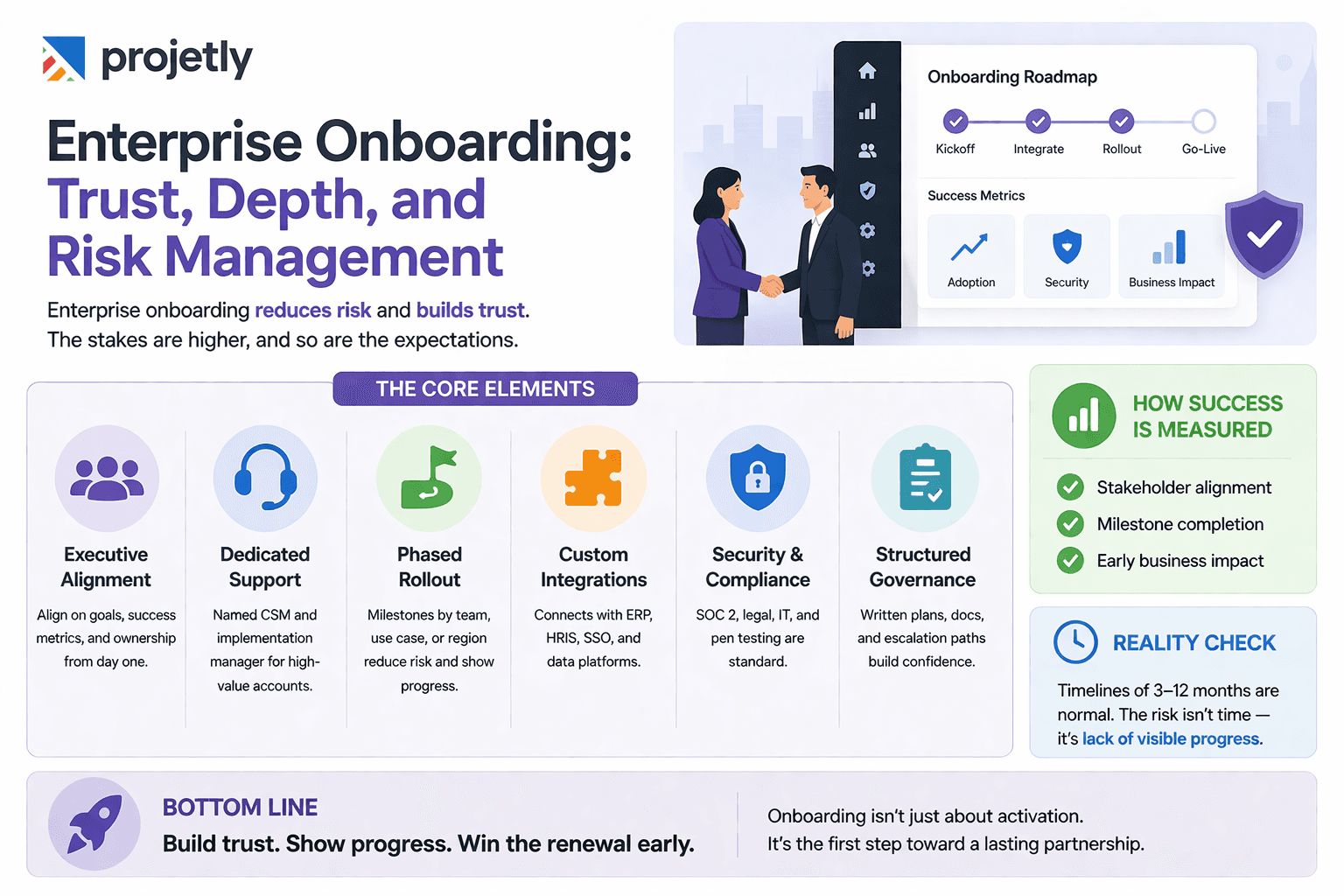
Enterprise onboarding operates on a fundamentally different logic. Where SMB onboarding optimizes for speed, enterprise onboarding optimizes for trust. The stakes are higher, enterprise contracts are typically 5 to 10 times larger than SMB deals, and so are the expectations.
Enterprise buyers have lived through failed software implementations. They are buying with risk in mind, and onboarding is where they find out whether the promises made during the sales cycle were real. A weak onboarding experience does not just damage adoption; it poisons the renewal conversation before it starts.
The Core Elements of Enterprise Onboarding
Executive alignment and success planning: Enterprise onboarding should begin with a structured kickoff that maps business objectives, defines success metrics, and establishes ownership across stakeholder groups.
Dedicated customer success resources: Enterprise clients expect a named CSM, an implementation manager, or both. Ad-hoc support is not sufficient for accounts with $100K+ contract values.
Phased rollout with milestone gates: Enterprise onboarding rarely moves in a straight line. Phasing by department, use case, or geography, with clear success criteria at each gate, reduces risk and demonstrates ongoing value.
Custom integrations and technical implementation: Enterprise environments include complex tech stacks: ERP systems, HRIS platforms, single sign-on providers, and data warehouses. Onboarding must account for these dependencies.
Security and compliance validation: SOC 2 reviews, data residency discussions, penetration testing, and legal review are standard in enterprise onboarding. Failing to plan for these creates delays that damage trust before adoption even begins.
Formal documentation and governance: Enterprise buyers expect written success plans, escalation paths, and documented onboarding milestones. This is not bureaucracy; it is evidence that you are a serious partner.
Enterprise onboarding success is measured not just in activation but in stakeholder satisfaction, milestone completion, and early signals of business impact. The renewal starts at kickoff.
The longer timeline of enterprise onboarding, often three to twelve months, is not a problem to solve. It reflects genuine complexity. The risk is not that onboarding takes time; it is that time passes without visible progress. Regular check-ins, documented milestones, and proactive communication prevent onboarding from stalling.
Get in Touch – We’re here to help you scale
Mid-Market Onboarding: The Hybrid That Most Teams Get Wrong
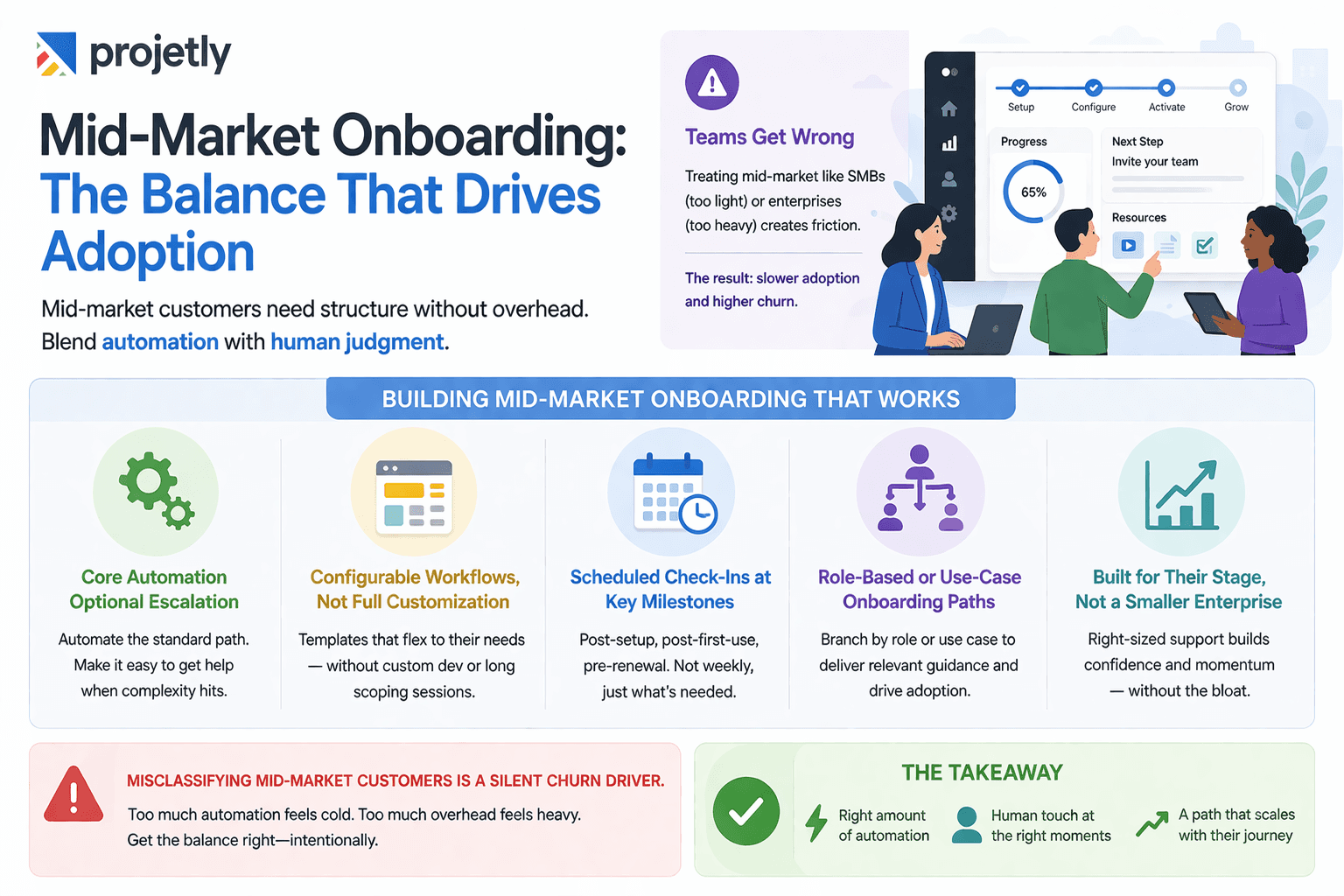
Mid-market onboarding is where SaaS teams most often stumble. The temptation is to treat mid-market customers like SMBs because the deal is smaller than enterprise, or like enterprises because the account feels more complex than a typical SMB. Both approaches create friction.
Mid-market customers need structure without overhead. They have enough internal complexity to benefit from guided onboarding — but not enough resources or patience for a six-month enterprise-style implementation. The right approach blends automation with human judgment.
Building Mid-Market Onboarding That Works
Core automation with optional escalation: Automate the standard activation path but make it easy for mid-market customers to request additional support when they hit complexity.
Configurable workflows, not full customization: Mid-market customers benefit from templates that can be adjusted without requiring custom development or extended scoping sessions.
Scheduled check-ins at key milestones: Unlike SMBs, mid-market customers benefit from human touchpoints at critical moments — post-setup, post-first-use, pre-renewal. Unlike enterprises, these do not need to be weekly.
Role-based or use-case onboarding paths: Mid-market teams span multiple departments. Branching onboarding flows by role (admin vs. end user) or use case significantly improves relevance and adoption.
Misclassifying mid-market customers is a silent churn driver. Give them neither the cold automation of a self-serve SMB experience nor the heavy overhead of a full enterprise engagement. Find the balance through intentional design, not default.
Start Free Today – Experience faster activation
How the Sales Process Shapes Onboarding Expectations
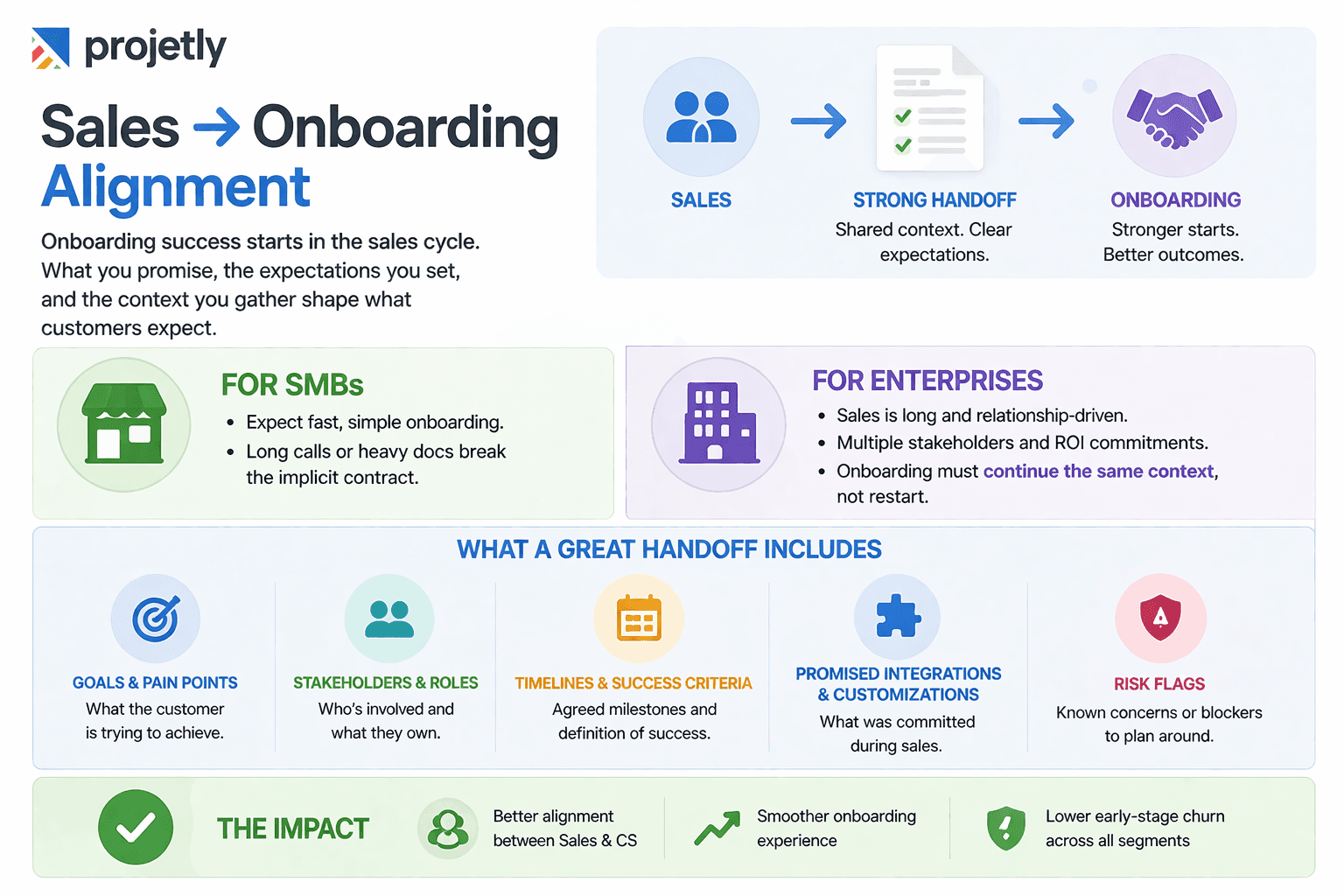
Sales → Onboarding Alignment (Why It Matters)
Onboarding success starts during the sales cycle
Promises, expectations, and context shape onboarding outcomes
For SMBs
Expect fast, simple onboarding
Long kickoff calls or heavy docs = broken expectations
For Enterprises
Sales is long and relationship-driven
Multiple stakeholders + ROI commitments involved
Onboarding must continue in the same context, not restart
What Great Handoff Looks Like
Customer goals & pain points
Key stakeholders & roles
Timelines & success criteria
Promised integrations/customizations
Risks identified during sales
The Impact
Better alignment between Sales & CS
Smoother onboarding experience
Lower early-stage churn across all segments
Contact Us – Let’s fix your onboarding gaps
Measuring Onboarding Success: Metrics by Segment
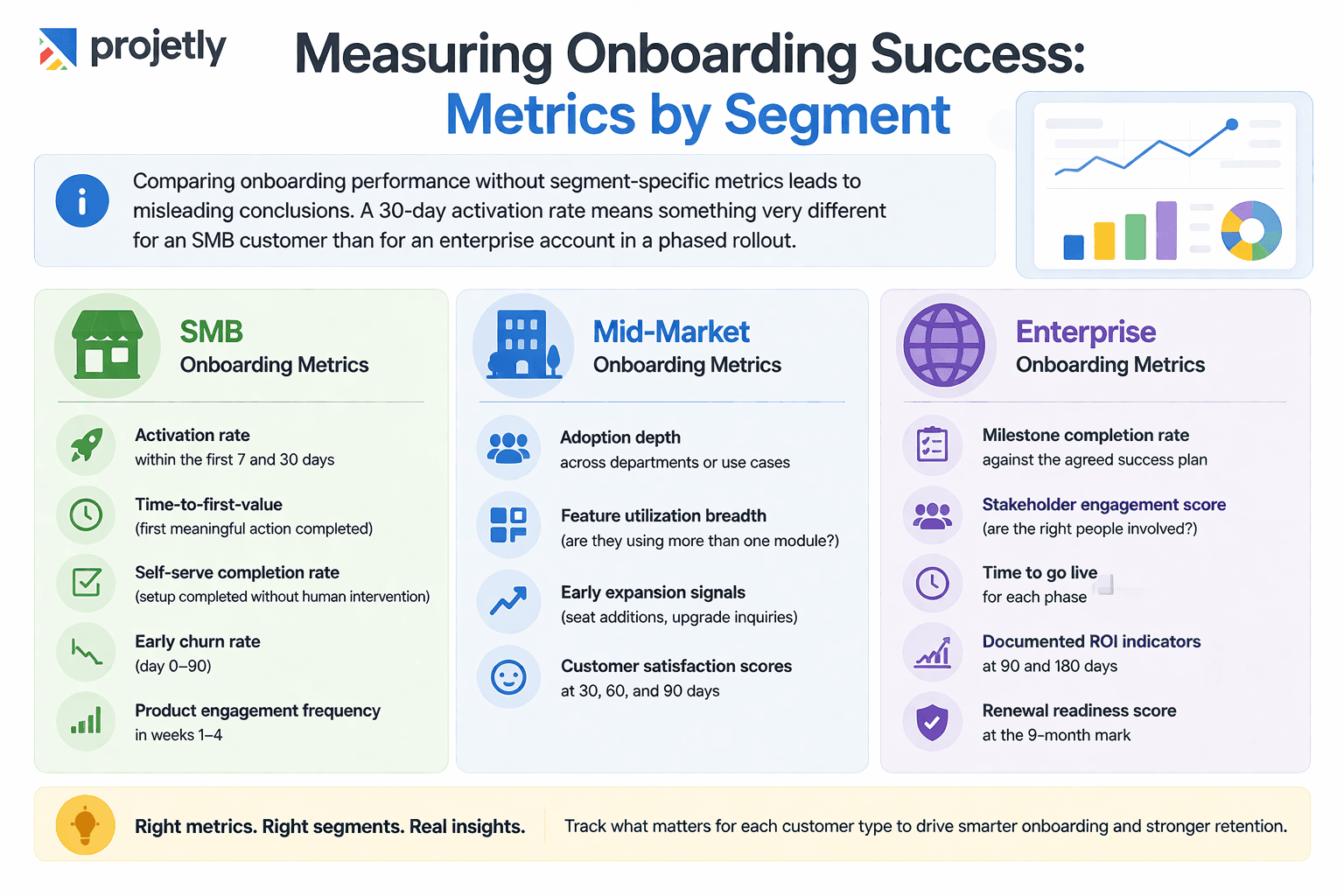
Comparing onboarding performance without segment-specific metrics leads to misleading conclusions. A 30-day activation rate means something very different for an SMB customer than for an enterprise account in a phased rollout.
SMB Onboarding Metrics
Activation rate within the first 7 and 30 days
Time-to-first-value (first meaningful action completed)
Self-serve completion rate (setup completed without human intervention)
Early churn rate (day 0–90)
Product engagement frequency in weeks 1–4
Mid-Market Onboarding Metrics
Adoption depth across departments or use cases
Feature utilization breadth (are they using more than one module?)
Early expansion signals (seat additions, upgrade inquiries)
Customer satisfaction scores at 30, 60, and 90 days
Enterprise Onboarding Metrics
Milestone completion rate against the agreed success plan
Stakeholder engagement score (are the right people involved?)
Time to go live for each phase
Documented ROI indicators at 90 and 180 days
Renewal readiness score at the 9-month mark
Research consistently shows that a 5% improvement in customer retention can increase profits by 25% to 95%. Segment-specific onboarding metrics are the most direct lever for improving that number.
Talk to Our Team – Get expert guidance
Building Scalable Onboarding Playbooks for Each Segment
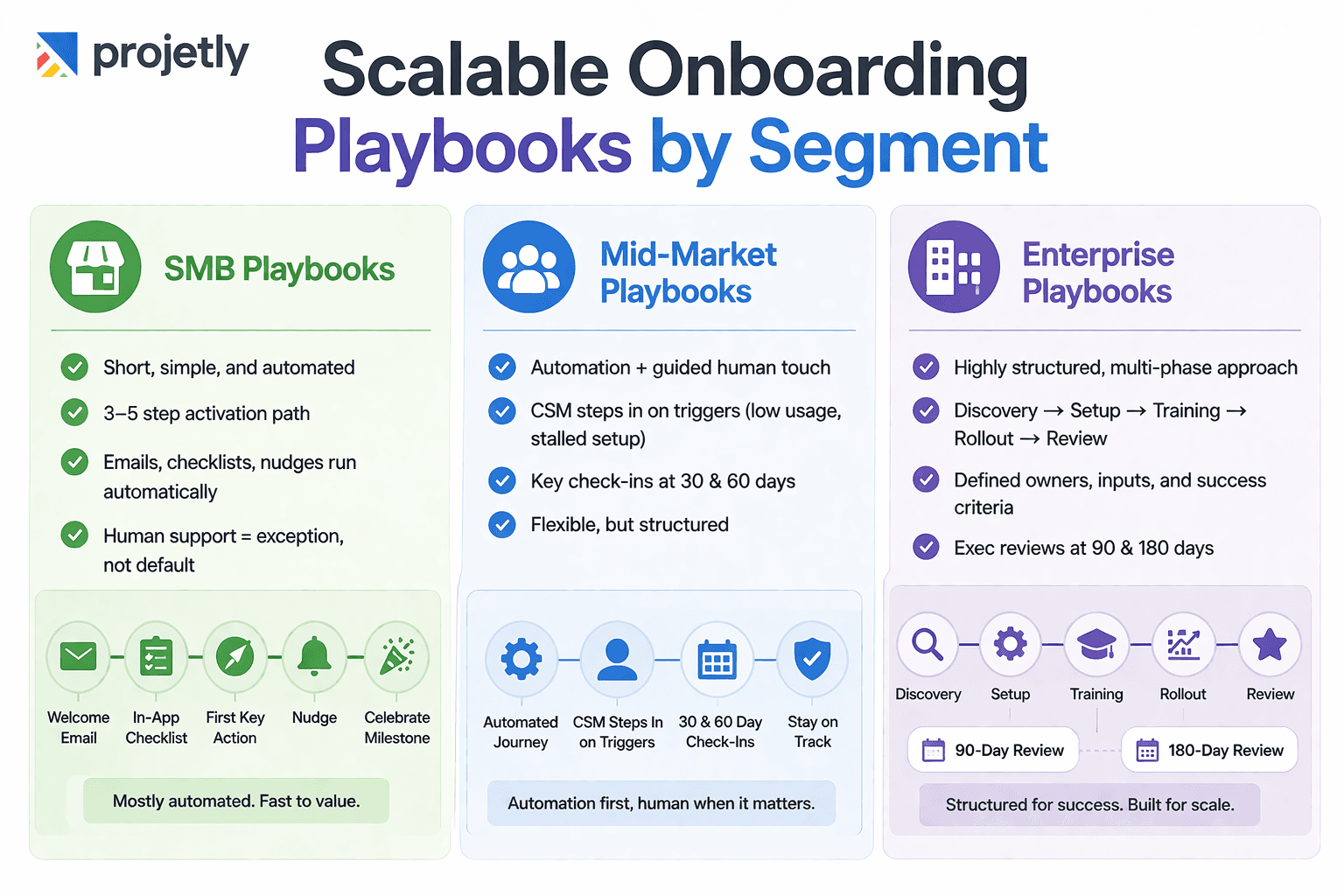
Strategy is only useful when it is operationalized. A playbook defines what happens at each stage of onboarding, who owns each step, and what triggers movement from one phase to the next.
SMB playbooks should be short, opinionated, and automatable. Define a clear activation path, typically three to five steps, and build automated triggers for every stage. Welcome emails, in-app checklists, behavioral nudges, and milestone celebrations should all run without manual input. The human exception should be the exception, not the rule.
Mid-market playbooks should introduce flexibility without introducing chaos. Build a standard automation layer, but define clear criteria for when a CSM should step in. Common triggers include stalled setup, low engagement in week two, or a customer request for a call. Scheduled check-ins at 30 and 60 days catch issues before they become churn signals.
Enterprise playbooks require the most structure. Typical phases include: pre-kickoff discovery, technical scoping, security and compliance review, integration setup, user training, phased rollout, and success review. Each phase should have documented inputs, outputs, owners, and success criteria. Executive business reviews at 90 and 180 days keep senior stakeholders engaged and provide early warning for renewal risk.
Playbooks are not static. The best SaaS teams review onboarding playbooks quarterly, using churn data, customer feedback, and adoption metrics to identify friction points and refine flows.
Schedule a Demo – Walk through your onboarding use case
Common Mistakes SaaS Teams Make in 2026
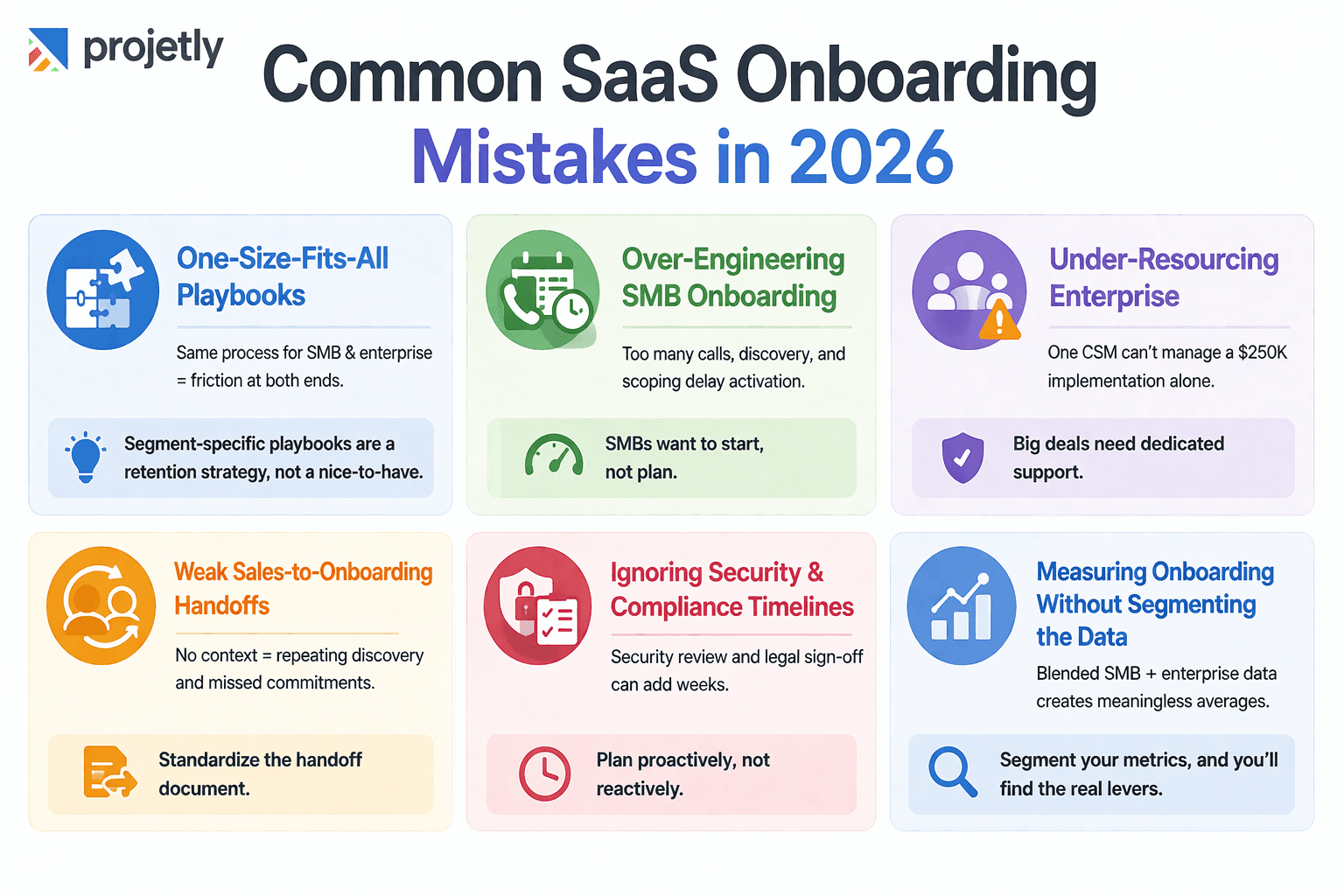
One-size-fits-all playbooks: Using the same onboarding process for a 20-person startup and a 5,000-person enterprise creates friction at both ends. Segment-specific playbooks are a retention strategy, not a nice-to-have.
Over-engineering SMB onboarding: Adding kickoff calls, discovery sessions, and custom scoping delays activation and signals complexity. SMBs want to start, not plan.
Under-resourcing enterprise onboarding: Expecting a single CSM to manage a $250K enterprise implementation without dedicated support creates risk disproportionate to the deal size.
Weak sales-to-onboarding handoffs: Starting onboarding without context from the sales process means repeating discovery conversations and missing commitments. Standardize the handoff document.
Ignoring security and compliance timelines: For enterprise accounts, security review and legal sign-off can add weeks. Planning proactively, not reactively, prevents avoidable delays.
Measuring onboarding without segmenting the data: Aggregating SMB and enterprise activation data produces averages that mean nothing. Segment your metrics, and you will find the real levers.
Start Your Free Trial – No friction, just value
The Future of Customer Onboarding: What Is Changing in 2026
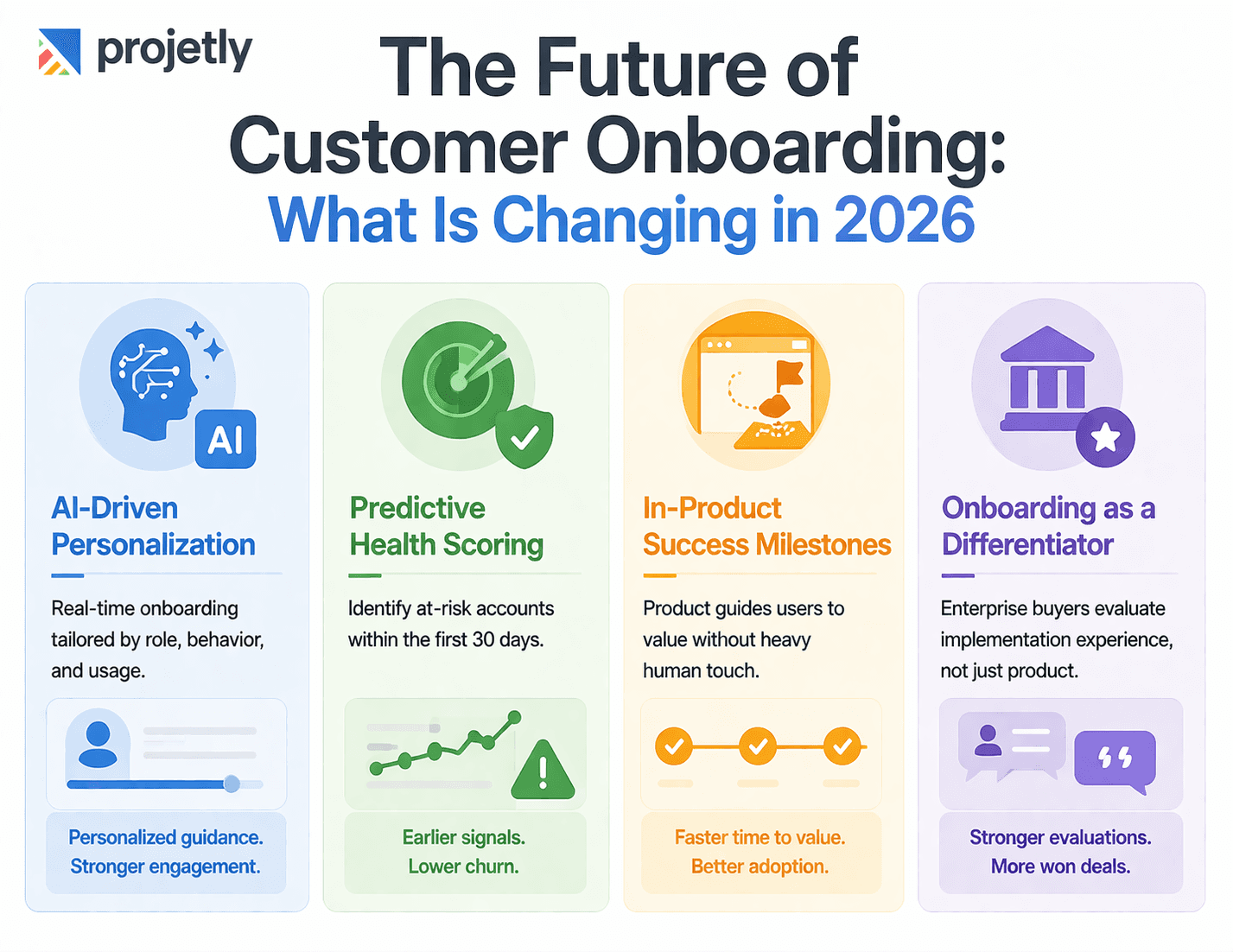
AI-driven personalization at scale: Behavioral AI is increasingly being used to personalize onboarding flows in real time, adjusting guidance based on role, usage patterns, and product area without manual CSM input. This is particularly powerful for SMB and mid-market segments where human capacity is limited.
Predictive health scoring from day one: Rather than waiting for churn signals to emerge, leading SaaS teams are using predictive models built on early onboarding behavior to flag at-risk accounts within the first 30 days. Early intervention is significantly cheaper than late-stage save plays.
In-product success milestones: Product-led onboarding, where the product itself guides users to meaningful outcomes without email or human touch, is becoming the baseline expectation for SMB customers and an increasingly important element of mid-market onboarding.
Enterprise onboarding as a competitive differentiator: As enterprise SaaS markets mature and switching costs decrease, the quality of onboarding is becoming a genuine differentiator in competitive evaluations. Enterprise buyers increasingly ask to speak with reference customers about implementation experience, not just product capability.
Start Free Today – Experience faster activation
Final Takeaway: Onboarding Is a Strategic Choice
SMB vs. enterprise onboarding is not a question of doing more or less. It is a question of doing what fits. The companies that recognize this and build onboarding systems that match how different customer segments actually buy, adopt, and grow consistently outperform those that do not.
SaaS companies that align onboarding to customer segment report 20–40% higher product adoption rates, lower customer acquisition costs, and significantly improved lifetime value compared to teams running one-size-fits-all onboarding.
SMBs value speed and simplicity. Enterprise customers value depth, trust, and demonstrated risk management. Mid-market customers need a balance between both. When your onboarding reflects those differences, it stops being a cost centre and starts being a growth engine.
The difference between SMB and enterprise onboarding is not just scale, it is intent. Build onboarding with intent, and retention follows.
You may also like

A Guide to Project Management Professional Certification

Laugh Your Way to Productivity: 50 Workplace Quotes

50 Funny Workplace Memes That’ll Brighten Your Workday.
What Does a Customer-First Mindset Mean? Explained in 2025

What It Takes to be a Great Customer Success Manager in 2025