Digital Sales Room

By
Sam

Seismic vs Projetly: The Better Digital Sales Room for 2026
Seismic is a sales enablement platform with digital sales rooms included in its broader suite. It excels at content governance and analytics but is built primarily for sellers rather than a self-serve buyer experience.
Projetly is an AI-native digital sales room built specifically for complex B2B deals, with the buyer portal, onboarding, and adoption tracking unified in one workspace. The core difference: Seismic manages content across a sales org, while Projetly manages the deal and the customer relationship that follows it.
Teams choosing between them are really choosing between a content platform with a room attached and a room built to run the deal end to end.
For a broader look at how these two stack up against the rest of the market, see our full breakdown of the 17 best digital sales room software platforms in 2026.
What Each Platform Is Built to Do
Seismic:
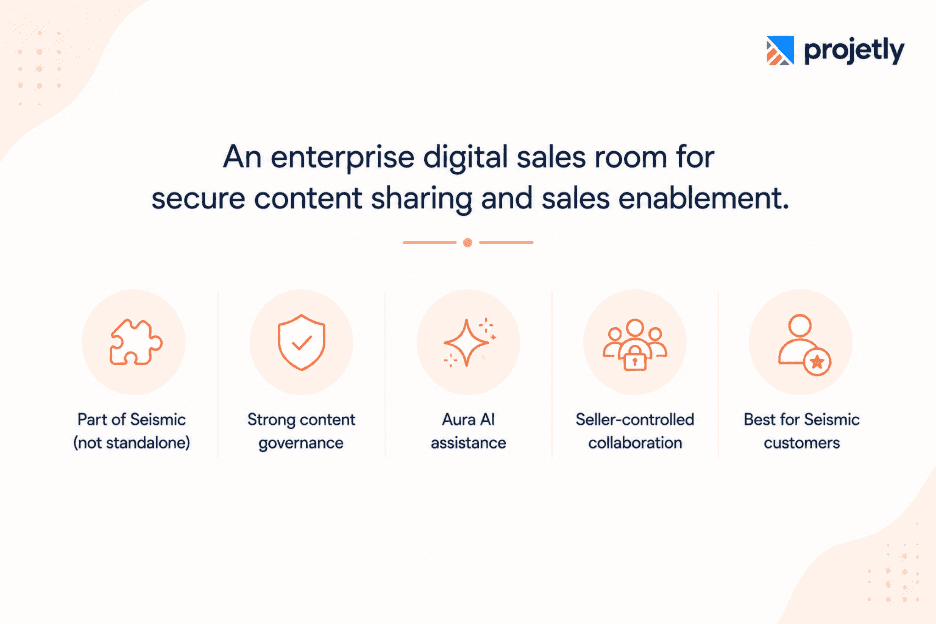
A digital sales room delivered as part of the Seismic Enablement Cloud’s Content suite, not available as a standalone purchase
Strong content governance, version control, and dynamic watermarking for regulated or compliance-heavy industries
Aura AI supports internal search and enablement questions, with Salesforce Agentforce integration
Content can only be added to the room by sellers, which limits true buyer-side collaboration
Best suited for large enablement teams that already run content operations through Seismic and want a room as an extension of that content library
Projetly:

An AI-native digital sales room built for B2B SaaS companies running complex, multi-stakeholder enterprise deals
Branded buyer portals, single link access, and multi-stakeholder collaboration built in from the start
Captures deal intelligence automatically from customer conversations through AI meeting transcription and summaries
Sales-to-onboarding continuity on one platform: at Closed Won, a team member creates the Project Room, which starts from the deal’s stakeholder map and shared content instead of a blank workspace.
Built for teams that need buyer-facing collaboration, not just an internal content library with a room bolted on
Where Seismic Is Genuinely Strong
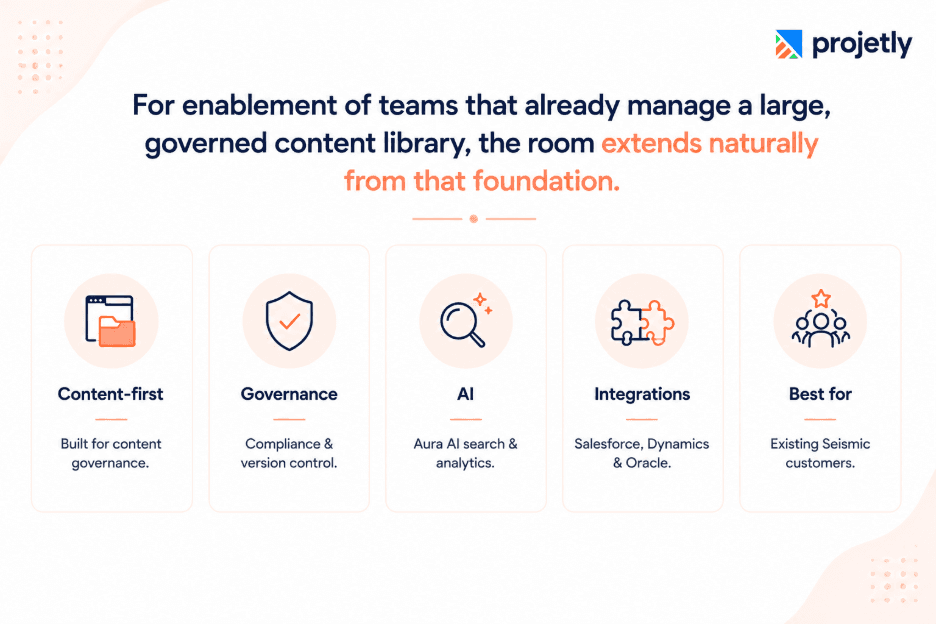
Content governance and compliance:
Detailed governance controls built for legal and regulatory requirements
Dynamic watermarking and internal-only content restrictions
Version control and centralized content management across the sales org
Analytics depth:
Reporting on both content performance and seller usage against business goals
Retrieval-based AI search across the full internal content catalog.
Enterprise integration footprint:
Native integrations with Salesforce, Microsoft Dynamics, and Oracle
Salesforce Agentforce integration for teams already standardized on that ecosystem
Honest recommendation: If your organization already runs Seismic for enablement of content and simply needs a room to extend that library to buyers, Seismic is a reasonable extension of a tool you already pay for.
Where Seismic Stops
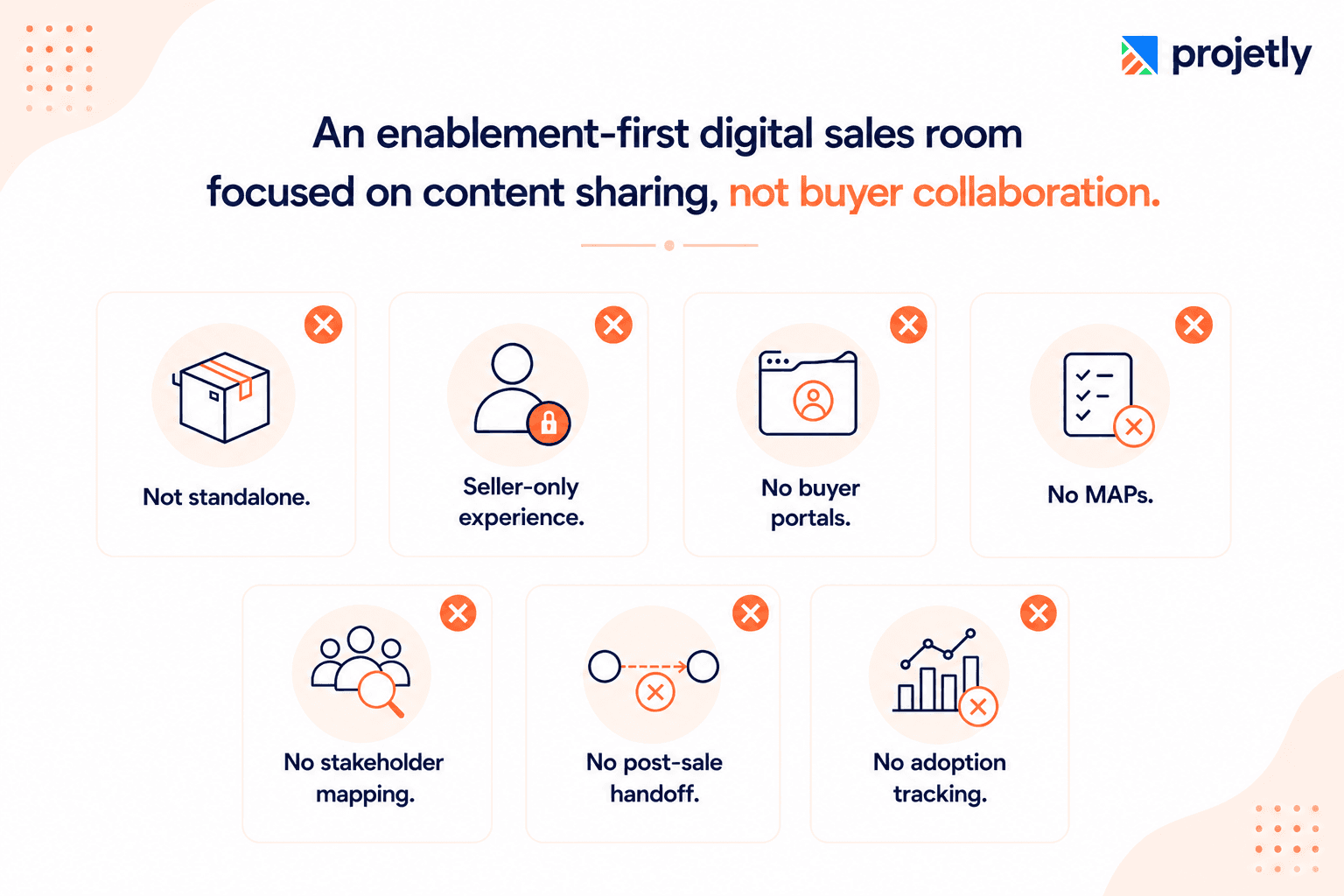
Not sold as a standalone product; only available bundled inside the Enablement Cloud Content suite
Content can only be added by sellers, limiting bidirectional buyer collaboration
No branded, customizable buyer portal or white-labeled microsite experience built for the buyer, distinct from an internal content share
No mutual action plans, shared timelines, buyer-seller chat, or async messaging in the room itself
No stakeholder mapping or organizational chart tools to track a multi-person buying committee
No customer onboarding portal, onboarding checklists, or same-platform handoff from Closed Won to onboarding
No post-sale engagement tracking after the deal closes
Where Projetly Goes Further
Buyer-first collaboration:
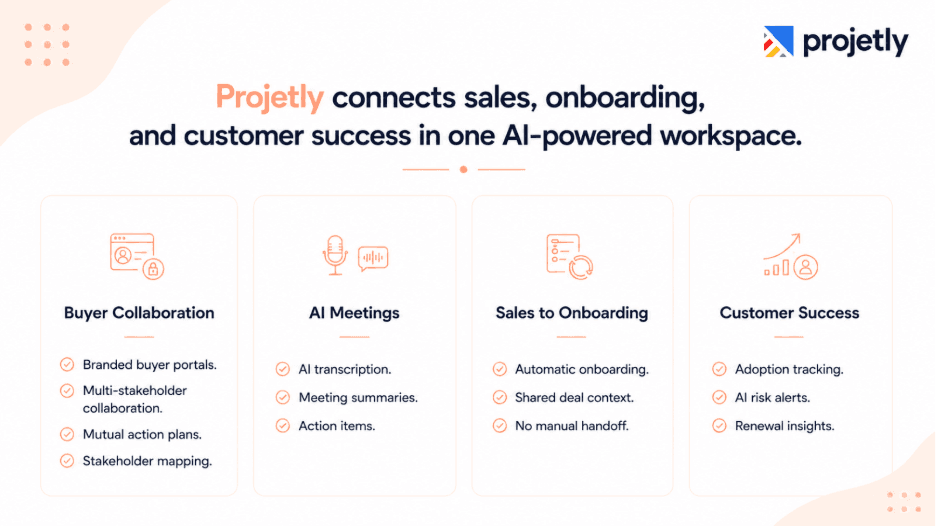
Branded, single-link buyer portals with multi-stakeholder access from day one. Mutual action plans, shared timelines, checklists, and buyer-seller chat built into the room, not layered on top. Stakeholder mapping and org charts to track every person in a complex buying committee
AI meeting intelligence:
Every customer call is recorded, transcribed, summarized, and converted into action items automatically. Commitments and decisions made on calls become searchable records tied to the deal. Deal context persists even when a rep leaves or is reassigned
Sales-to-onboarding continuity, same platform:
A team member converts the workspace into an onboarding project at Closed Won, carrying the stakeholder map, commitments, and shared content forward without a handoff call. See “Onboarding Continuity” below for why this matters at the account level.
Post-sale engagement tracking:
Tracks customer engagement after close, so account managers can act when activity drops. Feeds real engagement data into renewal and expansion conversations, not memory
Full Capability Comparison
If you are building your own scorecard beyond the two platforms below, our Digital Sales Room Evaluation Guide walks through the must-have criteria to check for during vendor demos.
Feature | Seismic | Projetly |
|---|---|---|
API access | Yes | In Roadmap |
Mutual Action Plans (MAPs) | No | Yes |
OpenAI integration | Yes | No |
Customer onboarding portal & guided checklists | No | Yes |
Dynamic proposal builder | No | No |
Single shareable link access | No | Yes |
Gong integration | Yes | No |
AI Agents for Sales, Onboarding & Delivery | No | Yes |
Branded buyer portals and microsites | No | Yes |
Slack / Microsoft Teams integration | Yes | Yes |
Intuitive No-Code Form Builder | No | Yes |
Buyer-seller chat / async messaging | No | Yes |
Deal Close → Onboarding handoff, same platform | No | Yes |
Native e-signatures | No | Yes |
Multi-stakeholder collaboration | No | Yes |
Onboarding Continuity: The Gap Seismic Doesn’t Close
Seismic treats the digital sales room as an extension of its content library. Once a deal closes, there is no built-in path for that room, or the context inside it, to continue into onboarding. Customer success teams start fresh in a separate system, rebuilding the stakeholder map and commitment history that already existed in the sales room.
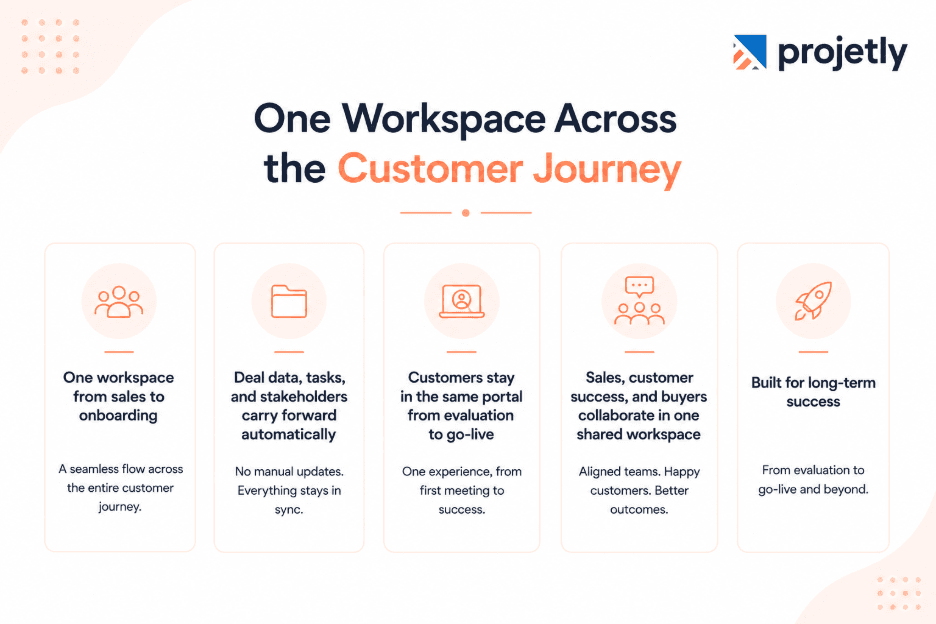
The same workspace used to run the sales cycle becomes the onboarding project once a team member creates it
Tasks, milestones, stakeholder access, and the deal record carry forward without re-entry
The customer stays in the environment they already know, from evaluation through go-live
Sales, customer success, and the customer operate in one shared space from first contact through first renewal
This matters most for teams where net revenue retention sits on the scorecard alongside new bookings. A deal room that ends at signature leaves adoption risk invisible until it shows up as churn. A deal room that continues into onboarding surfaces that risk early, while there is still time to act on it. For more on why this matters at the account level, see how high-performing B2B teams keep enterprise deals moving.
What Customers Say
Seismic verified G2 review, 4.6/5:
Reviewers on G2 highlight that Seismic makes it straightforward to customize customer-facing content and deliver tailored sales training that improves team readiness and engagement, with no significant drawbacks reported. The feedback reflects Seismic’s strength as a content and enablement platform rather than a buyer-facing collaboration tool. (G2, 2026)
Projetly verified G2 review, 4.8/5:
Reviewers on G2 highlight that Projetly bridges the gap between sales and onboarding by preserving customer context and improving collaboration, pointing to structured onboarding, easy integration, and strong support, with only a small learning curve for new users. (G2,2026)
Which Platform Fits Your Situation
Choose Seismic if:
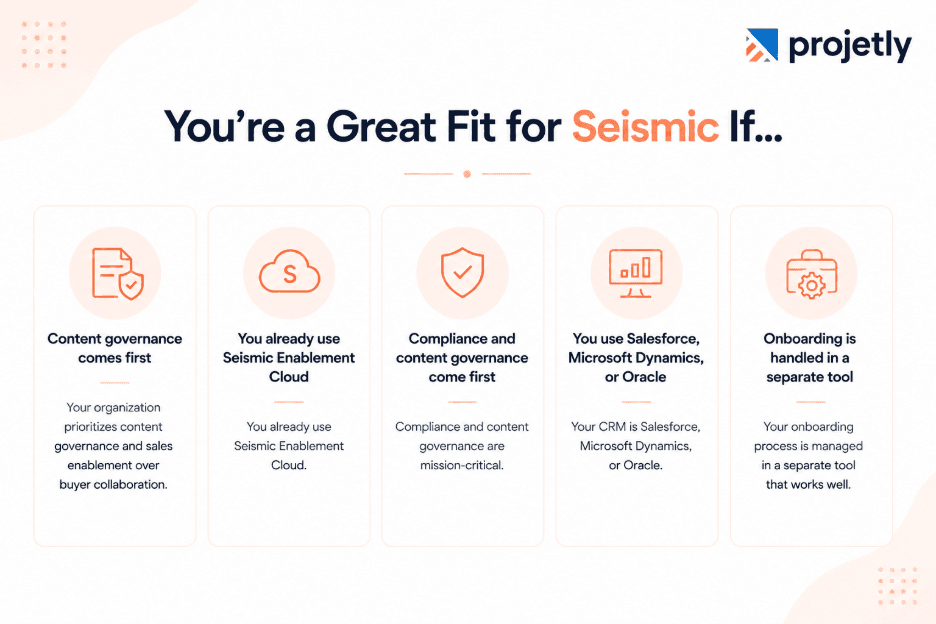
Your organization already runs the Seismic Enablement Cloud for content management and enablement.
Governance, watermarking, and compliance controls are a higher priority than buyer-facing collaboration.
You are standardized on Salesforce, Microsoft Dynamics, or Oracle and do not need HubSpot support.
Your customer success team runs onboarding in a separate system that already works well.
Choose Projetly if:
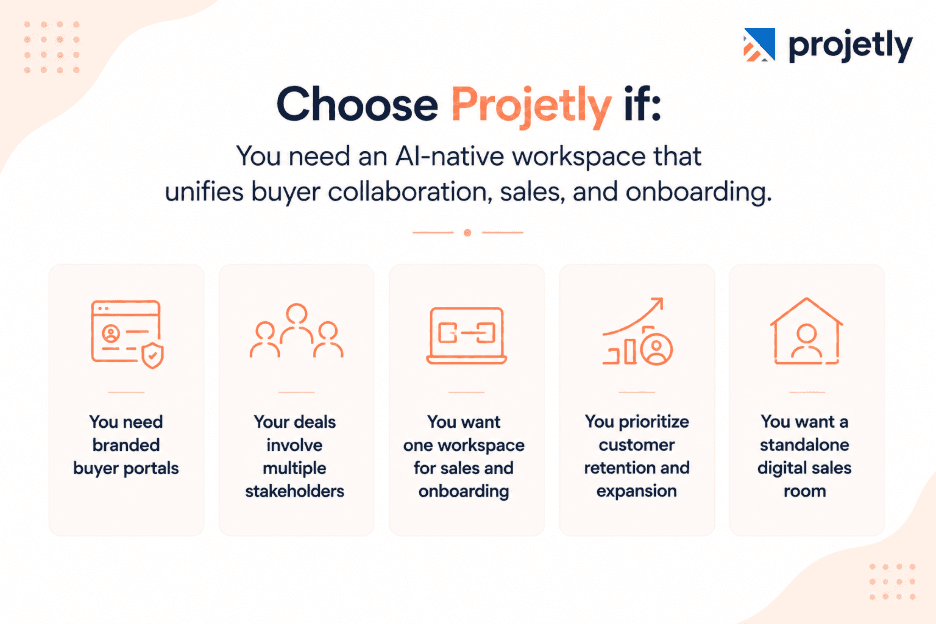
You need a branded, buyer-facing portal built for multi-stakeholder deals, not an internal content library extended outward
Your deals involve procurement, legal, or executive review and benefit from mutual action plans and stakeholder mapping
You want sales and customer onboarding to run in the same workspace, with no handoff call
Net revenue retention matters as much as new bookings, and context loss at handoff is a recurring problem
You want the room available as a standalone purchase rather than bundled into a larger content platform
Neither Seismic nor Projetly fits every team. If you are evaluating a lighter-weight, AI-driven deal workspace instead, see our roundup of 7 best Aligned alternatives for digital sales room software.
Ready to see how Projetly runs a complex enterprise deal from first room to first renewal. Book a walkthrough or start a free trial at projetly.ai.
For more on how Projetly approaches the full revenue lifecycle, see the Digital Sales Room overview and the customer onboarding platform page.
Looking for more options? See our full Seismic alternatives comparison.
Quick Summary
Seismic: Content-suite add-on, not standalone. Strong governance, watermarking, Salesforce/Dynamics/Oracle integrations.
Seismic gaps: Seller-only content, no buyer portal, no stakeholder mapping, no onboarding handoff, no post-sale tracking, no HubSpot.
Projetly: Standalone, AI-native room covering the full deal lifecycle from first contact to renewal.
Buyer experience: Branded multi-stakeholder portal, mutual action plans, org charts, built in, not bolted on.
AI layer: Every call transcribed and turned into searchable action items automatically.
Onboarding continuity: Workspace converts into the onboarding project at Closed Won, no handoff call, no re-entry.
Post-sale: Tracks engagement and surfaces signals before it becomes churn.
Choose Seismic if: already on the Seismic Enablement Cloud, and governance is the priority.
Choose Projetly if: buyer collaboration, onboarding continuity, and NRR matter as much as new bookings.
Frequently Asked Questions
Which platform is better for a company already using Seismic for the enablement of content?
If your enablement content operations already run through Seismic and you only need a room to extend that content to buyers, Seismic keeps everything in one vendor relationship. If you need a buyer-facing portal with onboarding and adoption tracking built in, Projetly is built for that specific gap.
How does Projetly's onboarding continuity actually work?
When a deal reaches Closed Won in Projetly, a team member converts the same workspace into an onboarding project. The stakeholder map, commitments, and shared content are already there, so the customer success team starts with full context instead of a separate handoff call.
Can buyers collaborate directly inside a Seismic deal room?
Content in Seismic's room can only be added by sellers, and the platform does not include mutual action plans, buyer-seller chat, or shared task management in the room itself, which limits direct buyer collaboration compared to purpose-built deal rooms.
Does Seismic support customer onboarding after a deal closes?
Seismic does not include a customer onboarding portal, onboarding checklists, or a same-platform handoff from a closed deal into an onboarding project. Teams typically move to a separate tool for that phase.
Is Seismic's digital sales room available as a standalone product?
No. Seismic's room is part of the Seismic Enablement Cloud's Content suite and is not sold on its own, so adopting it typically means adopting the broader content platform as well.
You may also like

A Guide to Project Management Professional Certification

Laugh Your Way to Productivity: 50 Workplace Quotes

50 Funny Workplace Memes That’ll Brighten Your Workday.
What Does a Customer-First Mindset Mean? Explained in 2025

What It Takes to be a Great Customer Success Manager in 2025