Digital Sales Room

By
Dhruv
Why Every SaaS Company Needs a Digital Sales Room in 2026
If your SaaS sales team is still closing deals through email threads, PDF attachments, and scattered Zoom follow-ups, you're not just behind the curve. You're actively losing deals to companies that aren't.
Welcome to 2026, where the B2B buying process has fundamentally changed, and the companies winning enterprise contracts aren't necessarily those with the best product. They're the ones offering the best buying experience.
That experience increasingly lives inside a Digital Sales Room (DSR), and if you haven't adopted one yet, this guide will explain exactly why that's about to become your most expensive oversight.
Replace Static Docs with Live Deal Rooms, Start a Free Trial Today
What is a Digital Sales Room?
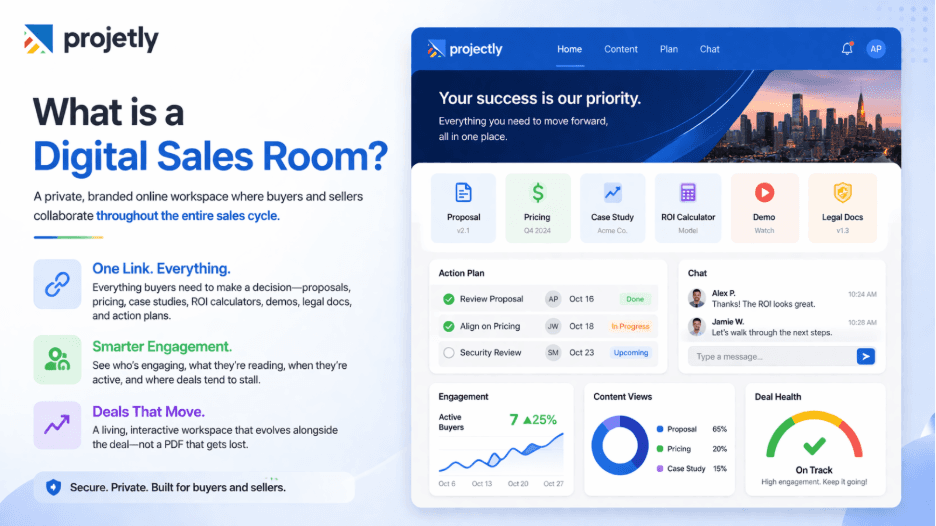
A Digital Sales Room is a private, branded online workspace where buyers and sellers collaborate throughout the entire sales cycle.
Think of it as a persistent microsite, one secure link that contains everything a prospective customer needs to make a purchasing decision: proposals, pricing tables, case studies, ROI calculators, demo recordings, legal documents, and mutual action plans.
But it's not just a content dump. The real value comes from what happens underneath the surface.
A DSR tracks who on the buyer's side is engaging with your materials, what they're reading, when they're active, and where deals tend to stall.
Unlike a static PDF that disappears into someone's Downloads folder, a DSR is a living, interactive workspace that evolves alongside the deal.
See How a Digital Sales Room Closes Deals Faster, Book a Demo Today
The Numbers That Make This Urgent in 2026
This isn't a "nice to have" category anymore. The data makes that clear.
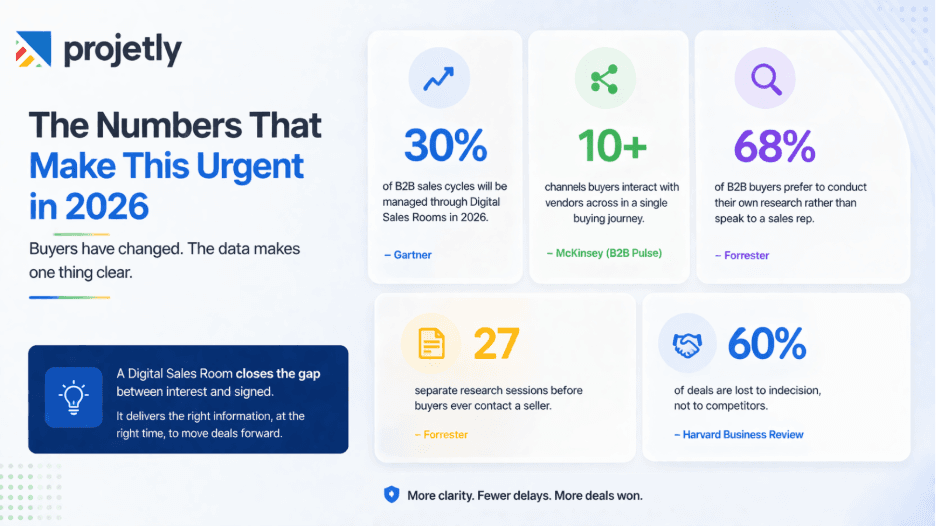
Gartner predicts that 30% of all B2B sales cycles will be managed through Digital Sales Rooms in 2026, up from single digits just three years ago. Meanwhile,
McKinsey's B2B Pulse research found that buyers now interact with vendors across more than 10 distinct channels during a single buying journey. Managing that across email and PowerPoint attachments is not just inefficient; it's structurally broken.
The buyer-side data is equally stark. Forrester research shows that 68% of B2B buyers prefer to conduct their own research rather than speak to a sales rep, and the average buyer goes through 27 separate information-gathering sessions before ever initiating contact with a seller.
By the time a prospect is in your pipeline, they've already formed strong opinions, and the way you deliver information from that point forward either validates or undermines those opinions.
On top of that, Harvard Business Review research indicates that 60% of deals are lost not to a competitor, but to indecision, deals that simply die in the space between "interested" and "signed." That's the gap a well-built Digital Sales Room is specifically designed to close.
Turn Your Next Deal into a Trackable Workspace, Start a free trial
Why SaaS Companies Are the Highest-Stakes Case
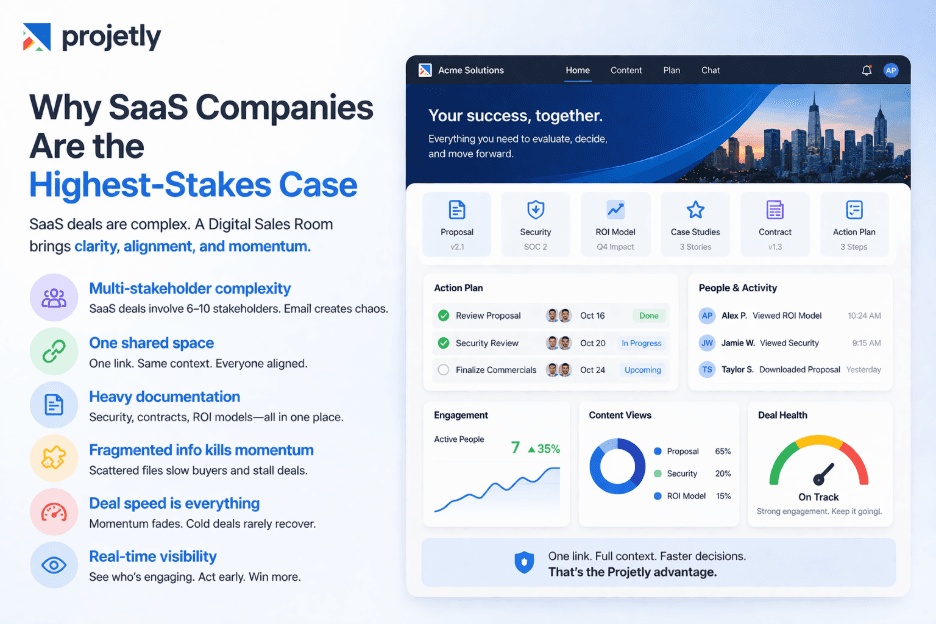
Every B2B company benefits from a DSR, but SaaS companies have the most to gain and the most to lose by waiting.
Here's why.
Multi-stakeholder complexity creates chaos: SaaS deals involve 6–10 decision-makers, champions, buyers, legal, IT, procurement, and leadership. Managing this over email leads to missed context, version confusion, and stalled deals.
One shared space keeps everyone aligned: A Digital Sales Room gives every stakeholder a single link with the same documents, updates, and context, no more forwarding threads or chasing files.
Heavy documentation slows deals down: From security reports to contracts and ROI models, SaaS deals generate a lot of content. Without a central hub, buyers waste time searching instead of deciding.
Fragmented information kills momentum: Buyers spend significant time reconciling scattered information. That friction directly impacts deal velocity and increases the risk of drop-off.
Deal speed is everything in SaaS; Momentum matters. When engagement drops, deals go cold fast and rarely recover fully.
Real-time visibility prevents deal slippage: DSRs show exactly who is engaging and when, helping teams act early instead of reacting late to silent deals.
Fix Your Deal Visibility Gaps, Contact us today
The Core Features That Drive Real Revenue Impact
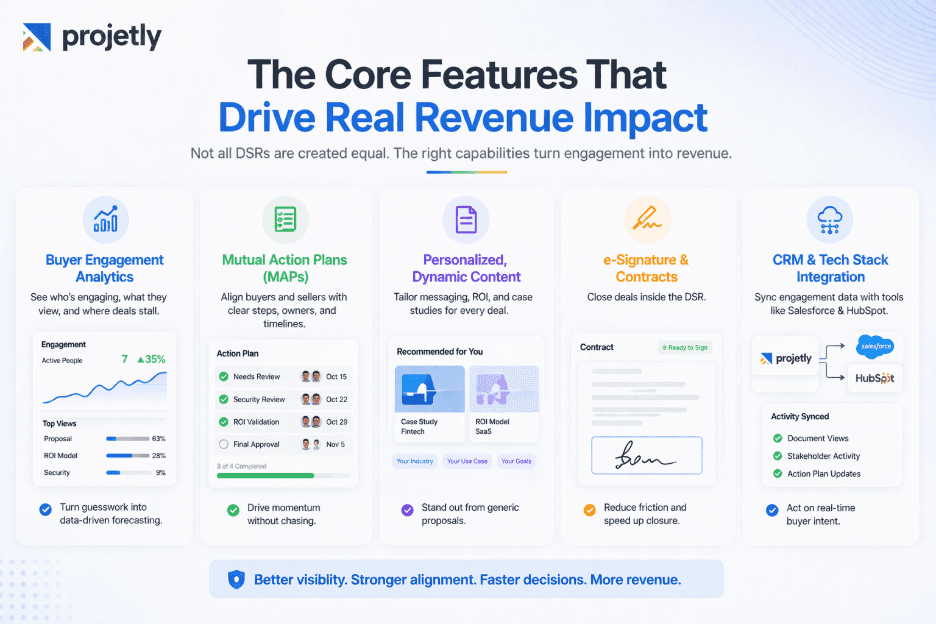
Not all Digital Sales Rooms are created equal, and the value you get depends heavily on what the platform actually does. Here's what separates a DSR worth deploying from one that becomes shelfware.
Key Digital Sales Room (DSR) Capabilities
Buyer Engagement Analytics: Real-time visibility into who’s engaging, what they’re viewing, and where interest drops.
Track stakeholders, document views, time spent, and activity
Identify buying signals vs. silence
Move forecasting from gut feel to data-driven accuracy
Mutual Action Plans (MAPs): A shared, structured roadmap that keeps both buyer and seller aligned.
Clear milestones, deadlines, and ownership
Helps champions drive internal alignment
Creates natural, non-pushy follow-ups
Personalized, Dynamic Content: Tailored experiences that make every deal feel custom-built.
Customize messaging, branding, and ROI models
Surface relevant case studies by use case/industry
Stand out from generic, static proposals
e-Signature & Contract Management: Close deals faster by reducing friction in the final step.
Sign directly within the DSR
Eliminate tool-switching and document back-and-forth
Fewer delays, faster deal closure
CRM & Tech Stack Integration: Turn DSR data into actionable insights inside your workflow.
Sync engagement data with CRM (e.g., Salesforce, HubSpot)
Give reps real-time buyer intent signals
Avoid switching between disconnected tools
See How a Digital Sales Room Closes Deals Faster, Book a Demo Today
What Happens to Deals Without a Digital Sales Room
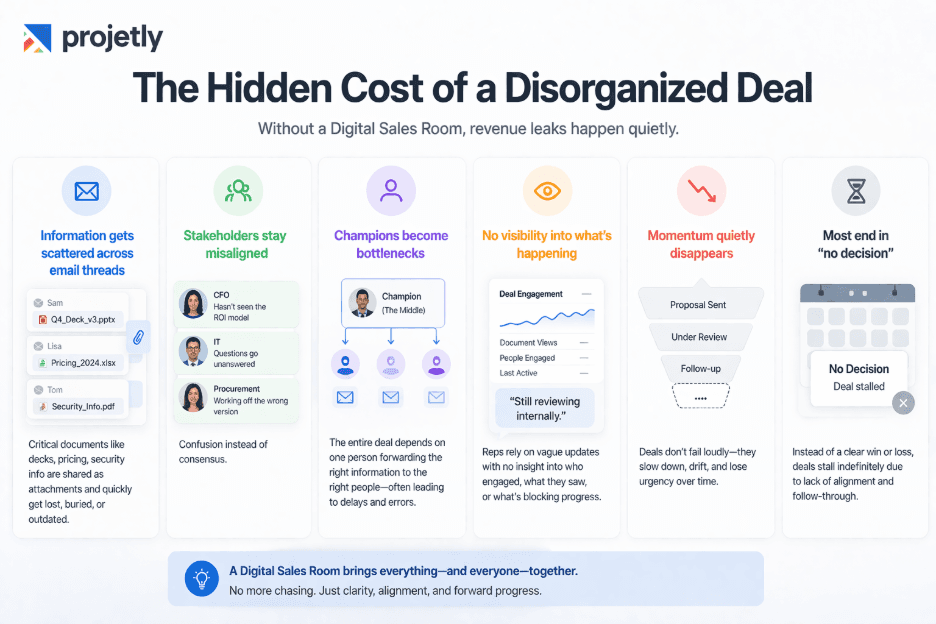
Information gets scattered across email threads: Critical documents like decks, pricing, security info, ar shared as attachments and quickly get lost, buried, or outdated.
Stakeholders stay misaligned: The CFO never sees the ROI model; IT questions go unanswered, and procurement works off the wrong version, confusing instead of consensus.
Champions become bottlenecks: The entire deal depends on one person forwarding the right information to the right people, often leading to delays and errors.
No visibility into what’s happening: Reps rely on vague updates like “still reviewing internally,” with no insight into who engaged, what they saw, or what’s blocking progress.
Momentum quietly disappears: Deals don’t fail loudly; they slow down, drift, and lose urgency over time.
Most end in ‘no decision’: Instead of a clear win or lose, deals stall indefinitely due to a lack of alignment and follow-through.
Create Your First Digital Sales Room Today. Start a Free Trial Today.
How a DSR Changes This
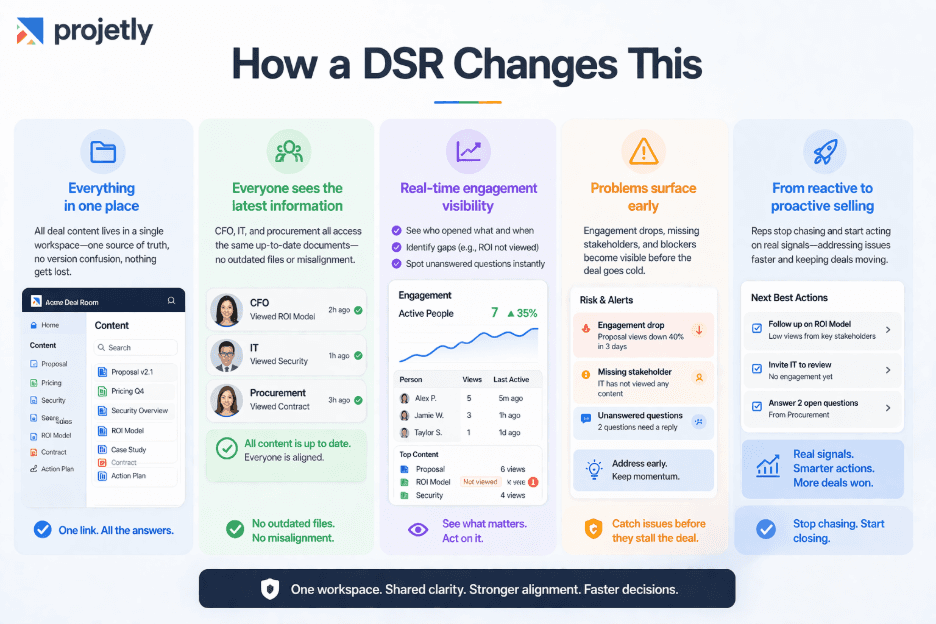
Everything lives in one shared space: Instead of scattered emails and attachments, all deal-related content is centralized in a single, organized workspace. Every stakeholder works from the same source of truth, eliminating version confusion and ensuring nothing gets lost or overlooked.
Every stakeholder sees the same, up-to-date information: Whether it’s the CFO reviewing ROI, IT checking security details, or procurement evaluating pricing, everyone accesses the latest documents in one place, no outdated files or miscommunication.
Real-time visibility into engagement: Sales teams gain instant insight into buyer behavior and activity inside the room. See exactly who opened what and when . Identify gaps, like key stakeholders skipping critical sections (e.g., ROI not viewed) . Spot unanswered questions or concerns as they arise
Problems surface early, not too late: Instead of relying on vague updates or assumptions, reps can act on real signals. If engagement drops, key stakeholders aren’t involved, or questions remain unresolved; these issues become visible early, before the deal loses momentum or goes cold.
From reactive follow-ups to proactive deal management: With clear engagement data, reps no longer chase deals blindly. They can step in at the right moment, address blockers quickly, and keep the deal moving forward with confidence.
Book a Demo → Experience a Smarter Way to Manage Deals
AI-Powered DSRs: What's Changed in 2026
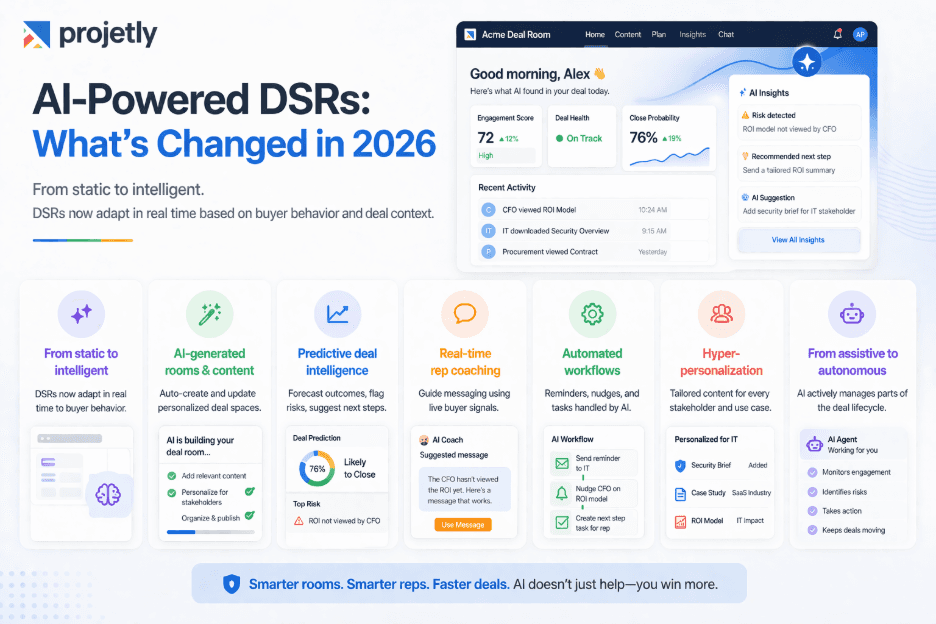
From static rooms to intelligent deal hubs: DSRs are no longer just content libraries; they’ve become AI-driven environments that adapt based on buyer behavior and deal context in real time.
AI-generated rooms and content: Sales reps no longer build rooms from scratch. AI can auto-create personalized sales rooms, suggest content, and update materials dynamically as the deal evolves.
Predictive deal intelligence: AI analyzes engagement patterns to predict deal outcomes, highlight risks, and surface next-best actions, turning DSRs into forecasting engines, not just collaboration tools.
Real-time coaching for reps: AI acts as a sales assistant, suggesting messaging, guiding follow-ups, and helping reps respond based on buyer intent signals and past winning patterns.
Automated follow-ups and workflows: Instead of manual chasing, AI triggers reminders, nudges stakeholders, and automates next steps to keep deals moving without constant rep intervention.
Hyper-personalized buyer experiences: Content, messaging, and even deal flows are tailored automatically to each stakeholder, industry, and use case, making every DSR feel custom-built.
Shift from assistance to autonomy: AI in sales is moving beyond support into partial automation, handling tasks like summarizing activity, recommending actions, and even managing parts of the deal lifecycle independently.
Contact Us → See How DSR Fits into Your Sales Process
The Buyer Experience Argument: Closing with Confidence
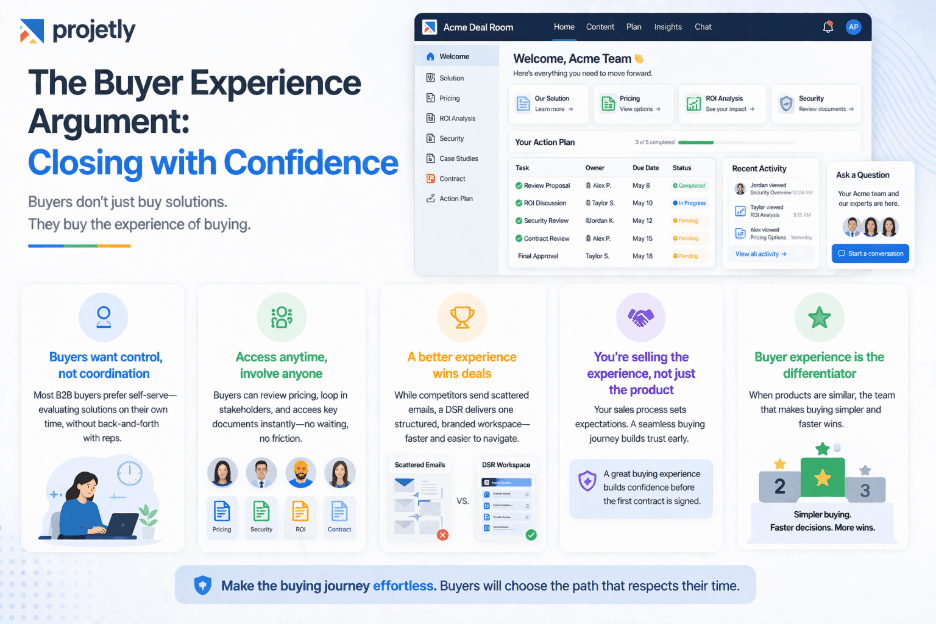
Buyers want control, not coordination: Most B2B buyers prefer self-serve experiences, evaluating solutions on their own time, without relying on back-and-forth with sales reps.
Access anytime involves anyone: Buyers can review pricing, share with stakeholders, and access key documents (like security or ROI) instantly, no waiting, no friction.
A better experience wins deals: While competitors send scattered emails, a DSR delivers a structured, branded workspace with everything in one place, making the buying process easier and faster.
You’re selling the experience, not just the product: The way you run the sales process signals what it’s like to work with you post-sale. A seamless buying experience builds trust early.
Buyer experience is the real differentiator: When products are similar, and switching is easy, the company that makes buying simpler, clearer, and faster has the edge.
Choosing the Right DSR Platform for Your SaaS Team
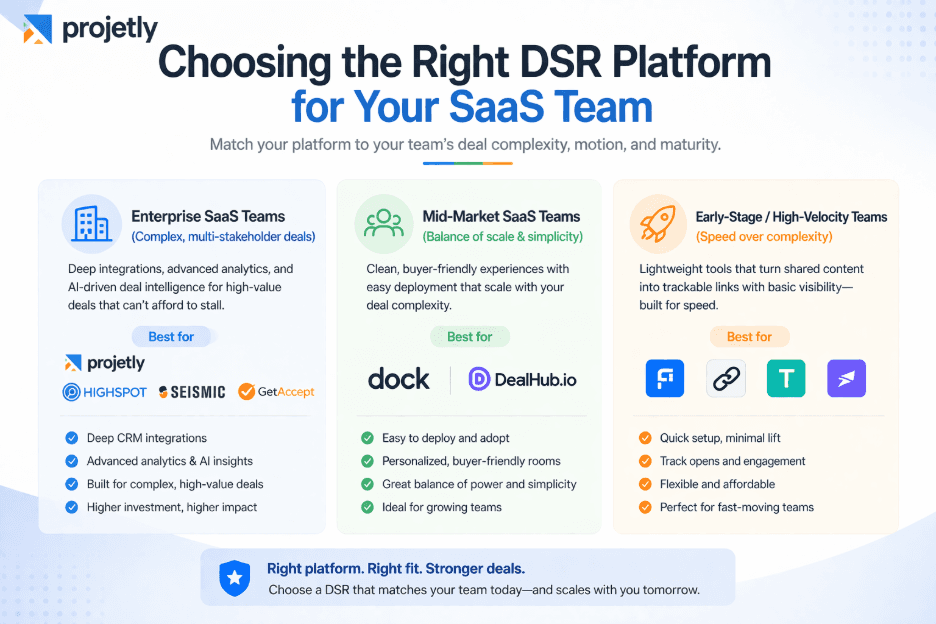
Enterprise SaaS teams (complex, multi-stakeholder deals): Platforms like Projetly, Highspot, Seismic, and GetAccept provide deep CRM integrations, advanced analytics, and AI-driven deal intelligence. They require higher investment but are essential for managing complex, high-value deals that would otherwise stall.
Mid-market SaaS teams (balance of scale & simplicity): Tools like Dock and DealHub.io offer clean, buyer-friendly experiences with easy deployment. They balance personalization and usability, making it easier to manage multi-stakeholder deals without added complexity.
Early-stage / high-velocity teams (speed over complexity: Lightweight tools enable quick setup and turn shared content into trackable links with basic visibility. They are ideal for teams that prioritize speed and flexibility over advanced features.
Non-Negotiable Features
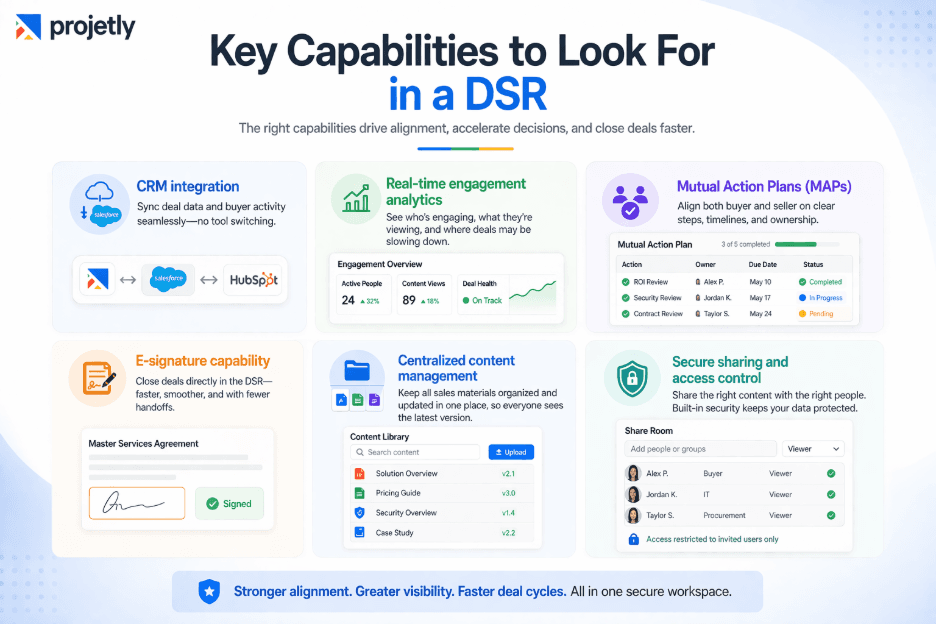
CRM integration: Ensures all deal data and buyer activity sync seamlessly with your existing workflow. This keeps sales teams aligned without switching between tools.
Real-time engagement analytics: Provides visibility into who is engaging, what they are viewing, and where deals may be slowing down. This helps teams act on real signals instead of assumptions.
Mutual Action Plans (MAPs): Align both buyer and seller on clear steps, timelines, and ownership. This improves accountability and keeps deals moving forward.
E-signature capability: Allows contracts to be signed directly within the DSR, reducing friction in the closing stage. Fewer handoffs lead to faster and smoother deal completion.
Centralized content management: Keeps all sales materials organized and updated in one place, ensuring every stakeholder accesses the latest version. This eliminates confusion caused by outdated or scattered documents.
Secure sharing and access control: Ensures sensitive documents are shared securely with the right stakeholders only. This builds trust with buyers while maintaining compliance and data protection standards.
Book a Demo → If You Can’t See Engagement, You Can’t Close Deals
Implementation: What “Good” Actually Looks Like
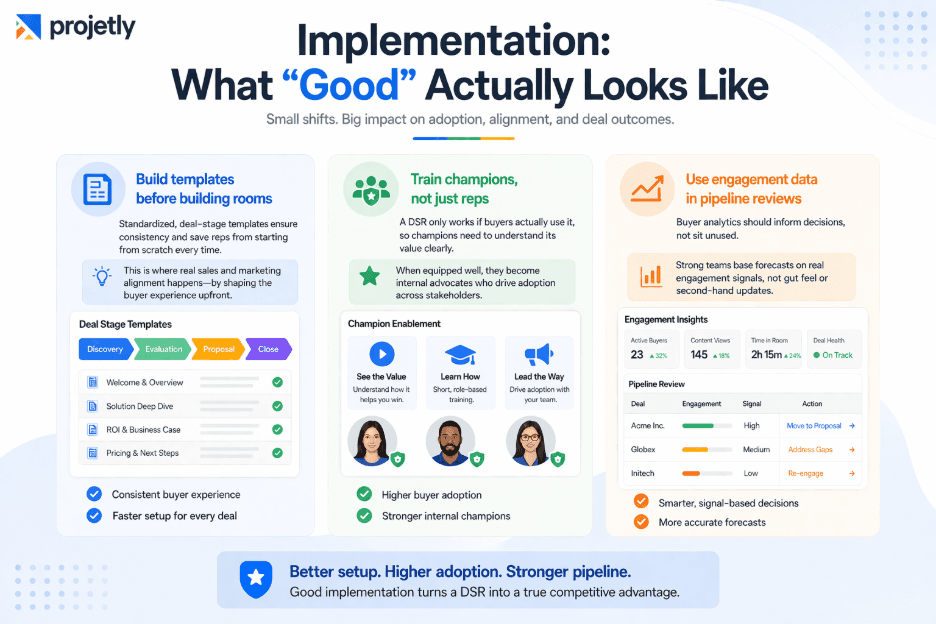
Build templates before building rooms: Standardized, deal-stage templates ensure consistency and save reps from starting from scratch every time. This is where real sales and marketing alignment happens, by shaping the buyer experience upfront.
Train champions, not just reps: A DSR only works if buyers actually use it, so champions need to understand its value clearly. When equipped well, they become internal advocates who drive adoption across stakeholders.
Use engagement data in pipeline reviews: Buyer analytics should inform decisions, not sit unused. Strong teams base forecasts on real engagement signals, not gut feel or second-hand updates.
See How DSR Fits into Your Sales Process, Book a free trial Today
The Bottom Line
Digital Sales Rooms are no longer an emerging technology. In 2026, they're the infrastructure layer on which modern B2B SaaS revenue teams are built.
The deals are more complex, the buyers are more independent, the committees are larger, and the tolerance for friction is lower than it has ever been. Email chains and static decks weren't built for this environment, they were built for a selling motion that no longer reflects how buyers buy.
Every SaaS company operating without a Digital Sales Room in 2026 is managing their most important business process, winning new customers, with tools designed for a different era. The question isn't whether to adopt one. It's how much revenue you're willing to lose before you do.
Looking to implement a Digital Sales Room for your SaaS team?
The best starting point is auditing your current deal cycle: where do deals go dark, which documents get forwarded incorrectly most often, and at what stage do multi-stakeholder deals most commonly stall. The answers will tell you exactly where a DSR will have the highest impact.
Frequently Asked Questions
1. What is a Digital Sales Room (DSR)?
A Digital Sales Room is a private, shared online space for each deal where all sales materials, conversations, and contracts live in one link. Buyers can review, collaborate, and sign, while sellers track engagement in real time.
2. How is it different from a Google Drive folder?
A Drive folder stores files.
A DSR drives deals.
It provides buyer analytics, engagement tracking, mutual action plans, and e-signatures, so teams know exactly what’s happening in a deal, not just what was shared.
3. Is it only for enterprise teams?
No.
Early-stage: Adds structure
Mid-market: Manages multiple stakeholders
Enterprise: Enables deep deal intelligence
There are DSR tools for every stage.
4. What should go inside a DSR?
Only what helps the buyer decide:
Personalized intro
Solution summary
Case studies
Pricing
ROI/business case
Security docs
Mutual action plan
Contract with e-sign
Keep it focused, no clutter.
5. How does it improve forecast accuracy?
DSRs replace guesswork with real buyer signals, who viewed what, when, and for how long. This makes pipeline reviews based on actual engagement, not rep assumptions.
6. DSR vs Sales Enablement: What’s the difference?
Sales enablement: Internal (helps reps)
DSR: External (buyer experience)
Enablement supports selling.
DSRs influence buying.
7. How long does it take to implement?
Basic setup: 1–2 weeks
Full rollout (templates + process): 4–6 weeks
Strong templates = better adoption and consistency.
You may also like

A Guide to Project Management Professional Certification

Laugh Your Way to Productivity: 50 Workplace Quotes

50 Funny Workplace Memes That’ll Brighten Your Workday.
What Does a Customer-First Mindset Mean? Explained in 2025

What It Takes to be a Great Customer Success Manager in 2025