NEW CLIENT ONBOARDING

By
Anuj

Multilingual Customer Onboarding: How Global Teams Deliver a Consistent Experience at Scale
Global expansion is no longer a future ambition for B2B SaaS and professional services companies; it is the default operating model.
Customers are now onboard simultaneously across North America, Europe, APAC, LATAM, and emerging markets, bringing different languages, time zones, and cultural expectations into every engagement.
Yet while products globalize with relative ease, onboarding rarely keeps pace.
Most organizations still rely on English-first onboarding programs stitched together with spreadsheets, email threads, Slack messages, and generic project tools.
As B2B onboarding volume grows and global teams expand, execution begins to break down. Tasks slip without warning, ownership becomes unclear, clients lose visibility, and internal teams spend more time coordinating than delivering value.
This breakdown has a real business impact.
Industry research shows that 55% of customers will stop using a product they don’t understand during onboarding, and as many as 75% of new users abandon SaaS products within the first week if onboarding is difficult. When this friction intersects with language differences, the risk compounds quickly.
This is where effective multilingual customer service becomes a strategic differentiator.
Multilingual onboarding is not simply about translation or multilingual content. It is about designing a structured, predictable onboarding experience that works consistently across languages, regions, and customer expectations without increasing headcount or operational drag.
Organizations that fail to operationalize onboarding at scale feel the impact quickly. Fragmented processes drive delays, with onboarding timelines running 20–30% longer on average, especially as multiple regions and teams are involved.
This guide explores how modern organizations design and scale multilingual onboarding programs, why global onboarding efforts break down and how leading teams deliver consistent, high-trust onboarding regardless of language.
Related Blog: Augmented Reality (AR) in Client Onboarding Experience 2026
Why Multilingual Customer Onboarding is a Growth Imperative
Customers do not experience your company in silos. They experience one brand, one onboarding journey, and one promise of value.
A customer onboarding from Germany expects the same clarity and accountability as one onboarding from the US. A customer in Japan expects the same momentum and professionalism as one in the UK. When onboarding quality varies by region, customers notice early, and confidence erodes quickly.
This expectation gap is measurable. Studies consistently show that customers are significantly more likely to remain engaged when onboarding communication happens in their native language, particularly during the first 30–60 days when confidence is fragile, and value realization is still forming.
However, language alone does not create confidence. Structure does.
Multilingual onboarding often exposes deeper operational challenges, such as:
Inconsistent onboarding standards across regions
Fragmented ownership across functions
Manual status updates and follow-ups
Limited client-facing visibility
These issues directly impact time-to-value, retention, and expansion. Teams operating without standardized B2B onboarding systems frequently experience longer onboarding cycles, higher support dependency, and increased internal stress as volume grows.
When executed well, multilingual onboarding becomes a growth lever. It enables organizations to onboard global customers faster, foster early trust, and scale predictably without hiring linearly.
What Multilingual Customer Onboarding Really Means (and What It Doesn’t)
Multilingual customer onboarding goes well beyond translating kickoff decks or help articles. It ensures the entire onboarding journey from expectations to milestones to outcomes feels clear, actionable, and transparent to customers in their preferred language.
What Multilingual Onboarding Is
A standardized onboarding program delivered consistently across regions
Clear milestones, timelines, and task ownership that apply globally
Client-visible progress tracking that reduces uncertainty
Structured communication channels across time zones
Thoughtful localization that respects cultural nuances and expectations
What It Is Not
Translating documents after meetings
Creating separate onboarding processes per region
Relying on email threads for execution
Scaling by hiring more regional onboarding managers
Translation without structure simply localizes confusion. High-performing teams focus on consistency first, then adapt language and context thoughtfully.
A Global Onboarding Scenario: Where Inconsistency Creeps In
Consider a mid-market SaaS company onboarding three enterprise customers simultaneously:
One in North America
One in EMEA
One in APAC
Each customer has a similar scope and timeline. Each expects a guided user onboarding experience with clear next steps.
Internally, however, execution looks different:
North America follows a structured onboarding project plan
EMEA relies on shared documents and emails
APAC tracks progress in spreadsheets and meetings
Kickoff calls go well. Expectations are aligned.
But execution tells another story.
Tasks stall because dependencies aren’t visible. Customers ask for updates because they don’t know what’s next. CSMs rewrite status updates in different languages. Escalations surface late because no one has a real-time view of onboarding health.
By week three, leadership sees three very different onboarding experiences for the same product.
This isn’t primarily a linguistic issue. It’s a systems and visibility failure amplified by multilingual complexity.
Related Blog: 5 Best Client Onboarding Software for Consulting Firms
What are the key challenges in multilingual onboarding, and how can they be overcome?
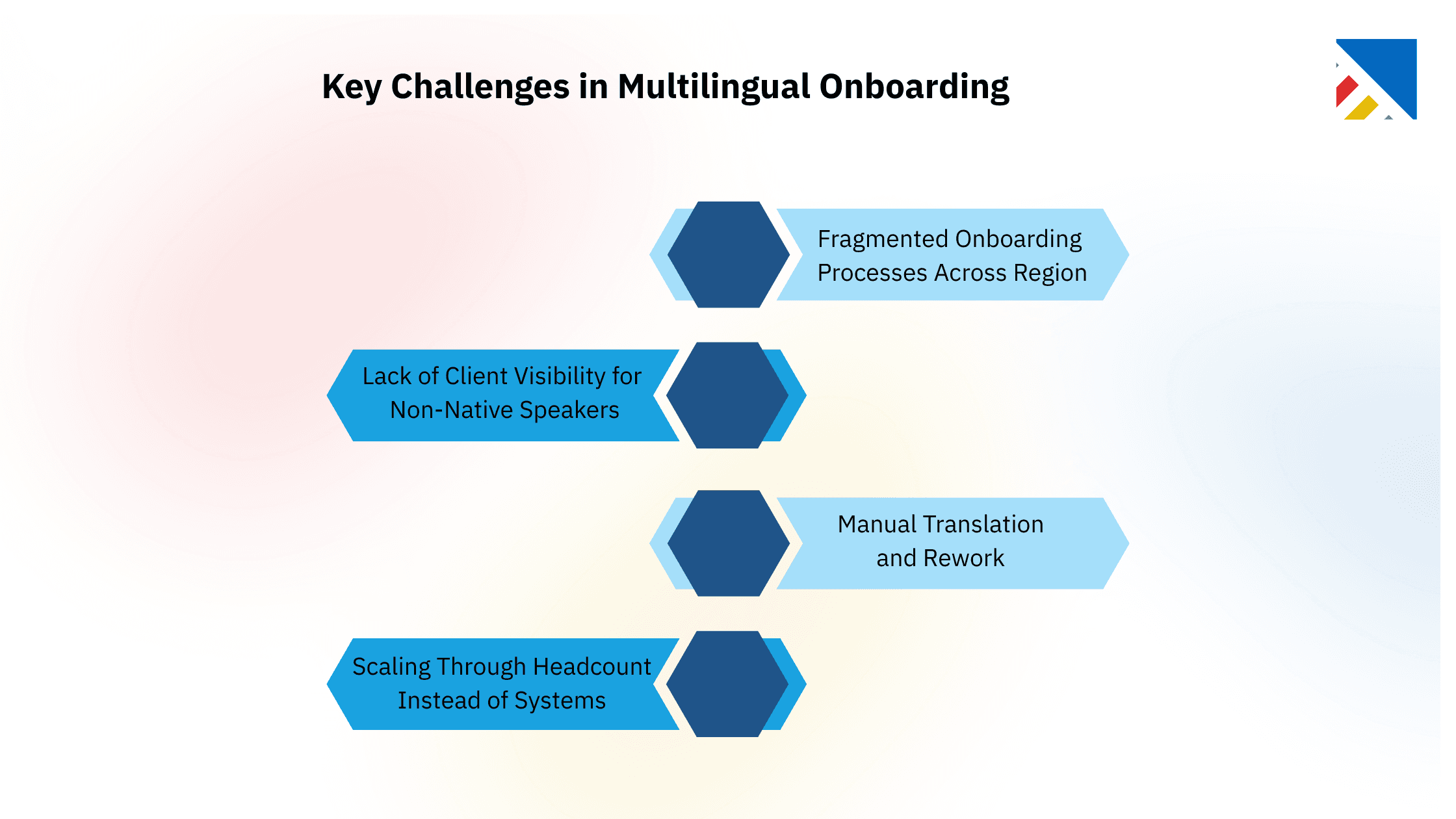
1. Fragmented Onboarding Processes Across Regions
As companies expand, onboarding evolves locally. Over time, these regional adaptations harden into silos.
The result:
No single onboarding standard
Best practices trapped in individuals
Inconsistent execution across global teams
Without a shared onboarding framework, consistency becomes impossible.
2. Lack of Client Visibility, Especially for Non-Native Speakers
When onboarding communication lives in email and chat:
Customers don’t know what’s expected
Dependencies remain hidden
Follow-ups multiply
For customers onboarding in a second language, this lack of visibility intensifies miscommunication and delays. Visibility builds trust. More messages do not.
This matters operationally. Teams report spending up to 35–40% of onboarding time on coordination and status reporting alone when visibility is not built into the onboarding system.
3. Manual Translation and Rework
Many teams rely on manual translation for meeting notes, task descriptions, and updates. This introduces delays and increases the risk of misunderstanding, especially in complex SaaS or regulated environments.
4. Scaling Through Headcount Instead of Systems
Without automation and structure, b2b onboarding scales linearly with people. As volume grows, coordination overhead increases, burnout rises, and quality becomes inconsistent.
The Business Impact of Multilingual Customer Onboarding Done Right
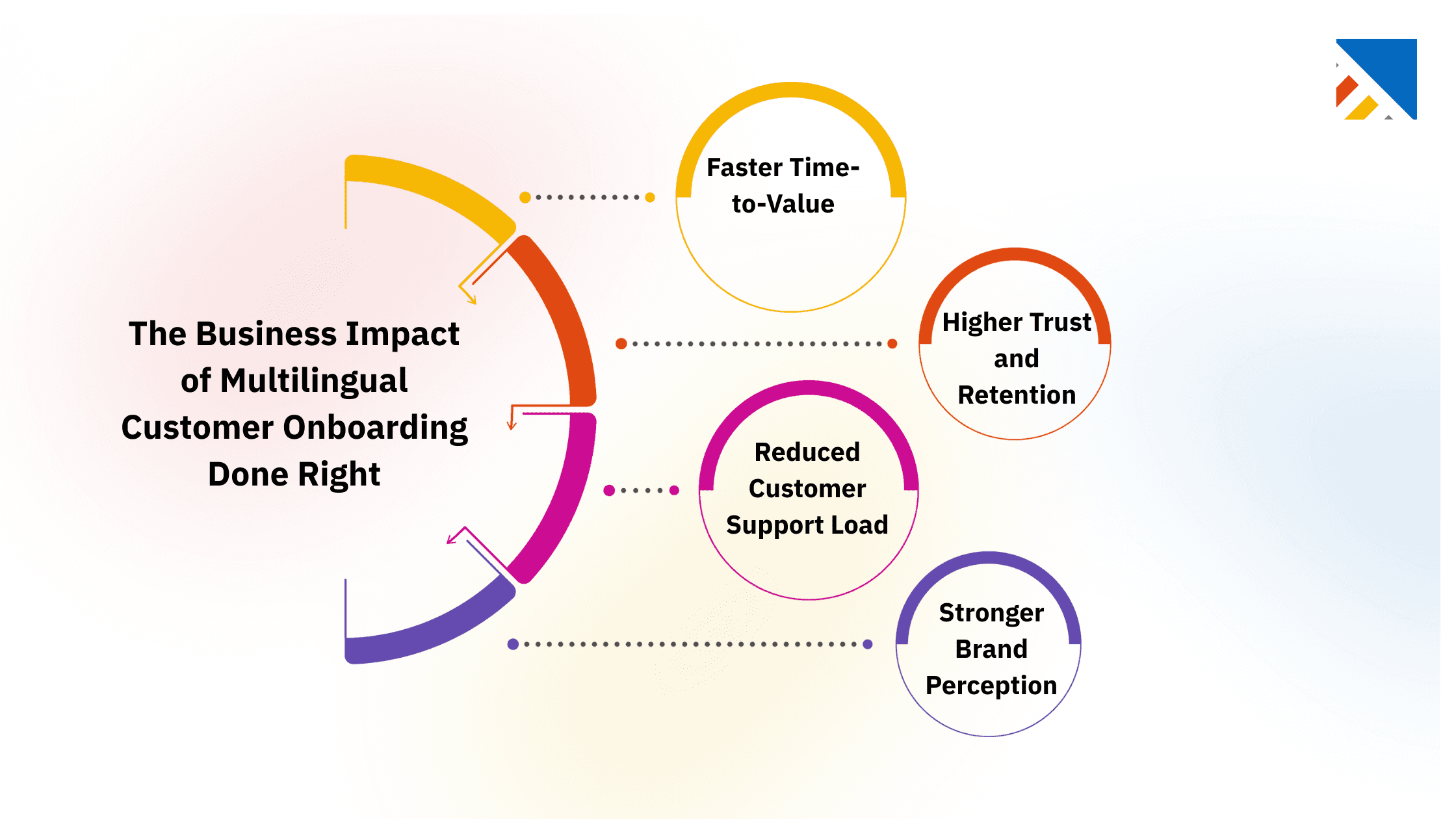
1. Faster Time-to-Value
Customers who clearly understand responsibilities, milestones, and outcomes, especially in their native language, reach value faster and engage more confidently.
2. Higher Trust and Retention
Clear, localized onboarding builds early confidence. That confidence compounds into stronger retention, expansion readiness, and advocacy.
3. Reduced Customer Support Load
Well-structured onboarding materials, walkthroughs, and a searchable knowledge base reduce unnecessary support requests. This allows the support team to focus on high-impact interactions instead of repetitive clarification.
Organizations that invest here see tangible results. Companies with structured, visible and smoother onboarding experiences consistently report double-digit improvements in onboarding CSAT, particularly across global and enterprise accounts.
4. Stronger Brand Perception
Multilingual onboarding signals professionalism, respect for different cultures, and a genuine commitment to diversity and inclusion, critical signals for enterprise buyers evaluating long-term partners.
Core Strategies for Implementing Multilingual Customer Onboarding
1. Standardize Before You Localize
Before translating anything, define a global onboarding blueprint. This includes milestones, dependencies, roles, escalation paths, and success criteria.
Without a shared framework, localization amplifies inconsistency.
2. Prioritize Languages Strategically
Analyze customer demographics, onboarding volume, and growth plans. Focus first on high-impact languages rather than attempting full global coverage immediately.
3. Localize Content, Don’t Just Translate
Effective localization adapts more than words. It considers tone, examples, formats, and cultural nuances. This applies to onboarding content, FAQs, training materials, customer portals, and client communications.
4. Use Technology to Scale
High-performing teams rely on:
AI-powered agent support and AI chatbots for first-layer multilingual assistance
Centralized onboarding platforms to manage execution
Digital adoption platforms for contextual guidance
Automation enables seamless onboarding while maintaining control and accountability.
5. Balance Automation With Human Expertise
Automation handles scale. Human expertise handles complexity, empathy, and high-stakes conversations, especially for enterprise or compliance-heavy onboarding.
What are the best practices for multilingual customer onboarding
They don’t localize chaos.
They standardize clarity.
One global onboarding framework
Reusable onboarding templates
Default client visibility
Automated coordination and updates
Early risk detection across regions
This approach consistently leads to faster onboarding completion and more predictable outcomes.
Designing a Scalable Multilingual Onboarding Model
A scalable multilingual onboarding model includes:
A defined global onboarding blueprint
Reusable onboarding templates
Built-in client access and transparency
Automated task creation and status updates
Continuous onboarding health monitoring
This model allows organizations to onboard global customers confidently without reinventing the process for every region.
How Modern Customer Onboarding Platforms Enable Multilingual Scale
Spreadsheets, email, and generic project tools break down at global scale. They lack ownership clarity, automation, and client-facing visibility.
Modern onboarding-first platforms are purpose-built to address these gaps.
Platforms like Projetly combine customer onboarding and implementation workflows with a PSA foundation. Instead of managing onboarding across disconnected tools, teams operate from one structured system that supports:
Client-centric portals with real-time visibility
AI-powered automation for meeting notes, task creation, and follow-ups
Standardized onboarding templates that scale across regions
Clear milestones, ownership, and accountability
Projetly is not a generic project management tool. It is designed specifically for customer onboarding and implementation teams that need predictability at scale, while still supporting multilingual support, regional adaptation, and human expertise.
Frequently Asked Questions
1. What is multilingual customer onboarding?
Multilingual customer onboarding is the practice of delivering a consistent, structured onboarding journey to customers in their preferred language. It ensures that onboarding steps, milestones, responsibilities, and progress visibility remain clear across regions without creating separate processes for each language or geography.
2. How is multilingual onboarding different from simple translation?
Translation focuses on converting text from one language to another. Multilingual onboarding goes further by aligning processes, timelines, ownership, and communication so customers can follow the onboarding journey confidently regardless of language. Without structure, translation alone often increases confusion rather than reducing it.
3. Why does multilingual onboarding often fail at scale?
Multilingual onboarding typically breaks down due to fragmented tools, inconsistent regional processes, manual coordination, and a lack of client visibility. Language differences amplify these issues, making delays, miscommunication, and missed dependencies harder to detect and resolve early.
4. Do companies need separate onboarding teams for each language or region?
No. High-performing organizations standardize onboarding workflows globally and then localize communication where needed. With the right structure, automation, and visibility, teams can support multiple languages and regions without scaling headcount linearly.
5. How does multilingual onboarding impact time-to-value?
Clear onboarding guidance in a customer’s native or preferred language reduces friction, shortens learning curves, and accelerates execution. When customers understand expectations and next steps clearly, they reach value faster and require fewer follow-ups from internal teams.
6. What role does automation play in multilingual onboarding?
Automation helps eliminate manual coordination, repetitive updates, and dependency tracking—areas where multilingual complexity often causes delays. Automated workflows, reminders, and status updates ensure consistency across regions while allowing teams to focus on high-impact customer interactions.
7. When should a company invest in a multilingual onboarding platform?
Organizations should consider a multilingual onboarding platform when onboarding volume increases, customers span multiple regions or languages, timelines start slipping, or teams spend excessive time chasing updates. These signals usually indicate that onboarding has outgrown spreadsheets, email, and generic project tools.
Related Blog: AI-Powered Customer Onboarding: How to Automate with AI
Final Thought: Multilingual Customer Onboarding Is a Leadership Decision
Multilingual onboarding is not a translation issue.
It is not a regional workaround.
And it is not solved with more meetings.
It is a leadership decision about how consistently your organization delivers clarity, confidence, and momentum across languages, regions, and cultures.
When B2B onboarding is structured, visible, and scalable, language becomes an adaptation, not a barrier.
If your onboarding team is managing global customers with fragmented tools and manual coordination, it may be time to rethink how onboarding is structured and delivered at scale.
Exploring an onboarding-first platform like Projetly can help teams standardize workflows, automate execution, and give global customers the visibility they expect without increasing headcount.
You may also like

A Guide to Project Management Professional Certification

Laugh Your Way to Productivity: 50 Workplace Quotes

50 Funny Workplace Memes That’ll Brighten Your Workday.
What Does a Customer-First Mindset Mean? Explained in 2025

What It Takes to be a Great Customer Success Manager in 2025