Digital Sales Room

By
Avaran

7 Best GetAccept Alternatives for Digital Sales Room Software
GetAccept is a solid pick for teams that want proposals, e-signatures, video messaging, and CRM sync bundled into one platform. But that breadth is also where the friction starts. Teams that only need document automation end up paying for a video and deal room layer they rarely open, and the platform stops short of anything resembling customer onboarding once a deal closes.
The strongest alternative is Projetly, an AI-native digital sales room built for enterprise B2B deals. It preserves deal context by carrying the same workspace straight from proposal through onboarding, instead of stopping at signature.
Other options worth evaluating include DealHub for enterprise CPQ and guided selling, PandaDoc for fast document automation at scale, Trumpet for stakeholder tracking and mutual action plans, Dock for a clean client-facing workspace, Qwilr for interactive web-based proposals, and Proposify for agency-style proposal design.
Below, we compare AI capabilities, CRM sync, pricing, G2 reviews, and onboarding continuity.
For a broader look at the category, see our roundup of the 17 Best Digital Sales Room Software in 2026.
Why Teams Look for a GetAccept Alternative

GetAccept genuinely earns its reputation for keeping prospects engaged after a proposal goes out, combining video messaging, live chat, and e-signature in a single flow. It is well regarded for enhancing sales productivity and moving deals from proposal to signature faster.
A few gaps still send buyers looking elsewhere.
Pricing starts at $25 per user per month for the entry eSign plan, but the Professional plan carries a five-user minimum, and full CRM integration plus advanced stakeholder engagement only unlocks at $49 per user per month or higher.
The platform bundles video messaging, live chat, and deal room engagement tracking together, which is overhead for teams that only need document generation and e-signature.
There is no dedicated path from a signed deal to customer onboarding, so once the contract is executed, the relationship must be rebuilt in a separate tool.
If your evaluation includes native CPQ, a lighter document only workflow, or a same-platform handoff from closed deal to onboarding, it is worth comparing GetAccept against the platforms below.
We compare the two most shortlisted options: GetAccept vs. Projetly: Which Digital Sales Room Fits Your Sales Team?
Comparison Table: GetAccept vs Top Alternatives
Platform | AI | CRM Sync | G2 Rating | Onboarding | Best For |
GetAccept | Content and meeting AI | Multi-CRM | 4.6/5 | No | Proposal and e-signature bundles |
Projetly | Meeting AI, onboarding AI | Salesforce and HubSpot | 4.8/5 | Same-platform handoff (manual) | Enterprise B2B sales |
DealHub | Guided selling AI | CRM integrations | 4.7/5 | No | Enterprise CPQ and quote-to-revenue |
PandaDoc | Document AI | Broad CRM integrations | 4.7/5 | No | Fast document automation at scale |
Trumpet | Deal health, summaries | Salesforce and HubSpot | 4.7/5 | No | Stakeholder tracking and branding |
Dock | Content AI | CRM integrations | 4.6/5 | Client portal | Client-facing workspaces |
Qwilr | Content AI | CRM integrations | 4.6/5 | No | Interactive web-based proposals |
Proposify | Content AI | CRM integrations | 4.6/5 | No | Agency style proposal design |
Detailed Breakdown of Each GetAccept Alternative
1. Projetly
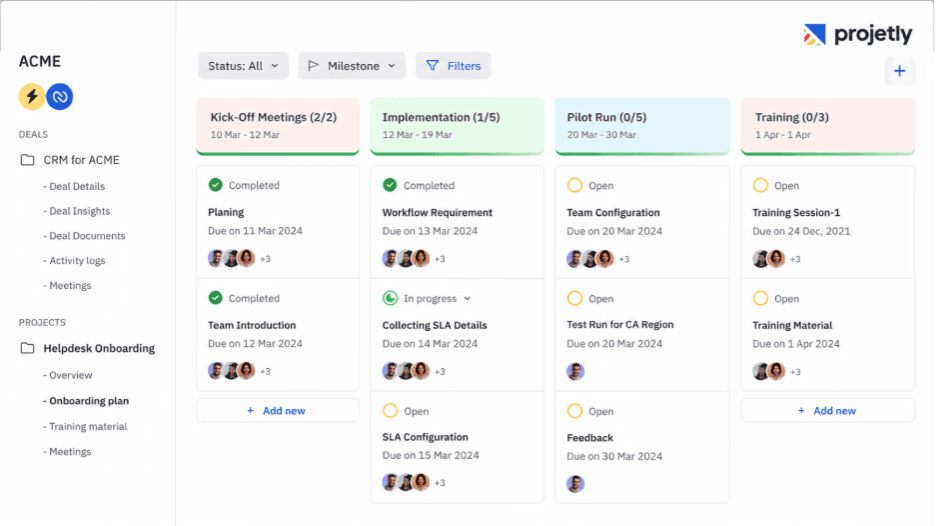
Projetly is an AI-native digital sales room built for complex enterprise B2B sales. It preserves deal context by carrying the same workspace straight from proposal through onboarding, instead of stopping at signature.
Key features:
AI-powered digital sales rooms with branded, centralized workspaces for the full sales cycle
AI meeting intelligence that transcribes calls, summarizes them, and extracts action items automatically.
Stakeholder engagement analytics showing document views, time spent, and activity by individual
Mutual action plans with shared tasks, stakeholder mapping, and milestone tracking
Native proposals and e-signatures inside the same room
Same-platform sales-to-onboarding handoff that converts won deals into onboarding projects without manual rebuilding
AI agents that track onboarding task progress and surface engagement signals to support delivery after the sale.
Limitations:
Newer to market than established competitors like GetAccept or PandaDoc.
Built for complex, multi-stakeholder enterprise sales rather than simple transactional deals.
Less suited to teams that close in a single call with one buyer.
Pricing: Custom, available on request from sales.
G2 Rating: 4.8/5.
Best for: Enterprise B2B SaaS, fintech, and IT services teams running multi-stakeholder deals where same-platform handoff into onboarding matters as much as the sale itself.
Learn more about how the workspace itself works on the Projetly Digital Sales Room page and see how the handoff is built on the customer onboarding platform page.
2. DealHub
DealHub positions itself as an agentic quote-to-revenue platform, combining guided selling, CPQ, contract management, and subscription billing in a single system. It is well regarded for its all-in-one approach, helping sales teams simplify quoting, approvals, and revenue workflows, particularly in mid-market organizations.
Key features:
Guided selling flows built around configuration rules and pricing logic
CPQ with version control and quote document generation
Deep CRM integration that keeps quoting and billing data in sync
Approval workflows for discounting and commercial terms
Limitations:
Reviewers note the platform can be complex to set up initially and requires meaningful configuration
Built more around quoting and revenue operations than buyer-facing engagement
Onboarding after close is not a native workflow
Pricing: Custom, quoted after a demo call.
G2 Rating: 4.7/5
Best for: Enterprise teams focused on complex, multi-product quoting rather than buyer engagement or deal room branding.
3. PandaDoc
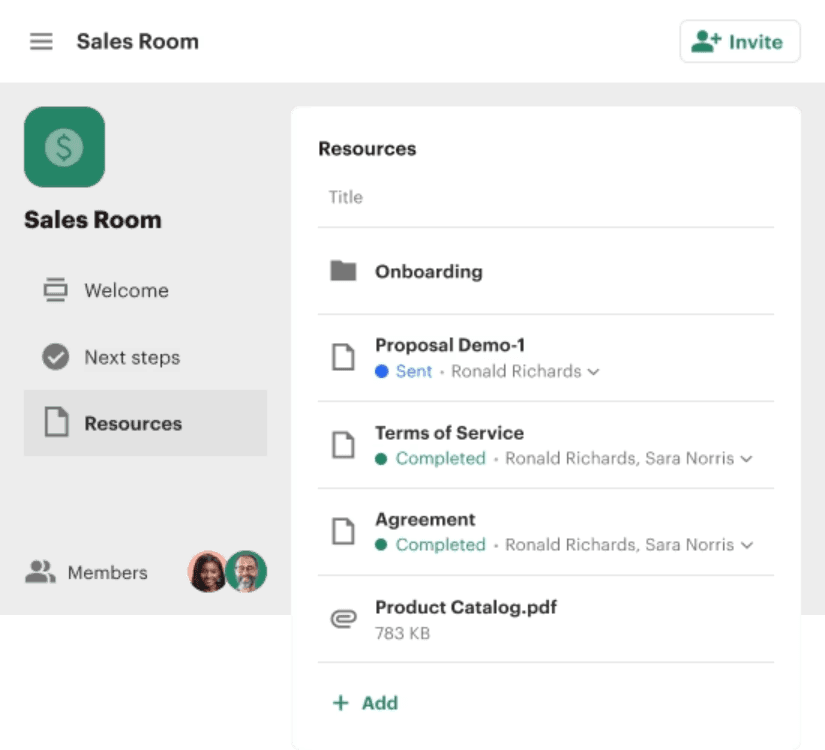
PandaDoc is the most direct document automation alternative to GetAccept, built around a deep template library and a fast drag-and-drop editor. It is designed to help sales teams create, send, track, and e-sign proposals, quotes, and contracts from a single platform.
Key features:
Large template library with a fast drag-and-drop document editor.
E-signature workflows built into every plan, including the free tier.
Broad CRM and payment integrations.
Contract management with approval workflows and audit tracking
Limitations:
Custom branding, CRM integrations, and payment collection are gated to the $49 per user per month Business plan
Lighter on buyer engagement analytics and stakeholder mapping than deal room-focused tools
Doesn’t extend into post-sale onboarding or customer handoff
Pricing: PandaDoc offers four plans: Free eSign ($0), Starter ($19/user/month, billed annually), Business ($49/user/month, billed annually), and Enterprise (custom pricing). Higher tiers add CRM integrations, deal rooms, approval of workflows, CPQ, workflow automation, SSO, APIs, and enterprise-grade controls.
G2 Rating: 4.7/5
Best for: Teams that need polished proposals and reliable e-signature fast, with minimal setup time and a light learning curve.
4. Trumpet
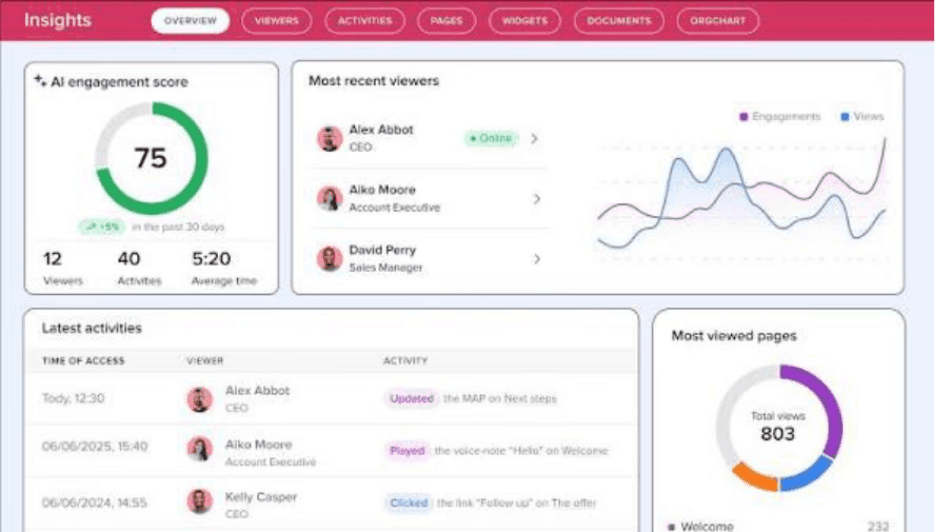
Trumpet is built around branded, stakeholder-level deal rooms called Pods, with strong engagement scoring and mutual action plans. It is widely recognized for its intuitive interface, fast setup, and buyer-friendly collaboration experience.
Key features:
Highly customizable deal room branding for each buyer.
Mutual action plans with shared tasks and stakeholder tracking.
Deal health scoring and AI-generated summaries.
Salesforce and HubSpot sync.
Limitations:
No native digital commerce integration
CPQ is only reachable through the API rather than built into the core product
No onboarding process once the deal is signed
Pricing: Trumpet offers four plans: Free (10 sales rooms, unlimited users), Pro ($45/user/month), Scale ($100/user/month), and Elite ($160/user/month). Annual billing is available, with higher tiers adding advanced collaboration, analytics, and enterprise capabilities.
G2 Rating: 4.7/5
Best for: Presentation-driven sales teams that want fast, branded room setup and detailed visibility into buying committee engagement.
5. Dock
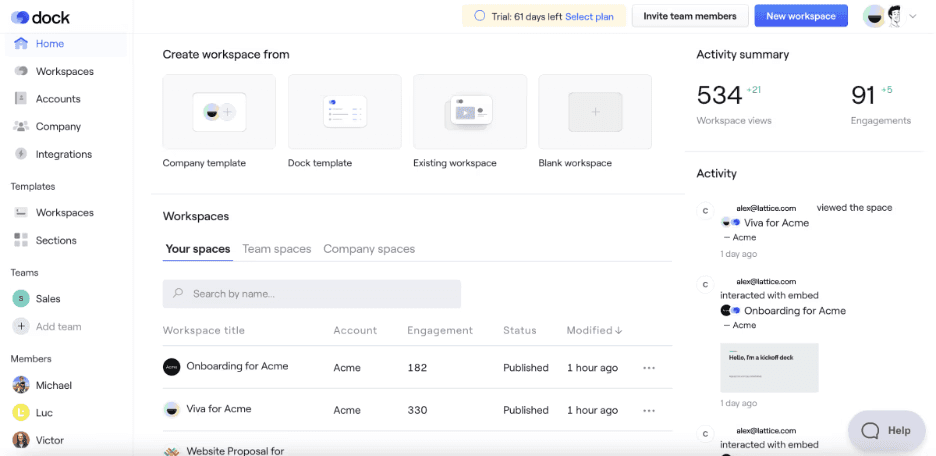
Dock focuses on a clean, client-facing workspace that carries deals from prospecting through onboarding in one shared space. It is known for its intuitive implementation process and streamlined content sharing for go-to-market teams.
Key features:
Shared client workspace spanning prospecting, deal execution, and onboarding
Mutual action plans editable by both buyers and sellers
Content sharing built around project-style organisation
CRM integrations for pipeline visibility
Limitations:
Ease of setup lags more established deal room platforms
Less depth in AI meeting intelligence than newer entrants
Onboarding continuity exists, but moving a won deal into onboarding still takes manual setup
Pricing: Dock uses flat platform fees, not per-seat pricing: Free ($0 forever), Standard ($350/month), and Premium ($1,000/month, billed annually). Enterprise is custom, via annual contract.
G2 Rating: 4.6/5
Best for: Teams that want a single, tidy client-facing workspace that persists past the signature without switching tools.
6. Qwilr
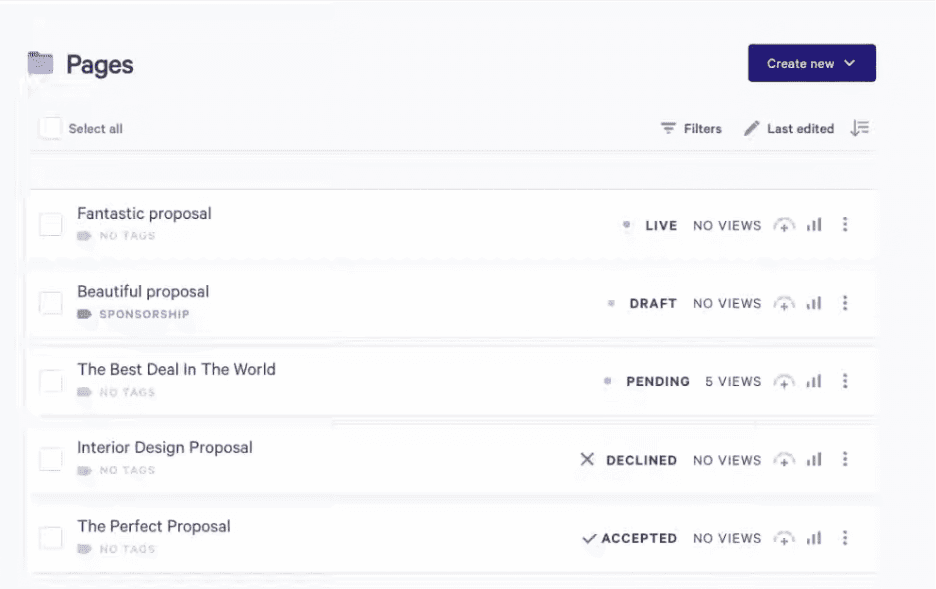
Qwilr builds interactive, web-based proposals with embedded pricing tables, videos, and images instead of static documents. It is designed to create engaging, branded buyer experiences and is particularly popular with small and mid-sized businesses.
Key features:
Web-based proposals with drag-and-drop customisation
Flexible, embeddable pricing modules for tailored quotes
Video and image embed for more visual proposals
CRM integrations for deal syncing
Limitations:
Lighter on guided selling and configuration rules than CPQ-focused platforms.
No mutual action plans or dedicated stakeholder mapping.
Stops at the signature, with no built-in bridge to onboarding.
Pricing: Qwilr offers three plans: Business ($35/user/month), Growth ($55/month, includes 5 users, billed annually), and Scale ($75/user/month). Higher tiers add advanced collaboration, workflows, integrations, and enterprise-ready features
G2 Rating: 4.6/5
Best for: Small and mid-sized teams that want visually engaging, easy-to-build proposals without a heavy CPQ layer.
7. Proposify
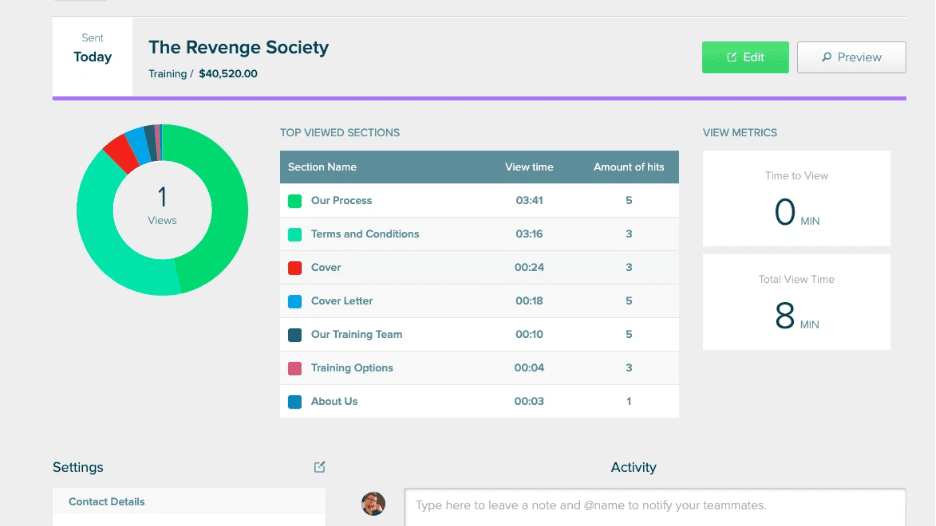
Proposify is a template-driven proposal platform built for agencies and professional services teams that send a high volume of similar proposals. It focuses on streamlining proposal creation, approvals, and e-signatures with reusable templates and collaborative workflows.
Key features:
Deep proposal template library geared toward services and agency work.
Approval workflows before proposals go out.
E-signature built into the proposal flow.
CRM integrations for deal tracking, including Salesforce as a paid add-on.
Limitations:
No native CPQ or guided selling.
No mutual action plans or deal room-style stakeholder analytics.
No native workflow for what happens after the deal is won.
Pricing: From $19/user/month for limited sends, Business tier around $41 to $49/user/month.
G2 Rating: 4.6/5
Best for: Agencies and services businesses that send frequent, similar proposals and want a fast, template-based workflow.
Compare more of the category?
Explore 17 Best Digital Sales Room Software in 2026
Onboarding Continuity: Where Most GetAccept Alternatives Fall Short
Where GetAccept and most of its alternatives fall short:
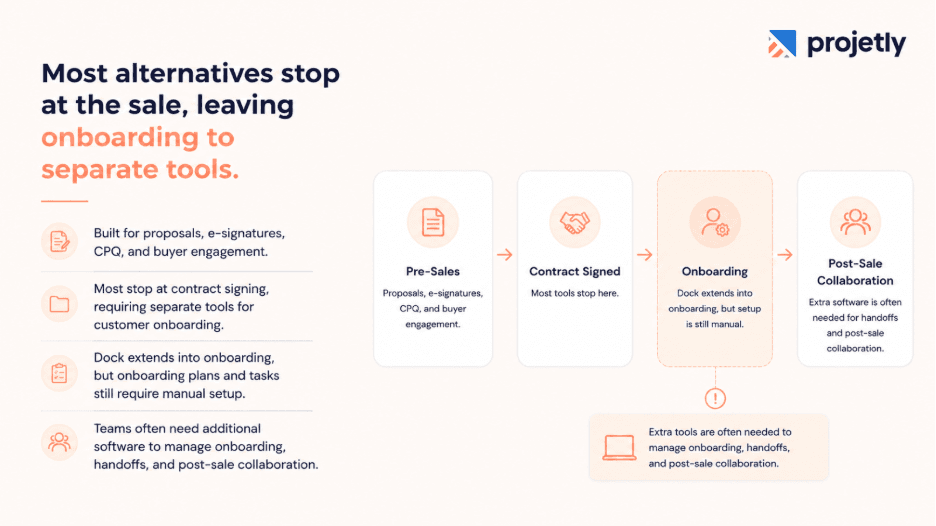
GetAccept, DealHub, PandaDoc, Trumpet, Qwilr, and Proposify are all built for the pre-sale motion, whether that means proposal creation, e-signature, CPQ, or buyer engagement tracking inside a deal room.
That focus is a real strength, but it means the tool’s job is largely done once the contract is signed.
Dock comes closest among the alternatives above, carrying a shared workspace from prospecting through onboarding, though the handoff still depends on manual setup.
A shared workspace or client portal preserves what is already there, but someone still must build the onboarding plan, assign tasks, and bring the new team up to speed by hand.
Where Projetly goes beyond:
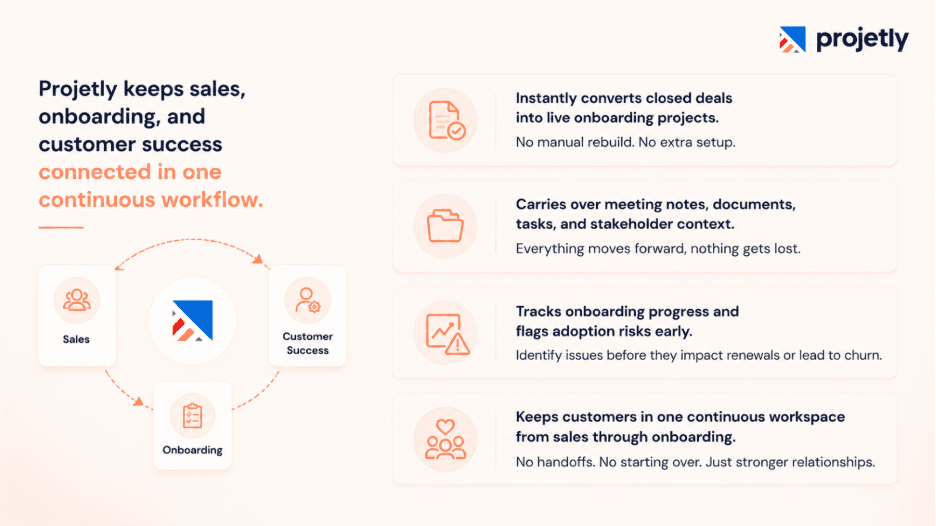
A team member converts the won deal into a live onboarding project, with no manual rebuild required.
Carries over meeting notes, documents, tasks, and stakeholder context from the original room.
Tracks onboarding task completion and surfaces engagement signals before it turns into churn.
Keeps the buyer in one continuous relationship instead of starting over with a new team and a blank workspace.
Frequently Asked Questions
How much does GetAccept cost compared to its alternatives?
GetAccept starts at $25/user/month for e-signature only and climbs to $79/user/month at its top tier, with a five-user minimum above entry. Dock's flat team pricing works out to roughly $70–100/user/month once divided by seat count. Trumpet runs higher, up to $99–160/user/month at its top tier. PandaDoc and Proposify offer lower entry points ($19/user/month), while Qwilr's $35/user/month entry is pricier than GetAccept's.
Which GetAccept alternative offers the best path from sales to onboarding?
Projetly is built specifically to carry a won deal into a live onboarding project: a team member creates the Project Room, and meeting notes, tasks, and stakeholder context are already there, no manual rebuild.
What is the closest alternative to GetAccept for document automation alone?
PandaDoc is the most direct swap for teams that mainly need templates, e-signature, and basic analytics without the video and deal room layer.
Is GetAccept good for enterprise sales teams?
GetAccept works well for teams that want proposals, e-signature, and light engagement tracking in one bundle. Enterprise teams running multi-stakeholder deals with a heavy CPQ need often look at DealHub, and those that want a same-platform bridge into onboarding tend to evaluate Projetly.
You may also like

A Guide to Project Management Professional Certification

Laugh Your Way to Productivity: 50 Workplace Quotes

50 Funny Workplace Memes That’ll Brighten Your Workday.
What Does a Customer-First Mindset Mean? Explained in 2025

What It Takes to be a Great Customer Success Manager in 2025