NEW CLIENT ONBOARDING
BEST PRACTICES

By
Anuj
The Complete Guide to B2B Customer Onboarding in 2026
Most B2B deals don’t fall apart in sales.
They stall after the contract is signed, during onboarding.
In this guide, you’ll learn what digital customer onboarding really means in 2026, why it directly impacts revenue and retention, and how leading companies turn it into a competitive advantage.
Digital customer onboarding is the process of verifying, activating, and integrating a new business client entirely through digital channels. It replaces paper forms and manual follow-ups with identity verification (IDV), automated documentation, e-signatures, compliance checks, and guided product activation workflows.
Done well, it cuts time-to-value from weeks to days, strengthens compliance, and significantly reduces early churn.
In 2026, B2B onboarding isn’t an operational task.
It’s your first real product experience, and a decisive growth lever.
Ready to make onboarding your edge?
Book a demo and see how to cut time-to-value and churn.
What is Digital Customer Onboarding in B2B?
Digital customer onboarding is the end-to-end process of bringing a new business client from a signed contract to a fully operational customer, without paper, without unnecessary delays, and without requiring them to show up in person.
It covers everything from initial identity and business verification, data collection, compliance checks, and document signing, all the way through to product setup, integrations, and the point where the customer first sees real value.
In a B2B context, this is considerably more complex than consumer onboarding. You're not verifying an individual you're verifying a legal entity with multiple directors, beneficial owners, regulatory obligations, and often cross-border requirements.
A midsize enterprise onboarding into a financial platform might require ultimate beneficial owner (UBO) disclosures, AML screening, credit checks, e-signed master service agreements, and API credential setup, all before they can log their first transaction.
Done well, this process is invisible to the client. Done poorly, it's the reason 40% of B2B relationships never get off the ground.
"Onboarding is the first product experience your customer has after they've said yes. It tells them everything about what working with you will actually feel like."
Why B2B Onboarding is a Make-or-Break Moment in 2026
The B2B buying cycle is long and expensive. Your sales team spends months building a relationship, the deal closes, and then onboarding drags on for six weeks while someone chases a director for an ID document.
By the time the client is active, enthusiasm has cooled, internal champions have moved on, and the competitor they shortlisted is already following up.
The data is unambiguous on this:
63% of B2B clients say onboarding speed influences long-term loyalty
40+ days is the average manual B2B financial onboarding time
3x more likely to expand clients who onboard successfully in under 2 weeks
$4M+ lost annually per institution from abandoned B2B onboarding
Beyond revenue, there's a regulatory imperative. In financial services, failing to conduct adequate KYC and KYB during onboarding carries real legal exposure. Regulators across the EU, UK, US, and APAC tightened AML and digital identity requirements significantly in 2025, and 2026 brings further enforcement focus on real-time beneficial ownership verification.
The companies that treat onboarding as a back-office function will keep bleeding good clients. The ones that treat it as a product worthy of design, iteration, and measurement are building durable competitive moats.
If your onboarding still relies on manual coordination and scattered tools, it’s time to upgrade. Start a free trial and see how structured, digital onboarding can accelerate time-to-value from day one.
The B2B Digital Onboarding Process: Step by Step
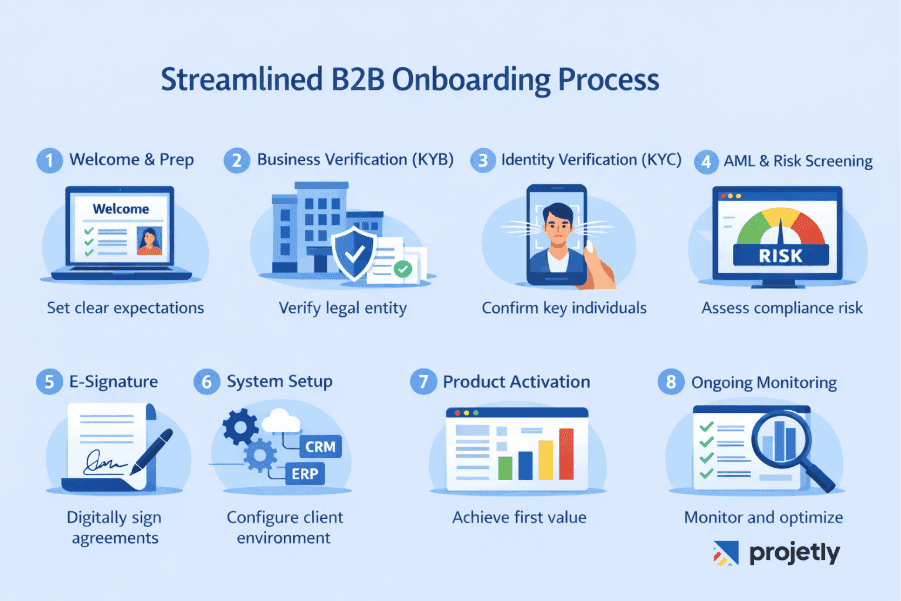
There's no universal onboarding playbook, but the highest-performing B2B companies across SaaS, financial services, and enterprise tech tend to follow a recognisable sequence.
Step 1: Pre-Onboarding Preparation & Welcome:
The moment a contract is signed, an automated welcome email triggers, complete with a dedicated onboarding portal, a named CSM contact, an expected timeline, and a checklist of what the client needs to prepare. The goal is to reduce anxiety and set clear expectations before the first form appears.
Step 2: Business Identity Verification (KYB)
The client's legal entity is verified against company registries, watchlists, and sanctions databases. This involves automated document processing of certificates of incorporation, articles of association, and proof of address, cross-checked in real time against authoritative sources.
Step 3: Individual Identity Verification (KYC)
Key persons like directors, authorised signatories, and beneficial owners complete digital identity checks via biometric facial matching and NFC-based document reading, completing in under three minutes on a smartphone. No branch visit required.
Step 4: AML Screening & Risk Assessment
PEP screening, adverse media checks, and sanctions list screening run simultaneously. A risk score routes low-risk clients to straight-through processing and flags higher-risk ones for enhanced due diligence, without holding up the entire queue.
Step 5: Digital Agreement & E-Signature:
Contracts, DPAs, SLAs, and regulatory disclosures are presented through an integrated e-signature flow. Legally binding across major jurisdictions, this replaces the old print-sign-scan cycle that used to add days to the process.
Step 6: Account & System Configuration:
User roles are assigned, integrations configured (ERP, CRM, SSO), and the client environment provisioned. In platform-led onboarding, much of this is self-serve, guided by contextual prompts and milestone checklists.
Step 7: Product Activation & First Value Milestone:
The single most important moment in onboarding is when the client completes their first meaningful action. Best-in-class onboarding is engineered to reach this milestone as fast as possible.
Step 8: Ongoing Monitoring & Relationship Activation:
Onboarding doesn't end at activation. Smart platforms continue monitoring compliance triggers while CSM teams execute structured check-ins to drive adoption and surface expansion opportunities.
Still relying on manual onboarding? Contact us today and see how to turn it into a growth engine.
The Biggest Challenges, and Why Most Companies Still Struggle
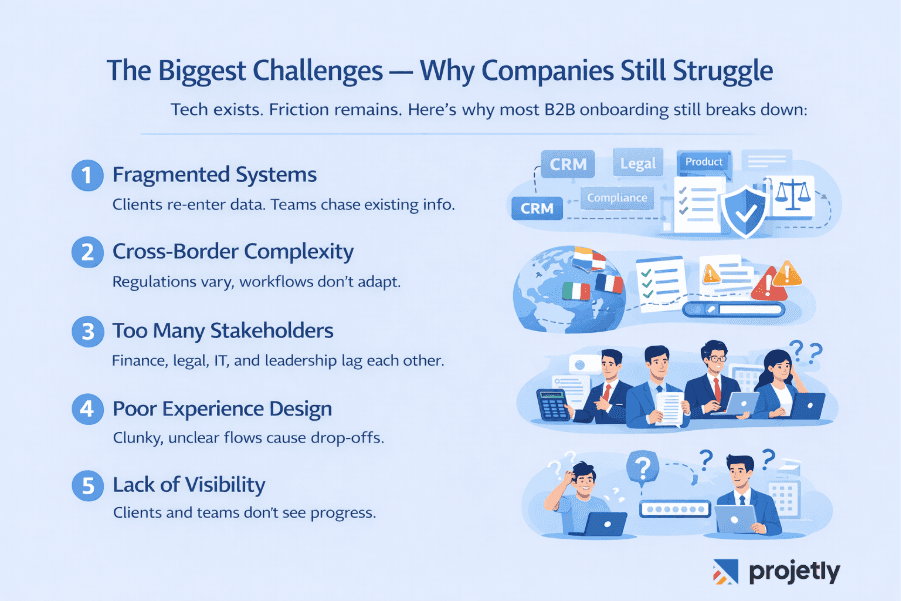
Despite the technology being available, the majority of B2B onboarding experiences remain frustrating. Here's why:
Fragmented Systems and Data Silos: Most mid-to-large enterprises run CRM, compliance, legal, and product systems that don't talk to each other. Client data entered at the sales stage doesn't automatically populate into the compliance platform. The result: clients re-enter the same information three or four times, and internal teams chase each other for data that already exists somewhere in the stack.
Regulatory Complexity Across Jurisdictions: A client headquartered in Germany, with subsidiaries in Singapore and a payments operation in Brazil, requires compliance with multiple, sometimes conflicting regulatory frameworks simultaneously. Onboarding workflows need to dynamically adapt to jurisdictional requirements, something most off-the-shelf tools weren't originally built to handle.
Multiple Stakeholders on the Client Side: B2B onboarding often requires input from the client's finance director, legal team, IT department, and C-suite, none of whom communicate at the same pace. Workflows that don't account for parallel-path stakeholder management will always bottleneck at the slowest participant.
Poor Onboarding Experience Design: Business buyers now expect the same quality of digital interaction they get from their personal banking apps. Clunky portals with no progress indicators and unclear instructions cause real abandonment, even from clients who were highly motivated to complete the process.
Lack of Visibility for Both Parties: Clients don't know where they are in the process. Internal teams don't know either. This visibility gap creates unnecessary back-and-forth, erodes trust, and turns a procedural inconvenience into an active relationship threat.
Manual Workflows Masquerading as "Digital" Many organisations call their process "digital" because they've replaced paper forms with PDF email attachments. True digital onboarding means automated verification, integrated workflows, real-time status updates, and zero manual handoffs for standard cases. Anything less is the digitization of a broken process, not transformation of it.
Download the Enterprise Onboarding Expansion Framework
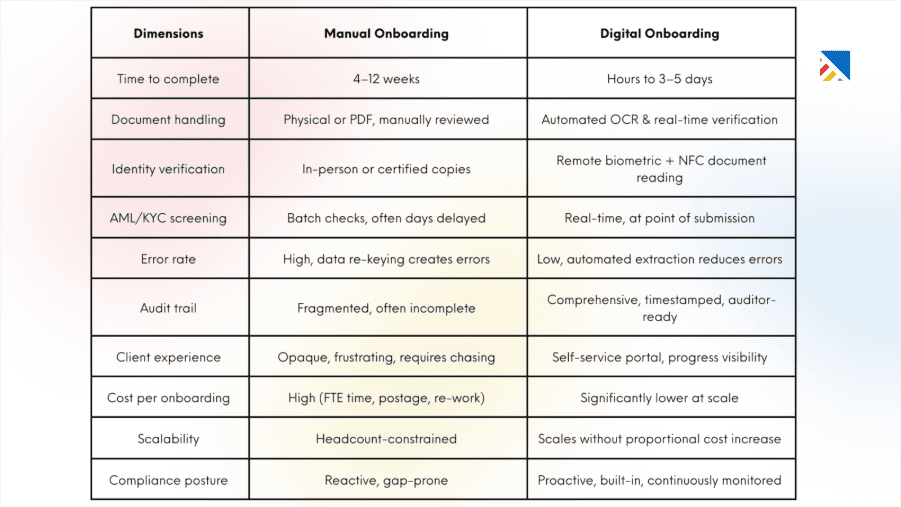
Manual vs. Digital Onboarding: A Direct Comparison
Best Practices for B2B Digital Onboarding in 2026
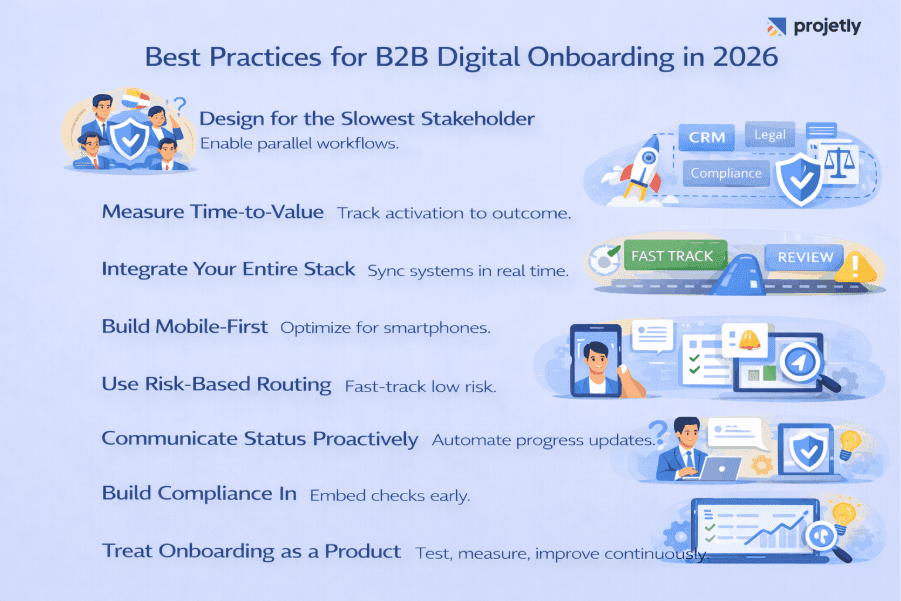
These aren't generic tips. These are the specific practices that separate onboarding processes that retain clients from those that quietly lose them.
Design for the Slowest Stakeholder: In B2B, the process moves at the pace of the busiest (or most disengaged) person required to complete a step. Redesign workflows to allow parallel completion; different stakeholders should be able to fill their sections simultaneously, not sequentially.
Measure Time-to-Value, Not Time-to-Complete: Completion of forms is not the goal. The goal is a client who has extracted real value from your product. Track the gap between activation and the first meaningful outcome. This is the metric that predicts retention.
Integrate Across Your Entire Stack: CRM, compliance platform, e-signature tool, and product backend should share data in real time. The client should never be asked for something your system already knows. Every duplicate data request is a trust withdrawal.
Build Mobile-First, Always Document: uploads, identity verification, and e-signatures now happen predominantly on mobile, even in enterprise contexts. If your onboarding portal isn't flawless on a smartphone, you're creating unnecessary friction for a high-value moment.
Use Risk-Based Routing: Not every client needs the same process. Route low-risk onboardings through a fast, automated track. Reserve enhanced due diligence for genuinely complex cases. This improves both client experience and compliance efficiency simultaneously.
Communicate Status Proactively: Automated status updates reduce inbound "where are we?" calls significantly. Clients who know what's happening stay engaged. Clients left in the dark assume the worst.
Build Compliance In, not on: Compliance requirements should be baked into the workflow architecture, not bolted on as a final review stage. When KYB, AML screening, and regulatory checks happen in real time throughout the process, they stop being blockers and start being invisible.
Treat Onboarding as a Product: Assign ownership, run A/B tests, track dropout rates by step, collect client feedback at the end of each stage, and iterate continuously. The best onboarding teams operate like growth product teams data-driven, user-obsessed, constantly shipping improvements.
Want to see these best practices in action? Book a demo and discover how modern B2B teams streamline onboarding in 2026.
AI & Automation in Modern B2B Onboarding
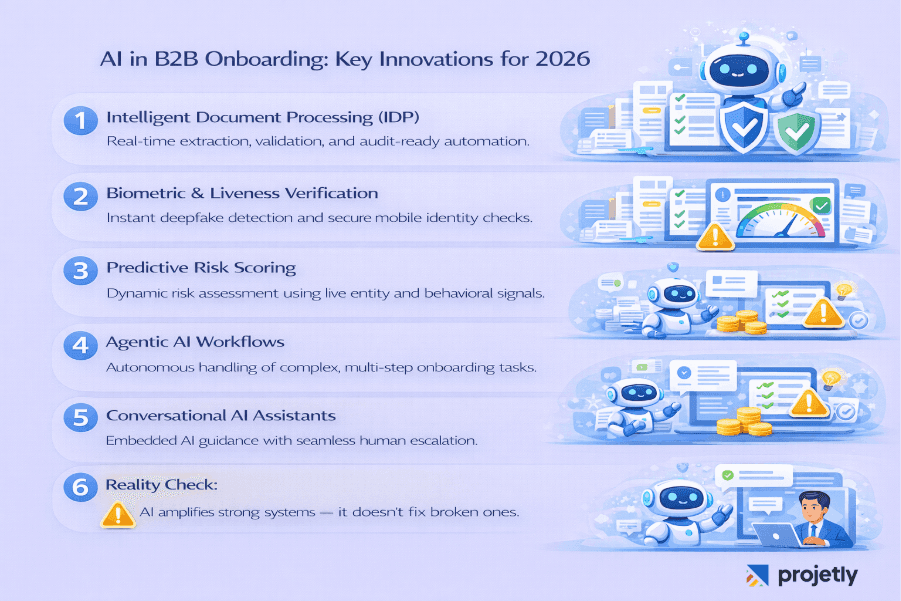
Artificial intelligence is no longer a differentiator in digital onboarding; it's fast becoming a baseline expectation. Here's where AI is making the most meaningful difference in 2026:
Intelligent Document Processing (IDP): Modern IDP extracts, validates, and cross-checks documents in real time, replacing manual PDF reviews with faster, more accurate, audit-ready automation.
Biometric & Liveness Verification: AI detects deepfakes, 3D masks, and spoofing attacks with 99%+ accuracy, completed in seconds via a smartphone selfie.
Predictive Risk Scoring: AI models assess risk dynamically using real-time signals like entity structure, jurisdiction, adverse media, and behavioral patterns.
Agentic AI Workflows: Autonomous AI handles multi-step onboarding tasks pulling third-party data, resolving discrepancies, and escalating complex cases with full context.
Conversational AI Assistants: Embedded AI guides clients through onboarding, answers questions instantly, and escalates to human support when needed.
Reality Checl: AI amplifies strong processes, it doesn’t fix broken ones. Design the workflow first, then layer AI for scale and speed.
A note on AI hype vs. reality: AI doesn't eliminate the need for thoughtful process design. Many organisations have discovered that implementing AI on top of a broken workflow just creates a faster broken workflow. The right sequence: fix the process first, then layer AI to amplify what's already working.
Modern B2B SaaS Onboarding: From Activation to Expansion
In B2B SaaS, onboarding complexity rarely comes from regulation, it comes from product depth, stakeholder alignment, and workflow change management. Enterprise SaaS buyers often include multiple personas (executive sponsor, admin, operators, IT, security), each requiring different setup steps and success milestones.
Historically, SaaS onboarding timelines stretched across the first 60–120 days of a contract, with value realization dependent on data migration, integrations, and internal adoption rather than simple account activation.
Leading SaaS companies are now optimizing for time-to-first value instead of time-to-go-live. Rather than waiting for full implementation, they guide customers toward early, measurable wins, a live dashboard, a completed workflow, or the first automated report.
Best-in-class SaaS onboarding programs now achieve:
Initial activation within the first 7–14 days
First measurable business outcome within 30–45 days
Expansion readiness signals within the first quarter
The key enabler is behavior-driven onboarding orchestration. Modern SaaS teams integrate product analytics, onboarding platforms, and customer success workflows so that usage signals automatically trigger guided steps, training interventions, or executive check-ins.
Instead of static implementation plans, onboarding is becoming adaptive and signal-driven, progressing faster for engaged customers while automatically escalating risk for accounts showing low adoption or stalled setup.
The result: faster activation, higher product adoption, and significantly lower early-stage churn, which, in subscription businesses, is where the majority of long-term revenue risk actually sits.
Ready to upgrade your onboarding? Contact us today.
Frequently Asked Questions
What is the difference between B2B and B2C digital onboarding?
B2C onboarding verifies one individual for a consumer product.
B2B onboarding verifies an entire legal entity, including directors, beneficial owners, and authorised signatories, while meeting AML and sanctions requirements and coordinating multiple stakeholders.
It’s more complex, higher value, and far more regulated.
How long should B2B digital onboarding take in 2026?
For low-to-medium risk clients with clean, complete documentation, best-in-class digital onboarding can be completed in 1–3 days. Standard digital processes should aim for under two weeks. Manual processes frequently take 4–12 weeks. Anything beyond two weeks for a standard client represents a meaningful competitive disadvantage.
What technologies are used in digital customer onboarding?
Core technologies include identity verification platforms (biometric matching, NFC document reading, liveness detection), OCR and intelligent document processing, e-signature platforms, AML and sanctions screening APIs, company registry integrations for KYB, case management systems, CRM integrations, and increasingly agentic AI systems for autonomous workflow orchestration.
What is KYB, and why does it matter in B2B onboarding?
KYB (Know Your Business) is the process of verifying that a business entity is legitimate, properly registered, and not subject to sanctions. It involves confirming company registration details, identifying ultimate beneficial owners (UBOs), and screening against global sanctions and watchlists. In regulated sectors, KYB is a legal requirement. Outside regulated sectors, it's critical for fraud prevention and reputational protection.
How do you measure the success of a B2B onboarding process?
Key metrics include time-to-first value (TTFV), onboarding completion rate, time-to-complete, dropout rate by stage, number of back-and-forth document requests, compliance deficiency rate at post-onboarding audit, and 90-day retention of newly onboarded clients. Time-to-first value is widely considered the single most predictive onboarding metric for long-term retention.
What is straight-through processing (STP) in onboarding?
Straight-through processing refers to an onboarding journey that completes with zero manual intervention; all verification, screening, and approval steps are handled automatically by integrated systems. Leading financial institutions are achieving STP rates of 60–70%+ for standard-risk clients, with higher-risk applications routed to enhanced due diligence workflows.
7. Is digital onboarding secure for B2B clients?
When implemented correctly, digital onboarding is significantly more secure than manual processes. Biometric liveness detection prevents impersonation. Real-time sanctions screening catches flags that manual checks miss. Automated document verification detects fraudulent documents with higher accuracy than human reviewers. And unlike paper-based processes, digital onboarding generates a comprehensive, timestamped audit trail of every check performed.
Customer Onboarding Software: What to Look for in 2026
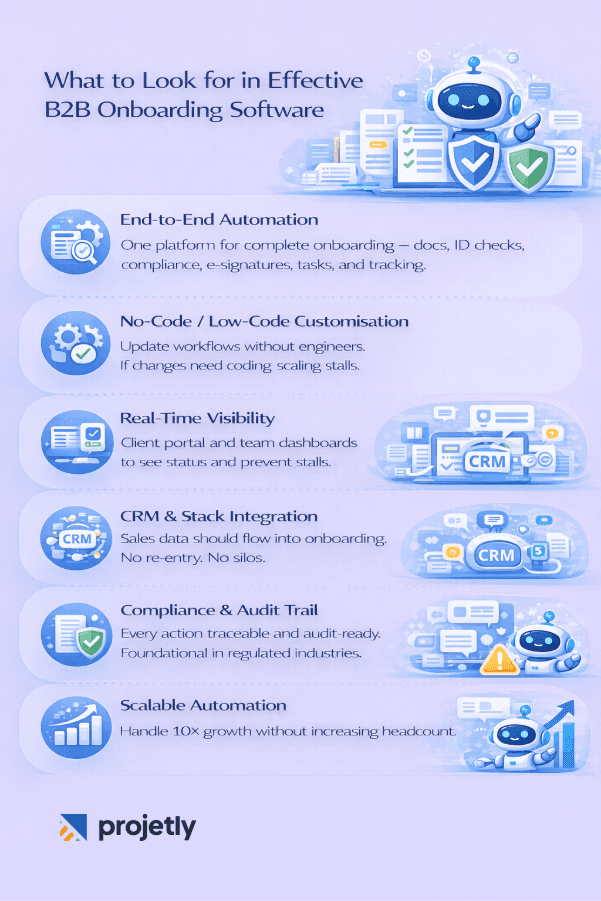
Choosing the right customer onboarding software is one of the highest-leverage decisions a B2B company can make. The wrong platform adds friction, manual work, and visibility gaps. The right one becomes the operational backbone of your entire client intake and activation journey.
Here’s what separates platforms that scale from those that stall:
End-to-End Workflow Automation: The platform should manage the full onboarding lifecycle, document collection, identity verification, compliance checks, e-signatures, task assignments, and progress tracking all in one connected system. Stitching together multiple point tools creates integration debt and operational blind spots.
No-Code / Low-Code Customisation: Every B2B onboarding process is different. Operations and Customer Success teams should be able to modify workflows, forms, and checklists without engineering support. If every change requires a sprint, your onboarding will lag behind your growth.
Real-Time Visibility for Both Sides: Clients should have a self-service portal to see what’s complete, what’s pending, and what’s next. Internally, teams need live dashboards and automated alerts to prevent stalled onboarding before it turns into churn risks.
CRM & Tech Stack Integration: Your onboarding system must sync with CRM, identity providers, e-signature tools, and product infrastructure. Sales data should flow automatically into onboarding, not be re-entered manually.
Compliance & Audit Trail: In regulated industries, every document, verification, and approval must be timestamped and traceable. Audit readiness isn’t optional in 2026; it’s foundational.
Scalability Without Headcount Growth: True onboarding software allows you to handle 5× or 10× volume with the same team. Growth should come from automation and system design, not from hiring more coordinators.
Projetly for B2B Customer Onboarding
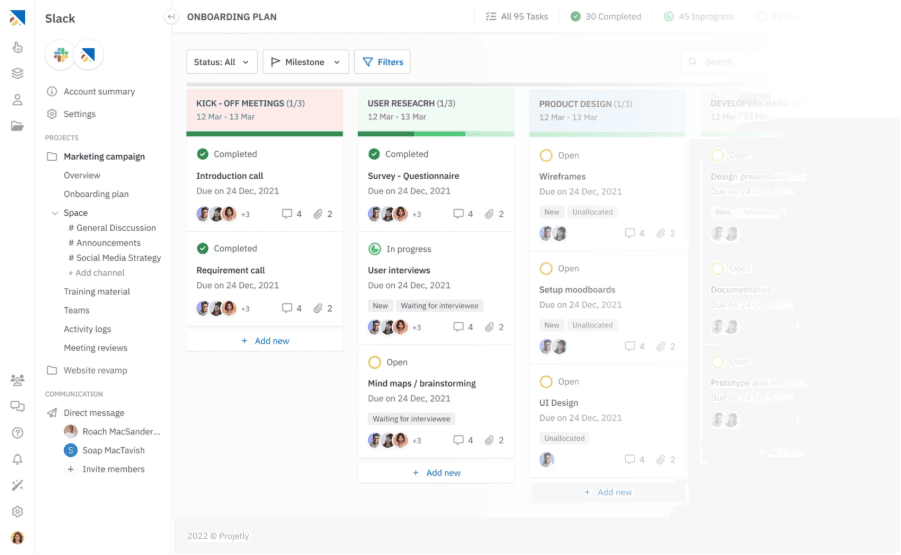
Projetly is a project and workflow management platform built for teams that run structured, repeatable processes at scale, making it a strong fit for B2B companies looking to bring order, visibility, and accountability to their customer onboarding operations.
Where Projetly Fits in the Onboarding Stack
Unlike dedicated compliance or identity verification platforms, Projetly operates at the workflow orchestration layerthe connective tissue between your sales handoff, your compliance checks, your technical setup, and your customer success activities. It's where onboarding tasks get assigned, tracked, escalated, and completed.
For B2B companies running complex, multi-stakeholder onboarding where multiple internal teams and multiple client contacts are moving in parallelProjetly provides the operational clarity that prevents things from falling through the cracks.
Key Capabilities of Projetly for Customer Onboarding
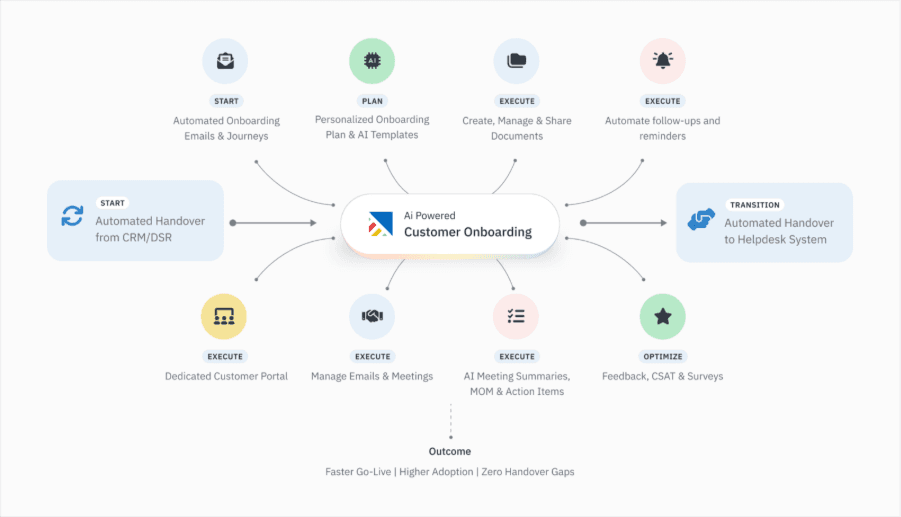
1. Repeatable Onboarding Templates: Build once, reuse endlessly, Projetly lets you create structured onboarding blueprints that automatically replicate for every new client, with predefined tasks, owners, deadlines, and dependencies.
2. Client-Facing Portal: Give customers self-serve visibility. Clients see what’s complete, what’s pending, and what’s next, reducing unnecessary status inquiries and improving transparency.
3. Cross-Project Dashboard: CSMs and ops teams get a single view of all active onboardings who’son track, who are stalled, and where escalation is needed, so nothing slips through the cracks.
4. Automated Task Assignments: Projetly automatically assigns tasks based on role, stage, and workflow logic, eliminating manual coordination and reducing delays.
5. Progress Tracking & Milestones: Track onboarding health with visual indicators, progress metrics, and milestone completion, helping teams stay accountable and aligned.
6. Dependencies & Workflow Logic: Manage complex onboarding steps with task dependencies, ensuring that critical steps happen in the right sequence and teams work in parallel where possible.
7. Alerts & Notifications: Automated reminders and notifications keep internal teams and clients informed, reducing bottlenecks and accelerating completion.
8. Integrations with Tech Stack: Sync with CRM, identity providers, e-signature tools, and core systems, so onboarding data flows seamlessly without manual re-entry.
9. Real-Time Visibility and Reporting: Live dashboards and reports give both internal teams and clients transparency into progress, risk areas, and timelines.
10. Scalability Without Added Headcount: Projetly’s automation and workflows let teams handle higher onboarding volumes without proportionally increasing staff.
Why It Works for B2B Specifically
Consumer onboarding is typically an experience.
B2B onboarding isn’t. It involves multiple stakeholders on both sides, finance, legal, IT, leadership moving at different speeds across parallel workstreams.
Spreadsheets and generic project tools weren’t built for that level of coordination. They create noise, not clarity.
Projetly is designed for multi-threaded B2B onboarding. With structured task dependencies, milestone tracking, and role-based visibility, it gives each stakeholder a clear view of what they own without overwhelming them with everything else.
For B2B companies aiming to reduce onboarding timelines, improve first-90-day satisfaction, and give Customer Success teams a scalable operational foundation, Projectly isn’t just helpful, it’s strategic.
Ready to see how structured onboarding works in practice? Book a demo and experience Projetly in action.
Digital customer onboarding is no longer a back-office function; it's a frontline revenue and retention driver. The B2B companies pulling ahead in 2026 aren't just digitising their old process. They're rebuilding it from the ground up around the client experience, with compliance, automation, and measurable time-to-value at the centre.
You may also like

A Guide to Project Management Professional Certification

Laugh Your Way to Productivity: 50 Workplace Quotes

50 Funny Workplace Memes That’ll Brighten Your Workday.
What Does a Customer-First Mindset Mean? Explained in 2025

What It Takes to be a Great Customer Success Manager in 2025