NEW CLIENT ONBOARDING

By
Sammy Jones
Customer Onboarding Software Solutions: A Guide 2026
Customer onboarding is no longer a back-office formality. In 2026, it sits at the intersection of revenue protection, regulatory compliance, and customer lifetime value, and the software organisations that choose to manage it are increasingly the difference between market leaders and laggards.
The stakes are real. Industry research consistently shows that the first 90 days of a customer relationship determine whether they expand, stay flat, or churn. Yet most organisations still rely on a patchwork of spreadsheets, static PDFs, and manually chased emails to manage what is, in effect, the most commercially critical phase of any customer relationship.
This guide is written for operations leaders, product managers, CX directors, and compliance heads who want a clear-eyed view of what the modern customer onboarding software landscape looks like, what truly separates the best solutions, and how to build a procurement decision that holds up at the board level.
Want to see how modern onboarding platforms work in practice? Book a demo of Projetly today.
What is Customer Onboarding Software, and Why Does the Definition Matter in 2026?
The term "Best customer onboarding software" covers a surprisingly wide surface area. At the narrow end, it can mean in-app product tours for SaaS platforms. At the broad end, it describes enterprise-grade client lifecycle management suites that orchestrate KYC, document collection, regulatory screening, and multi-stakeholder approvals across months-long processes.
Getting this definition right before you evaluate vendors matters enormously. Buying an in-app guidance tool when you need a regulatory-compliant onboarding engine will cost you far more in remediation than the initial licence fee.
For this guide, we treat customer onboarding software as any platform or solution that structures, automates, tracks, and optimises the process of bringing a new customer from contract signature or account opening to active, fully-enabled engagement with your product or service.
Key insight: The most significant shift in 2026 is that enterprise buyers are consolidating what was previously three or four separate tools, project management, document collection, identity verification, and in-app guidance, into unified platforms. Point solutions still win in SMB contexts, but enterprise procurement is moving toward integrated orchestration.
The Four Categories of Customer Onboarding Software
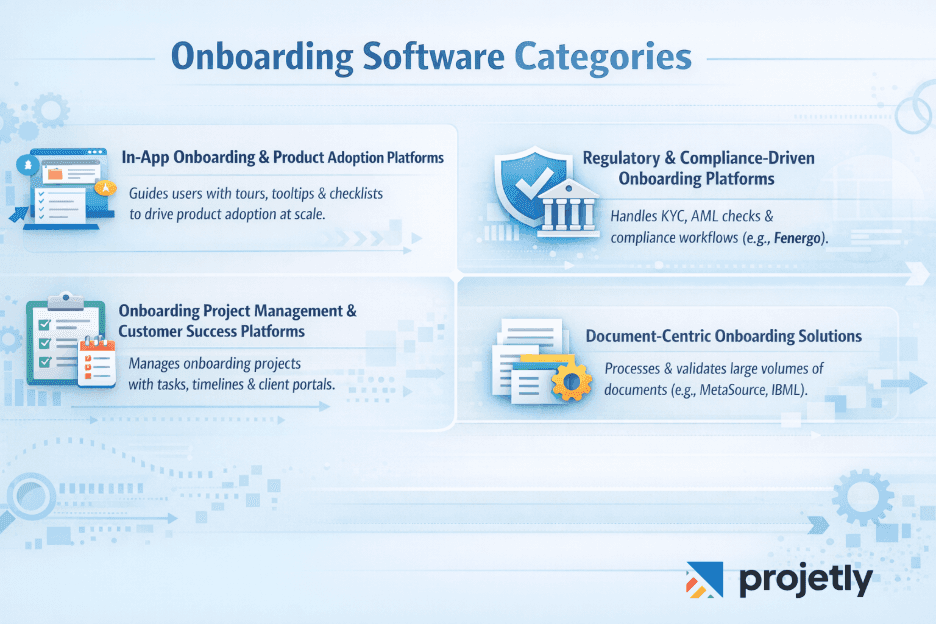
1. In-App Onboarding and Product Adoption Platforms
These tools embed directly inside your product and guide users through feature discovery, workflow completion, and activation milestones without requiring human intervention at every step. They are the natural home for SaaS companies that onboard at volume.
Core capabilities: Interactive product tours, contextual tooltips, progressive checklists, in-app announcements, A/B tested onboarding flows, and behavioural analytics that show where users drop off.
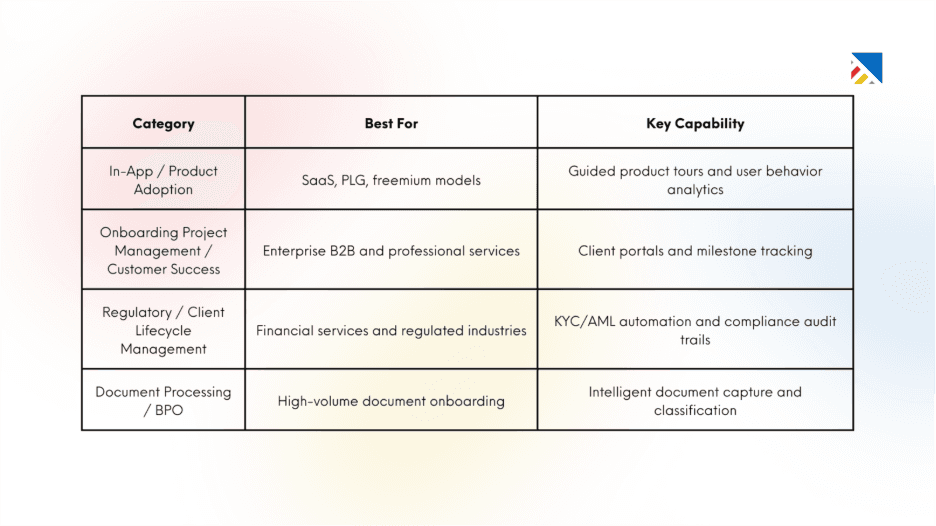
Where they excel: Consumer SaaS, PLG (product-led growth) motions, and freemium-to-paid conversion pipelines where human-touch onboarding at scale is economically impossible.
Where they fall short: Complex B2B onboarding involving external document collection, multi-party approvals, or regulated data often requires more than what these platforms were designed for.
2. Onboarding Project Management and Customer Success Platforms
These solutions treat onboarding as a structured project, with tasks, owners, timelines, external client portals, and escalation logic. They are built for high-touch enterprise SaaS, professional services firms, and any organisation where the onboarding process involves coordination between multiple internal teams and multiple customer stakeholders.
What distinguishes the best in this category is not task management itself (most project tools can do that) but the customer-facing layer: branded portals where clients upload documents, track progress, and receive communications, all without generating a flood of email threads and Slack messages.
In 2026, leading platforms in this category have also added AI-assisted scheduling, automated milestone nudges, and CRM-native data sync, making the customer experience feel seamless even when the internal coordination is genuinely complex.
3. Regulatory and Compliance-Driven Onboarding Platforms
For financial services, banking, insurance, and any sector where onboarding means Know Your Customer (KYC), Anti-Money Laundering (AML) screening, and identity verification, the software requirements are fundamentally different from the SaaS product adoption tools above.
These platforms must handle jurisdictional rule variation, ongoing monitoring obligations, perpetual KYC refresh cycles, and audit-grade data trails. The commercial risk of getting this wrong is not just customer experience; it is regulatory censure, fines, and reputational damage.
Fenergo, for example, operates in this space, providing client lifecycle management infrastructure for tier-one banks and financial institutions where client onboarding is inseparable from regulatory compliance. The platform handles entity data management, automated KYC workflows, and jurisdiction-specific rule configuration that would be impossible to maintain manually at scale.
4. Document-Centric and BPO-Supported Onboarding Solutions
A fourth category covers the heavy-lifting end of onboarding: document capture, classification, extraction, and processing. Companies dealing with large volumes of incoming customer documents, insurance applications, mortgage packages, healthcare registration forms, government filings require intelligent document processing capabilities that go beyond simple PDF storage.
Solutions in this category, including those offered by providers like MetaSource and IBML, combine intelligent capture technology with workflow automation and often human-in-the-loop review for exceptions. The value proposition is accuracy and throughput at volume, not customer experience finesse.
Want to streamline your customer onboarding? Start your free trial today.
Quick Comparison: Onboarding Software Categories
What the Best Customer Onboarding Software Actually Does: Beyond the Feature List
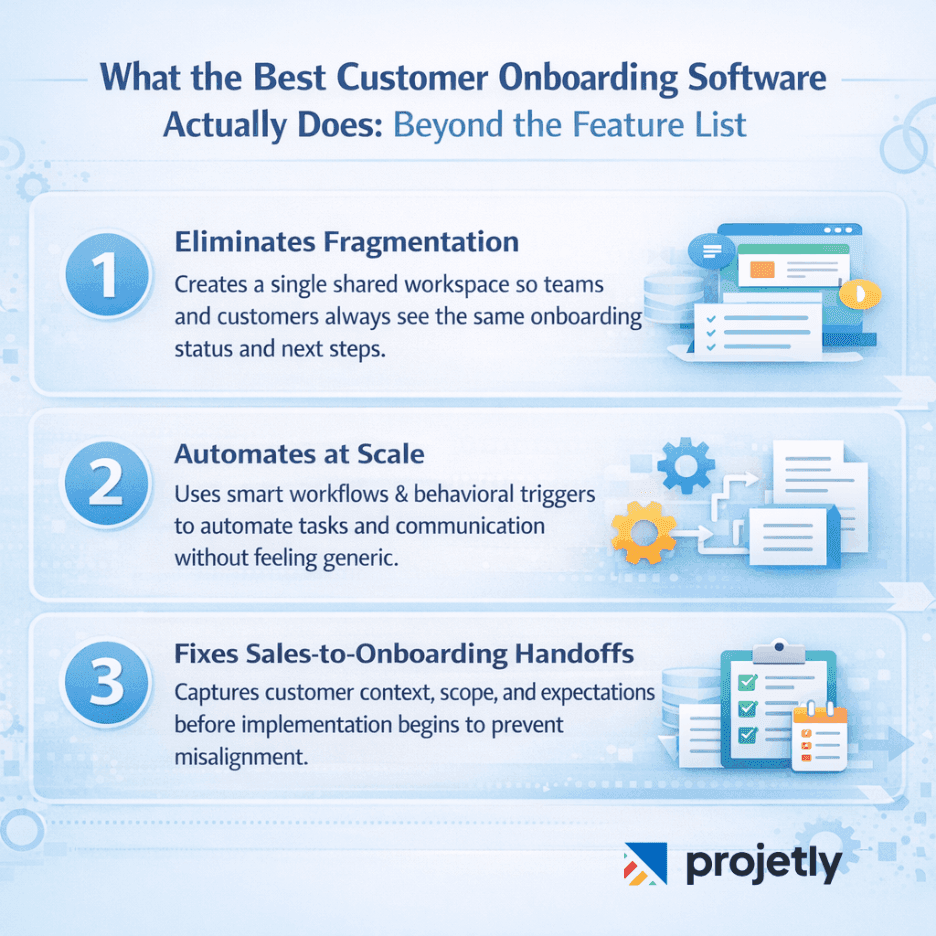
Feature matrices from vendor websites all start to look alike after a while. What matters more than any individual feature is whether a platform solves the three core problems that actually cause onboarding to fail in practice.
Problem 1: Fragmentation and Lack of Visibility
In most organizations, onboarding spans sales handoff, implementation, legal, compliance, finance, and the customer success team, each working from their own tools and their own version of the truth. A customer calls in asking for an update, and no one person can answer because the status lives across five different systems.
The best onboarding platforms create a single thread of record, not just for internal teams but for the customer. Everyone sees the same view, the same outstanding items, and the same timeline. This alone reduces average onboarding time significantly, simply by eliminating the coordination overhead that is currently invisible on most ROI calculations.
Problem 2: Manual Effort at Scale
Even well-designed onboarding processes break down under volume. A process that works perfectly for ten new customers per month becomes unmanageable at a hundred, because the task of personalising, chasing, and updating every customer individually becomes a full-time job for someone who probably has other responsibilities.
Automation in onboarding software needs to be smart, not just fast. Blanket email sequences are not the answer, they produce the kind of generic communication that customers recognise immediately as automated and ignore. The better platforms use conditional logic, triggered by actual customer behaviour and task completion status, to send the right communication at the right moment. This is still automated, but it does not feel automated.
Problem 3: Poor Handoff from Sales
The gap between what sales promises and what the implementation team inherits is one of the most persistent sources of onboarding failure. Information gathered during the sales cycle does not make it to the people running onboarding. Expectations set during demos do not get recorded. Timelines agreed in the proposal are not reflected in the delivery schedule.
Software alone cannot fix a broken handoff process, but it can enforce one. The best platforms create a structured intake step that forces sales to document customer context, agreed scope, and specific expectations before the onboarding team takes ownership. When this is built into the system rather than relying on discipline, it actually happens.
Projetly: Built for End-to-End Onboarding
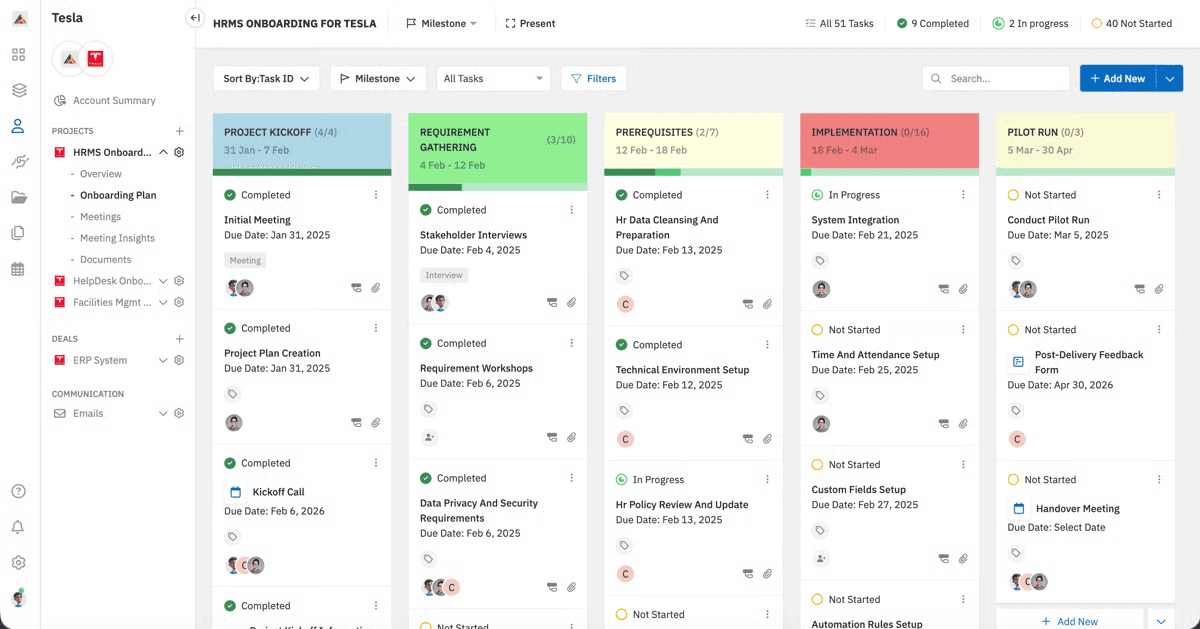
Among the platforms purpose-built for structured customer onboarding in 2026, Projetly stands out for the breadth of what it handles within a single coherent system, rather than requiring organisations to stitch together multiple point solutions.
Projetly is designed for teams that run onboarding as a genuine operational discipline: projects with defined phases, task ownership, external stakeholder coordination, and measurable outcomes.
The platform gives operations and customer success teams a structured environment where every onboarding engagement has a clear status, every task has a clear owner, and no customer falls through the cracks simply because someone forgot to send a follow-up.
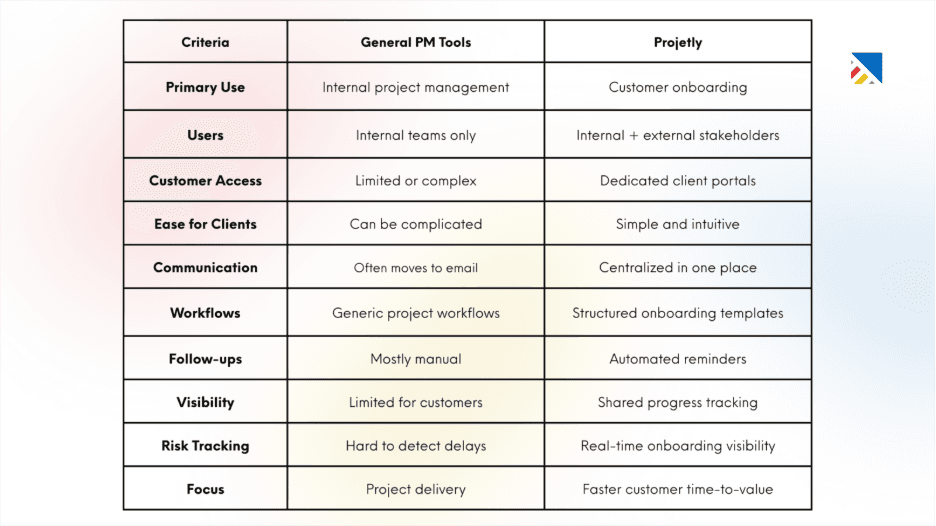
Where Projetly Differs from Generic Project Tools
Automation That Reflects Real Onboarding Logic
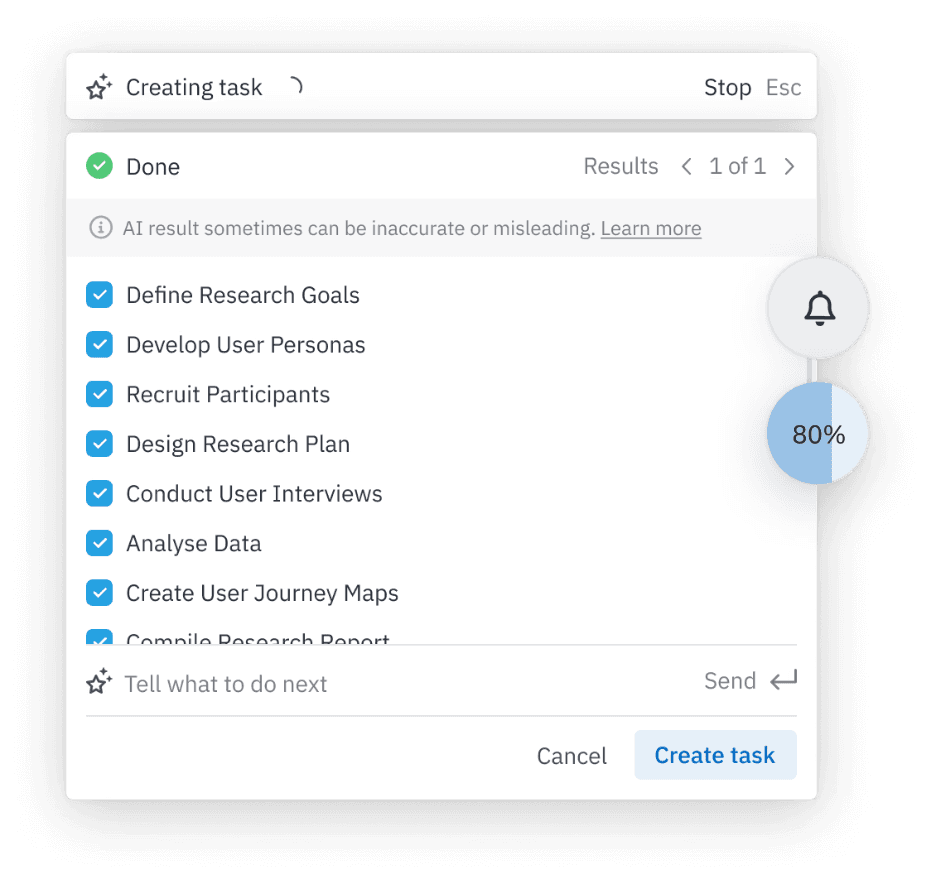
Projetly automation is built around real onboarding workflows, not generic task automation.
Milestone-based logic automatically unlocks dependent tasks as onboarding progresses.
Document submissions trigger review tasks for the right team members.
Deadline alerts notify only the relevant stakeholders, not the entire team.
Automation is conditional and context-aware, adapting to the onboarding stage.
This approach avoids the limitations of bolt-on automation found in generic tools.
Teams spend less time coordinating manually and more time moving onboarding forward.
The result is faster customer activation.
Faster activation leads to better retention and expansion revenue.
Reporting and Business Intelligence
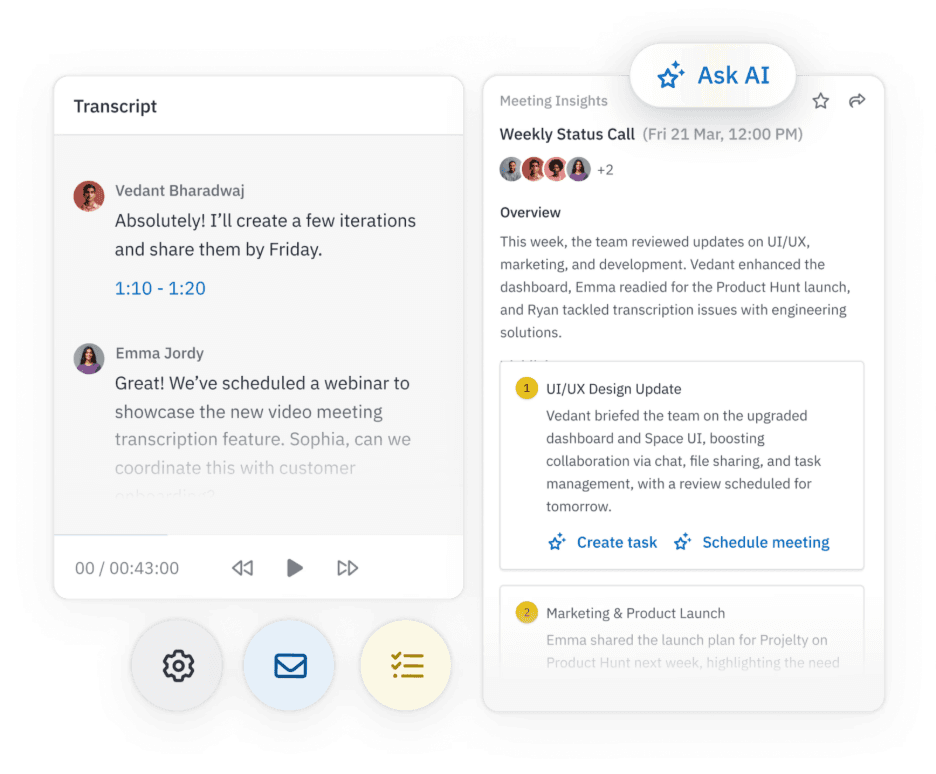
Projetly provides actionable insights, not just basic status updates.
Reporting shows average onboarding time by customer segment.
Tracks task completion rates to measure execution efficiency.
Identifies bottlenecks that slow down onboarding.
Provides team capacity and workload visibility for better planning.
Enables data-driven process improvement, not reactive analysis after issues occur.
Helps organizations treat customer onboarding as a revenue-driving function.
Built for complex, multi-stakeholder enterprise onboarding processes.
Reduces operational risk caused by managing onboarding with generic tools.
Interested in learning more about Projetly? Contact us today.
Key Criteria for Evaluating Customer Onboarding Software in 2026
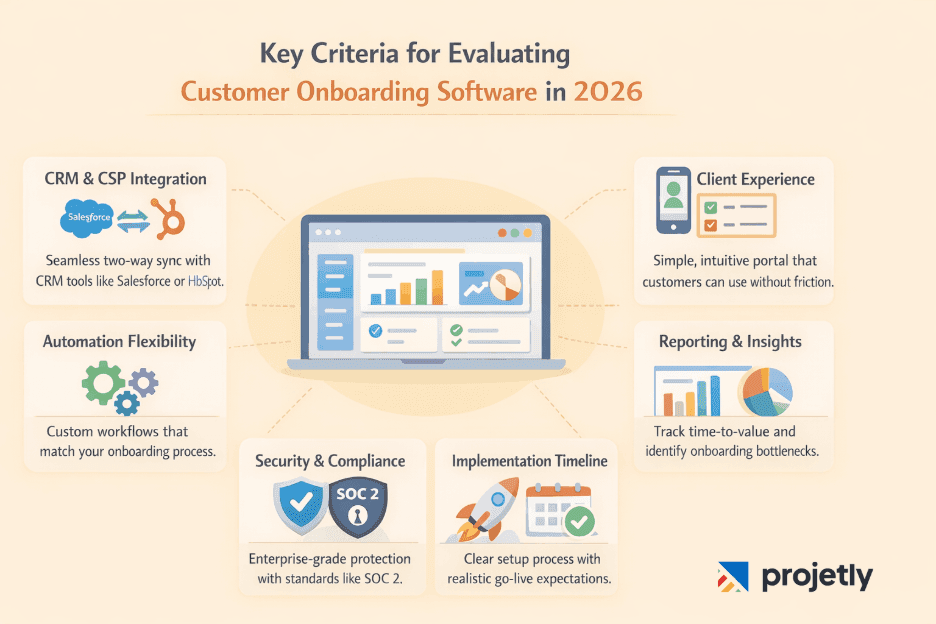
If you are building a business case or running a formal vendor evaluation, the following criteria should anchor your scoring:
CRM & CSP integration depth: The onboarding platform should integrate tightly with CRMs like Salesforce or HubSpot, with bidirectional data sync, not just one-way exports.
Client-facing experience quality: Evaluate the tool from the customer’s perspective, the portal should be intuitive, mobile-friendly, and ideally not require customers to create yet another account.
Automation configurability: Ensure the platform allows custom automation based on your onboarding logic, rather than forcing teams to rely only on preset workflows.
Reporting granularity: The system should provide detailed metrics, such as time-to-value by customer segment and identification of tasks that cause delays.
Security & compliance: Strong data protection and compliance standards are essential, especially when onboarding involves sensitive or regulated information. Certifications like SOC 2 Type II are often the minimum requirement.
Implementation timeline: Understand the vendor’s setup and go-live process, and ask for reference customers with similar onboarding complexity to ensure the rollout is realistic.
Curious how Projetly can improve your onboarding process? Contact us today.
The ROI Conversation: How to Frame Customer Onboarding Software at Board Level
Onboarding software investment decisions often stall because the value case is framed around cost reduction, hours saved, and headcount avoided. The more accurate one connects onboarding quality directly to three revenue metrics:
Time-to-value (TTV): The faster a customer reaches their first meaningful outcome with your product or service, the more likely they are to renew and expand. Every week shaved from average onboarding duration has a calculable impact on cohort NRR.
Churn at 90 days: Early churn is almost always an onboarding failure, not a product failure. Customers who churn in the first quarter rarely do so because the product did not work; they do so because they never properly adopted it. Reducing this cohort by even a few percentage points has a disproportionate impact on LTV.
Expansion revenue timing: Customers who onboard successfully and reach full activation earlier are more ready to expand earlier. The correlation between structured onboarding and upsell timing is well-documented and commercially significant.
When you build your business case around these three levers, rather than operational efficiency alone, the procurement decision moves from IT budget to strategic investment, and the approval process reflects that shift.
What to Expect from Customer Onboarding Software in the Next 12 Months
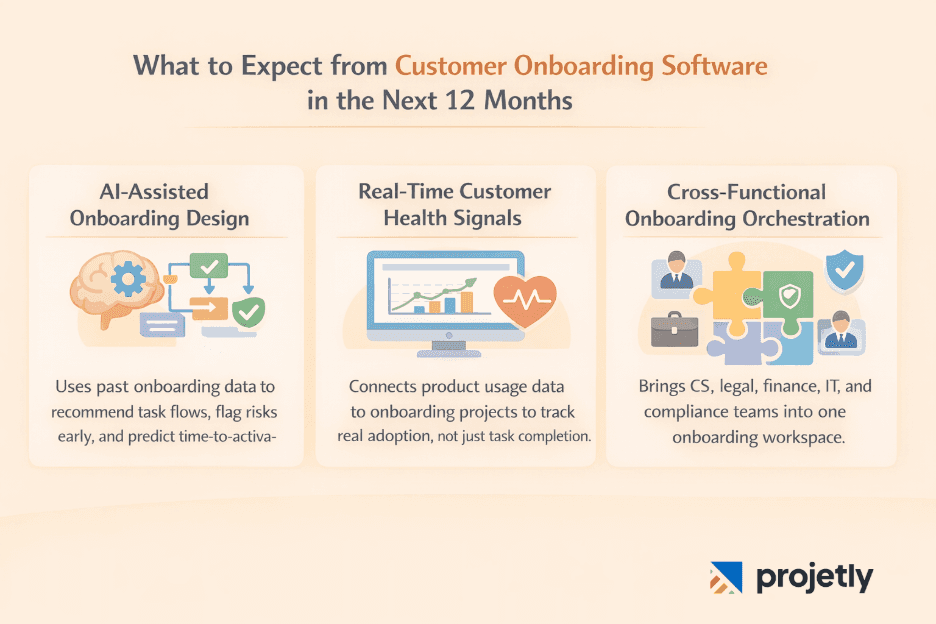
The platforms that will define this space through 2026 and beyond are investing in three areas:
AI-assisted onboarding design: Using historical data from completed onboardings to recommend optimal task sequences, flag risk factors early, and predict time-to-activation for new engagements.
Real-time customer health signals integrated into onboarding: Connecting in-product usage data to the onboarding project so teams can see not just whether tasks are complete, but whether the customer is actually adopting what they have been onboarded on.
Cross-functional onboarding orchestration: Moving beyond the customer success team to include legal, finance, IT, and compliance stakeholders within the same onboarding environment, particularly relevant as enterprise deals involve more departments and longer setup cycles.
Organizations that invest in purpose-built onboarding infrastructure now will find themselves with a structural advantage: better data about what drives activation, faster iteration on process, and a customer experience that becomes a genuine differentiator rather than a pain point.
Ready to streamline your customer onboarding? Start your free trial today.
Choosing the Right Customer Onboarding Solution for Your Organization
There is no single “best” customer onboarding platform, only the platform that best fits your business model, customer profile, and operational maturity.
A practical way to think about the decision:
PLG SaaS companies scaling high-volume onboarding should prioritize tools with in-app guidance and behavioral analytics that reduce reliance on human intervention.
Enterprise B2B companies running high-touch onboarding need platforms with structured project management, client portals, and conditional automation. Projetly is built specifically for this model.
Organizations in regulated industries must prioritize security, compliance, and auditability. Compliance architecture should be built into the platform — not added later as a module.
Teams overwhelmed by document-heavy onboarding will often see greater ROI from intelligent document processing and workflow automation than from customer-experience tools alone.
Under-investing in onboarding technology creates more than operational friction. It leads to slower revenue activation, higher churn, compliance exposure, and damaged customer relationships that are difficult to recover.
In 2026, these risks are well understood and avoidable with the right systems in place.
This guide is intended for operations, customer success, and technology leaders evaluating the best customer onboarding software. The insights are based on industry research, vendor capability analysis, and practitioner experience from organizations running onboarding at scale.
You may also like

A Guide to Project Management Professional Certification

Laugh Your Way to Productivity: 50 Workplace Quotes

50 Funny Workplace Memes That’ll Brighten Your Workday.
What Does a Customer-First Mindset Mean? Explained in 2025

What It Takes to be a Great Customer Success Manager in 2025