NEW CLIENT ONBOARDING

By
Dhruv
How to Measure Customer Health Score and Drive Retention
Imagine Sarah, a Customer Success Manager at a fast-growing SaaS company. Her customer base is expanding rapidly, product adoption is increasing, and new onboarding workflows are rolling out.
Yet, despite a seemingly healthy pipeline, Sarah notices an alarming trend: some customers churn unexpectedly. After investigating, she discovers the root cause: there was no unified guide to customer health scores. Each CSM relied on intuition, anecdotal feedback, or partial usage data. As a result, warning signs went unnoticed until it was too late.
This is a common scenario in many companies scaling quickly. The solution? A structured health scoring system that produces a single score reflecting a customer’s health, engagement, and risk.
In this guide, we’ll cover:
What is a customer health score and why it matter
Key metrics to track
How to build a health score
How to improve customer health
Examples of customer health scorecards
By the end, you’ll understand how tracking customer health scores can help CS teams proactively reduce churn, allocate resources efficiently, and drive retention.
Related Blog: A Blueprint for Seamless Remote Customer Onboarding
What Is a Customer Health Score?
A customer health score is a metric that indicates the overall strength of a customer relationship. It blends multiple score signals, including product usage, engagement, onboarding progress, support interactions, billing behavior, and relationship activity.
In simple terms:
Higher scores indicate satisfied, engaged customers
Lower scores indicate at-risk customers needing intervention
Most SaaS companies use:
A 0–100 score
Weighted metrics
Color-coded health scoring (Green, Yellow, Red)
Automated triggers for score changes
A well-designed customer health score removes guesswork. Instead of subjective assessments, CS teams rely on data-driven signals to segment accounts, automate workflows, and identify at-risk customers.
By consolidating these signals, the score gives a comprehensive view of a customer’s health. Each score provides actionable insight, helping customer success managers know exactly which customers require attention, which are ready for upsell, and which are showing early signs of disengagement.
Why a Customer Health Score Matters
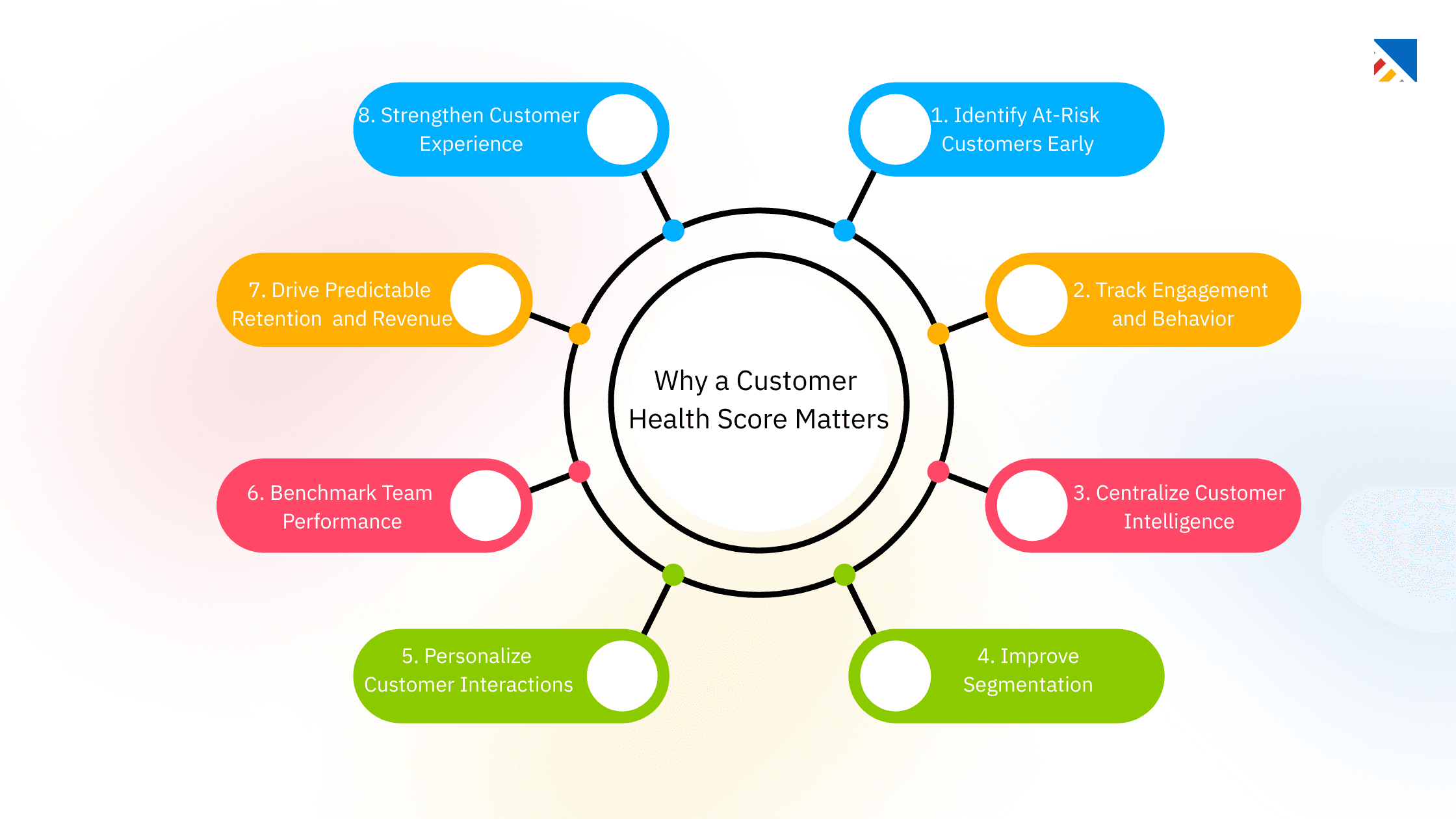
1. Identify At-Risk Customers Early
A health scoring system acts as an early warning tool. When scores drop due to declining product usage or stalled onboarding, CS teams can intervene before customers are at risk. Early intervention ensures a proactive approach to customer success and helps drive retention.
2. Track Engagement and Behavior
Customer health score metrics track login frequency, feature adoption, session duration, and overall customer engagement. Scores reflect changes immediately, signalling potential problems. For instance, if a customer suddenly stops using core features, their score declines even if support tickets are low. This helps CS teams take targeted actions to retain the account.
3. Centralize Customer Intelligence
SaaS companies often struggle with fragmented data. A customer health score consolidates CRM, product analytics, support tickets, and billing info into a single score, giving customer success leaders a unified view. Tracking customer health scores in one place allows for faster decisions and ensures everyone is aligned on account health.
4. Improve Segmentation
Using health scores, accounts can be segmented based on score criteria:
Healthy accounts indicate a high score, strong adoption
At-risk accounts indicate a low score, need intervention
Expansion-ready accounts indicate engaged and ripe for upsell
This type of customer segmentation allows CS teams to focus on accounts that truly matter and prioritize resources efficiently.
5. Personalize Customer Interactions
A customer health score helps CS teams customize outreach. For at-risk accounts, frequent check-ins, targeted onboarding, or workflow audits may be necessary. Healthy accounts may get advanced feature guidance, roadmap previews, or upsell opportunities. Tailored interactions improve client satisfaction and overall customer success outcomes.
6. Benchmark Team Performance
Health scores become a tool to benchmark CS team performance. Leaders can track score distribution across accounts, monitor trends, and identify playbooks that improve customer health. This also supports accurate forecasting, resource allocation, and understanding which metrics best predict churn.
7. Drive Predictable Retention and Revenue
Proper health scoring removes guesswork. Strong scores correlate with renewals, while declining scores indicate at-risk customers. This visibility allows for more accurate revenue forecasts and improved customer outcomes.
8. Strengthen Customer Experience
Proactive health scoring ensures CS teams can address issues before they escalate. Scores help identify declining usage, feature confusion, or hidden friction points. Acting on these insights improves client satisfaction and turns customers into advocates.
Key Metrics to Include in a Customer Health Score
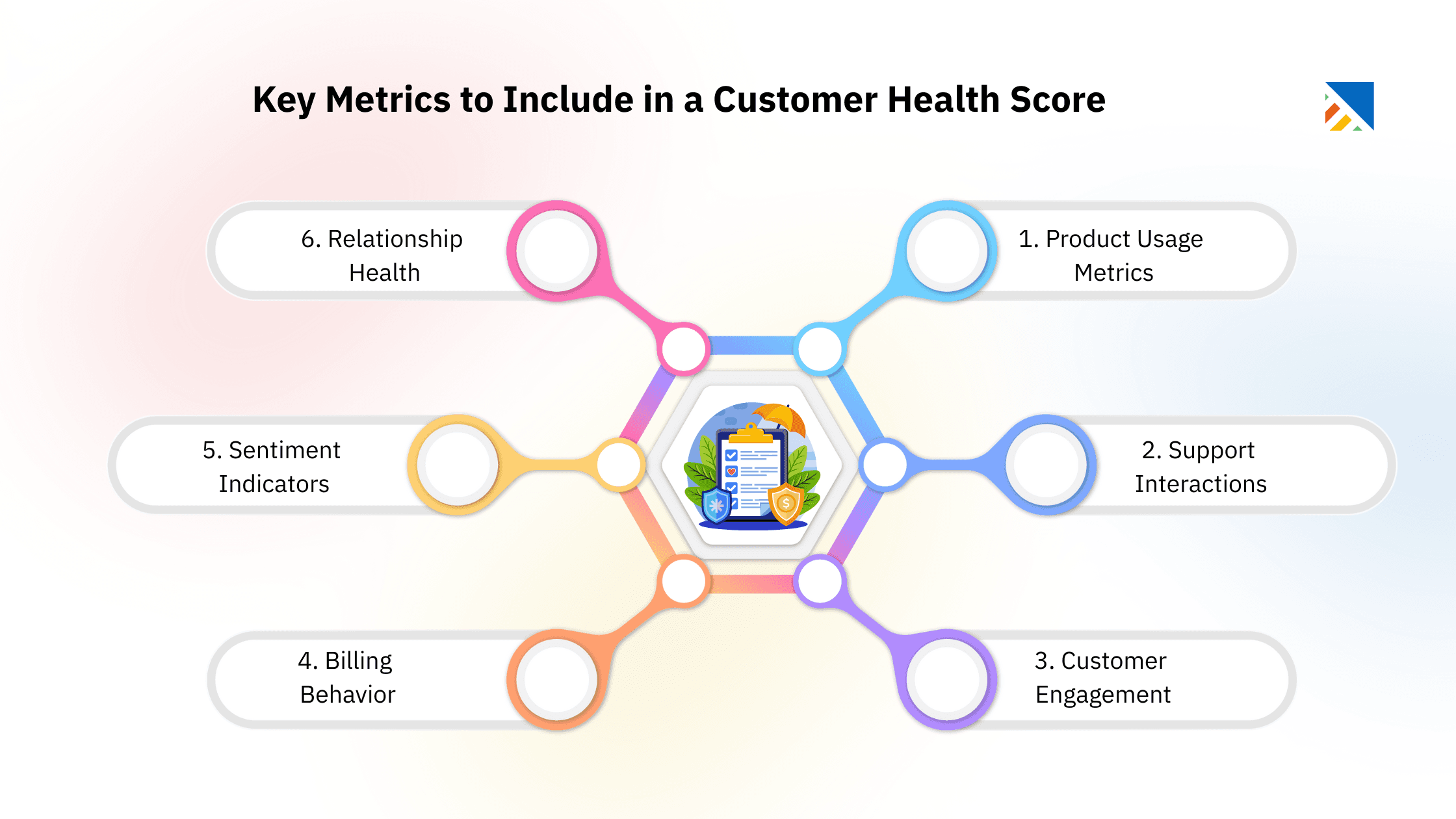
Choosing the right metrics ensures your health scoring system is predictive, actionable, and aligned with the customer journey.
1. Product Usage Metrics
High product usage is a strong sign of healthy adoption. Track login frequency, feature adoption, depth of engagement, and seat utilization to understand how well customers are using your product. Low usage should lower the health score and flag risk, while consistent high usage signals a healthy, engaged customer.
2. Support Interactions
Support activity reveals friction in the customer experience. Track metrics like ticket volume, resolution time, reopen rates, and escalations to gauge how smoothly customers are progressing. Rising ticket trends or slow response times should lower the health score and flag potential churn risks.
3. Customer Engagement
Track signals like email opens, event attendance, forum participation, and customer satisfaction surveys to understand overall engagement. Higher participation indicates stronger involvement, boosts health scores, and strengthens long-term loyalty.
4. Billing Behavior
Late payments, downgrades, and irregular billing patterns lower the health score and signal potential financial risk within the account. Consistent financial behavior, on the other hand, reinforces stability and strengthens long-term retention potential.
5. Sentiment Indicators
Include metrics like NPS, CAT, CES, and qualitative survey comments to capture how customers truly feel about the experience. This sentiment data adds important context beyond raw usage and helps reveal hidden risks or advocates.
6. Relationship Health
Track champion engagement, decision-maker involvement, QBR participation, and renewal meetings. Disengaged champions tend to have lower scores, indicating an at-risk status.
How to Create a Customer Health Score
Follow these steps to create a health score that is actionable, predictive, and aligned with the customer lifecycle.
Step 1: Identify Key Metrics
Select metrics that reflect value, engagement, and satisfaction. Examples: onboarding completion, weekly usage, NPS, support tickets, and expansion-readiness.
Step 2: Assign Weights
Determine metric importance. Total weight = 100%. Usage 50%, sentiment 30%, support 20% is a common approach.
Step 3: Score Metrics
Normalize all metrics to 0–100. High usage indicates a high score; low usage indicates a low score.
Step 4: Aggregate Scores
Combine weighted metrics:
Customer Health Score = Σ (Metric Score × Weight)
This single score gives a snapshot of customer health.
Step 5: Segment Customers
Divide customers into Healthy (75–100), Neutral (50–74), and At-risk (0–49). This segmentation helps CS teams prioritize interventions.
Step 6: Operationalize the Score
Embed the customer health score in dashboards, CRMs, and workflows. Utilize automation to trigger alerts for low health scores, schedule follow-ups, and provide real-time guidance to CS teams.
Related Blog: High-Touch vs Low-Touch Onboarding for Customer Success
How to Improve Customer Health Scores
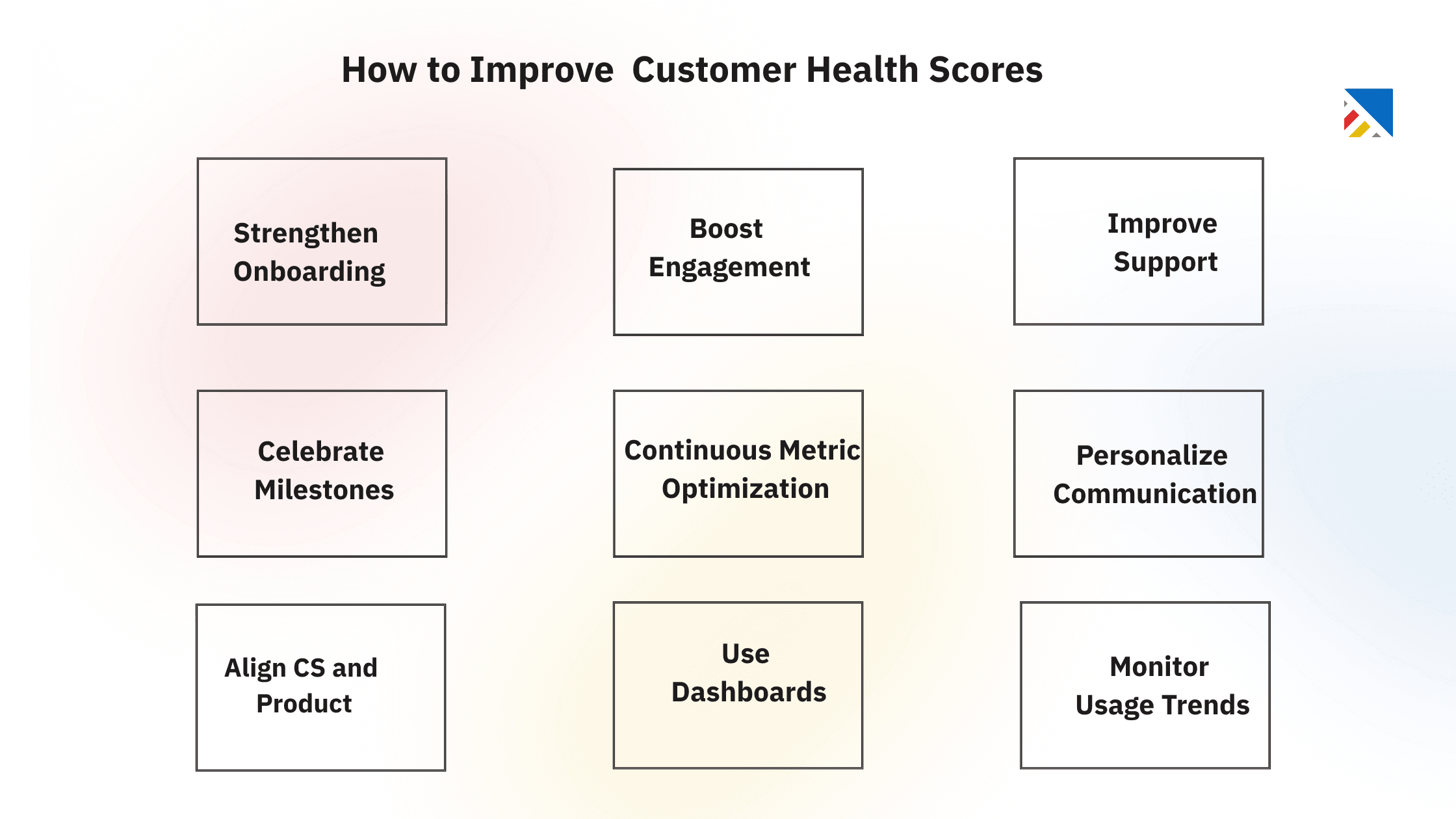
Measuring a customer health score is just the start. To improve customer health, CS teams can:
1. Strengthen Onboarding
Customize onboarding by customer segments
Automate repetitive tasks for efficiency
Highlight early first-value milestones
Provide guided training for complex product usage
2. Boost Engagement
Use in-app prompts, emails, and automation
Encourage community participation
Host webinars and training sessions
3. Improve Support
Ensure fast ticket resolution
Offer self-service knowledge bases
Track support and health score signals to catch at-risk customers
4. Personalize Communication
Align success plans with goals
Share personalized product usage metrics
Tailor communications to roles or departments
5. Monitor Usage Trends
Set automated alerts for score changes
Intervene early on declining feature usage
Prevent customers from being at risk in scenarios
6. Use Dashboards
Visualize score distribution
Prioritize at-risk accounts
Track metrics best predicting churn
7. Align CS and Product
Provide feedback to product teams
Adjust onboarding and features based on score signals
Create cross-functional playbooks
8. Continuous Metric Optimization
Review and refine key metrics
Adjust weights in the customer health score formula
Include new score criteria as needed
9. Celebrate Milestones
Acknowledge customer achievements
Share ROI and success stories
Reinforce positive behavior to maintain higher health score
Customer Health Score Example
Here’s a sample customer health scorecard:
Metric | Weight | Score | Weighted Result |
|---|---|---|---|
Product Usage | 40% | 85 | 34 |
NPS | 25% | 70 | 17.5 |
Support Tickets | 20% | 60 | 12 |
Onboarding Completion | 15% | 90 | 13.5 |
Final Score | — | — | 77 |
A good health score (>75) indicates a stable, healthy customer. A low score (<50) identifies at-risk accounts needing intervention. Health scores are built to provide CS teams actionable insight, enabling tracking customer health scores, proactive engagement, and driving retention.
Related Blog: Customer Onboarding Metrics: The Guide to Predict Client Success
Benefits of Using Customer Health Scores
Proactive Retention
A customer health score enables customer success teams to spot at-risk accounts early and intervene before churn occurs. This proactive approach strengthens customer trust and keeps clients engaged throughout their lifecycle.
2. Identify Upsell Opportunities
High scores often indicate satisfied, engaged customers ready for upsell or expansion opportunities. CS teams can use these insights to align health scoring with revenue growth and account planning.
3. Optimize Resource Allocation
By segmenting customers based on health scores, CS teams can prioritize at-risk accounts while allocating resources efficiently. This ensures attention is focused where it matters most, improving overall customer success outcomes.
4. Predictable Customer Outcomes
Tracking score signals across the customer journey provides visibility into renewals, expansion, and potential churn. This data-driven approach allows customer success leaders to forecast and plan more accurately.
5. Improved Customer Satisfaction and Loyalty
A customer health score guides personalized support, onboarding, and engagement strategies. By addressing issues early and tailoring interactions, companies increase customer satisfaction and foster long-term loyalty.
Frequently Asked Questions
1. How is a customer health score calculated?
A customer health score is calculated using a weighted formula that combines key metrics like product usage, customer sentiment, support activity, and engagement levels.
Formula: Health Score = Σ (Metric Score × Assigned Weight)
2. What does a customer health score measure?
It measures the overall likelihood of customer renewal, retention, expansion, or churn by evaluating how actively and effectively a customer uses your product.
3. What is a customer score?
A customer score, such as Customer Effort Score (CES) quantifies how easy it is for customers to interact with your product or support team.
Formula: CES = Total Score ÷ Number of Responses
4. What are the components of a customer health score?
Core components include:
Product usage patterns
Support interactions and ticket volume
Customer engagement
Sentiment (NPS/CSAT)
Billing and payment behavior
Relationship depth and touchpoints
5. How do you calculate Customer Effort Score (CES)?
Numeric scale: CES = Total Score ÷ Total Responses
Sentiment scale: CES = % Positive – % Negative
6. Why is a customer health score important?
A customer health score helps Customer Success teams proactively identify at-risk accounts, improve retention, prioritize outreach, and uncover new expansion opportunities before churn signals appear.
Conclusion
Customer health scores are the backbone of proactive customer success. As seen in Sarah’s story, relying on intuition or scattered data causes blind spots, delayed interventions, and unexpected churn. But when SaaS companies adopt a structured, data-driven health scoring system, they unlock complete visibility into client engagement, risk signals, and growth potential.
By measuring the right metrics, assigning meaningful weights, and centralizing insights, customer health scores provide a single source of truth for your entire team. This empowers Customer Success to identify at-risk accounts early, personalize engagement, optimize resources, improve forecasting accuracy, and strengthen customer satisfaction. Ultimately, a well-designed customer health score turns customer success from reactive support into a predictable retention and expansion engine.
Ready to Transform Customer Health Scoring? Try Projetly
If you’re ready to move beyond spreadsheets and manual tracking, Projetly makes customer health scoring effortless and impactful.
With Projetly, you can:
Create customizable, weighted customer health score models
Track usage, sentiment, support, and billing signals automatically
Get real-time alerts when customer health declines
Visualize portfolio-wide customer health in one dashboard
Enable your CS team to act early and prevent churn
Projetly helps you measure what truly matters so you can deliver proactive success, predictable renewals, and long-term customer loyalty.
Start using Projetly to build smarter customer health scores and strengthen retention from day one.
You may also like

A Guide to Project Management Professional Certification

Laugh Your Way to Productivity: 50 Workplace Quotes

50 Funny Workplace Memes That’ll Brighten Your Workday.
What Does a Customer-First Mindset Mean? Explained in 2025

What It Takes to be a Great Customer Success Manager in 2025