Project Management

By
Avaran
Ethical AI in Project Management: Balancing Efficiency with Human-Centric Practices
Imagining the Future of AI in Project Management
Imagine a scenario in which a project manager, Avaran, leads a complex artificial intelligence transformation project for a global supply chain company. The project involves using AI tools to optimize inventory, enhance operational visibility, and support project decision-making. The AI system runs advanced natural language processing to interpret customer service requests, predict shipment delays, and suggest corrective actions.
Everything appears to be working perfectly until a supplier reports that their bids are consistently flagged as high risk without explanation. Another stakeholder questions whether the system collected personal information without informed consent. A legal advisor warns Arjun that the company may face legal issues if sensitive data is processed without compliance. Concerns rise around AI results, prompting the leadership team to examine how the algorithm makes decisions.
This moment highlights a critical truth: AI in project management is not only a technological advancement but a responsibility that requires strong ethics, transparency, human oversight, and sound governance. Due to AI adoption across industries, organizations must integrate ethical considerations for AI projects into their project management practices.
Related Blog: The Rise of No-Code and Low-Code PSA Tools in 2025
The Rise of AI in Project Management
Artificial intelligence is rapidly reshaping project management processes across project planning, scheduling, resource allocation, risk management, communication, and reporting. AI offers significant benefits that improve project outcomes, including:
Enhanced risk forecasting accuracy
Data-driven decision-making
Faster resolution of project issues
Improved project progress analysis and reporting
Scenario modelling and strategic planning
Increased efficiency through automated workflows
Gen AI and natural language processing are widely used to automate documentation, create project reports, analyze communication patterns, and support knowledge management. These technologies help project management professionals leverage AI to improve project outcomes.
However, the use of artificial intelligence requires ethical responsibility. Organizations must ensure that systems support fairness, data privacy, accountability, and transparency, especially in decisions affecting employees, customers, and stakeholders.
Why Ethical AI Is Crucial for Project Managers
Project decisions have long-term implications. Project managers must understand the ethics of AI to protect stakeholders and uphold trust. Ethical considerations include:
Bias and discrimination in systems and algorithms
Clarity and transparency in how systems make decisions
Accountability for outcomes influenced by AI insights
Protection of sensitive data and personal data during data collection
Human oversight to ensure responsible use of AI
Security concerns around AI misuse and vulnerabilities
AI systems must be developed in a manner that respects human rights, regulations, and global AI ethics. AI must support, not replace, human decision-making. Project managers must ensure that teams utilise AI ethically and responsibly.
Key Ethical Considerations for AI in Projects
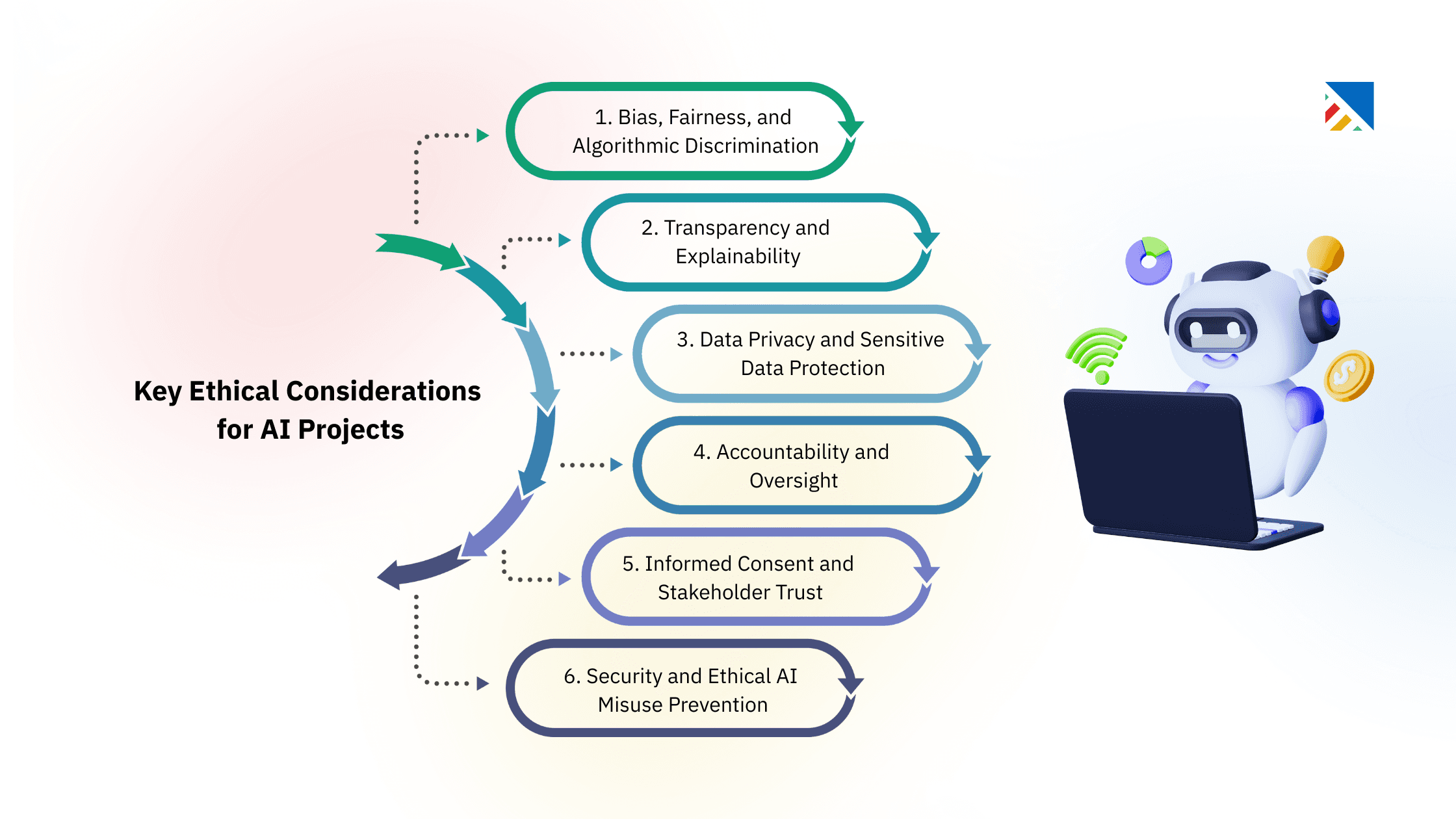
1. Bias, Fairness, and Algorithmic Discrimination
AI models are only as fair as their training data. If historical data contains biases, the AI system may replicate discriminatory patterns, causing ethical dilemmas and stakeholder distrust.
2. Transparency and Explainability
AI decision-making processes must be understandable. Without transparency, project leaders and stakeholders cannot validate decisions or challenge inaccurate results.
3. Data Privacy and Sensitive Data Protection
AI systems often require extensive data collection. Organizations must comply with regulations, protect personal data, and ensure secure storage throughout the project lifecycle.
4. Accountability and Oversight
Accountability defines who is responsible when AI systems influence decisions that produce harm or errors. Human oversight reduces risks and prevents AI from making decisions that conflict with ethical standards.
5. Informed Consent and Stakeholder Trust
Stakeholders should be informed about how AI is used and must grant consent when data collection affects them. Transparency strengthens long-term project trust.
6. Security and Ethical AI Misuse Prevention
AI requires controls to prevent misuse, unauthorized access, and security breaches. Security is a core component of responsible leadership and ethical AI operations.
Ethical Issues and AI Challenges Project Leaders Face
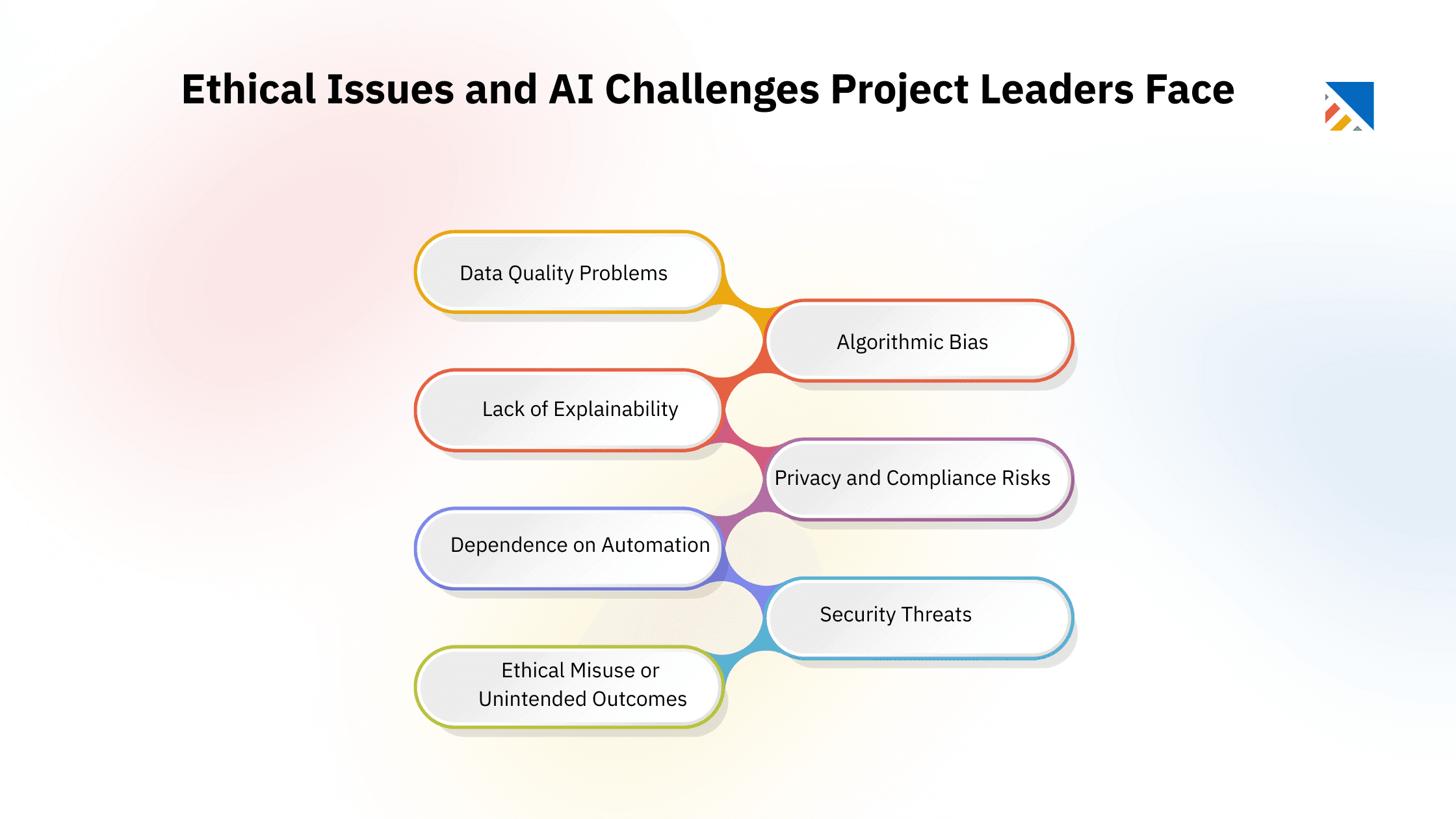
AI introduces new layers of complexity into project environments, and project leaders must manage both technical and ethical challenges. Some of the most common issues include:
1. Data Quality Problems
Poor or incomplete data can lead to inaccurate AI outputs, flawed recommendations, and misguided project decisions. Ensuring clean, relevant, and unbiased data is essential for preventing algorithmic errors.
2. Algorithmic Bias
AI systems may unintentionally discriminate against certain groups if trained on biased historical data. This can create unfair project outcomes, affecting stakeholders, employees, or vendors.
3. Lack of Explainability
When AI makes decisions that cannot be easily explained, it becomes difficult for project managers to justify choices, gain stakeholder trust, or verify accuracy. This lack of clarity can slow down decision-making.
4. Privacy and Compliance Risks
AI systems often handle sensitive data. Any failure to comply with privacy laws like GDPR or regional regulations can lead to legal consequences and stakeholder distrust.
5. Dependence on Automation
Over-reliance on AI may reduce human critical thinking and introduce blind spots. Teams must maintain human oversight to ensure balanced, responsible decision-making.
6. Security Threats
AI systems can be vulnerable to cyberattacks, model manipulation, or unauthorized access. Weak security controls may expose projects to operational and reputational risks.
7. Ethical Misuse or Unintended Outcomes
AI can be misused intentionally or produce unintended results if not monitored. Project leaders must ensure safeguards, reviews, and clear governance to prevent misuse.
These challenges highlight the need for a strong ethical framework, continuous monitoring, and human oversight throughout the AI project lifecycle.
The Ethics of AI in Project Management: A Responsibility Framework to Implement AI
Ethical AI requires a structured set of responsibilities that guide teams from planning to how they implement AI systems. A strong responsibility framework includes:
1. Governance and Policy Standards
Organizations must define clear AI governance policies that outline how data will be collected, stored, processed, and monitored. These policies should align with global AI ethics standards and regulatory requirements.
2. Role-Based Accountability
Project managers, data scientists, compliance officers, and executives should have clearly defined responsibilities. Everyone must know who is accountable for data quality, model validation, transparency, and ethical decision-making.
3. Ethical Risk Assessments
Before deploying AI, teams must perform ethical impact assessments to evaluate potential bias, discrimination, privacy risks, or harmful consequences. These assessments help teams proactively mitigate issues.
4. Monitoring and Validation
AI systems should be continuously monitored to detect errors, drifts, or unintended behaviors. Regular model validation ensures AI remains fair, accurate, and aligned with project goals.
5. Human-in-the-Loop Oversight
AI should support, not replace, human judgment. Project managers must ensure that critical decisions always involve human review, especially when they impact people or strategic outcomes.
6. Transparency and Documentation
All decisions, data sources, model changes, and AI behaviours should be thoroughly documented. This creates an auditable trail that supports accountability, compliance, and stakeholder communication.
This framework helps organizations deploy AI responsibly, ensuring transparency, fairness, and accountability throughout every stage of project management.
These principles reflect global expectations around AI governance and responsible use of artificial intelligence.
Best Practices for Using AI in Project Management
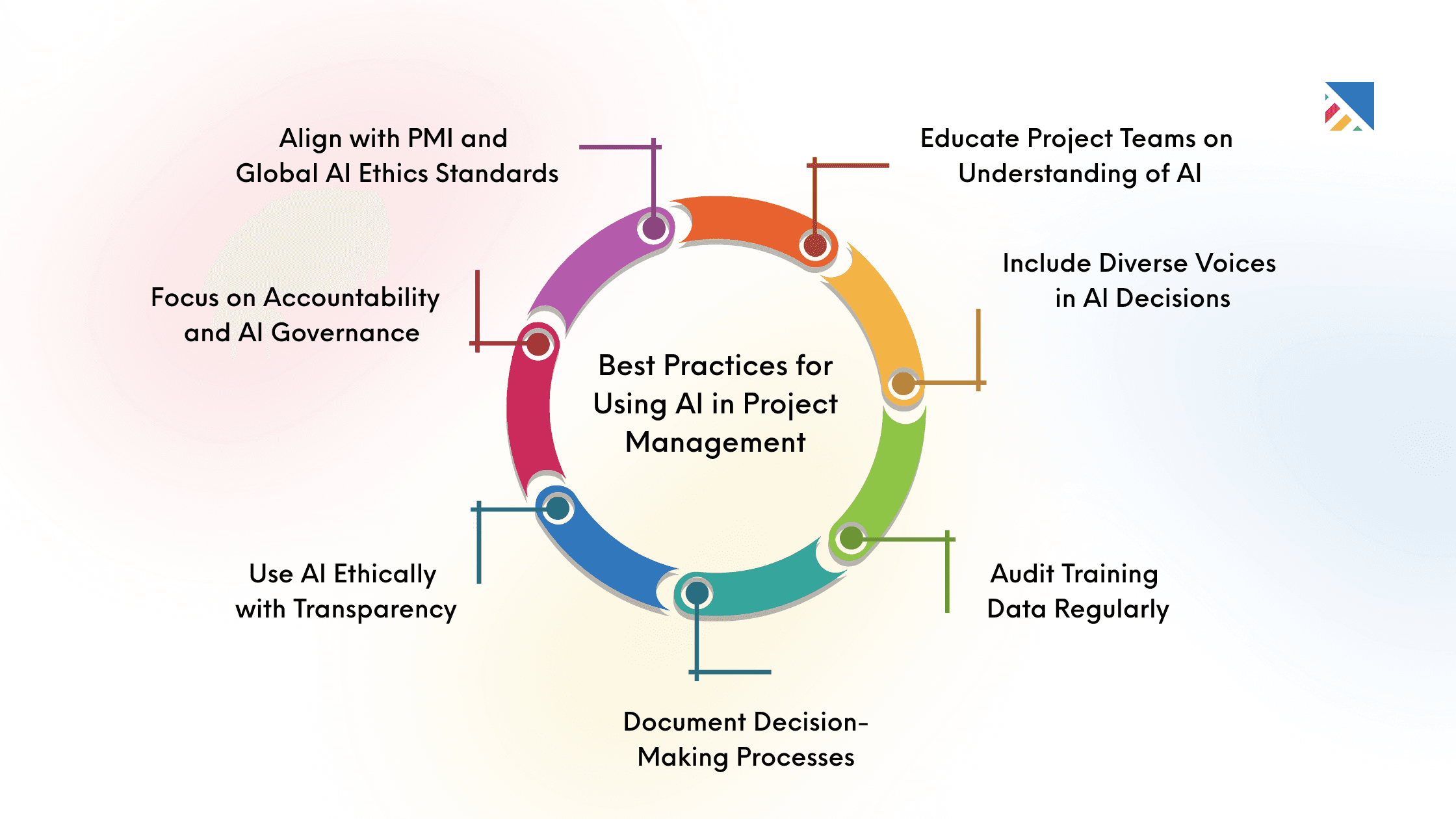
To ensure ethical AI adoption and the successful implementation of AI systems, organizations should apply the following best practices when integrating AI into project management.
1. Educate Project Teams on Understanding of AI
Project professionals need a clear understanding of AI capabilities, limitations, and ethical concerns. Training should explore:
Use of artificial intelligence in real project decisions
Generative AI and generative AI tools for documentation and reporting
Algorithm behavior and how to validate AI outputs
Ethical concerns associated with AI-driven systems
This knowledge helps project managers use AI ethically and improve project performance.
2. Include Diverse Voices in AI Decisions
Inclusive AI reduces bias and strengthens decision outcomes. AI implementation should involve:
Cross-functional representation
Legal, compliance, and risk experts
Stakeholders affected by AI outcomes
Diverse perspectives reduce ethical risk within project environments.
3. Audit Training Data Regularly
Training data influences AI outcomes. Data audits should verify:
Accuracy and relevance of data
Representation of diverse stakeholder groups
Minimization of bias in model learning
Audits support ethical standards and trustworthy AI results.
4. Document Decision-Making Processes
Documenting AI decision-making processes enhances transparency, accountability, and oversight. Detailed records support:
Regulatory compliance
Internal governance audits
Post-implementation analysis
Lessons learned for future projects
5. Use AI Ethically with Transparency
AI must operate transparently. Stakeholders should know:
What the AI system does
What data it uses
How its decisions are generated
How human oversight is applied
This ensures AI is used responsibly and ethically.
6. Focus on Accountability and AI Governance
Governance ensures responsible AI adoption. Organizations should define:
Roles and responsibilities for AI systems
Ethical standards and compliance procedures
AI risk assessment guidelines
Strong AI governance upholds ethical standards throughout project management practices.
7. Align with PMI and Global AI Ethics Standards
Global AI ethics frameworks and PMI guidance help organizations ensure that the implementation of AI complies with legal and moral expectations. Alignment supports responsible leadership and protects stakeholders from harm.
Related Blog: Vertical-Specific Professional Services PSA Solutions
AI Governance and the Role of the Project Manager
Project managers must ensure AI aligns with the project scope definition, objectives, risks, and stakeholder expectations. Their responsibilities include:
Evaluating ethical implications of AI decisions
Monitoring AI results throughout the project lifecycle
Confirming human oversight in AI-driven decisions
Ensuring compliance with governance rules
Supporting responsible use of AI technologies
Project managers play a central role in ensuring that AI is deployed ethically and responsibly.
The Future of Ethical AI in Project Management
AI adoption will continue to expand, and AI will also increasingly support strategic decision-making, project forecasting, and automation. Future developments include:
Predictive modeling for resource planning
AI-driven scheduling and change analysis
Greater use of generative AI in policy, reporting, and strategic documentation
Enhanced cross-organizational data intelligence
The future requires organizations to uphold ethical practices and integrate AI responsibly.
Platforms such as Projetly provide project teams with structure, collaboration visibility, and governance capabilities that support ethical AI in project management without encouraging over-reliance on automation. These tools assist project professionals in maintaining transparency, security, and data integrity while using AI to enhance productivity.
Related Blog: The Role of Gen AI in Professional Services Automation
Conclusion
Ethical considerations for projects are essential for trustworthy and sustainable AI adoption in project management. AI is crucial for organizations seeking competitive advantage and operational improvement, but AI systems must respect fairness, transparency, accountability, human oversight, data privacy, and security.
Ethical AI is a requirement, not an option. Organizations must approach AI responsibly to achieve project success and ensure that artificial intelligence strengthens, rather than replaces, human judgment. Ethical AI supports responsible leadership, protects stakeholders, and establishes the foundation for the future of AI in project management.
Frequently Asked Questions
1. What are the ethics of AI in projects?
Ethics in projects means building and using AI responsibly by ensuring fairness, transparency, privacy, and accountability. They help prevent harmful outcomes and ensure AI benefits all users.
2. What are the 7 principles of ethical AI?
They include ethical design, transparency, inclusivity, privacy protection, accountability, explainability, continuous monitoring, and accessibility. These principles guide teams to create trustworthy and safe AI systems.
3. Why is ethical AI use significant in project management?
It prevents biased decisions, improves trust, reduces risks, and supports accurate planning and resource allocation. Ethical practices ensure AI enhances project outcomes rather than introducing new problems.
4. How is AI used in project management?
AI automates tasks, predicts risks, manages schedules, allocates resources, and improves reporting.
It helps teams make faster, data-driven decisions with less manual effort.
5. What are common AI ethics issues?
Common issues include privacy violations, biased data, lack of transparency, weak security, and potential misuse.
Addressing these early ensures safer and fairer AI outcomes.
6. How can organizations maintain ethical AI?
They can monitor models, audit data, document decisions, and collect diverse user feedback.
Regular reviews help catch and fix issues before they cause harm.
7. Why is transparency important in ethical AI?
Transparency helps users understand how AI makes decisions and builds trust.
It also makes it easier to detect errors, biases, or unintended behavior.
You may also like

A Guide to Project Management Professional Certification

Laugh Your Way to Productivity: 50 Workplace Quotes

50 Funny Workplace Memes That’ll Brighten Your Workday.

What Does a Customer-First Mindset Mean? Explained in 2025

What It Takes to be a Great Customer Success Manager in 2025