Customer onboarding toolkit

By
Dhruv
7 Customer Onboarding Mistakes to Avoid That Drive Churn (2026)
You finished the implementation on day 55 of a 60-day timeline. Training attendance was strong. The executive sponsor sent a complimentary email. By every internal metric, the onboarding was a win.
Six months later, the customer asked to "review the contract scope."
That language, careful, formal, non-committal, is the sound of a renewal slipping away. And the painful part? The mistake wasn't made at month six. It was made in week two, when the team accepted that the executive sponsor was "too busy for weekly check-ins" and kept moving anyway.
Customer onboarding mistakes are rarely dramatic. They're quiet. They look like reasonable decisions made under time pressure. They accumulate in the background while adoption metrics look healthy, and they surface right when you need confidence the most: renewal time.
This post covers the seven onboarding mistakes that show up most consistently in first-year churn, and what to do differently.
Start your free trial and streamline onboarding
Why Onboarding Mistakes Are So Hard to Catch
The challenge with B2B onboarding errors is that the feedback loop is long. A flawed implementation doesn't announce itself at launch. Usage metrics can look solid for months. Teams celebrate, move to the next account, and don't revisit the assumptions baked into week one.
According to research cited by Rework Resources, poor sales-to-customer-success handoffs alone account for 30–40% of first-year churn.
TSIA has found that ineffective onboarding increases time to value by 30–40%, a delay that correlates strongly with non-renewal.
Forrester puts the remediation cost even higher: realigning value expectations after implementation costs 3–5 times more than establishing clear alignment during onboarding.
The math is unforgiving. Getting onboarding right isn't just a best practice; it's a revenue decision.
Mistake | What’s Wrong | Fix |
|---|---|---|
Launch = Finish | Stops at go-live | Track 30-60-90 day outcomes |
Static Success Criteria | Goals never updated | Review at 30 days |
One-Size Onboarding | Same for all users | Segment by role |
Exec Disengagement | Leaders drop off | Re-engage before proceeding |
Lost Handoff Context | Teams lose key insights | Use shared account context |
Wrong Metrics | Tracks usage, not impact | Measure business outcomes |
No Feedback Loops | Misses real signals | Add structured feedback checkpoints |
Mistake 1: Treating Launch as the Finish Line
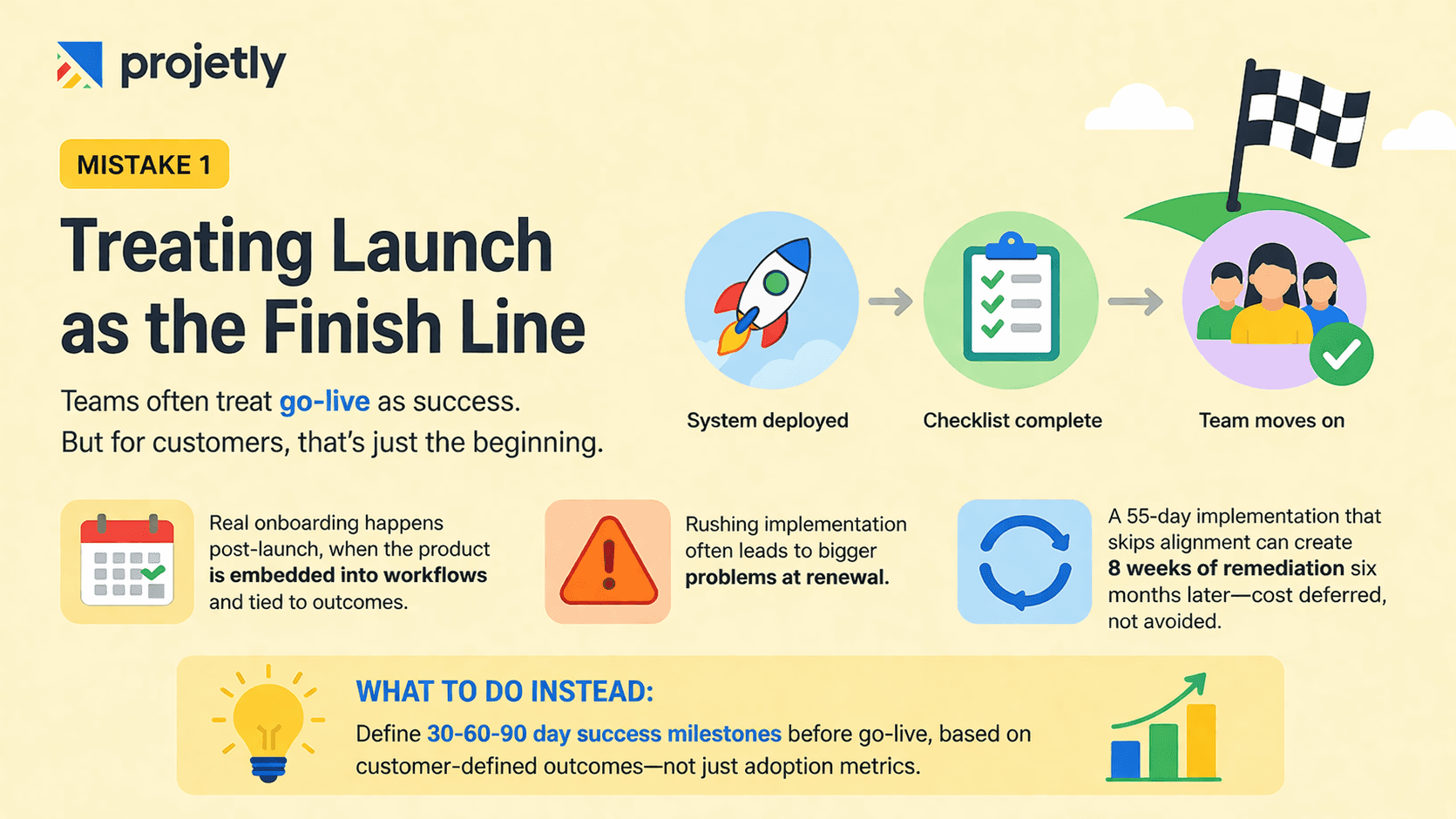
The most common onboarding mistake is treating go-live as success. The system is deployed, the checklist is done, and the team moves on.
But for the customer, go-live is day one, not the finish line.
Real onboarding happens after launch: embedding the product into workflows, tying usage to outcomes, and proving it’s indispensable.
Teams that optimize for speed often pay later. A fast implementation that skips alignment just creates delayed churn risk, not real success.
What to do instead
Plan for success after go-live:
Define 30, 60, 90-day milestones before launch
Use customer-defined outcomes, not internal metrics
Track whether the product is actually delivering value
Because deployment isn’t success, impact is.
Start Your Free Trial and See Results
Mistake 2: Defining Success Criteria Once and Never Revisiting Them
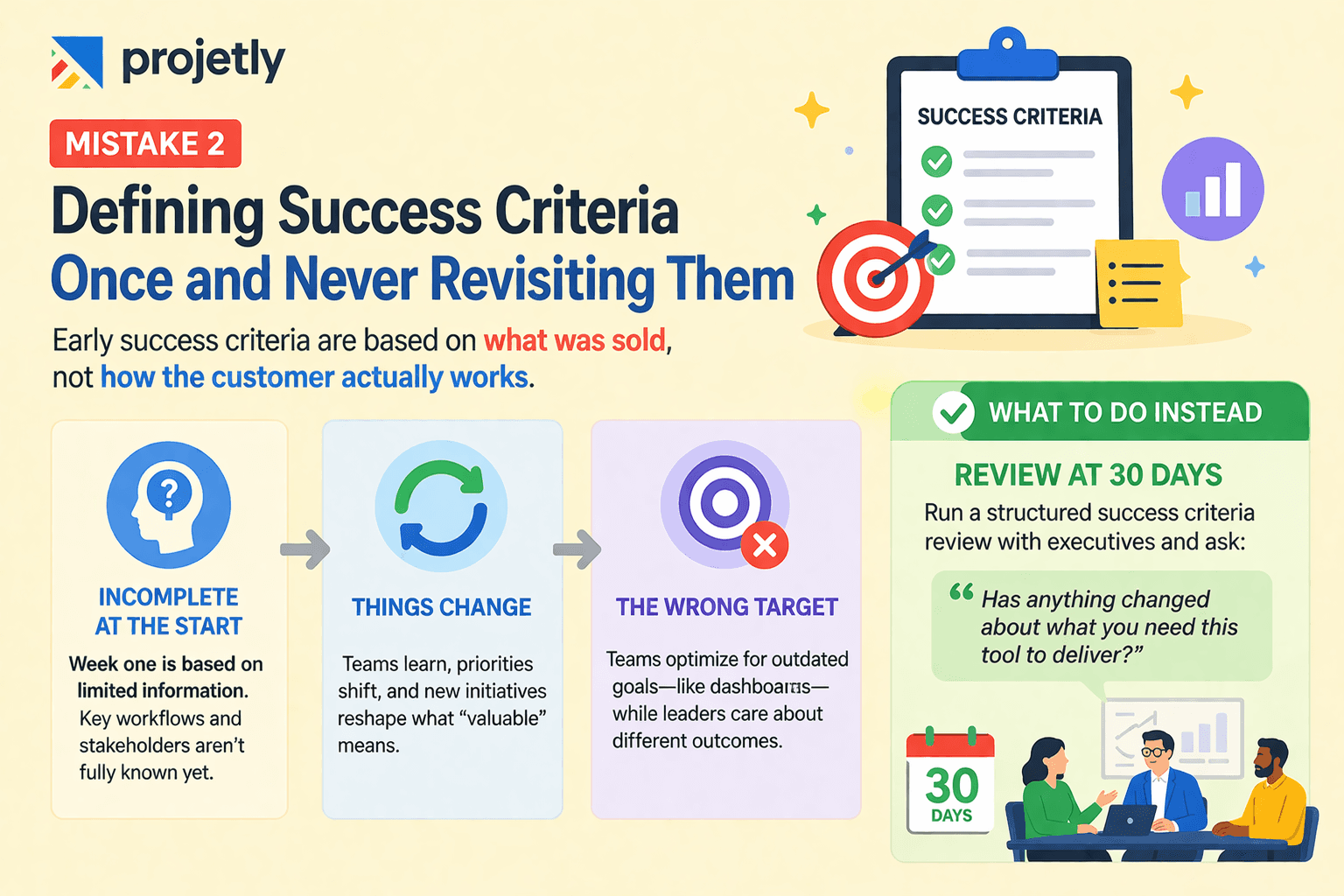
The success criteria set in week one are based on incomplete information.
You know what was sold, not how the customer actually operates, what workflows matter most, or who will judge success.
As onboarding progresses, reality shifts:
Workflows differ from discovery
Priorities change
New initiatives redefine value
But if success criteria aren’t revisited, teams keep optimizing for the wrong goal.
That’s how you end up building the perfect dashboard, while leadership is measuring something else entirely.
What to do instead
Revalidate success early:
Schedule a 30-day success criteria review
Involve executive stakeholders
Ask directly: “Has anything changed about what success looks like?”
Because onboarding isn’t static, and your definition of success shouldn’t be either.
Mistake 3: Ignoring User Segmentation and Applying a One-Size-Fits-All Approach
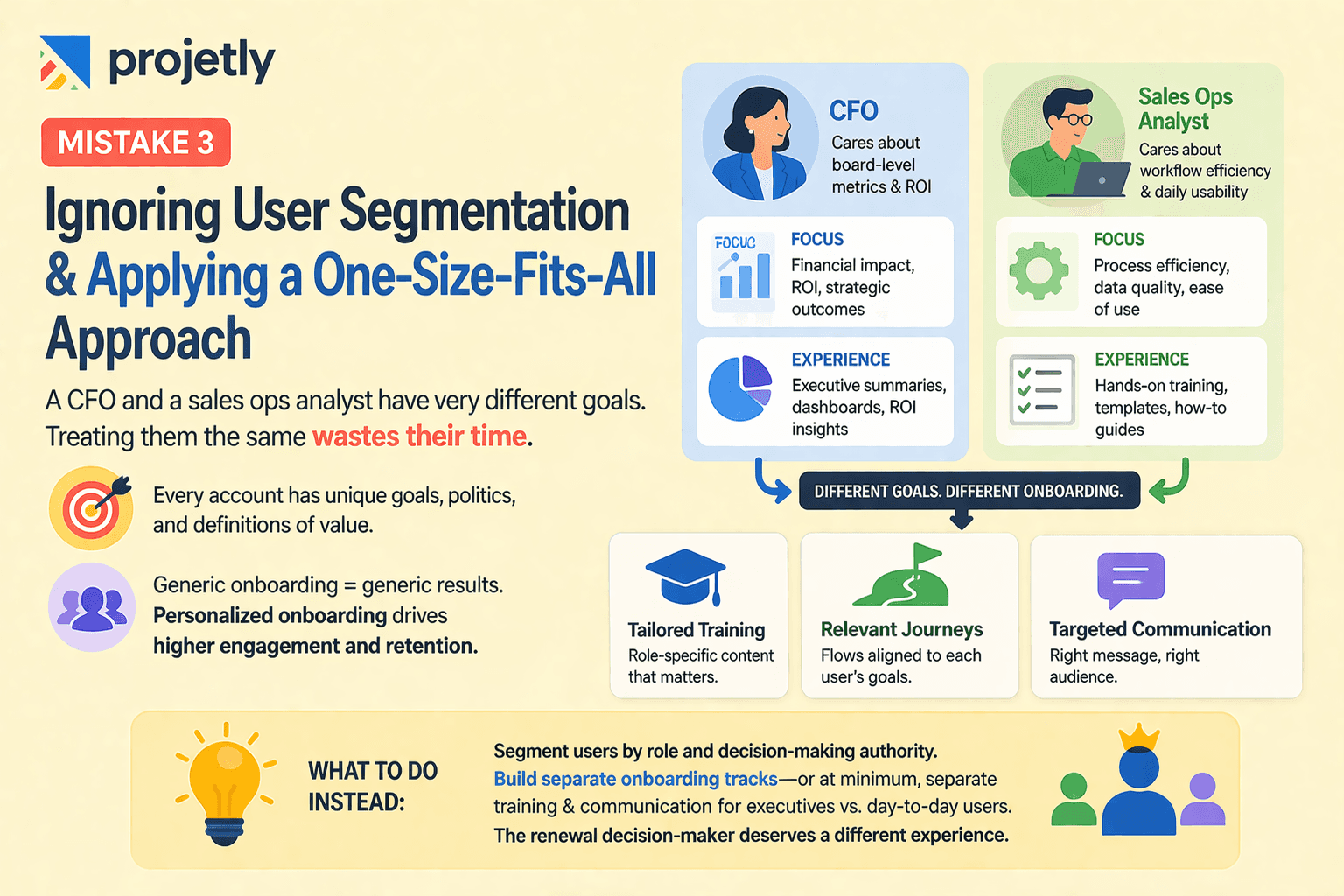
Customer Onboarding a CFO and a sales ops analyst the same way is a mistake.
One cares about ROI and board metrics. The other cares about workflows and daily usability.
Treat them identically, and you waste both their time.
The same applies at the account level. Every customer has different goals, priorities, and definitions of value. Generic onboarding, same deck, same setup, same playbook, leads to generic outcomes. It signals you’re delivering a product, not solving a problem.
High-performing teams personalize early. Companies like HubSpot and Notion tailor onboarding based on role and goals, increasing engagement and reducing drop-off.
What to do instead
Personalize onboarding by role and impact:
Segment users by role and decision authority
Create separate tracks for executives vs. operators
Align onboarding to what each persona values most
Because the person deciding renewal shouldn’t experience onboarding the same way as the person using the tool daily.
Mistake 4: Letting Executive Stakeholders Disengage
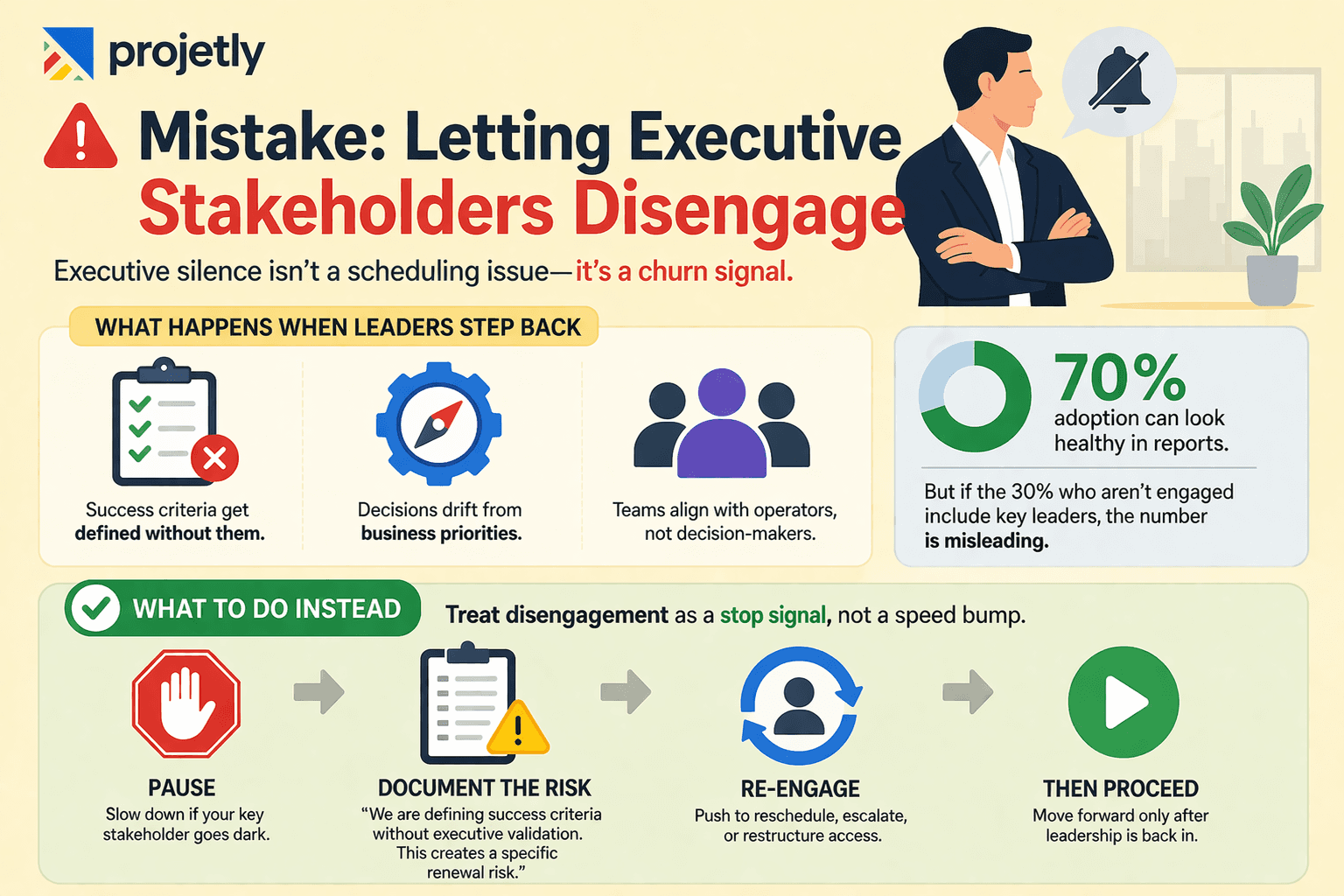
This is the mistake that most reliably predicts churn, and the one teams avoid addressing.
When a champion says they’re “too busy” for onboarding calls, it’s not just a scheduling issue. It’s a misalignment signal. The executive who defined the problem is no longer connected to the solution.
When they disengage, things quietly drift:
Success criteria are defined without them
Decisions miss strategic priorities
Teams align with operators, not decision-makers
By renewal, the buyer barely remembers what the solution was meant to achieve.
Even strong adoption can hide this. If key stakeholders aren’t engaged, the numbers are misleading.
What to do instead
Treat executive disengagement as a stop condition, not a delay:
Pause and document the risk clearly
Call out the gap: “We’re defining success without executive validation”
Push to re-engage, reschedule, escalate, or adjust access
Because if the buyer isn’t involved, the outcome won’t matter.
Mistake 5: Losing Context Across Handoffs
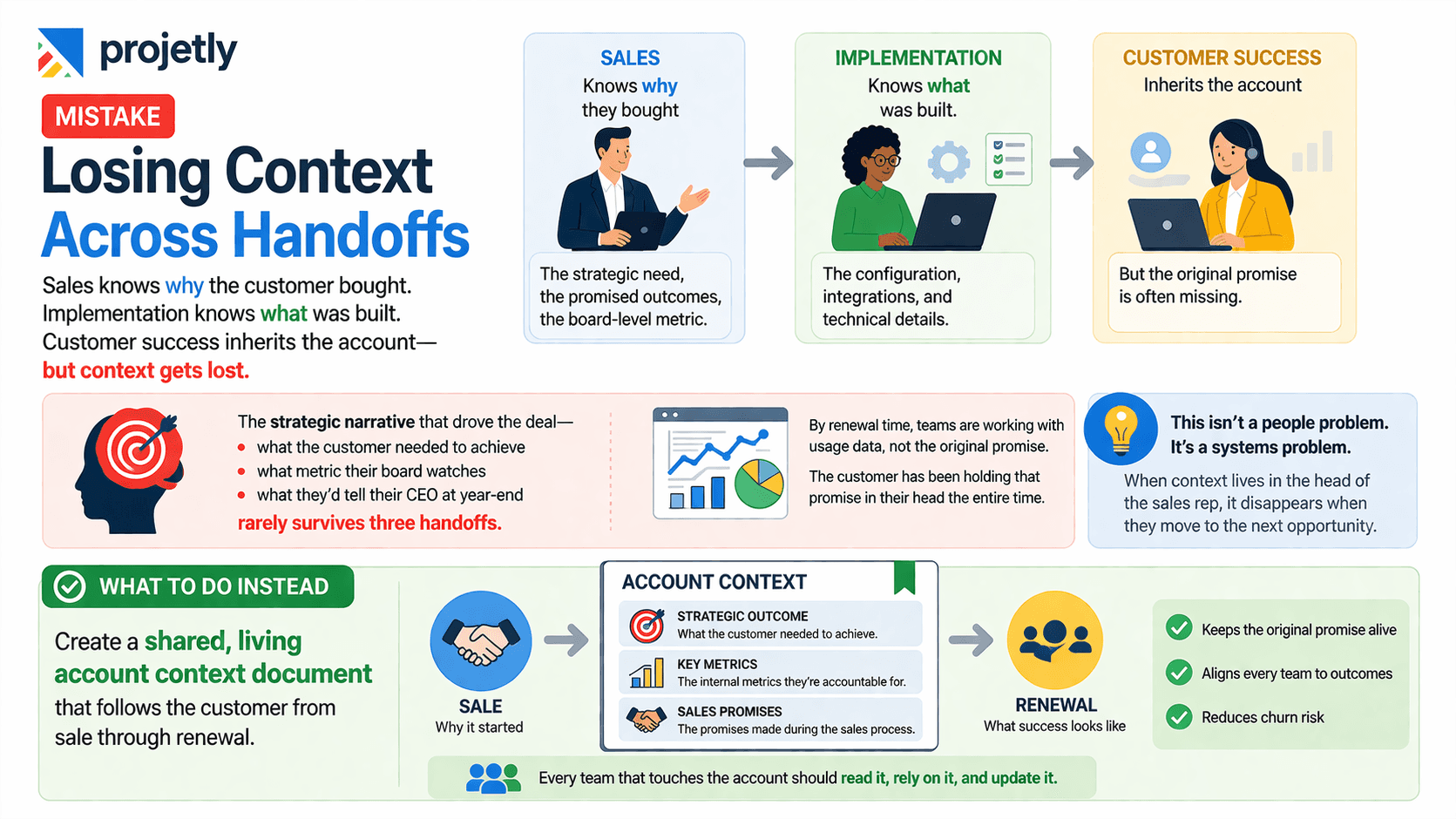
Sales knows why the customer bought. Implementation knows what was built. Customer success inherits the account.
At every handoff, context is lost.
The original promise, what the customer needed to achieve, the metric leadership cares about, the story they’d tell their CEO rarely survives intact. By renewal, CSMs rely on usage data, while the customer is still measuring you against that original expectation.
This isn’t a people problem. It’s a systems problem.
When context lives in someone’s head, it disappears with the handoff.
What to do instead
Create a shared, living account context:
Capture the strategic outcome the customer cares about
Document key metrics and success criteria
Record promises made during sales
Make it visible across teams, and update it continuously.
Because if the context doesn’t transfer, neither does the value.
Mistake 6: Tracking the Wrong Metrics (Usage Without Meaning)
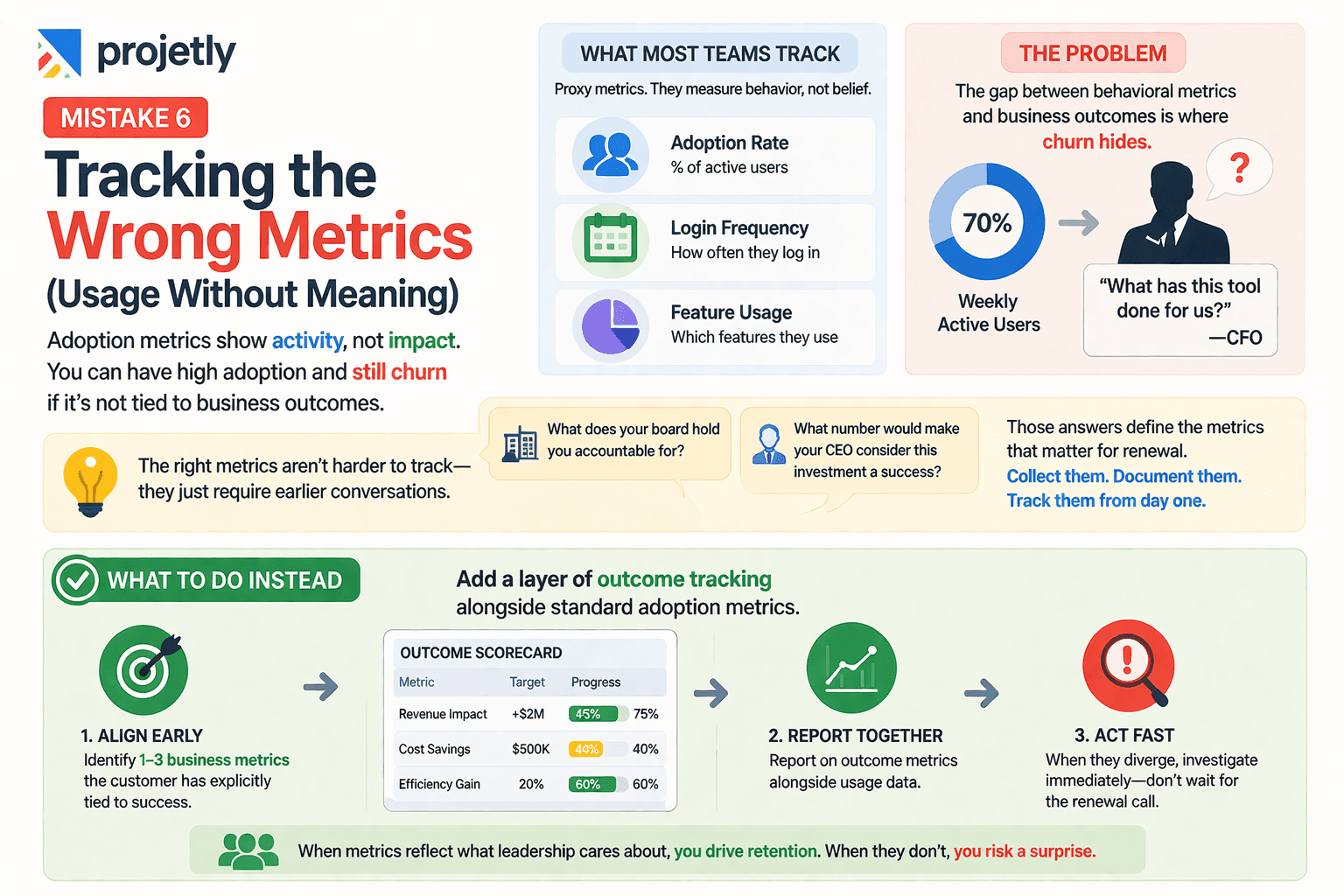
Adoption rates, logins, and feature usage are useful, but they’re proxy metrics. They show behavior, not belief.
A customer can have high activity and still churn if the wrong users are engaged, or if usage isn’t tied to real business outcomes.
That gap between activity and impact is where churn hides.
You might celebrate strong adoption, but can your customers’ leadership answer:
“What has this tool actually delivered for us?”
If not, the risk is already there.
The metrics that matter aren’t harder to track; they just require better conversations early on.
What does success look like for their leadership? What number defines ROI?
What to do instead
Track outcomes, not just activity:
Define 1–3 business metrics tied to success for each customer
Align these with leadership expectations early
Report them alongside usage data
If usage is high but outcomes aren’t, act immediately, not at renewal.
Because adoption doesn’t guarantee success. Outcomes do.
Mistake 7: Not Collecting Customer Feedback During Onboarding
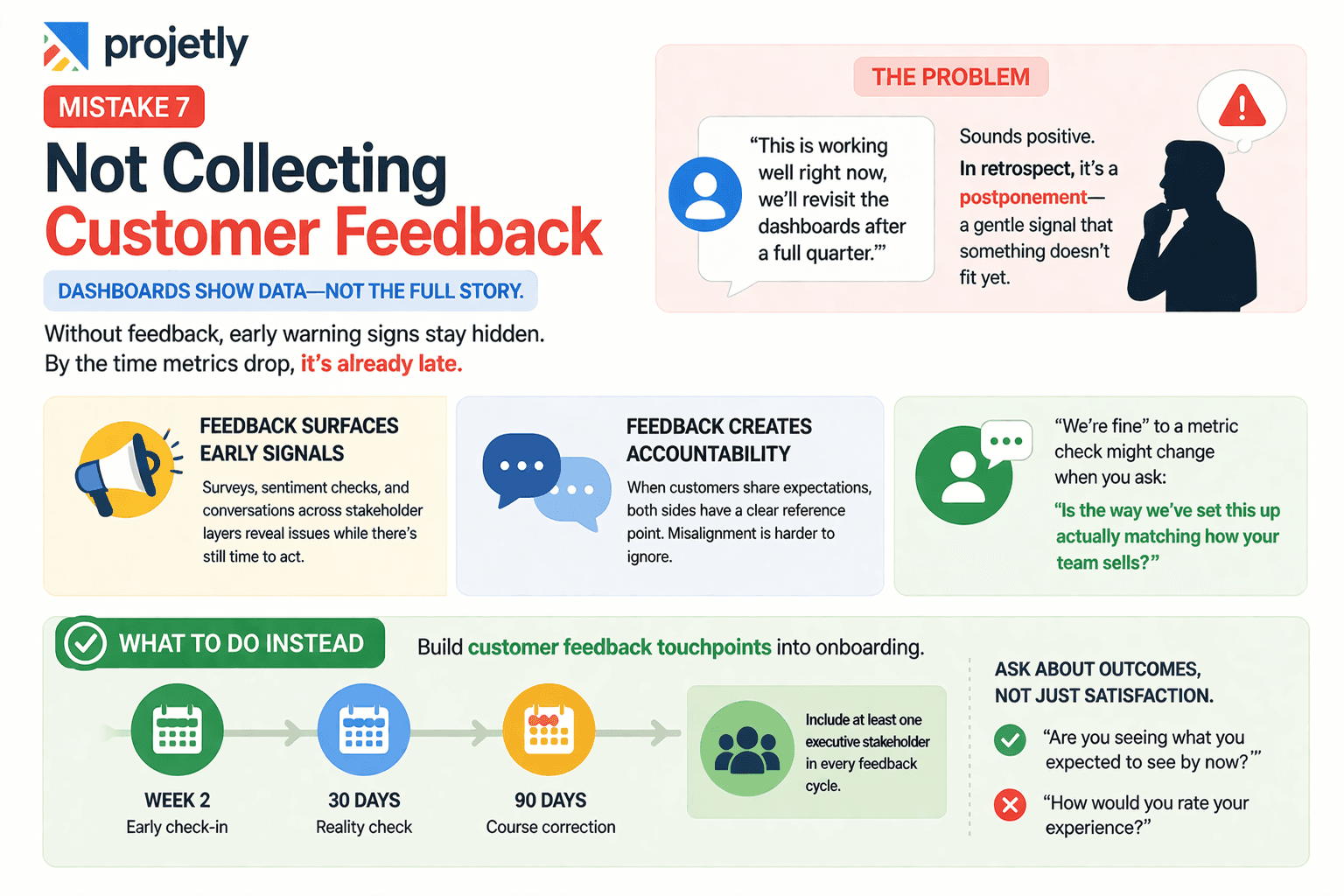
Teams that rely only on dashboards to judge onboarding health miss what matters most. Metrics show activity, not sentiment or misalignment.
You’ll hear, “This is working well, we’ll revisit later.”
It sounds positive, but it’s often a polite signal that something isn’t quite right.
Data tells you what’s happening. Feedback tells you why.
That’s why structured feedback loops are critical. Surveys, check-ins, and real conversations surface issues early, while there’s still time to fix them. A customer who says “everything’s fine” on metrics may reveal gaps when asked,
“Does this setup actually match how your team works?”
Feedback also creates accountability. Once expectations are clearly stated, misalignment can’t quietly grow.
What to do instead
Build feedback into onboarding:
Week 2: Early check
Day 30: Adoption review
Day 90: Outcome validation
Focus on outcomes, not satisfaction:
“Are you seeing the results you expected?”
Because B2B onboarding doesn’t fail from a lack of data, it fails when teams stop listening.
Fix Your Onboarding Gaps, Talk to Us
The Underlying Issue: Onboarding as a Handoff, Not a Journey
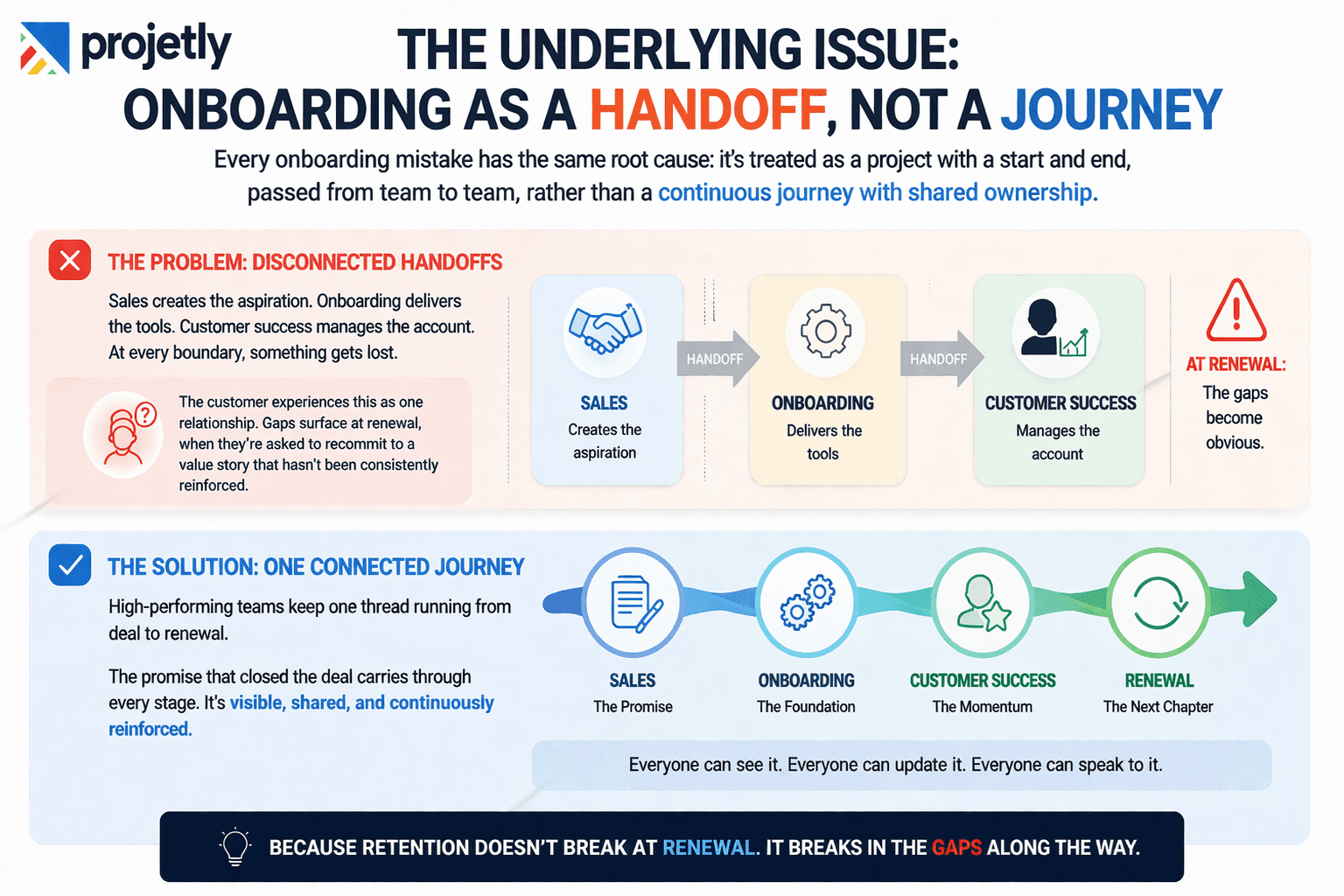
Every mistake on this list shares a root cause: onboarding is treated as a project with a start date and an end date, passed from team to team, rather than a continuous journey with shared ownership.
Sales create the aspiration. Customer Onboarding delivers the tools. Customer success manages the account. At every boundary, something gets lost. The customer, who experiences this as one continuous relationship, eventually feels the gaps, usually at renewal, when they're asked to recommit to a value story nobody has been consistently telling.
The organizations that retain and expand customers in 2026 treat the customer journey as a single, connected thread.
The promise that closed the deal is the same thread that runs through configuration, training, QBRs, and renewal conversations. Everyone on the team can see it, update it, and speak to it.
Onboarding Mistakes Checklist: What to Audit Today
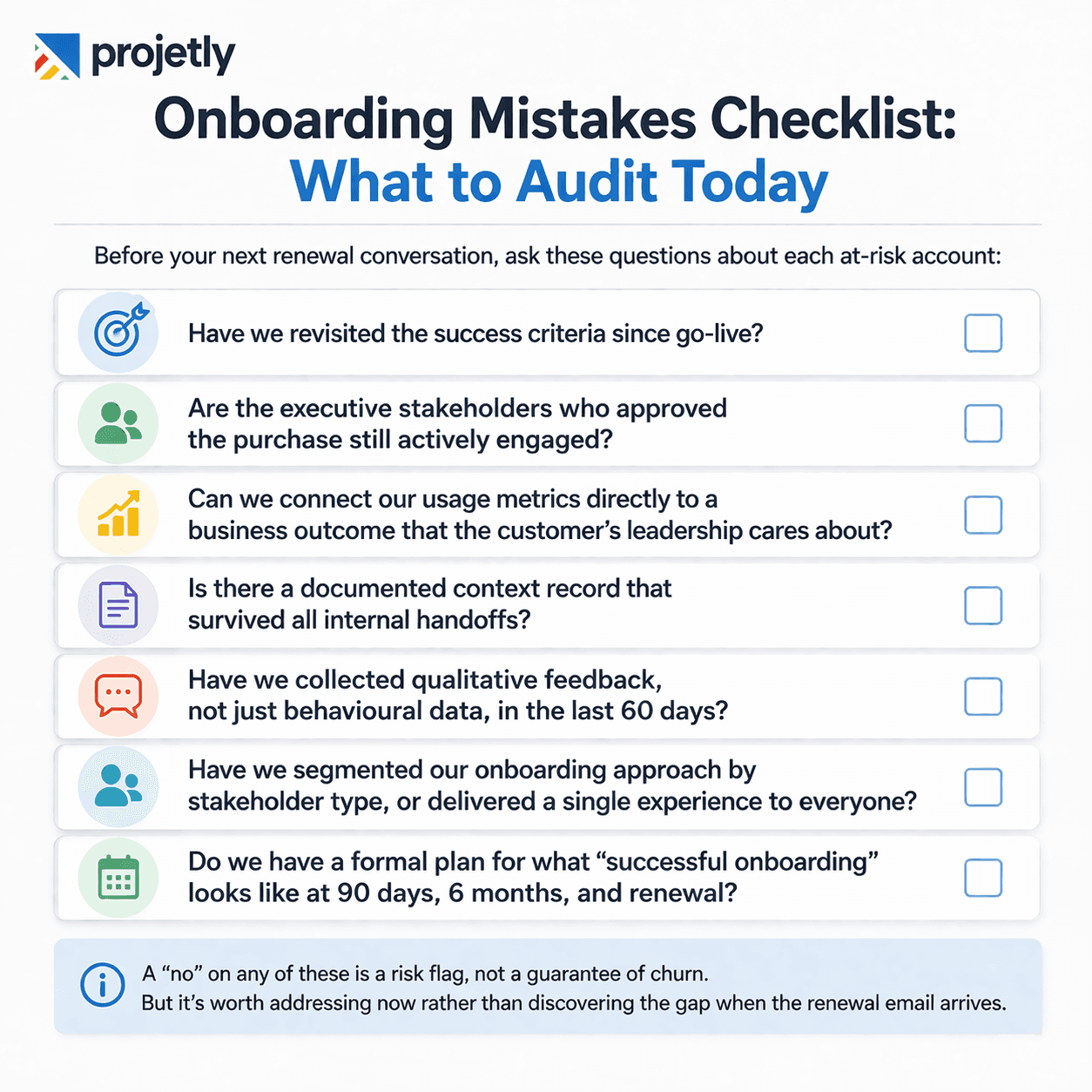
Before your next renewal conversation, ask these questions about each at-risk account:
Have we revisited the success criteria since go-live?
Are the executive stakeholders who approved the purchase still actively engaged?
Can we connect our usage metrics directly to a business outcome that the customer's leadership cares about?
Is there a documented context record that survived all internal handoffs?
Have we collected qualitative feedback, not just behavioural data, in the last 60 days?
Have we segmented our onboarding approach by stakeholder type, or delivered a single experience to everyone?
Do we have a formal plan for what "successful onboarding" looks like at 90 days, 6 months, and renewal?
A "no" on any of these is a risk flag, not a guarantee of churn. But it's worth addressing now rather than discovering the gap when the renewal email arrives, written in careful, measured language.
Final Thought: Build Conviction, Not Just Completion
The real work of customer onboarding isn't completing the checklist. It's building genuine conviction, at the executive level, where renewal decisions get made, that the product is central to how the business operates and that the outcomes promised during the sale are actually materializing.
Completion is checkboxes. Conviction is what keeps customers.
The teams that understand this distinction deliver onboarding experiences that look the same at launch but feel completely different six months later: not a formal, measured renewal conversation, but a call where the customer asks how soon they can expand.
Frequently Asked Questions
1. What is the most common customer onboarding mistake that leads to churn?
The single most common mistake is treating launch as the finish line. Teams complete the implementation, hit their milestones, and move on, while the customer is still figuring out whether the product actually delivers on what was promised. Churn rarely happens because of a bad launch. It happens because nothing meaningful was built after it.
2. How do you know if your onboarding process is causing churn?
The clearest sign is a renewal conversation that starts with phrases like "reviewing contract scope" or "aligning on success metrics." By that point, the damage is already done. Earlier warning signs include executive stakeholders going quiet after go-live, adoption plateauing below 80%, and an inability to connect your usage data to a business outcome that the customer's leadership actually measures.
3. Why does executive disengagement during onboarding matter so much?
Because executives control renewals, not end users. A product can have strong day-to-day adoption among individual contributors and still churn if the VP or CFO who approved the budget never connected the implementation to the outcome they were buying. When decision-makers disengage during onboarding, they arrive at renewal without conviction, and without conviction, the default answer is no.
4. What's the difference between onboarding completion and onboarding success?
Completion means the checklist is done, the system is configured, training has happened, and the team can use the product. Success means the customer believes the product is essential to achieving the outcome they bought it for. You can have 100% completion and zero success. The metric that matters at renewal isn't days to launch; it's strength of conviction.
5. How often should success criteria be revisited during onboarding?
At a minimum, once at the 30-day post-launch mark. Success criteria set during implementation are based on incomplete information. Once customers are using the product daily, they often discover that what they thought they needed and what they actually need are slightly different things. A formal 30-day review, with executive participation, catches that drift before it compounds into a six-month misalignment.
6. What does a good sales-to-customer-success handoff look like?
A good handoff preserves the "why" behind the deal, not just what was purchased, but what business outcome the customer was trying to achieve, what metric their leadership is watching, and what was explicitly promised during the sales process. That context should live in a shared, accessible document that every team member who touches the account can read and update. If that context only exists in the sales rep's memory, it's already lost.
7. Can onboarding mistakes be fixed after go-live?
Yes, but it costs significantly more, in time, senior resources, and deferred revenue, than getting it right the first time. Recovery is possible: reconnecting with executives, rebuilding reporting around the right metrics, and re-engaging passive stakeholders can turn a shaky renewal into an expansion. But it takes weeks of effort that should never have been necessary, and it starts with a difficult conversation where you essentially admit the first six months were measuring the wrong things.
Want to build an onboarding process that drives conviction, not just adoption? Book a demo and see how our platform helps customer success teams connect implementation to renewal.
You may also like

A Guide to Project Management Professional Certification

Laugh Your Way to Productivity: 50 Workplace Quotes

50 Funny Workplace Memes That’ll Brighten Your Workday.
What Does a Customer-First Mindset Mean? Explained in 2025

What It Takes to be a Great Customer Success Manager in 2025