Digital Sales Room

By
Sammy Jones

Key Differences Between Trumpet and Projetly
Trumpet is a highly customizable digital sales room built around “Pods,” with strong CRM sync, a document writer that drafts executive summaries from call transcripts, and Maestro AI scoring engagement across every stakeholder. For teams that want deep layout control and a white-glove setup experience, it’s a strong option.
Projetly is an AI native digital sales room built for complex B2B enterprise deals. It captures intelligence from every customer in conversation automatically, standardizes rep execution with custom pipelines and AI next-best-action guidance, connects sales directly to customer onboarding, and tracks post-sale engagement to protect net revenue retention.
The difference is not the features. It is how far into the revenue lifecycle each platform is actually built to go.
What Each Platform is Built to Do
Trumpet:
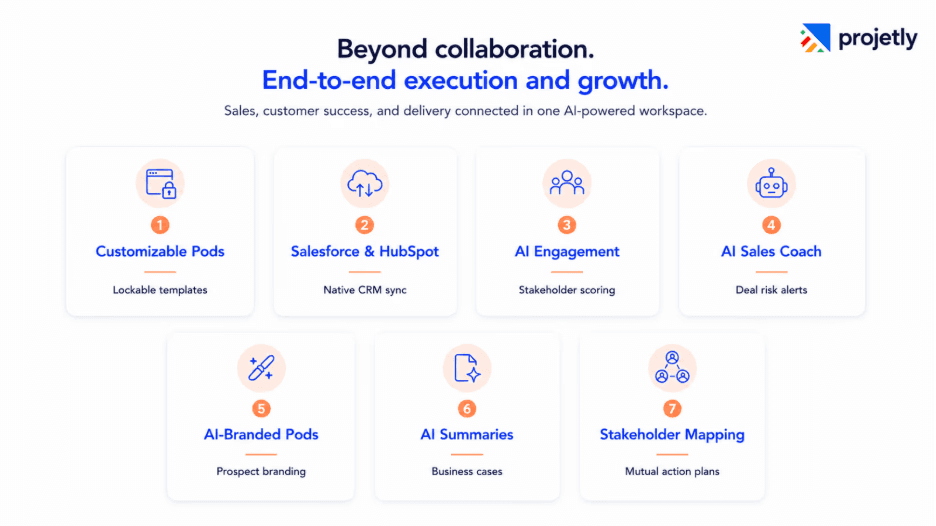
Customizable Pods, covering navigation, background, headers, content blocks, and branding, with lockable templates for governance
Deep, two-way integration with Salesforce and HubSpot
Maestro AI scores engagement across every deal and stakeholder, drilling into individual scores within the org chart
Casey AI sales coach scans Pods for red flags and suggests next steps
Composer AI auto-brands a Pod with a prospect’s logos and colors
A document writer widget that drafts executive summaries and business cases from Pod activity and Gong call transcripts
Stakeholder Scout, which identifies missing personas in a deal and helps map mutual action plans
Best suited for teams that want granular design control and dedicated “white glove” onboarding support from Trumpet’s own team
Projetly:
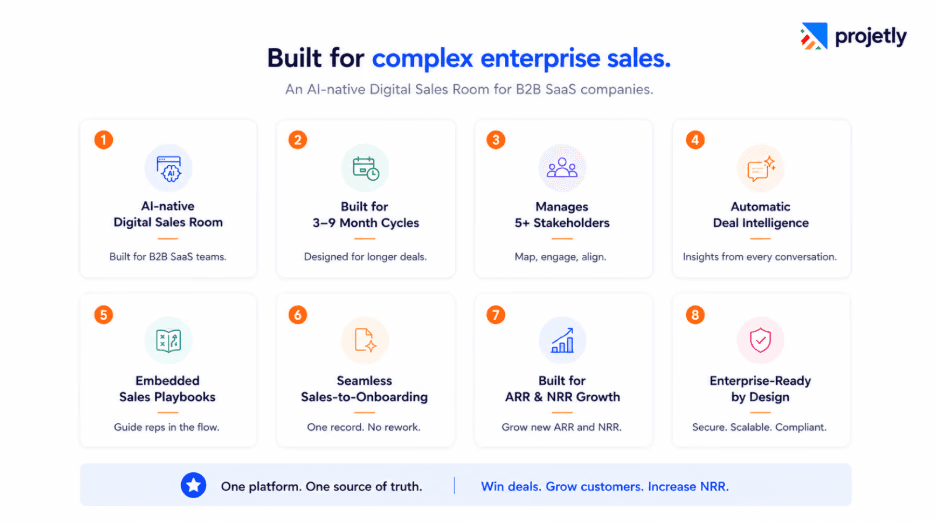
An AI native digital sales room built for B2B SaaS companies running complex enterprise deals
Designed for sales cycles of three to nine months with five or more stakeholders
Captures deal intelligence automatically from every customer conversation, no rep input required
Scales rep performance with custom pipelines and AI next-best-action guidance
Carries deal context into customer onboarding: your team creates a Project Room from the closed deal and picks up AI-generated onboarding templates there.
Built for teams where NRR sits alongside new ARR on the scorecard
Where Trumpet is Genuinely Strong
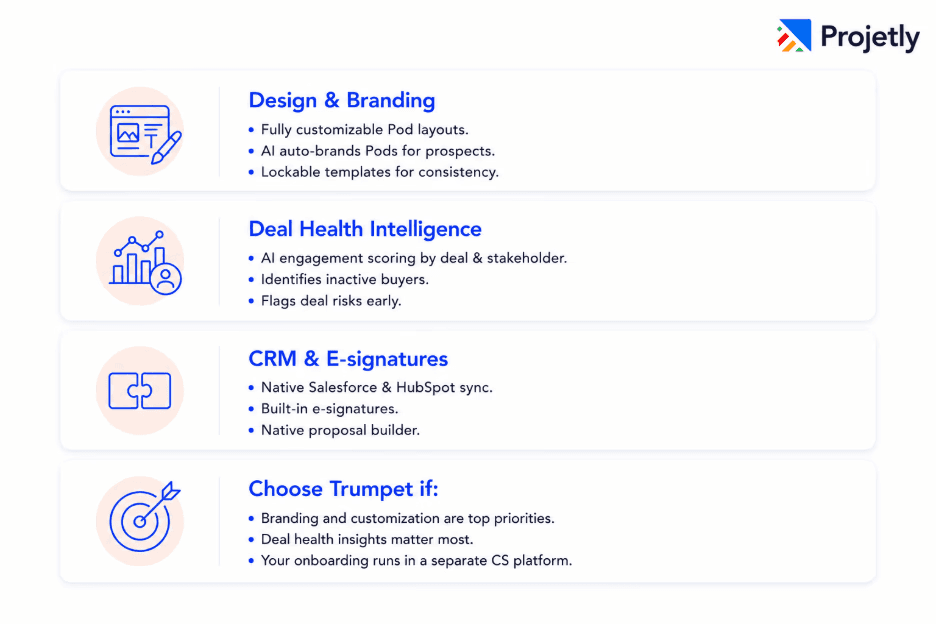
Trumpet delivers one of the most customizable Pod experiences in the category, paired with genuine AI investment in deal health scoring and content generation.
Design and branding control:
Navigation, headers, content blocks, fonts, and colors are all configurable per Pod
Composer AI auto-brands a Pod with a prospect’s logo and color palette
Lockable templates keep governance intact while still allowing personalization
Deal health intelligence:
Maestro AI scores engagement across every deal and every stakeholder
Scores drill down into an org chart view, showing which individual has gone quiet
High-risk deals are flagged early when engagement drops below healthy benchmarks
CRM depth and native e-signature:
Deep, two-way integration with Salesforce and HubSpot
Native e-signature is included, removing a DocuSign dependency at the contract stage
Dynamic proposal builder is available natively, which neither Aligned nor Projetly currently offers
Honest recommendation: if layout customisation and deal health scoring matter more to your team than native meeting intelligence or a built-in onboarding handoff, and your CS team runs onboarding independently in a separate system, Trumpet is a well-built choice.
Where Trumpet Stops
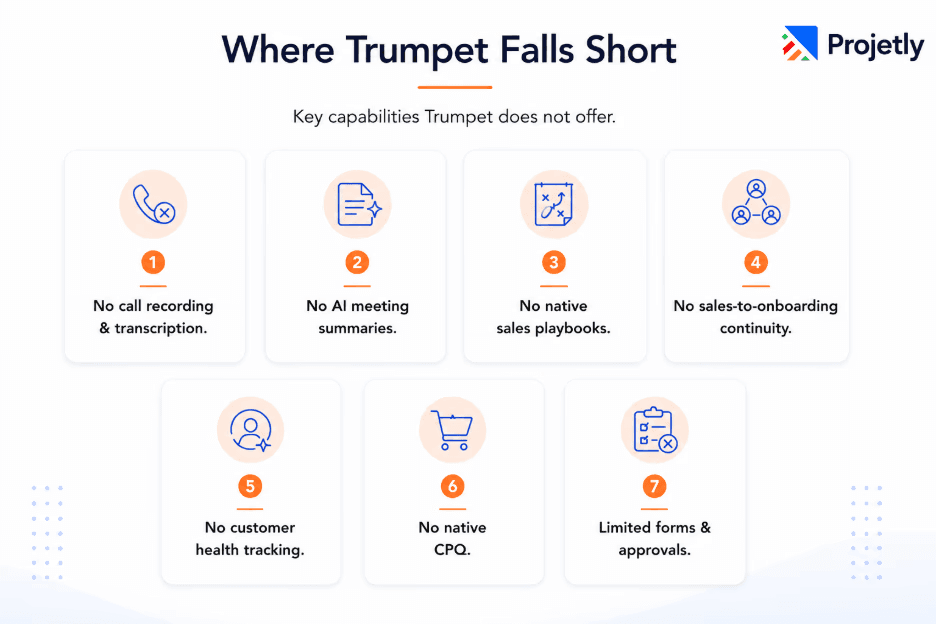
Trumpet scores deal health and drafts content well, but it does not capture what was actually said on a call, and it does not carry the deal forward once it closes.
No native meeting transcription, AI-generated meeting summaries, or action item extraction. The document writer widget drafts summaries from Gong transcripts, which means a Gong subscription is a prerequisite rather than a built-in capability
No configurable pipeline or AI next-best-action to standardize how reps run a deal stage by stage
No unified workspace connecting sales, onboarding, and delivery. Trumpet ends at Closed Won
No post-sale engagement tracking beyond the sales cycle
No embedded digital commerce or CPQ integration.
Forms, surveys, and approval workflows are only partially supported, with no dedicated change management workflow
Where Projetly Goes Further
Projetly extends beyond deal room collaboration to include account execution, onboarding, and account growth. It keeps sales, customer success, and delivery connected in a single AI-powered workspace.
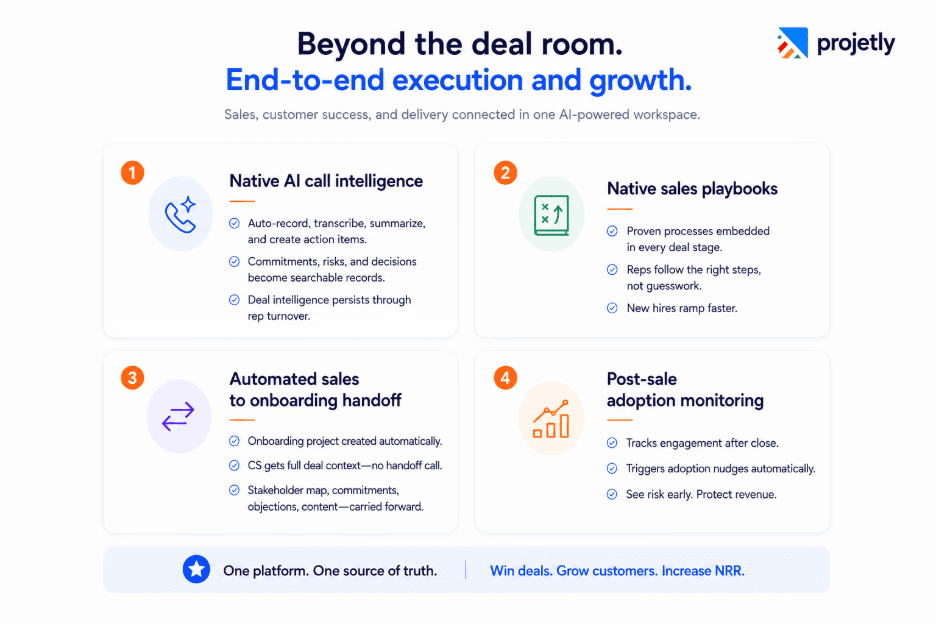
1. Native AI call intelligence
Every customer meeting is recorded, transcribed, summarized, and converted into action items automatically, with no third-party call recording tool required
Commitments, risks, and decisions become searchable records inside the deal room
Deal intelligence persists through rep turnover
Trumpet’s summary generation depends on Gong transcripts rather than native call capture
2. Custom pipelines and next best action
Deal stages run through configurable pipelines, so every rep works the same defined stages
AI next best action recommends the right move at each stage with the reasoning behind it, so reps do not rely on a manager checking in
New hires ramp faster because the pipeline stages and recommended actions live in the tool, not in a wiki
Trumpet has no equivalent custom-pipeline or next-best-action capability
3. Manual, same-platform handoff
when a deal closes, a team member starts the onboarding project from the deal record in a few clicks.
CS gets access to the same workspace as the closed deal: stakeholder map, commitments, objections, content shared
Moving specifics into the onboarding plan is still a manual step, but nothing has to be re-requested from the buyer or rebuilt from a blank page
Trumpet has no equivalent mechanism once a Pod closes
4. Post-sale engagement tracking
Tracks customer engagement after close
Shows when account activity drops, so account managers can act
Gives account managers visibility into engagement, so they can spot accounts going quiet
Trumpet’s Maestro AI scores engagement during the sales cycle, but that scoring does not extend into a post-sale onboarding or adoption workspace
Where Projetly Stops
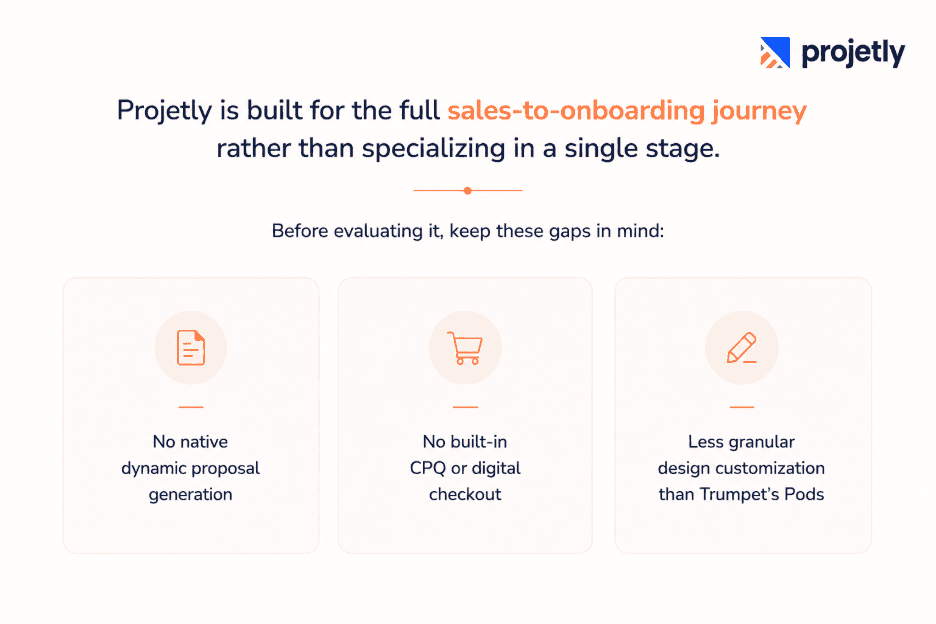
No native dynamic proposal builder. Proposals and business cases can be attached and shared inside the room, but Projetly does not generate them dynamically the way Trumpet does
No embedded CPQ or digital commerce checkout inside the room. Pricing and quoting can be attached and shared, but not configured or transacted natively
Design customization is functional rather than deeply granular. Teams that want to control layout down to individual fonts, headers, and content blocks per room, the way Trumpet’s Pods allow, may find Projetly more templated by comparison.
Honest recommendation: if dynamic proposal generation, real-time CRM field sync, or granular per-room branding are must-haves today, weigh that against Projetly’s onboarding continuity and native call intelligence before deciding. For most B2B SaaS teams, the tradeoff favours continuity, but it is a real tradeoff, not a one-sided comparison.
Full Capability Comparison
Capability | Trumpet | Projetly |
Buyer portal and mutual action plans | Yes | Yes |
Dynamic proposal builder | Yes | No |
Native e-signature | Yes | Yes |
Stakeholder mapping and org charts | Yes (AI Org Charts) | Yes |
Bidirectional CRM sync (Salesforce, HubSpot) | Yes | Yes (Salesforce, HubSpot) |
Gong integration | Yes | No |
Native meeting transcription and AI summaries | No | Yes |
Custom pipelines and next best action | No | Yes |
Manual, same-platform handoff | No | Yes |
Post-sale engagement tracking | No | Yes |
Forms, approvals, and survey workflows | Partial | Yes |
Embedded digital commerce or CPQ | No (CPQ via API only) | Partial |
Freemium plan | Yes | Yes |
Microsoft Teams integration | Yes | Yes |
Download the Guide: How High-Performing B2B Teams Keep Enterprise Deals Moving
Learn how leading B2B teams eliminate deal stalls, align stakeholders, and accelerate enterprise sales.
Onboarding Continuity: The Capability That Defines the Revenue Arc
The Gartner Market Guide for Digital Sales Rooms (February 2026) defines the category as platforms that should support the full customer lifecycle, covering presales, initial sale, customer growth, renewal, and relationship building. Gartner also notes that the rate of expansion of use cases across the full customer lifecycle is increasing as DSRs become the single source of engagement.
Trumpet’s own vendor profile in the same guide focuses on deal execution: Pods, Maestro AI scoring, Casey’s coaching, and Composer’s branding. None of that scoring or coaching extends into a dedicated onboarding workspace once the deal closes.
What continuity means in practice with Projetly:
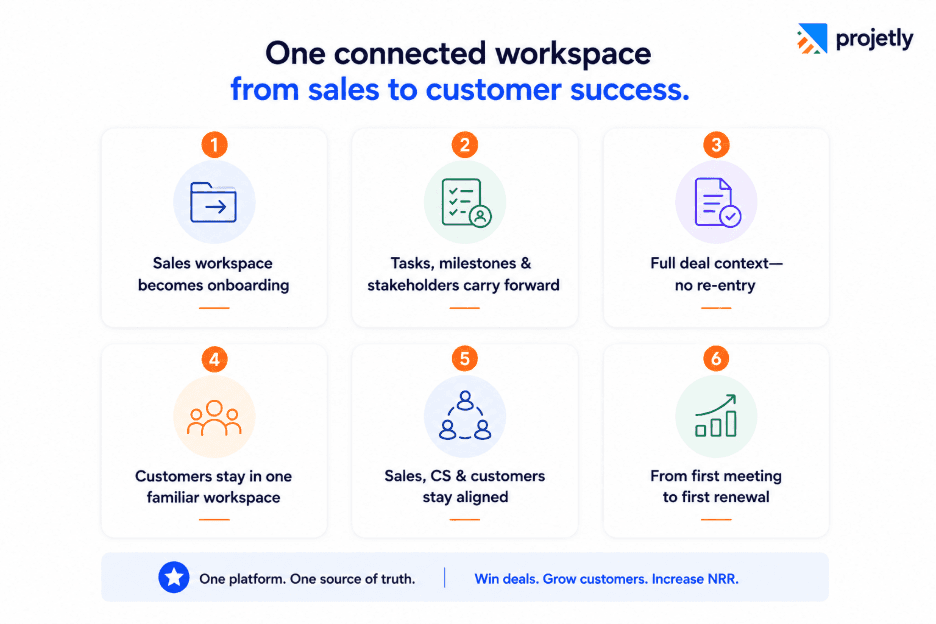
The workspace that ran the sales cycle becomes the onboarding project
Tasks, milestones, stakeholder access, and the full deal record carry forward without re-entry
The customer stays in the same environment they used to evaluate and buy
Sales, CS, and the customer operate in one shared workspace from first contact through first renewal
Why it produces measurable outcomes:
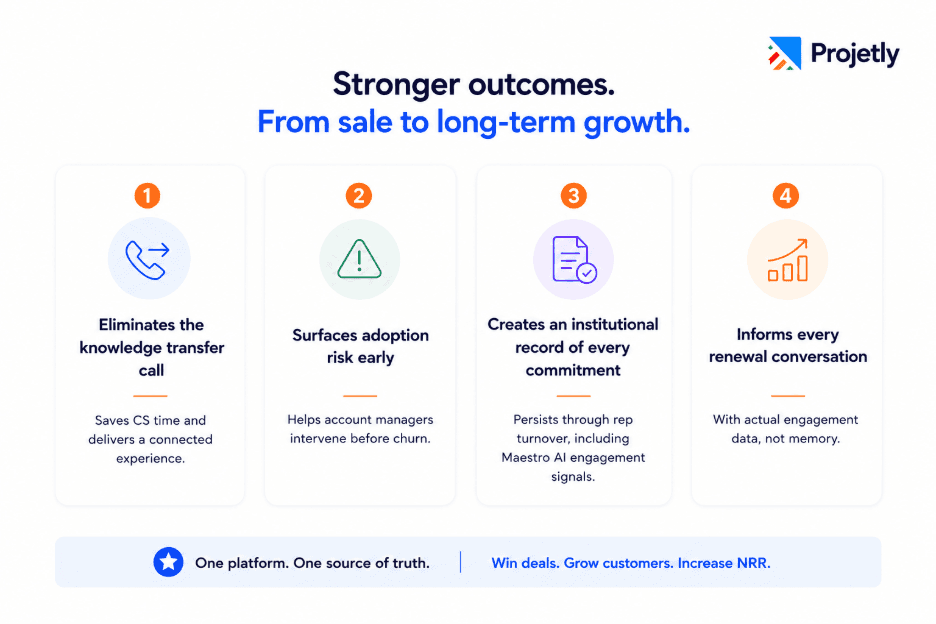
Eliminates the knowledge transfer call, saving CS time and signaling a connected buying and delivery experience
Surfaces engagement data early so account managers can intervene before churn
Creates an institutional record of every commitment that persists through rep turnover, including the engagement signals Maestro AI would have tracked during the sale
Informs every renewal conversation with actual engagement data, not memory
What Trumpet provides:
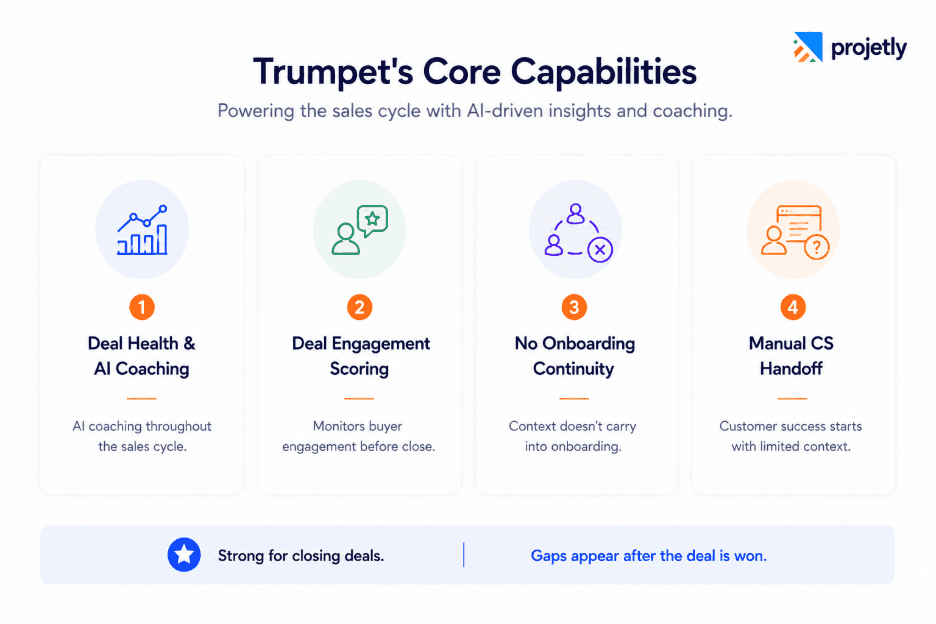
Deal health scoring and coaching through the sales cycle
No mechanism to carry the stakeholder map, engagement scores, or commitments into a dedicated onboarding workspace
CS team starts from a separate tool with whatever context is passed along manually
What Customers Say
Trumpet (G2 verified review, 4.7 out of 5):
Trumpet transformed scattered emails and disconnected tools into one streamlined, customer-facing workspace, according to a G2 reviewer, driving stronger engagement and faster deal velocity through its intuitive UI, deep CRM integration, and context-aware AI. Their feedback pointed to room for growth: deeper branding customization, an easier onboarding curve, and more advanced AI personalization. (G2, 2026)
Projetly (G2 verified review, 4.8 out of 5):
A Mid-Market reviewer on G2 praised Projetly for unifying onboarding and product adoption into a single platform, replacing a previously fragmented toolset. Since switching, they’ve streamlined workflows, gained better visibility into user progress, and seen higher activation with fewer drop-offs. Their main request: deeper messaging integrations like WhatsApp for mobile-first engagement.(G2, May 2026)
Which Platform Fits Your Situation
Choose Trumpet if:
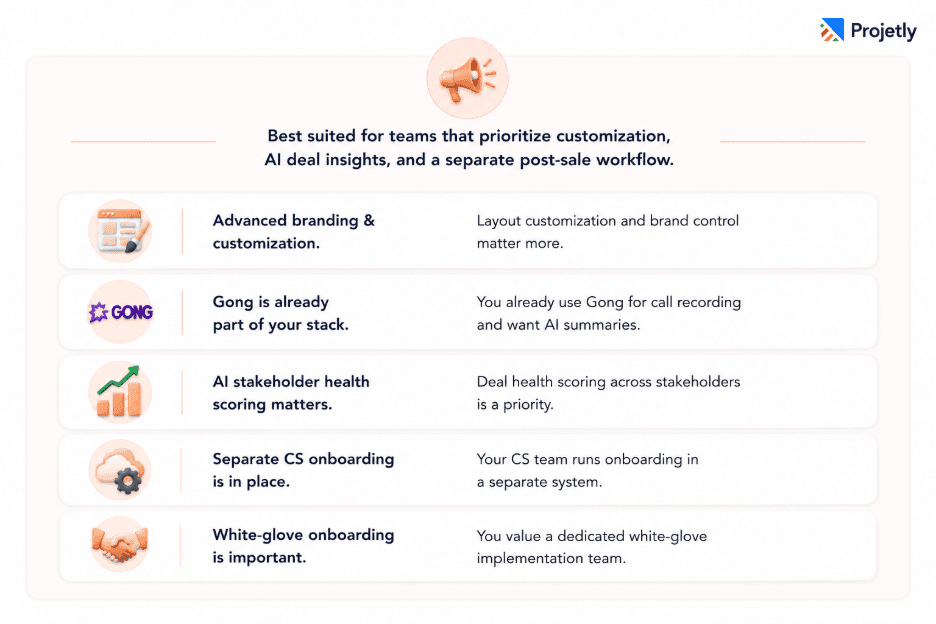
Layout customization and brand control matter more than native meeting intelligence
You already run Gong for call recording and want a widget that drafts summaries from those transcripts
Deal health scoring across stakeholders is a priority, and Maestro AI covers your use case
Your CS team runs onboarding in a separate system, and that handoff is already working
You value a dedicated white-glove implementation team during setup
Choose Projetly if:
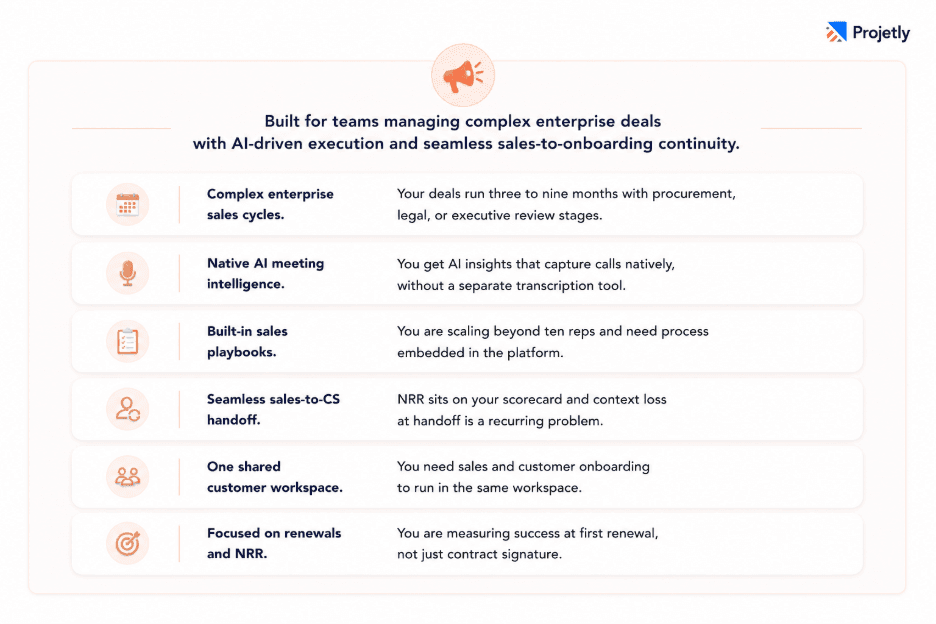
Your deals run three to nine months with procurement, legal, or executive review stages
You want AI meeting intelligence that captures calls natively, without depending on a separate transcription tool
You are scaling beyond ten reps and need process embedded in the platform, not documented in a wiki
NRR sits on your scorecard and context loss at handoff is a recurring problem
You need sales and customer onboarding to run in the same workspace
You are measuring success at first renewal, not just contract signature
Ready to see how Projetly runs a six-month enterprise deal from first room to first renewal? Book a 30-minute walkthrough or start a free trial at projetly.ai.
For more on how Projetly approaches the full revenue lifecycle, see the Digital Sales Room overview and the customer onboarding platform page.
Frequently Asked Questions
Does Trumpet support post-sale customer health tracking?
Not natively. Trumpet’s engagement scoring is built for the sales cycle. Once a deal closes, there is no mechanism to continue that scoring into an onboarding or adoption workspace. Projetly continues tracking engagement after close, so account managers can see when activity drops.
How does Projetly handle the onboarding handoff that Trumpet does not cover?
When a deal closes in Projetly, a team member creates the onboarding Project Room from the deal record. The stakeholder map, commitments, and shared content are already documented there, so there’s no re-entry, though the project itself is a deliberate step, not an automatic conversion.
Trumpet has a dynamic proposal builder, and Projetly does not. Should that be a dealbreaker?
Only if proposal generation inside the deal room is a core requirement today. For teams where the higher cost is losing context at handoff or lacking a standardized sales process, Projetly's custom pipelines, AI next-best-action, and onboarding continuity typically outweigh a missing proposal builder.
Is Trumpet's Maestro AI comparable to Projetly's deal intelligence?
They solve different problems. Maestro AI scores engagement and deal health across stakeholders during the sales cycle, which is genuinely useful. Projetly's AI captures what was actually said and committed on every call and carries that record into onboarding, so the intelligence does not stop at Closed Won.
Does Trumpet's document writer widget replace native meeting intelligence?
Not fully. Trumpet's document writer drafts executive summaries and business cases by analyzing Pod activity and call transcripts pulled from tools like Gong. That means the underlying transcription and recording still depend on a separate subscription. Projetly captures, transcribes, and summarizes calls natively, without requiring a third-party tool.
You may also like

A Guide to Project Management Professional Certification

Laugh Your Way to Productivity: 50 Workplace Quotes

50 Funny Workplace Memes That’ll Brighten Your Workday.
What Does a Customer-First Mindset Mean? Explained in 2025

What It Takes to be a Great Customer Success Manager in 2025