Project Management
PSA Software

By
Sammy Jones

What does AI actually do in Project Management, and does it work?
AI in Project Management automates routine tasks, predicts risks before they escalate, and allocates resources based on real-time data, cutting project delivery time by up to 20% and improving client retention.
For Directors of Implementation managing 20+ concurrent enterprise onboarding, that gap is the difference between hitting quarterly targets and fighting fires every week.
According to the Project Management Institute, 80% of project management tasks will be handled by AI by 2030. But the tools making a measurable difference today are already live, and SaaS teams using them are completing projects faster while keeping clients longer.
AI in project management works through three core mechanisms: machine learning for risk prediction, natural language processing (NLP) for task automation, and real-time dashboards for visibility. The result isn't just efficiency, it's a fundamentally different way to run implementation at scale.
Why do Traditional Project Management tools fail SaaS implementation teams?
Traditional tools require manual effort at every stage, offer no predictive capability, and break down the moment your team spans more than one time zone.
As Planview notes, only about 35% of projects succeed with legacy tooling, largely because static, spreadsheet-based systems can't keep pace with the demands of modern SaaS delivery.
Here's where traditional tools cost you most:
Problem | Business Impact |
|---|---|
Manual task assignments | Teams lose 10+ hours/week on admin |
No real-time dashboards | Delayed decisions and missed escalations |
Poor resource visibility | Burnout in one region, idle capacity in another |
No risk prediction | Teams react 2–3 weeks too late |
Manual time tracking | Billing errors erode up to 10% of revenue |
No freemium lifecycle tracking | Conversion opportunities go undetected |
Rigid project structures | Agile, fixed-fee, and retainer models can't coexist |
The pattern is consistent: traditional tools force teams to work around the system instead of the system working for them.
What are the most impactful AI project management use cases for SaaS teams?
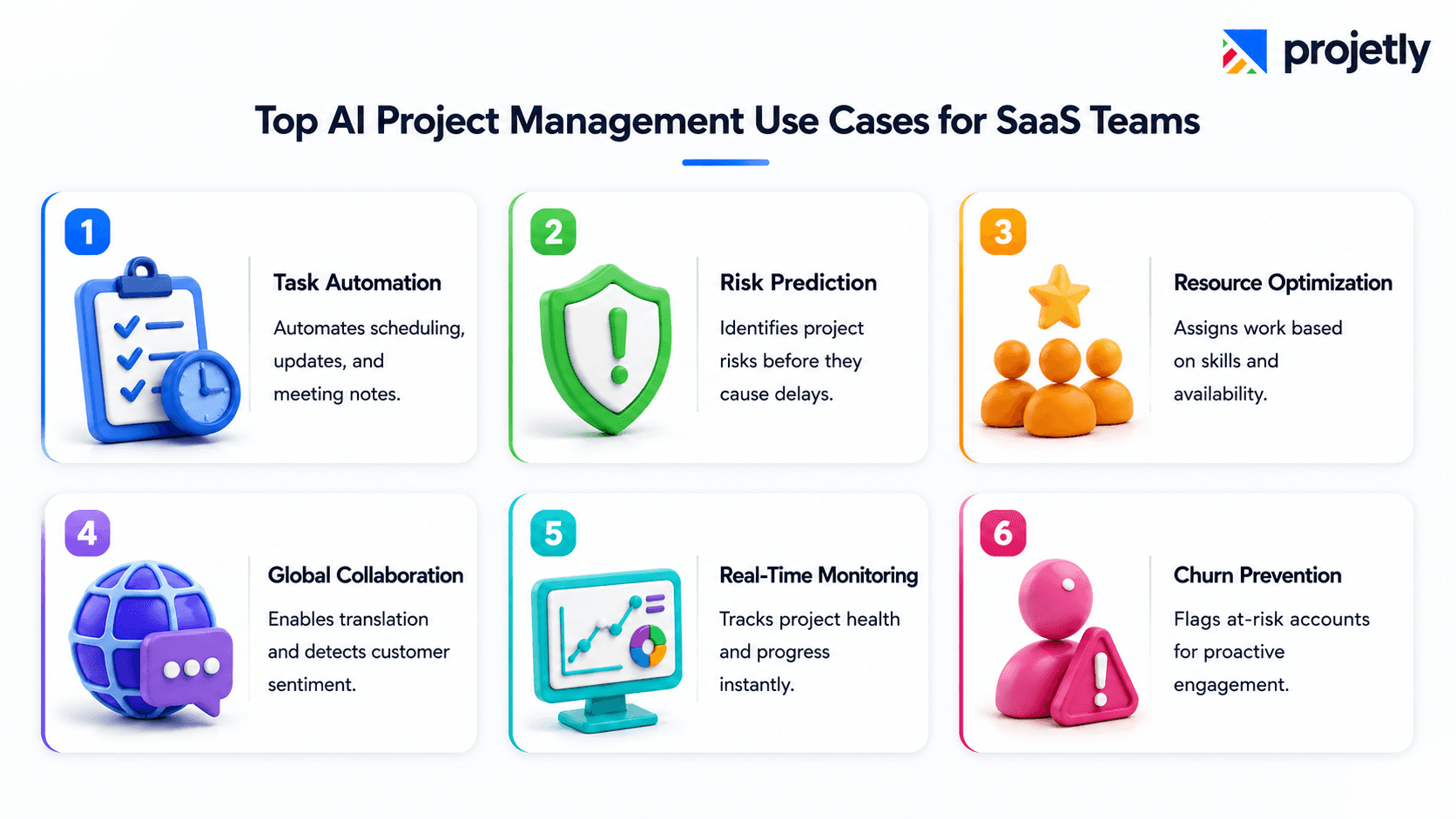
The six highest-ROI applications of AI in project management for SaaS implementation are: task automation, predictive risk detection, intelligent resource allocation, global collaboration, real-time monitoring, and freemium churn prevention.
1. Automated Task Management
AI handles scheduling, status updates, and meeting summaries using NLP, eliminating the manual admin loop. Implementation teams using AI-driven task automation save up to 10 hours per week, per project manager.
2. Predictive Risk Detection
Machine learning models scan historical project data and flag risks before they become delays. According to Gartner, by 2028, PMO leaders will rely on AI to predict delays with over 90% accuracy, enabling teams to act before timelines slip.
3. Optimized Resource Allocation
AI matches tasks to team members based on skills, availability, and current workload, not just who's next on the list. This prevents the common failure mode where one regional team is overloaded while another sits underutilized.
4. Multilingual Global Collaboration
AI-powered client portals with real-time translation support, distributed SaaS teams working across regions. Sentiment analysis on client comments gives implementation leads early warning of dissatisfaction, before an escalation lands on their desk.
5. Live Project Monitoring
Real-time dashboards replace the weekly status email. Implementation managers see task completion rates, billing accuracy, and project health in one view, reducing the need for sync calls by up to 40%.
6. Freemium Churn Prevention
AI surfaces at-risk freemium accounts based on engagement signals and usage patterns, giving account managers a specific window to reach out with personalized upsell messaging, not a generic drip sequence.
Discover the Framework Behind Enterprise Customer Expansion
Download the Enterprise Expansion Framework →
How does Projetly use AI to solve implementation bottlenecks?
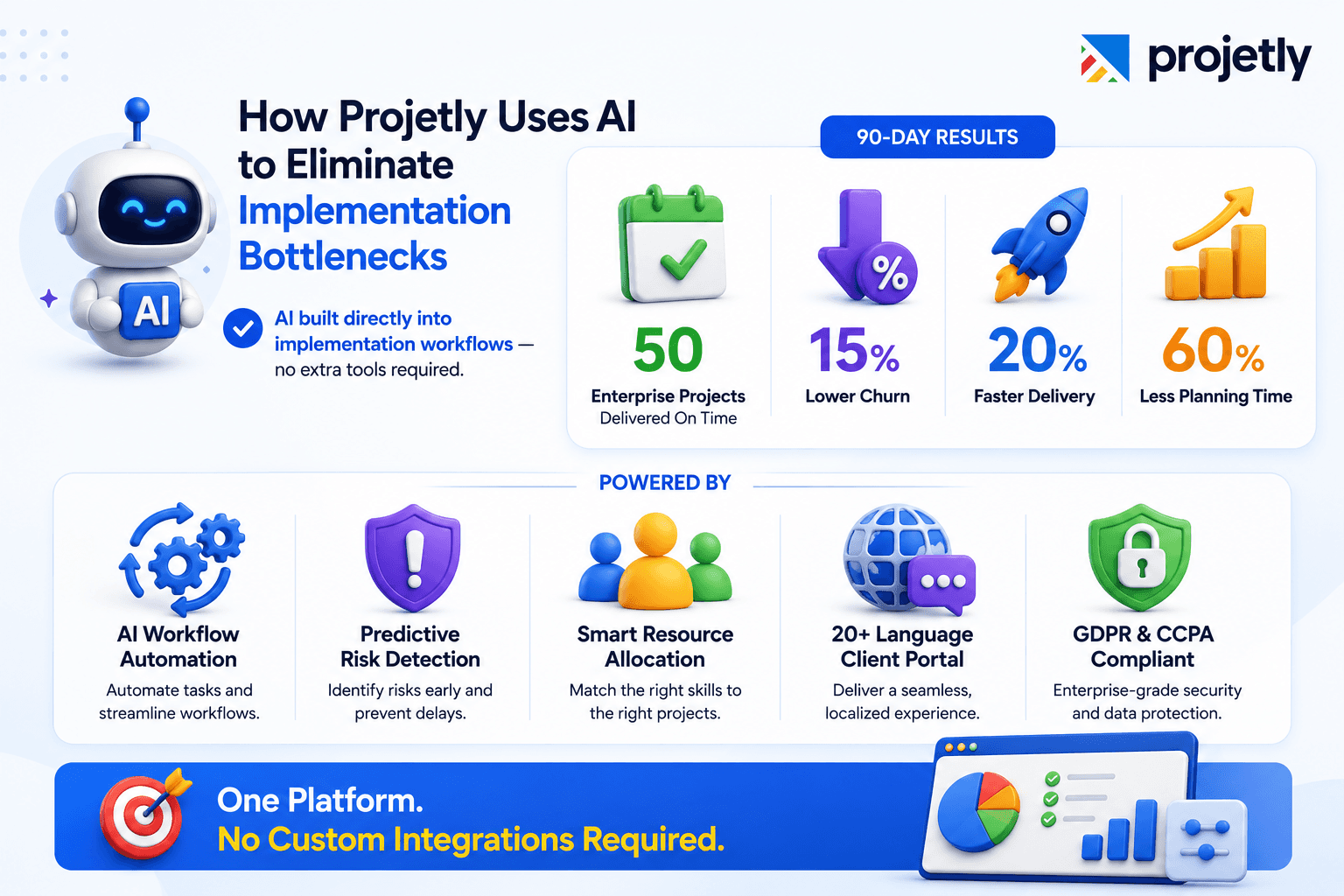
Projetly's AI layer sits directly inside the PSA workflow, so implementation teams don't switch tools to get risk alerts, resource recommendations, or billing insights.
Most AI project management tools add AI as a layer on top of existing workflows, creating adoption friction. Projetly builds it in from the start.
A global SaaS implementation team recently used Projetly to deliver 50 enterprise client projects across the US, Europe, and Asia in three months, under tight compliance requirements and with a distributed team that had never used a unified platform before.
The results after 90 days:
All 50 projects delivered on schedule
Freemium churn dropped by 15%
Project delivery time improved by 20%
Planning cycles reduced by over 60%
The key was Projetly's combination of automated workflow routing by region and role, predictive delay detection at 90% accuracy, and a GDPR- and CCPA-compliant multilingual client portal supporting 20+ languages, all in one platform without custom integration work.
What challenges should you expect when adopting AI for PSA?
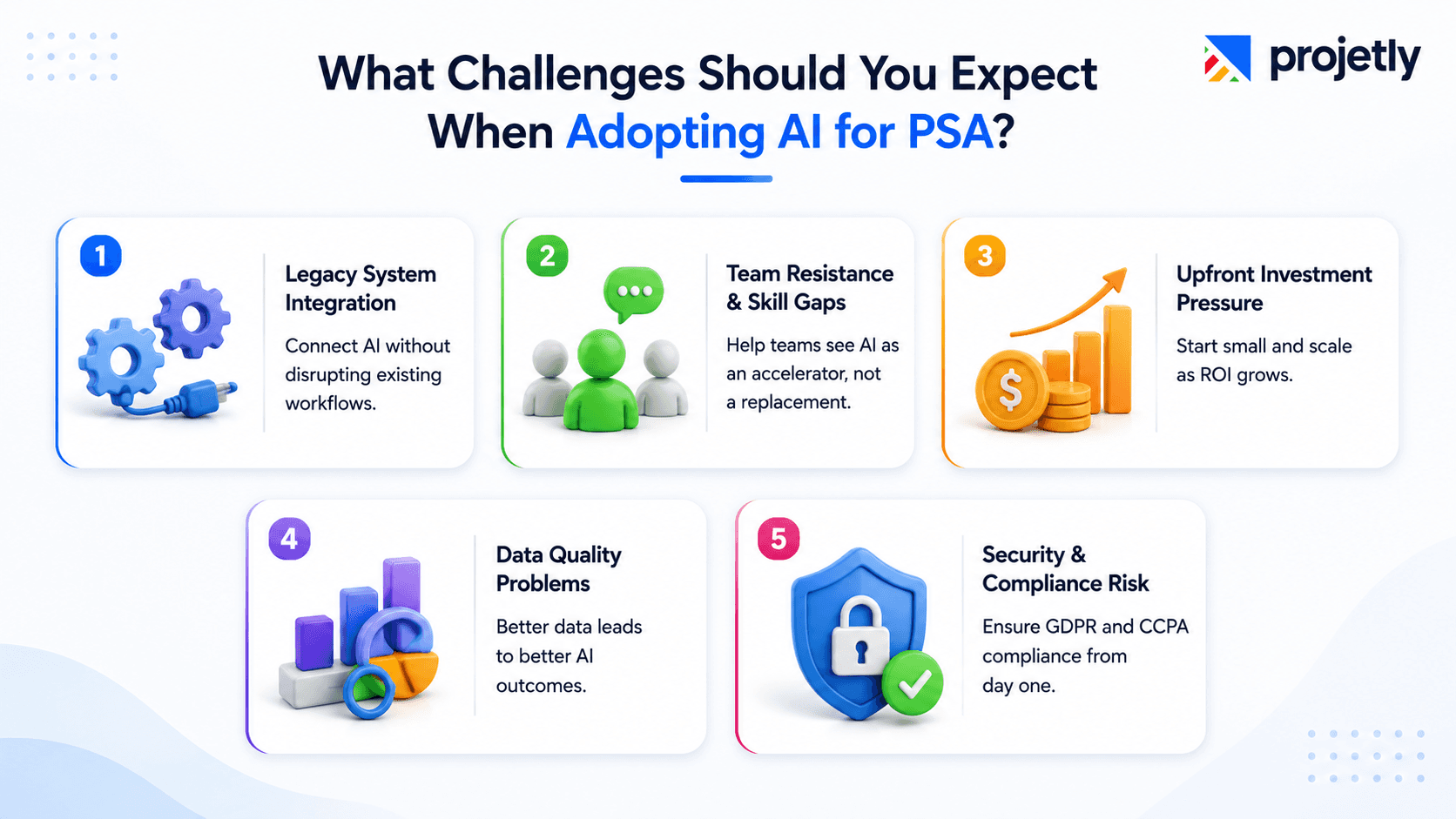
The five most common barriers to AI adoption in project management are: legacy system integration, employee resistance, upfront cost, data quality, and compliance risk. Each has a direct mitigation path.
Integration with Legacy CRMs
Connecting AI tooling to older systems can break workflows if rushed. A phased rollout, starting with one project type or one region, reduces disruption and builds team confidence before full deployment.
Team Resistance and Skill Gaps
Fear of job displacement slows adoption more than any technical barrier. Structured onboarding sessions focused on how AI handles admin (not strategy) shifts the framing from threat to accelerator.
Upfront Investment Pressure
Starting with core features and expanding over 6–12 months keeps costs predictable. Most teams reach positive ROI within 90 days when automation replaces manual billing reconciliation alone.
Data Quality Problems
AI predictions are only as accurate as the data behind them. Running a data audit before deployment and establishing a monthly review cycle ensures the system improves rather than calcifies bad inputs.
Security and Compliance Risk
Any platform handling enterprise client data must meet GDPR and CCPA standards at a minimum. Projetly includes built-in encryption and compliance controls, removing the need for custom legal review at each implementation.
How do you know if your team is ready to switch to AI-driven project management?
Use this five-point scorecard to assess your implementation team's AI readiness before committing to a platform.
Score each item 1 (not in place) to 3 (fully in place):
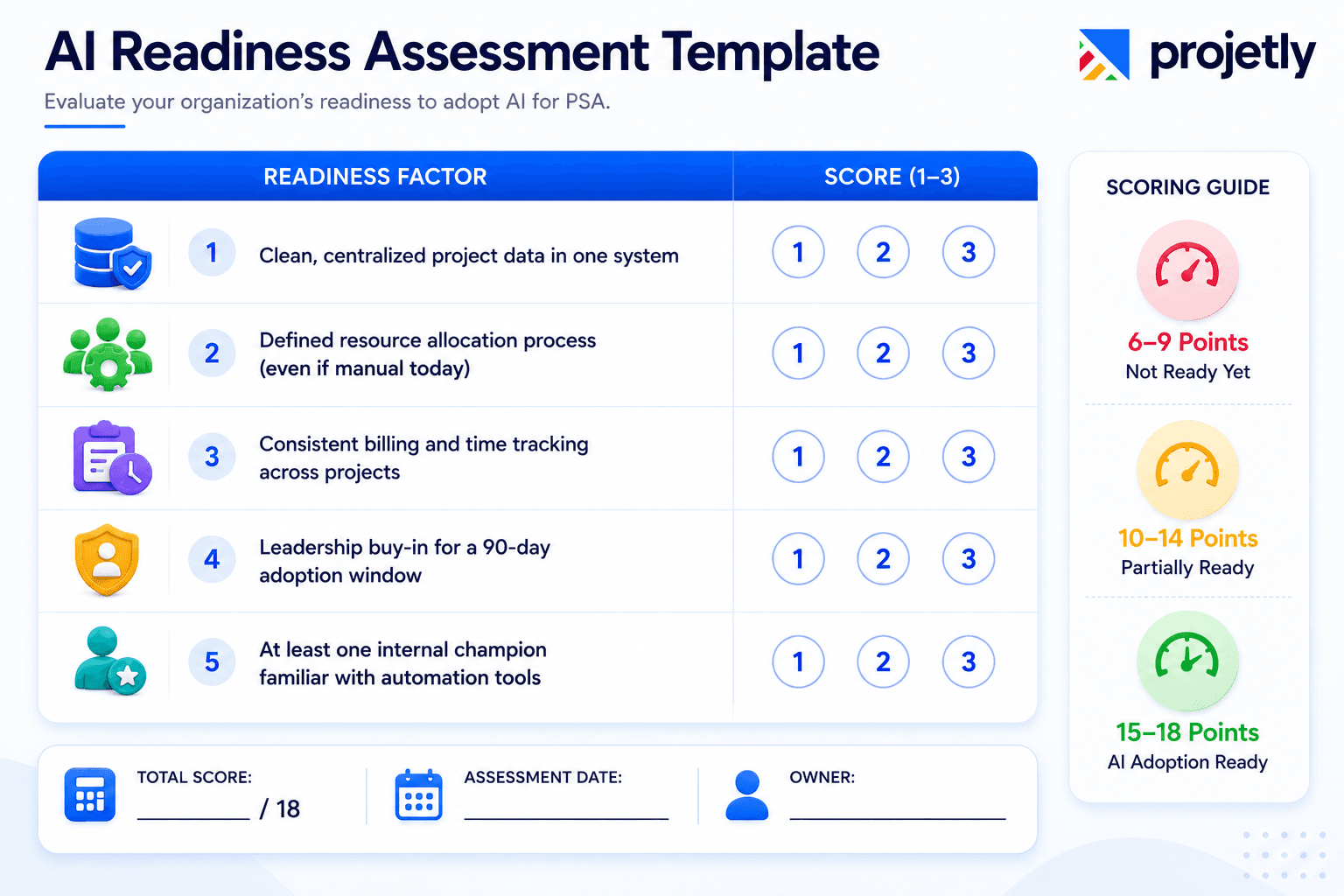
Score interpretation:
12–15: Ready to deploy. Start with risk prediction and resource allocation.
8–11: Ready with preparation. Run a data audit and pilot with one project type first.
5–7: Not yet ready. Spend 30 days consolidating data and aligning stakeholders before evaluating platforms.
You may also like: A Guide on the Role of AI in Transforming Project Management
Frequently Asked Questions
Will AI replace project managers in SaaS implementation teams?
No, AI eliminates admin work, not project managers. According to PMI's research, companies using AI deliver 61% of their projects on time versus 47% for those without it. The difference comes from project managers using AI to focus on client relationships, escalation decisions, and strategic planning, work that algorithms can't replicate.
How long does it take to see ROI from an AI project management tool?
Most SaaS implementation teams reach positive ROI within 90 days. The fastest gains come from automating billing reconciliation and time tracking, which typically eliminates the manual errors that erode up to 10% of revenue. Risk prediction and resource allocation improvements compound over the following two quarters.
How accurate is AI at predicting project delays?
Leading AI project management tools predict delays with up to 90% accuracy by analyzing historical project data, task velocity, and resource utilization patterns. Gartner projects this capability will become standard across PMO tooling by 2028, but Projetly delivers it today inside the PSA workflow without a separate analytics layer.
Is AI in project management secure enough for enterprise client data?
Yes, provided the platform meets GDPR and CCPA compliance standards. Reputable platforms process data with encryption at rest and in transit, role-based access controls, and region-specific data residency options. Projetly includes built-in compliance controls that remove the need for custom legal review at each enterprise implementation.
What's the difference between AI project management and traditional project management software?
The core difference is prediction vs. reporting. Traditional tools tell you what happened after the fact, through static reports and manual status updates. AI project management tools tell you what is likely to happen next, flagging at-risk projects with 90% accuracy and automatically rerouting resources before a delay becomes a missed deadline.
How many team members need to use the tool for AI to work effectively?
AI accuracy improves with data volume, but meaningful results are visible from the first 5–10 active users. The more consistently team members log tasks, time, and project updates, the sharper the risk predictions and resource recommendations become. A monthly data audit in the first 90 days accelerates the system's learning curve significantly.
Can AI project management tools handle multiple project types — agile, fixed-fee, and retainer?
Yes, this is one of the clearest advantages over legacy tools. AI-driven platforms like Projetly support agile sprints, fixed-scope enterprise deliverables, and ongoing retainer engagements within the same system. Workflow templates, billing logic, and resource routing adapt automatically to each project type, so teams stop working around the tool and start letting the tool work for them.
TL;DR
AI in project management reduces delivery time by up to 20% and freemium churn by 15% for SaaS implementation teams, based on Projetly user data.
Traditional project management tools cause teams to lose 10+ hours per week on manual admin and miss risk signals by 2–3 weeks on average.
AI predicts project delays with up to 90% accuracy using machine learning on historical data, enabling teams to escalate or reallocate before timelines slip.
Projetly's multilingual client portal supports 20+ languages with built-in GDPR and CCPA compliance, removing the need for region-by-region custom setup.
The top five adoption barriers are integration complexity, team resistance, upfront cost, data quality, and compliance risk, each with a direct mitigation path.
Before selecting an AI PSA platform, run the five-point readiness scorecard above to determine whether your team needs a phased rollout or a full deployment.
Ready to see what AI-driven implementation management looks like for your team? Book a Projetly Demo →
You may also like

A Guide to Project Management Professional Certification

Laugh Your Way to Productivity: 50 Workplace Quotes

50 Funny Workplace Memes That’ll Brighten Your Workday.
What Does a Customer-First Mindset Mean? Explained in 2025

What It Takes to be a Great Customer Success Manager in 2025