PRO TIPS

By
Avaran
What is the Enterprise Sales Process, and How Do You Execute It in 2026?
The enterprise sales process is an 8-stage framework, ICP definition, outbound prospecting, discovery, stakeholder mapping, solution design, proposal and negotiation, legal review, and closing with adoption planning designed to close high-value deals ($100K–$1M+ ACV) involving 8–15 stakeholders over 6–18 months.
Teams that run a disciplined process with MEDDPICC discovery and formal champion development win 20–30% of the qualified pipeline. Those without it win less than 15%
Table of Contents
How Is Enterprise Sales Different from SMB or Mid-Market?
What Are the 8 Stages of the Enterprise Sales Process?
What Is MEDDPICC and Why Does Every Stage Depend on It?
Who Are the Stakeholders, and How Do You Map Them?
How Do You Build a Business Case That Gets Internal Approval?
How Do You Write a Proposal That Closes Without a Discount War?
How Do You Keep Legal Review from Killing Deal Momentum?
What Happens After Signing That Determines Renewal?
What Metrics Tell You If Your Enterprise Sales Process Is Healthy?
TL;DR: 5 Facts Every VP of Enterprise Sales Needs to Know
Frequently Asked Questions
1. How Is Enterprise Sales Different from SMB or Mid-Market?
Enterprise deals do not just differ in size; they differ in kind. A VP of Sales running an SMB motion and an enterprise motion simultaneously is effectively running two separate businesses with incompatible playbooks.
Dimension | SMB | Mid-Market | Enterprise |
|---|---|---|---|
Deal Value (ACV) | Under $25K | $25K–$100K | $100K–$1M+ |
Sales Cycle | Days to weeks | 1–3 months | 6–18 months |
Decision-Makers | 1–2 | 3–5 | 8–15 |
Procurement Process | None or minimal | Light review | Legal, IT, Finance, Security |
Customization Need | Low | Moderate | High—tailored demos, POCs, MSAs |
Champion Required? | Rarely | Sometimes | Always—deals die without one |
The practical implication: enterprise AEs who treat their pipeline like a mid-market funnel, demo early, push for fast close, lose deals they should win. The investment in discovery, stakeholder mapping, and champion development is not optional overhead. It is the process.
2. What Are the 8 Stages of the Enterprise Sales Process?
Each stage builds on the one before it. Skipping stages does not accelerate deals; it creates gaps that surface later as stalled procurement, ghosted champions, or last-minute legal surprises.
Stage | Primary Goal | Key Output |
|---|---|---|
1. ICP Definition & Territory Planning | Identify accounts most likely to buy and expand | Tiered account list with intent signals |
2. Outbound Prospecting | Earn 30 minutes with someone who has budget authority | Confirmed discovery meeting |
3. Discovery (MEDDPICC) | Understand the business problem, buyer, and process | Completed MEDDPICC map |
4. Stakeholder Mapping & Champion Development | Identify every influencer, blocker, and buyer | Stakeholder map + champion action plan |
5. Solution Design & Proof of Value | Connect capabilities to outcomes and prove them | POC success criteria sign-off or validated demo |
6. Proposal, Pricing & Negotiation | Confirm what was agreed verbally; shift to 'which tier' | Signed proposal with pricing tier selected |
7. Legal, Security & Final Approval | Clear procurement without losing momentum | Redlined MSA approved by both legal teams |
8. Closing & Adoption Planning | Hand off with clarity; set up renewal and expansion | Mutual success plan with 90-day milestones |
3. What Is MEDDPICC and Why Does Every Stage Depend on It?
MEDDPICC is a discovery framework that maps the eight variables that determine whether an enterprise deal closes: Metrics, Economic Buyer, Decision Criteria, Decision Process, Paper Process, Identify Pain, Champion, and Competition.
It is used during Stage 3, but referenced through every subsequent stage. A deal with incomplete MEDDPICC, especially a missing economic buyer or no identified champion, is not a real opportunity. It is a forecast risk.
Element | Key Question to Answer | Why It Matters |
|---|---|---|
M – Metrics | What does success look like in numbers? | Gives the champion quantified justification for spending |
E – Economic Buyer | Who controls the budget? Have you spoken to them? | Deals without EB access stall at procurement 73% of the time |
D – Decision Criteria | What does the buying committee weigh most heavily? | Shapes how you position against competitors |
D – Decision Process | Who approves? Who reviews legal, security, and final sign-off? | Surfaces timeline risks and hidden blockers early |
P – Paper Process | What does procurement look like? Fiscal year constraints? | Prevents legal-stage surprises from collapsing close plans |
I – Identify Pain | What is the cost of doing nothing, in dollars or risk? | Creates the urgency that drives internal approval |
C – Champion | Who will advocate for you internally when you're not in the room? | The single highest-leverage variable in enterprise sales |
C – Competition | Which vendors are being evaluated? What do they like about them? | Informs differentiation and shapes your POC success criteria |
How Projetly changes Stage 3: Most enterprise teams score MEDDPICC informally in deal reviews, which means the same rep who owns the deal decides how complete it is. Projetly's deal intelligence layer scores each MEDDPICC dimension independently on a 1–5 scale, pulls signals from call transcripts and email threads, and flags gaps automatically.
The result: Projetly customers report cutting average deal review time from 47 minutes to 14 minutes, and reducing 'surprise' stalls in legal and procurement by 38%, because the gaps that cause those stalls are surfaced in Stage 3, not Stage 7.
→ See how it works: Start a Free Trial Today
4. Who Are the Stakeholders, and How Do You Map Them?
Enterprise buying groups average 8 to 10 stakeholders. Selling to one person and expecting them to carry the deal internally is the single biggest reason enterprise opportunities go dark after a strong discovery call.
A stakeholder map is not an org chart exercise. It is a risk assessment: who has influence, who has veto power, who is neutral, and who needs to be converted.
Stakeholder | Primary Concern | How to Engage |
|---|---|---|
Economic Buyer (CFO/CEO) | ROI, risk, strategic fit | Executive briefing; business case tied to P&L impact |
Champion | Internal credibility, career upside | Coach their internal presentation; arm them with talking points |
Technical Evaluator | Integration depth, security, implementation risk | Structured POC with weekly check-ins |
End User | Ease of use, workflow disruption | Product demos, peer testimonials, trial access |
Legal / Procurement | Contract terms, liability, compliance | Share your MSA early; flag firm vs. negotiable positions upfront |
IT / Security | Data governance, access controls, compliance | SOC 2 reports, completed security questionnaires, DPA templates |
Champion development is the highest-leverage activity in enterprise sales. A strong champion does not just pass along information; they sell your solution in rooms you will never be invited into. Invest in them: share objection-handling frameworks, coach their internal presentation, and help them build a business case that makes them look smart to their executive team.
5. How Do You Build a Business Case That Gets Internal Approval?
Most enterprise deals do not die because the buyer said no. They die because the champion could not get a yes from someone with budget authority. The business case is what crosses that gap.
Component | What to Include |
|---|---|
Current State Cost | Quantify the cost of the problem today: headcount hours lost, revenue at risk, compliance exposure, or competitive disadvantage. Use the buyer's own numbers wherever possible. |
Expected Outcomes | Hard savings, efficiency gains, or risk reduction, expressed in dollars and timeframes. "Better reporting" is not an outcome. "40% reduction in manual reconciliation time" is. |
Implementation Timeline | Realistic go-live date, resource requirements, and who owns what. Overpromising here destroys the relationship within 90 days of signing. |
Total Cost of Ownership | Full cost over 2–3 years vs. status quo and vs. competitors. Include implementation, training, and integration costs, not just ACV. |
Run a structured POC (30 to 60 days, jointly defined success criteria, dedicated technical resource from your side, weekly check-ins). An unsupported POC fails more than 60% of the time. A structured POC with co-signed success criteria converts at over 70%.
6. How Do You Write a Proposal That Closes Without a Discount War?
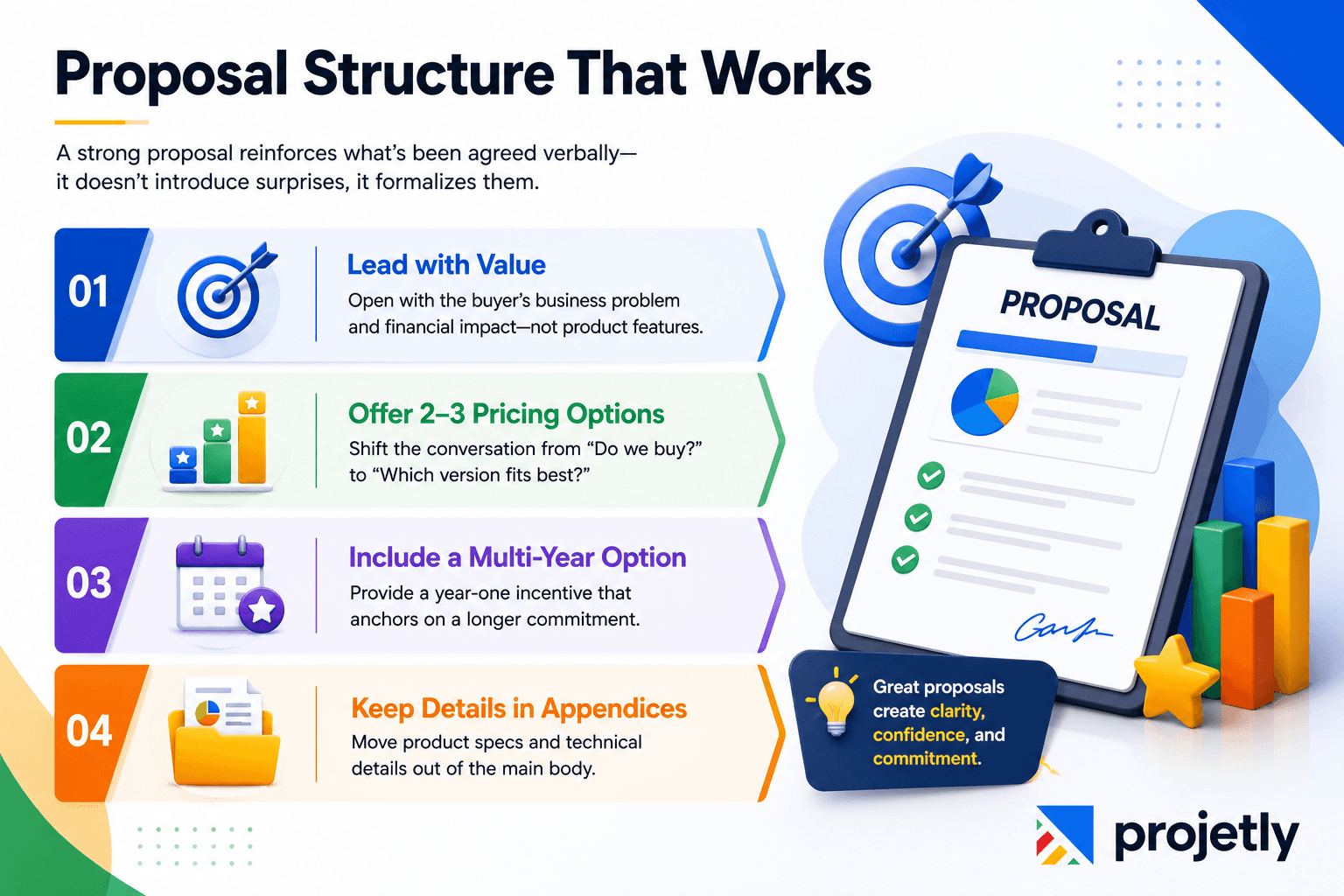
By the time a proposal is delivered, none of its terms should be a surprise. The best enterprise proposals confirm what has already been agreed verbally. They do not introduce new information; they formalize it.
Proposal structure that works:
Executive summary: open with the buyer's business problem and financial impact, not your product features
Pricing tiers: offer 2–3 options to shift the conversation from "do we buy?" to "which version?"
Multi-year option: present a year-one incentive that anchors on a longer commitment
Appendices: move product specs and technical details out of the main body.
Negotiation principles:
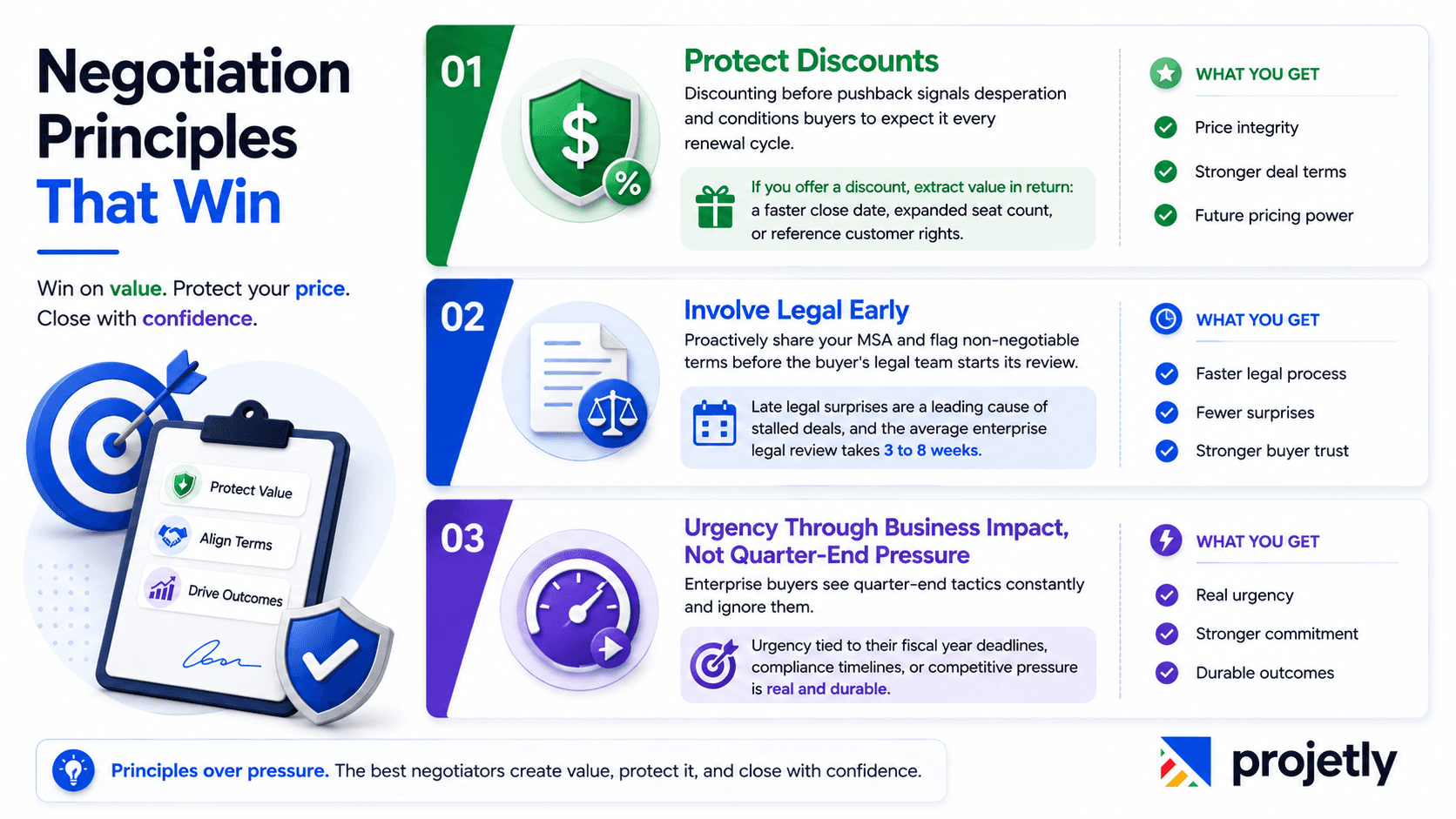
Protect discounts. Discounting before pushback can come across as desperation and may condition buyers to expect it every renewal cycle. If you offer a discount, extract value in return: a faster close date, an expanded seat count, or reference-customer rights.
Involve legal early. Proactively share your MSA and flag non-negotiable terms before the buyer's legal team starts its review. Late legal surprises are a leading cause of stalled deals, and the average enterprise legal review takes 3 to 8 weeks.
Urgency through business impact, not quarter-end pressure. Enterprise buyers see quarter-end tactics constantly and ignore them. Urgency tied to their fiscal year deadlines, compliance timelines, or competitive pressure is real and durable.
7. How Do You Keep Legal Review from Killing Deal Momentum?
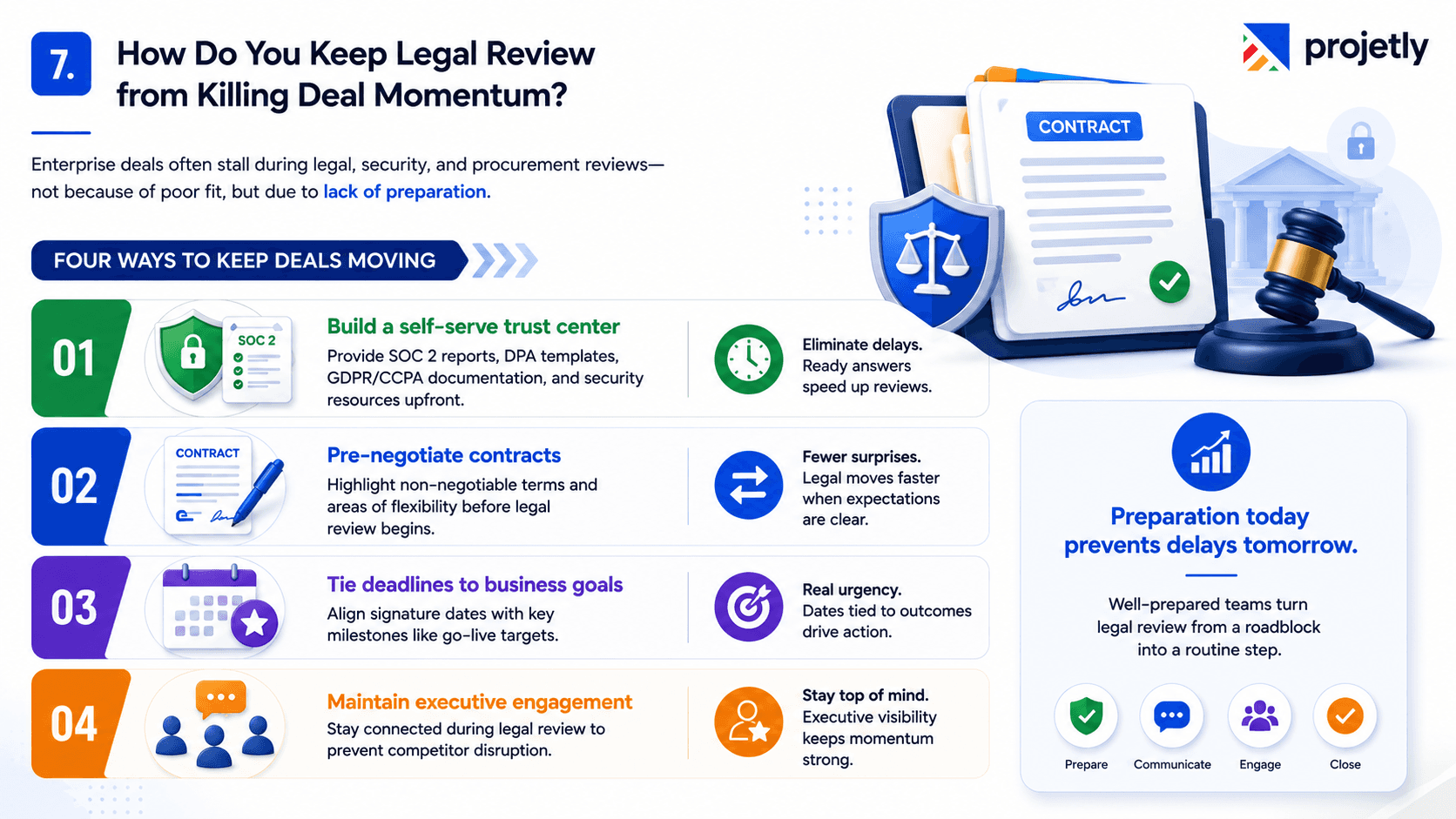
Legal, security, and procurement review is where enterprise deals most commonly stall, not because of deal quality, but because of preparation gaps.
In 2026, AI-related data processing agreements, cross-border data transfer requirements, and expanded cybersecurity mandates have made enterprise buyers apply more scrutiny to vendor contracts than at any point in the past decade.
Four actions that prevent a 3-week legal process from becoming a 12-week blockage:
Maintain a self-serve trust center with SOC 2 reports, penetration test summaries, GDPR/CCPA documentation, and standard DPA templates available on demand. Security questionnaires are a 4-week bottleneck only when your team is unprepared.
Proactively redline your own contract before legal review begins. Flag which positions are firm and which are negotiable upfront. Buyers' legal teams move faster when they know where the flexibility is.
Set milestone dates with your champion tied to their business objectives. "We need signatures by [date] to hit your Q3 go-live target" is more effective than any close urgency tactic.
Continue executive touchpoints during legal review. This stage is not a pause in deal activity; it is when the competitor is most likely to make a last-minute push.
8. What Happens After Signing That Determines Renewal?
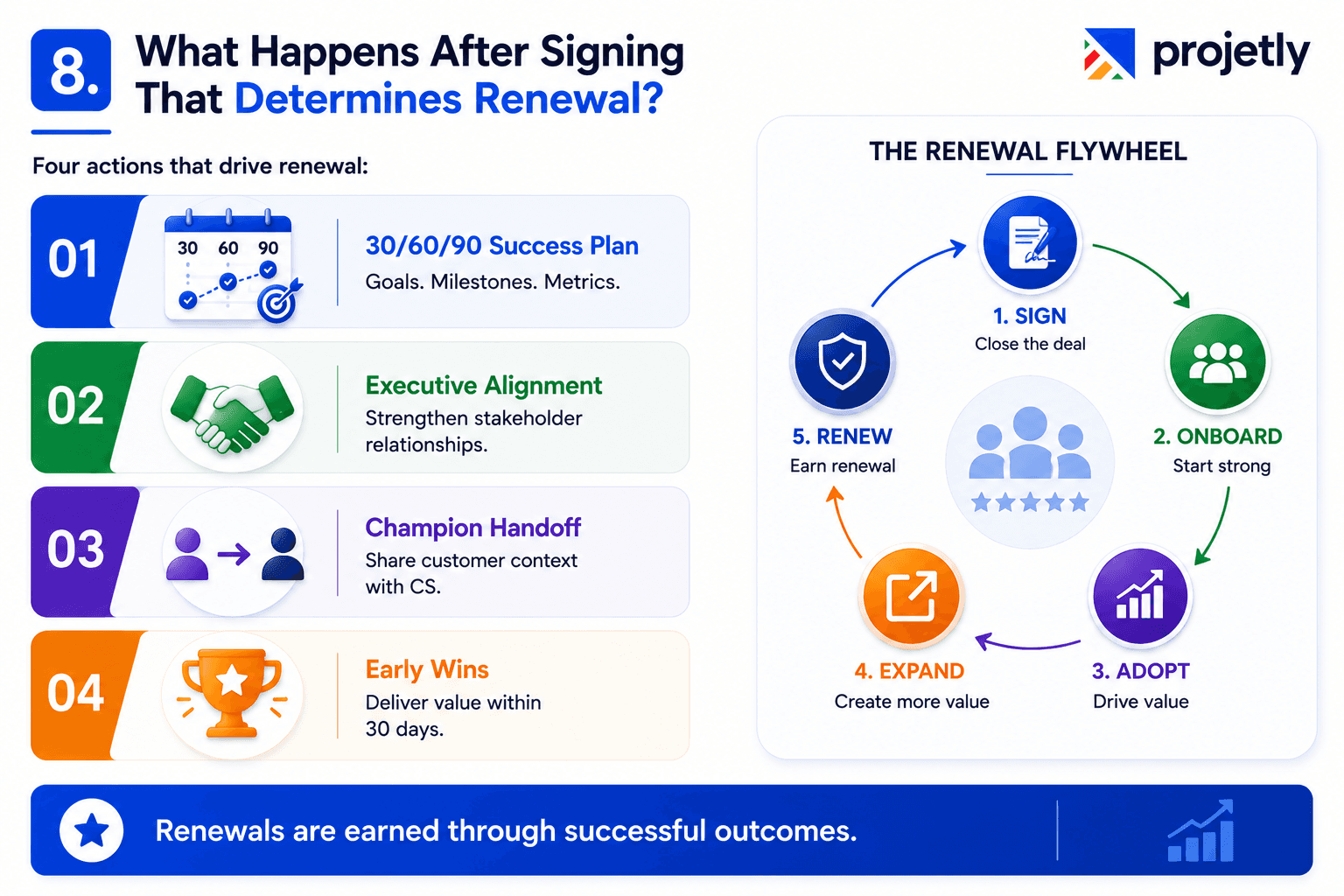
The close is not the finish line. It is the beginning of the relationship that determines renewal, expansion, and whether your champion becomes a reference account or a cautionary tale.
Mutual Success Plan: before signatures, co-create a 30/60/90-day onboarding roadmap that documents goals, milestones, executive sponsors, and the success metrics your champion committed to internally.
Executive Sponsor Alignment: map your internal executive sponsor to theirs. C-to-C relationships at the enterprise level are directly correlated with higher retention and faster expansion.
Structured Champion Handoff: the champion who drove the buying process needs a documented handoff to your customer success team, including their goals, internal stakeholders, political dynamics, and the success criteria they promised their CFO.
Early Win Identification: define a quick, visible win achievable within 30 days of go-live. A win, the champion can internally validate the decision and set the foundation for their first expansion conversation.
9. What Metrics Tell You If Your Enterprise Sales Process Is Healthy?
Gut feel is not a pipeline metric. The following KPIs tell you exactly where your enterprise process breaks down and which deals are real.
Metric | Why It Matters | Enterprise SaaS Benchmark |
|---|---|---|
Average Sales Cycle Length | Identifies stage-level bottlenecks and where deals stall | 6–12 months |
Win Rate (Qualified Pipeline) | Measures ICP fit and champion development quality | 20–30% is strong; below 15% signals systemic gaps |
Average Contract Value (ACV) | Tracks deal size trends; should grow year-over-year | Growth matters more than absolute figure |
Pipeline Coverage Ratio | Ensures adequate runway to hit quota | 3–4x quota minimum |
Stakeholder Coverage Score | Measures deal risk and multi-thread depth | 3+ engaged contacts per active deal |
Champion Strength Score | Predicts whether internal advocacy exists to carry the deal | Score 1–5 qualitatively per deal review |
Time in Stage | Shows where deals stall most often | Compare against baseline by deal tier and ACV |
10. TL;DR: 5 Facts Every VP of Enterprise Sales Needs to Know
Enterprise sales cycles run 6 to 18 months and involve 8 to 15 stakeholders; a process built for 1-call closes does not scale to this environment.
Deals with no identified economic buyer or champion stall at procurement more than 70% of the time; MEDDPICC discovery is not optional overhead; it is the process.
Teams with longer discovery stages (4+ calls) close faster overall than teams who rush to demo; more time in Stage 3 eliminates the surprises that stall Stages 6, 7, and 8.
Average enterprise legal review takes 3 to 8 weeks; teams that proactively share their MSA and trust centre documentation cut this timeline by up to 40%.
A qualified win rate of 20–30% is strong for enterprise SaaS; anything below 15% signals ICP misalignment, weak champion development, or an insufficient business case.
See How Projetly Supports Every Stage of the Enterprise Sales Cycle → Book a Demo
Frequently Asked Questions
1. What is the enterprise sales process?
An 8-stage framework, ICP definition, prospecting, discovery, stakeholder mapping, solution design, proposal, legal review, and closing, for closing $100K–$1M+ deals with buying committees of 8–15 stakeholders over 6–18 months.
2. How long does an enterprise sales cycle take?
6 to 18 months for most deals. Above $500K ACV, expect 12+ months. Thorough MEDDPICC discovery in Stage 3 is the single biggest factor in closing faster.
3. What is MEDDPICC?
A discovery framework covering Metrics, Economic Buyer, Decision Criteria, Decision Process, Paper Process, Identify Pain, Champion, and Competition. Deals are missing an economic buyer or champion stall at procurement more than 70% of the time.
4. What is a sales champion, and how do you develop one?
An internal advocate who sells for you when you're not in the room. Develop them by coaching their internal presentation, sharing objection-handling frameworks, and helping them build an ROI case that makes them look credible to their CFO.
5. What is a POC, and how do you run one?
A 30–60 day structured evaluation with jointly defined success criteria. Agree on success metrics in writing before it starts, assign a dedicated technical resource, and run weekly check-ins. Unsupported POCs fail 60%+ of the time; structured ones convert at 70%+.
6. What does a good enterprise win rate look like?
20–30% on the qualified pipeline is strong. Below 15% signals ICP misalignment, weak champion development, or an insufficient business case. The fix is in Stages 3 and 4, not Stage 6.
7. How are enterprise sales different in 2026?
Three shifts: legal review is more rigorous (AI data agreements, cybersecurity mandates), intent data makes ICP targeting 2–3x more precise, and buying committees have grown from 6–8 to 8–15 stakeholders on average, making multi-threading non-negotiable.
You may also like

A Guide to Project Management Professional Certification

Laugh Your Way to Productivity: 50 Workplace Quotes

50 Funny Workplace Memes That’ll Brighten Your Workday.
What Does a Customer-First Mindset Mean? Explained in 2025

What It Takes to be a Great Customer Success Manager in 2025