PRO TIPS

By
Sam
Enterprise Sales Tools Stack: Must-Have Software in 2026
If you're running enterprise sales in 2026 and your team is still copy-pasting contact data between tabs, manually logging calls, or building forecasts in spreadsheets, you're already behind. The companies' winning complex, multi-threaded deals today aren't just hiring better reps. They're building a tighter stack.
Enterprise sales have always been a game of information and timing.
Who's in the buying committee?
Which accounts are actually in-market right now?
Which deal that looks healthy is actually about to slip?
The right software stack answers these questions before your rep must ask them. But the wrong stack, bloated, siloed, poorly integrated, slows everything down and drains your budget.
This guide breaks down the must-have categories in a modern enterprise sales tech stack in 2026, the top tools in each, and what you actually need to know before you buy.
Book a demo and see how modern enterprise sales teams close faster.
What Makes an Enterprise Sales Stack Different
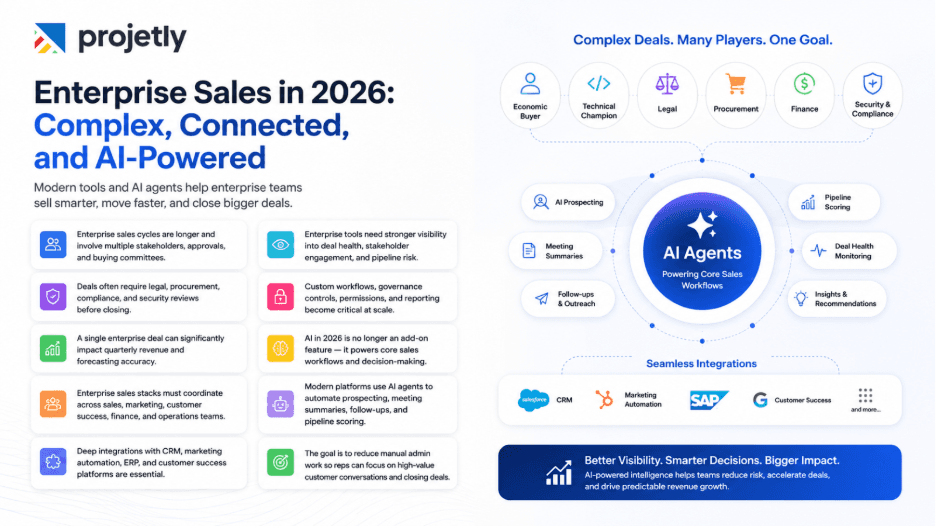
Midmarket tools get outgrown fast at enterprise scale. Enterprise sales involve longer buying cycles, multiple stakeholders, legal and security reviews, custom procurement processes, and revenue numbers where a single deal can move the quarter.
That means your stack needs to do far more than track activities or log CRM updates. Enterprise sales platforms must coordinate across revenue teams, centralize deal visibility, and help teams manage increasingly complex buying journeys.
Modern enterprise stacks also need deep integrations with adjacent systems like marketing automation, customer success, finance, and ERP platforms. Just as importantly, they must surface deal risk early, improve forecasting accuracy, and help teams move large accounts through complex approval cycles faster.
The shift in 2026 is that AI isn't just a feature tacked onto these tools anymore. It's load-bearing infrastructure.
The best platforms now use AI agents to automate prospecting tasks, score pipeline health, generate call summaries, and draft follow-up sequences, freeing reps to spend more time on the conversations that close deals.
See how modern enterprise sales teams manage complex deals. Book a demo today.
CRM: The Foundation Everything Else Is Built On
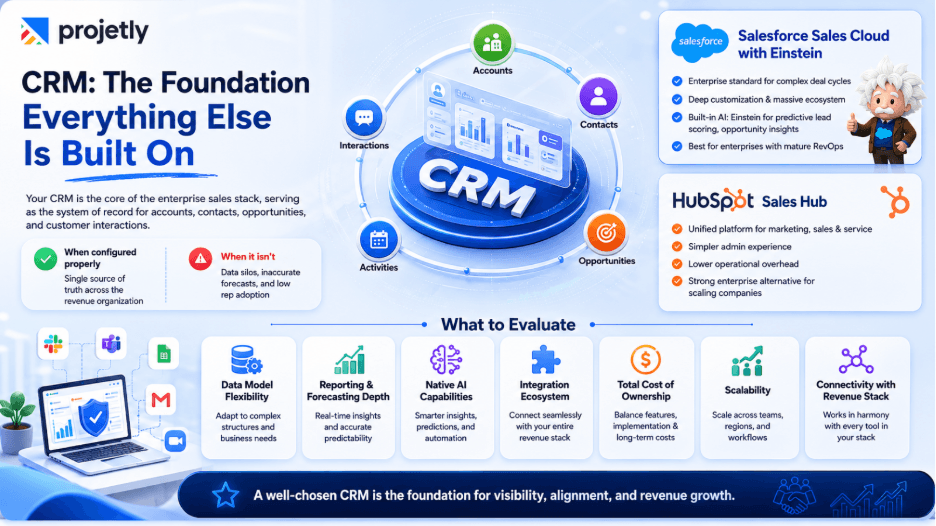
No category in the enterprise sales stack matters more than the CRM. It serves as the system of record for every account, contact, opportunity, activity, and customer interaction.
When configured properly, the entire revenue organization operates from a single source of truth. When it isn’t, teams end up dealing with data silos, conflicting forecasts, duplicate records, and reps avoiding the system altogether.
Salesforce Sales Cloud with Einstein
Salesforce Sales Cloud with Einstein remains the standard for large enterprise sales organizations. Its object model is deeply customizable, the integration ecosystem is unmatched, and Einstein AI now delivers predictive lead scoring, opportunity health insights, and next-best-action recommendations directly inside the workflow.
For organizations managing highly complex deal cycles, layered approval processes, and large revenue teams, Salesforce is still the default recommendation, especially for enterprises with more than 200 sales reps and a dedicated revenue operations function capable of configuring and maintaining it properly.
HubSpot Sales Hub
HubSpot Sales Hub has matured significantly at the enterprise tier over the last few years. Its biggest advantage is platform unification, marketing, sales, and customer service all operate within the same ecosystem without requiring heavy middleware or complex integrations.
For companies scaling from midmarket into enterprise, HubSpot has become a compelling alternative. It offers a more streamlined admin experience, lower integration overhead, and faster operational simplicity compared to traditional enterprise CRM deployments.
What to Evaluate
When comparing enterprise CRM platforms, focus on:
Data model flexibility
Reporting and forecasting depth
Native AI capabilities
Integration ecosystem and API maturity
Total cost of ownership, including admin overhead
Scalability across revenue teams and workflows
How well the CRM connects with the rest of your revenue stack
Start your free trial and experience a faster way to manage enterprise deals.
Sales Intelligence and Data Enrichment: Know Who to Target and When
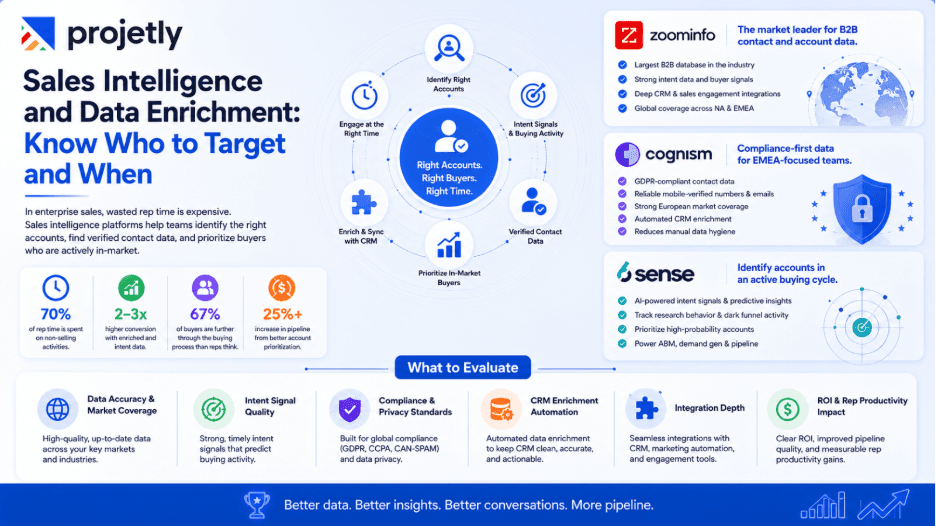
In enterprise sales, the biggest waste of resources is rep time spent chasing the wrong accounts. Sales intelligence and data enrichment platforms help teams solve two major problems: finding accurate contact and company data, and identifying which accounts are showing buying intent.
The best platforms don’t just provide email addresses anymore. They help revenue teams prioritize outreach, enrich CRM records automatically, surface intent signals, and improve the efficiency of account-based sales strategies.
ZoomInfo
ZoomInfo remains the dominant player in B2B contact and account intelligence. Its database is one of the largest in the market, with strong coverage across North America and EMEA, making it a common choice for global GTM teams.
Beyond contact data, ZoomInfo has invested heavily in intent data, buying signals, and workflow automation. Its integrations with major CRMs and sales engagement platforms also make deployment relatively straightforward for enterprise organizations.
The downside is cost. ZoomInfo is positioned as a premium platform, so enterprise teams should regularly evaluate usage, adoption, and ROI before renewal cycles.
Cognism
Cognism has become a preferred option for enterprise teams where GDPR compliance and European market coverage are critical. Its compliance-first approach is built into the platform itself rather than added as a secondary layer.
For EMEA-focused sales organizations, Cognism often delivers more reliable data quality than many competitors. Its automated CRM enrichment capabilities also reduce manual admin work and improve overall database hygiene for RevOps teams.
6sense
6sense operates differently from traditional contact data providers. Its core value is identifying which accounts are actively researching solutions before they ever fill out a form or speak to sales.
By tracking intent signals, content engagement, keyword research, and dark funnel activity, 6sense helps sales and marketing teams prioritize high-probability accounts earlier in the buying cycle.
For enterprise ABM programs, 6sense has become foundational infrastructure for account prioritization, pipeline acceleration, and more efficient marketing spend allocation.
What to Evaluate
Data accuracy and market coverage
Intent signal quality
Compliance and privacy standards
CRM enrichment automation
Integration depth with CRM and engagement tools
Overall ROI and rep productivity impact
Have questions about scaling enterprise sales? Contact our team today.
Sales Engagement: Scale Personalized Outreach Without Sacrificing Quality
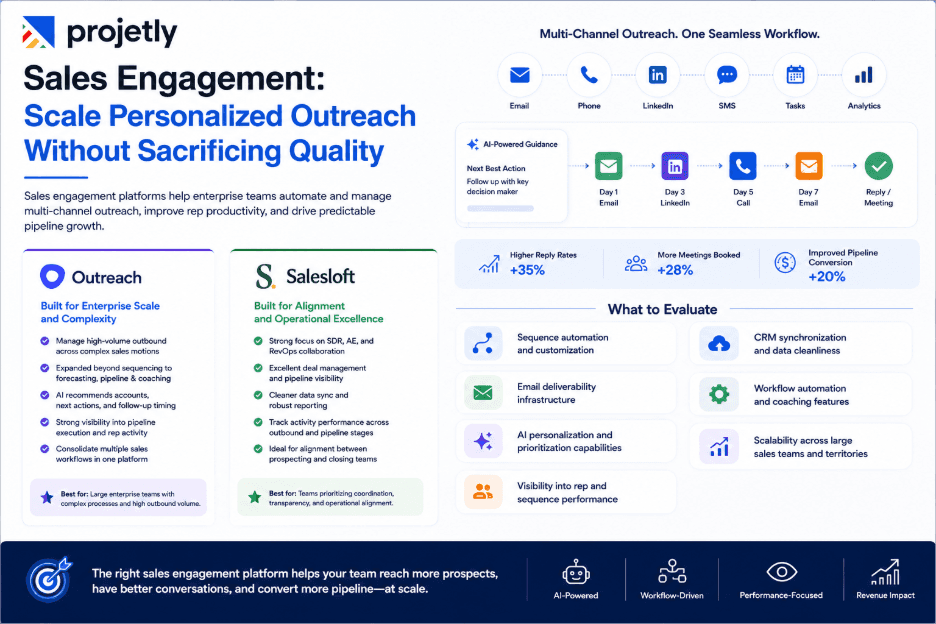
Sales engagement platforms are the operational backbone of modern outbound sales. They help teams automate and manage multi-channel outreach across email, phone, LinkedIn, and other touchpoints while giving managers visibility into rep activity, sequence performance, and pipeline progression.
As enterprise sales cycles become more complex, these platforms have evolved beyond basic sequencing tools into broader workflow and revenue execution systems.
Outreach
Outreach is designed for large enterprise sales organizations managing high-volume outbound activity and complex sales motions. The platform has expanded well beyond sequencing into areas like forecasting, pipeline management, sales coaching, and workflow automation.
Its AI capabilities help reps prioritize which accounts to engage, recommend next actions, and improve follow-up timing. For sales leaders, Outreach provides strong visibility into pipeline execution and rep activity without relying entirely on manual CRM updates.
For enterprises looking to consolidate multiple sales workflows into a single platform, Outreach is often one of the strongest options.
Salesloft
Salesloft approaches sales engagement with a stronger focus on collaboration between SDRs, AEs, and revenue operations teams. Its deal management, pipeline visibility, and analytics capabilities are particularly well-regarded in organizations where operational alignment matters heavily.
Revenue teams also value Salesloft for its cleaner data synchronization and reporting structure, making it easier to track activity performance across outbound and pipeline stages.
For organizations prioritizing coordination between prospecting teams and closing teams, Salesloft remains a strong enterprise choice.
What to Evaluate
Sequence automation and customization
Email deliverability infrastructure
AI personalization and prioritization capabilities
Visibility into rep and sequence performance
CRM synchronization and data cleanliness
Workflow automation and coaching features
Scalability across large sales teams and territories
Want to simplify your enterprise sales workflow? Schedule a personalized demo.
Conversation Intelligence: What Actually Happens on Your Calls
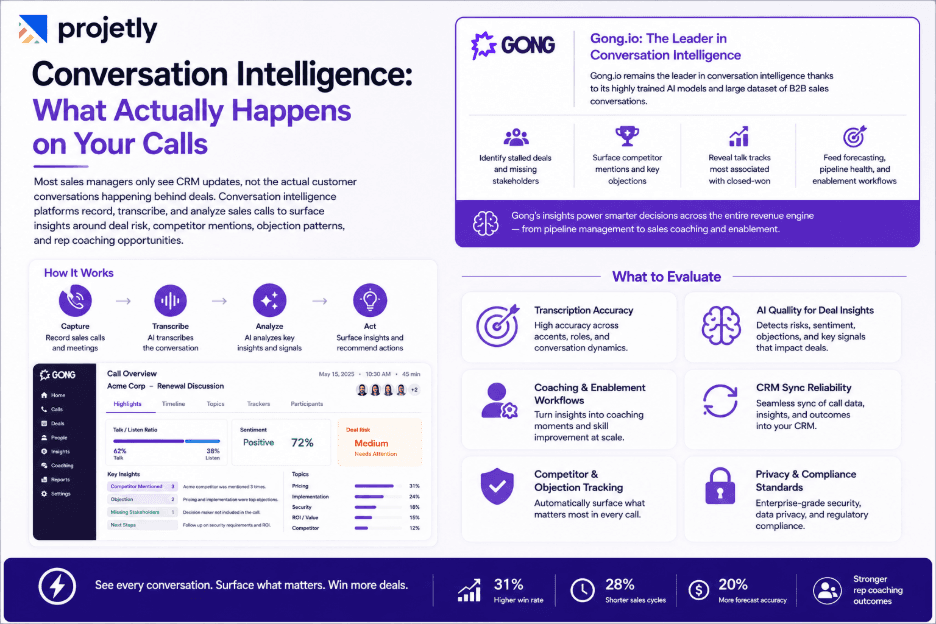
Most sales managers only see pipeline updates and CRM notes, not what’s being said in customer conversations. Conversation intelligence platforms solve that problem by recording, transcribing, and analyzing sales calls automatically.
These tools surface insights around deal risks, competitor mentions, objection patterns, stakeholder engagement, and rep coaching opportunities, turning every customer interaction into usable sales data.
Gong.io
Gong.io remains the dominant platform in conversation intelligence, largely because of the scale and quality of its AI training data. Its models are trained on millions of B2B sales conversations, allowing it to deliver highly accurate insights around deal health, buyer engagement, and rep performance.
Gong can identify when competitors are mentioned, detect stalled buying committees, highlight missing qualification steps, and surface the talk tracks most associated with closed-won deals. For enterprise sales organizations, this creates a major advantage in both forecasting accuracy and rep coaching.
Beyond coaching, Gong has evolved into a broader revenue intelligence platform. The insights it generates often feed directly into CRM forecasting, pipeline health scoring, enablement programs, and executive reporting.
For many enterprise teams, Gong becomes less of a standalone tool and more of a connective intelligence layer across the entire revenue stack.
What to Evaluate
Transcription accuracy across languages and accents
AI quality for deal and coaching insights
Competitor and objection tracking capabilities
CRM synchronization reliability
Coaching and enablement workflow integration
Forecasting and pipeline visibility features
Privacy and compliance standards for call recording
Try the platform free and see how Digital Sales Rooms improve buyer engagement.
Revenue and Pipeline Management: Forecast with Confidence
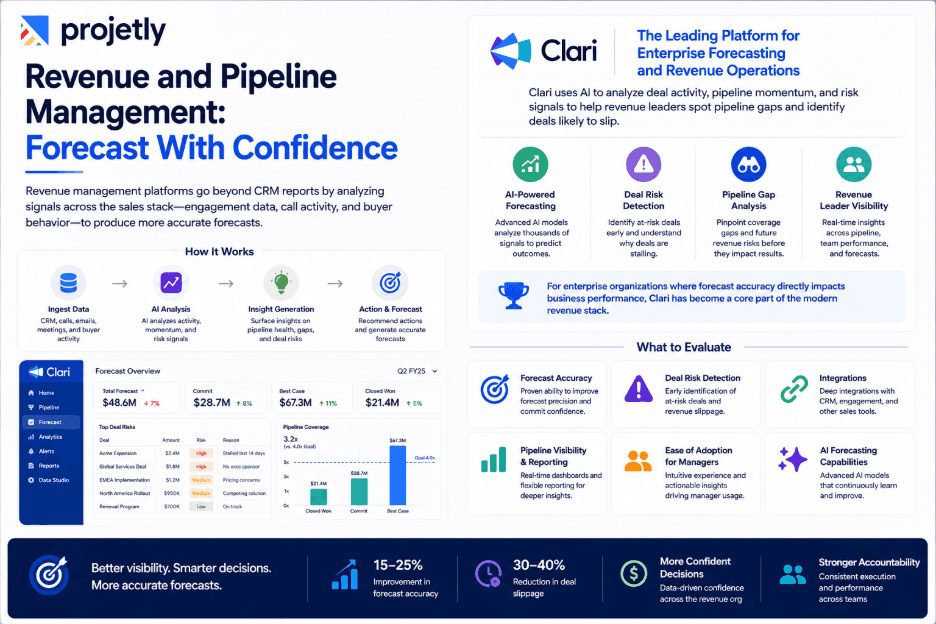
CRM reports only reflect what reps manually enter. Revenue management platforms go further by analyzing signals across the entire sales stack, including CRM activity, engagement data, call recordings, and buyer behavior, to produce more accurate forecasts.
Clari
Clari is the leading platform in enterprise revenue operations and forecasting. Instead of relying entirely on rep-submitted forecasts, Clari uses AI to analyze pipeline activity, deal momentum, engagement patterns, and risk signals across the revenue stack.
The platform helps revenue leaders identify pipeline gaps early, detect deals likely to slip, and improve forecast accuracy throughout the quarter. For CROs and CFOs, this creates a more reliable and defensible revenue view for executive planning and board reporting.
At enterprise scale, where missing forecast targets has major business consequences, Clari has become a core part of modern revenue operations.
What to Evaluate
Forecast accuracy and reliability
Deal risk detection capabilities
Integration depth with CRM and engagement tools
Pipeline visibility and reporting quality
Ease of adoption for sales managers
AI sophistication for forecasting models
Talk to us about building a smarter, more connected sales stack.
Proposal and Contract Automation: Remove Friction at the Close
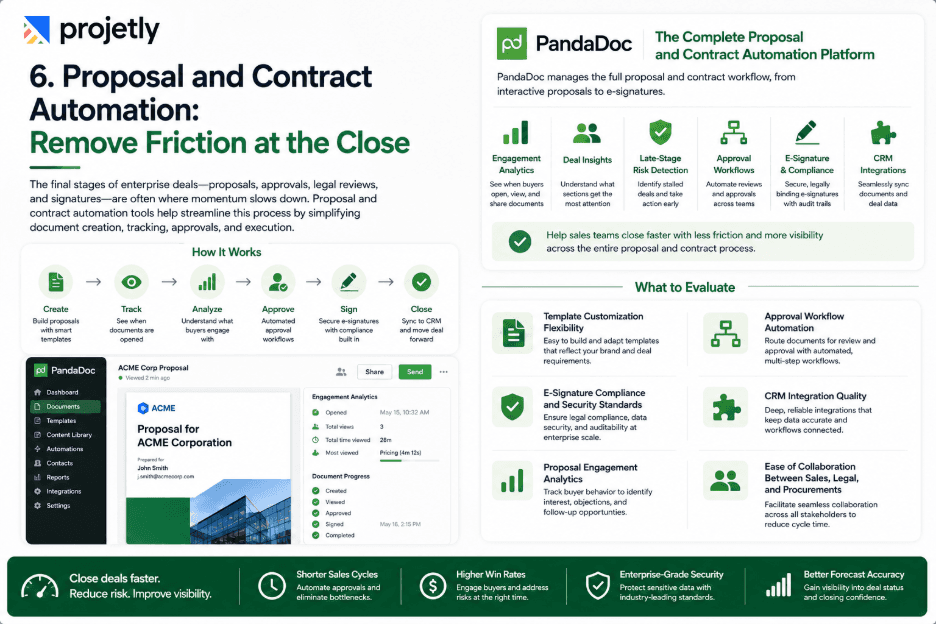
The final stages of enterprise deals, proposals, approvals, legal reviews, and signatures, are often where momentum slows down. Proposal and contract automation tools help streamline this process by simplifying document creation, tracking, approvals, and execution.
PandaDoc
PandaDoc manages the full proposal and contract workflow, from interactive proposals to e-signatures. Its engagement analytics show when buyers open proposals, which sections they spend time reviewing, and whether documents are being shared internally.
These insights help sales teams time follow-ups more effectively and identify late-stage deal risks before momentum is lost. Combined with automated approval workflows, native e-signature support, and CRM integrations, PandaDoc is a strong fit for enterprise sales teams managing high-value deals.
What to Evaluate
Template customization flexibility
Approval workflow automation
E-signature compliance and security standards
CRM integration quality
Proposal engagement analytics
Ease of collaboration between sales, legal, and procurement
Explore how Digital Sales Rooms improve buyer engagement and deal visibility. Book a demo.
Sales Enablement: Make Sure Reps Use the Right Content
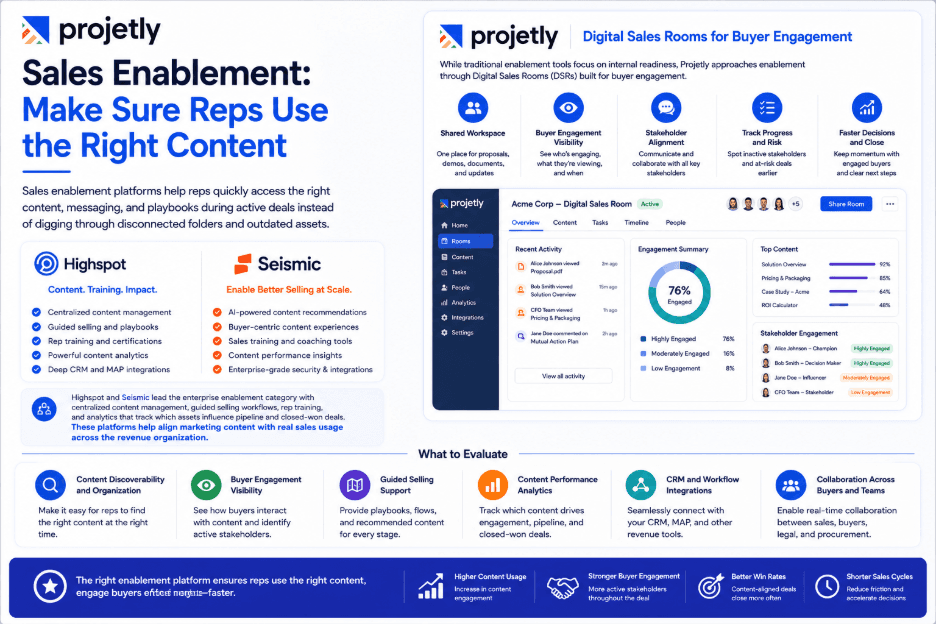
Sales enablement platforms help ensure reps can easily access the right content, messaging, playbooks, and competitive intelligence during active deals instead of wasting time searching through disconnected folders and shared drives.
Highspot and Seismic
Highspot and Seismic remain the dominant enterprise enablement platforms. Both provide centralized content management, guided selling workflows, rep training, and analytics that show which assets are influencing pipeline progression and closed-won deals.
For large revenue organizations, these platforms help close the gap between what marketing creates and what sales teams actually use in customer conversations.
Projetly: Digital Sales Rooms for Buyer Engagement
While traditional enablement platforms focus on internal sales readiness, Projetly approaches enablement from the buyer engagement side through Digital Sales Rooms (DSRs).
Instead of sending static PDFs, scattered links, and long email threads, Projetly gives sales teams a shared buyer workspace where proposals, demos, onboarding documents, mutual action plans, security questionnaires, and stakeholder communication all live in one place.
This creates better visibility into buyer engagement throughout the deal cycle. Sales teams can see which stakeholders viewed content, what documents are being revisited, where deals may be stalling, and how actively the buying committee is engaging.
For enterprise sales teams managing complex, multi-stakeholder deals, Digital Sales Rooms help reduce friction, improve coordination, and keep deals moving forward without relying entirely on email follow-ups.
What to Evaluate
Content organization and discoverability
Buyer engagement visibility
Guided selling and playbook support
Analytics on content usage and deal impact
Integration with CRM and sales workflows
Ease of collaboration between buyers and revenue teams
Launch your free trial and streamline your sales workflow in minutes.
How to Think About Stack Integration
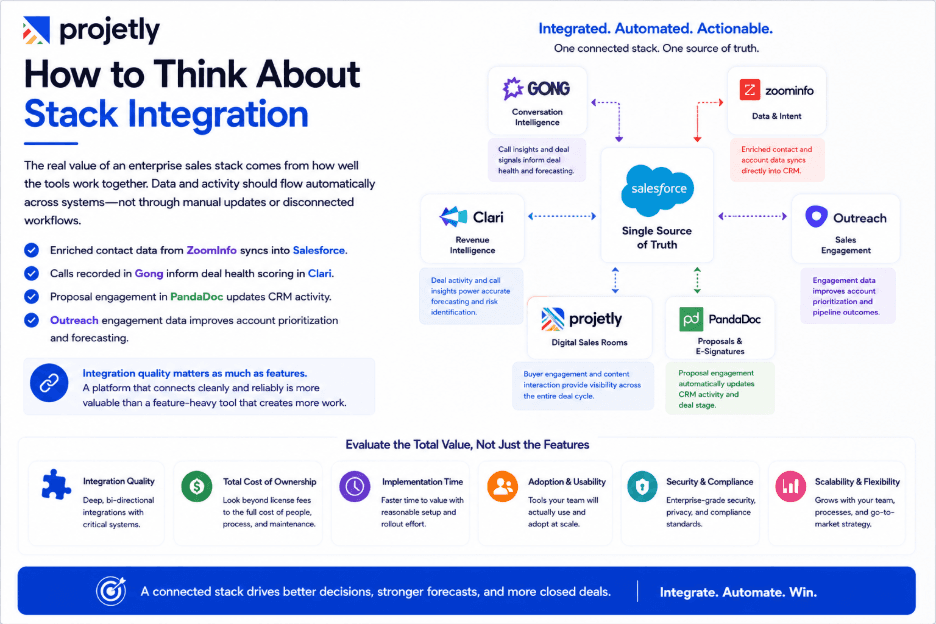
The real value of an enterprise sales stack comes from how well the tools work together. Data and activity should flow automatically across systems instead of relying on manual updates and disconnected workflows.
For example, contact data enriched in ZoomInfo should sync directly into Salesforce. Calls recorded in Gong should influence deal health scoring in Clari. Proposal engagement in PandaDoc should update CRM activity automatically, while Outreach engagement data should help improve account prioritization and forecasting.
When evaluating tools, integration quality matters just as much as feature depth. A platform that integrates cleanly with the rest of your stack is often more valuable than a feature-heavy tool that requires constant manual work or complex middleware to maintain.
The other major consideration is total cost of ownership. Enterprise software buying in 2026 involves far more than license pricing. Revenue leaders and procurement teams should also evaluate implementation timelines, admin overhead, adoption risk, integration complexity, and long-term maintenance costs before committing to multi-year contracts.
Contact us to learn how Digital Sales Rooms improve deal collaboration.
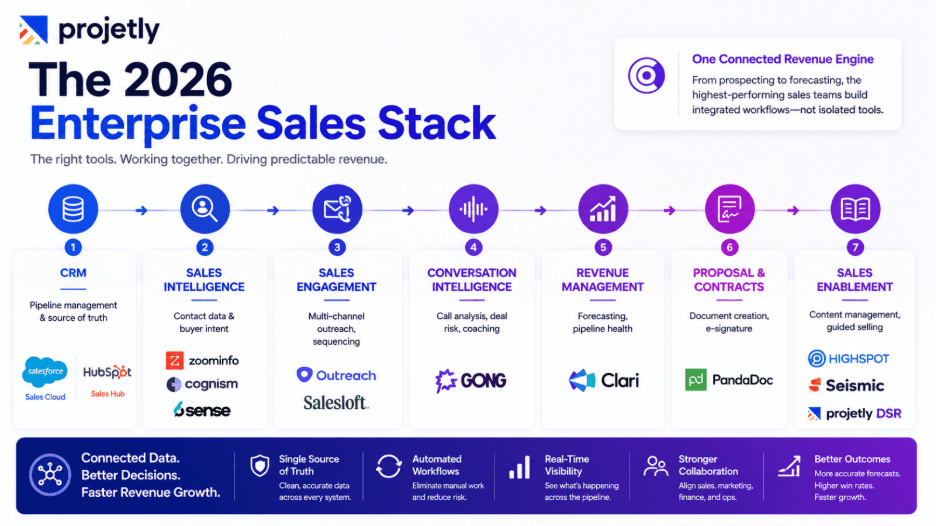
The 2026 Enterprise Sales Stack
Final Thought: Build for Outcomes, Not for Coverage
The instinct when building an enterprise sales stack is to buy something in every category and figure out adoption later. That approach leads to shelfware, budget waste, and frustrated reps who feel like the tools are working against them rather than for them.
The better approach is to start with your biggest bottlenecks, where is the pipeline stalling?
Where are reps losing time to manual work?
Where is forecast accuracy most unreliable, and build the stack around solving those problems specifically. A tighter stack that's deeply adopted and well-integrated will outperform a comprehensive one that nobody fully uses.
In 2026, the companies winning enterprise sales aren't necessarily the ones with the most tools. They're the ones who've chosen the right tools, connected them intelligently, and built the operational discipline to use them consistently.
You may also like

A Guide to Project Management Professional Certification

Laugh Your Way to Productivity: 50 Workplace Quotes

50 Funny Workplace Memes That’ll Brighten Your Workday.
What Does a Customer-First Mindset Mean? Explained in 2025

What It Takes to be a Great Customer Success Manager in 2025