Digital Sales Room

By
Anuj

Dock.us vs. Projetly DSR: Which Digital Sales Room Actually Closes Deals Faster?
Heads up: this post is written by the Projetly team. We've kept the comparisons factual and encourage you to trial both, but we'll be direct about where the gap matters most for enterprise revenue teams.
Most sales teams evaluating Digital Sales Rooms ask the wrong question. They compare feature lists and pick the tool with the most checkboxes.
The right question is this: what happens after the buyer clicks "Accept"?
If your DSR's job ends at the signature, you've already lost the next deal, because onboarding friction, handoff gaps, and lost deal context are the fastest way to kill renewal rates and referrals.
That's the lens through which Dock.us and Projetly DSR need to be evaluated. Not just how well they close deals. But how well they set up everything that comes after.
The Fundamental Difference
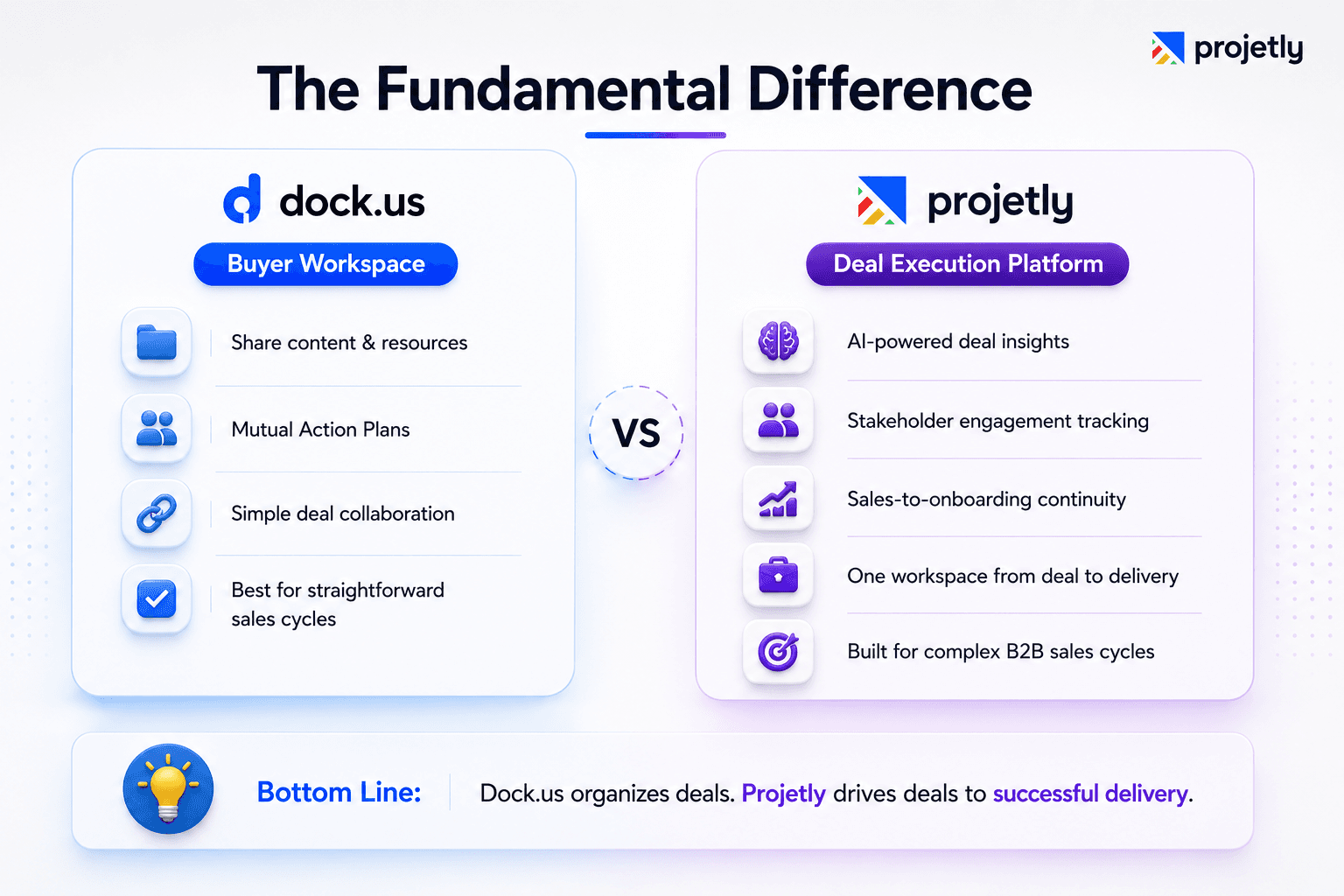
Dock.us is a buyer workspace. It does that job cleanly, shares content, mutual action plans, and a single link that keeps the deal organized. For straightforward sales cycles, it's a polished, easy-to-adopt tool.
Projetly DSR is a deal execution platform. It's built for the reality of enterprise B2B sales: multiple stakeholders with competing priorities, long sales cycles where momentum dies in inboxes, and a sales-to-onboarding handoff that traditionally loses every insight your rep spent months building.
Projetly connects the Digital Sales Room to AI-powered deal execution, onboarding workspaces, and customer success, so you can win the deal and deliver on it in the same platform.
The short version: Dock manages the deal. Projetly wins it and delivers it.
Feature Comparison
Both platforms share the same DSR foundation, branded buyer portals, content sharing, mutual action plans, and buyer engagement tracking. That's table stakes. The 15 differences below are where the decision actually gets made.
# | Feature | Dock.us | Projetly DSR |
|---|---|---|---|
1 | Native e-signatures | ❌ Via DocuSign / PandaDoc | ✅ Built in |
2 | AI meeting transcription & summaries | ❌ | ✅ |
3 | Automated MoM & action item extraction | ❌ | ✅ |
4 | Meeting follow-up recommendations | ❌ | ✅ |
5 | Stakeholder mapping & org charts | ❌ | ✅ |
6 | AI Agents for Sales, Onboarding & Delivery | ❌ | ✅ |
7 | Automated Deal Close → Onboarding project | ❌ | ✅ |
8 | Dedicated customer onboarding portal | ✅ Basic | ✅ Full |
9 | AI-powered customer adoption nudges | ❌ | ✅ |
10 | No-code form builder & embedded forms | ❌ | ✅ |
11 | Approvals & change management workflows | ❌ | ✅ |
12 | Sales playbooks | ❌ | ✅ |
13 | Crypto token rewards & milestone incentives | ❌ | ✅ |
14 | Zapier integration | ⚠️ Partial (via Webhooks) | ✅ |
15 | Freemium plan | ❌ | ✅ |
Every one of these gaps has a compounding cost, an extra tool subscription, a manual workaround, or a workflow that simply doesn't happen. For enterprise revenue teams, that adds up fast.
Where the AI Gap Is Impossible to Ignore
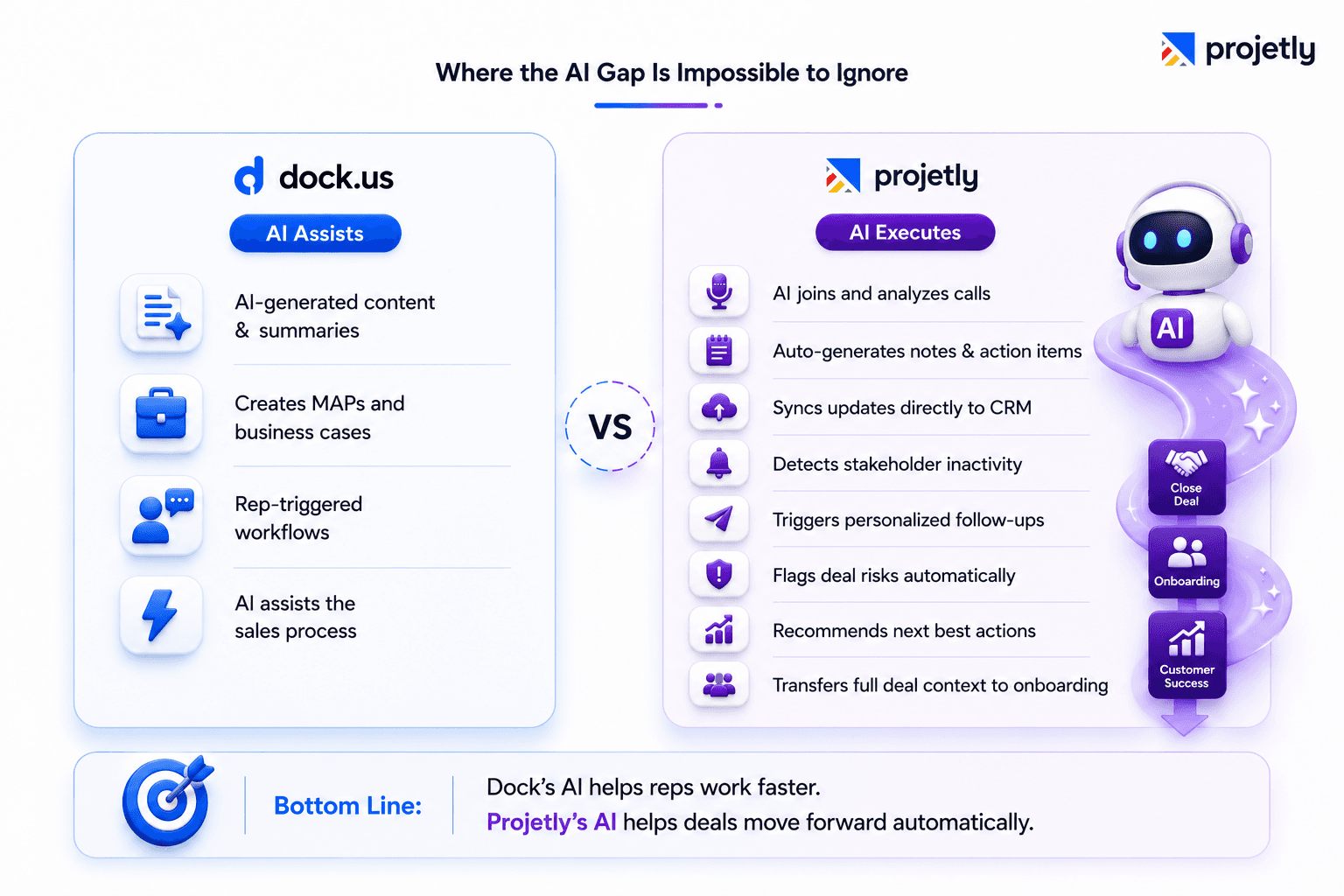
Dock uses AI to generate content, business cases, MAPs, and deal summaries. It's rep-prompted and rep-executed. Useful, but passive.
Projetly's AI Sales Agent operates differently. It doesn't wait for a rep to open the platform and ask for something.
It joins your calls and captures everything. It auto-generates meeting notes and action items and syncs them to your CRM without anyone touching a keyboard.
When a stakeholder goes quiet for three days, it triggers a personalized follow-up before the rep even notices the silence. When deal engagement drops, it surfaces the risk and recommends the right next move.
And when the deal closes?
The AI doesn't stop. It carries the full context of every meeting, every decision, and every commitment made during the sales cycle directly into the customer's onboarding workspace. Your CS team doesn't start from a handoff email. They start from everything.
That's not AI that assists. That's AI that executes, from the first call to a fully onboarded customer.
Going Deeper?
We put together a practical guide for enterprise revenue teams running complex, multi-stakeholder deals.
→ Download: How High-Performing B2B Teams Keep Enterprise Deals Moving
Where Each Tool Falls Short
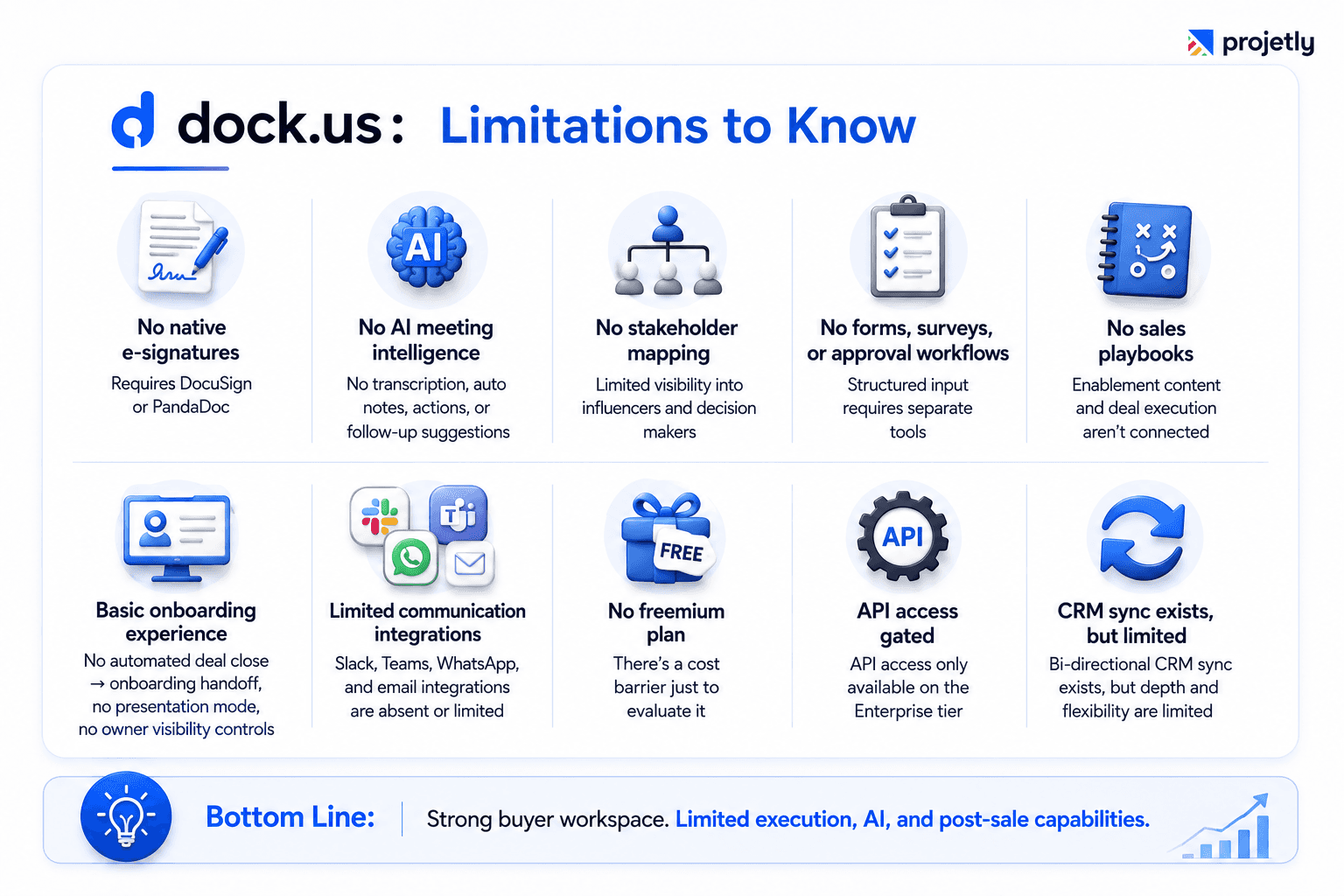
Dock.us: real gaps to know before you commit:
No native e-signatures: DocuSign or PandaDoc required, which adds cost and a context switch at the most critical moment of a deal
Zero AI meeting intelligence: no transcription, no auto-generated MoMs, no action item extraction, no follow-up recommendations. Reps are still doing this manually
No stakeholder mapping or org charts: limited visibility into who's actually influencing the decision behind the scenes
No forms, surveys, or approval workflows: any structured input collection requires separate tooling
No sales playbooks: enablement content and deal execution aren't connected
Onboarding portal is basic: no automated deal close → onboarding project handoff, no presentation mode, no project owner visibility controls
Bi-directional CRM sync exists, but Slack, Teams, WhatsApp, and email integrations are absent or very limited
No freemium plan: there's a cost barrier just to evaluate it
API access gated to the Enterprise tier
Projetly DSR: Honest Caveats:
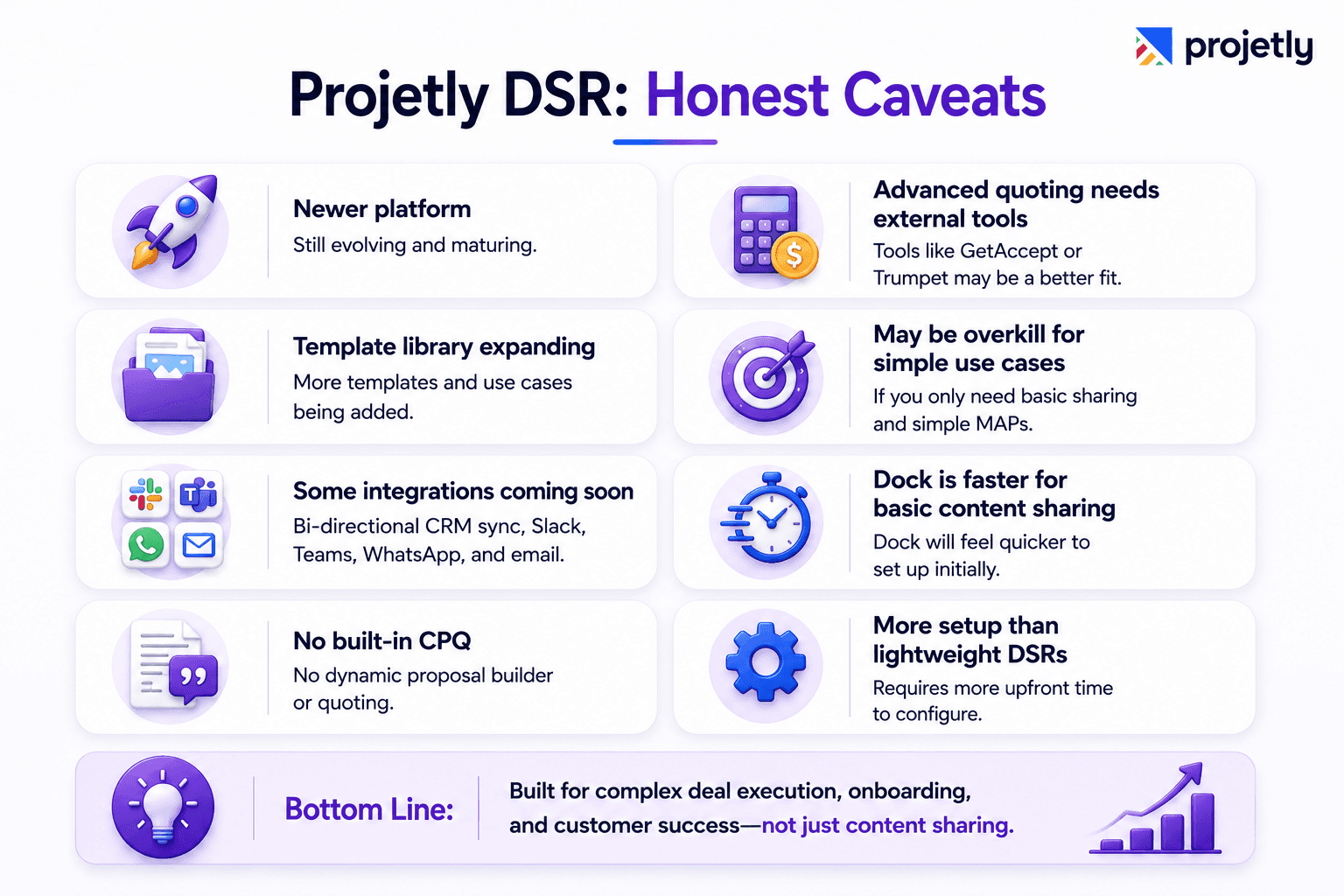
Newer platform, the template library is still growing, and some integrations (bi-directional CRM sync, Slack, Teams, WhatsApp, email) are on the roadmap rather than live today
No dynamic proposal builder, if CPQ-style quoting is central to your workflow, GetAccept or Trumpet may have an edge there
If your only need is lightweight content sharing and simple MAPs, Dock will feel faster to set up initially
We're not going to pretend Dock is a bad product. For simple deal cycles, it's genuinely solid.
But for enterprise revenue teams where AI execution, onboarding continuity, and stakeholder intelligence matter, Dock's ceiling becomes visible fast, and you'll hit it exactly when the stakes are highest.
What Teams Are Saying
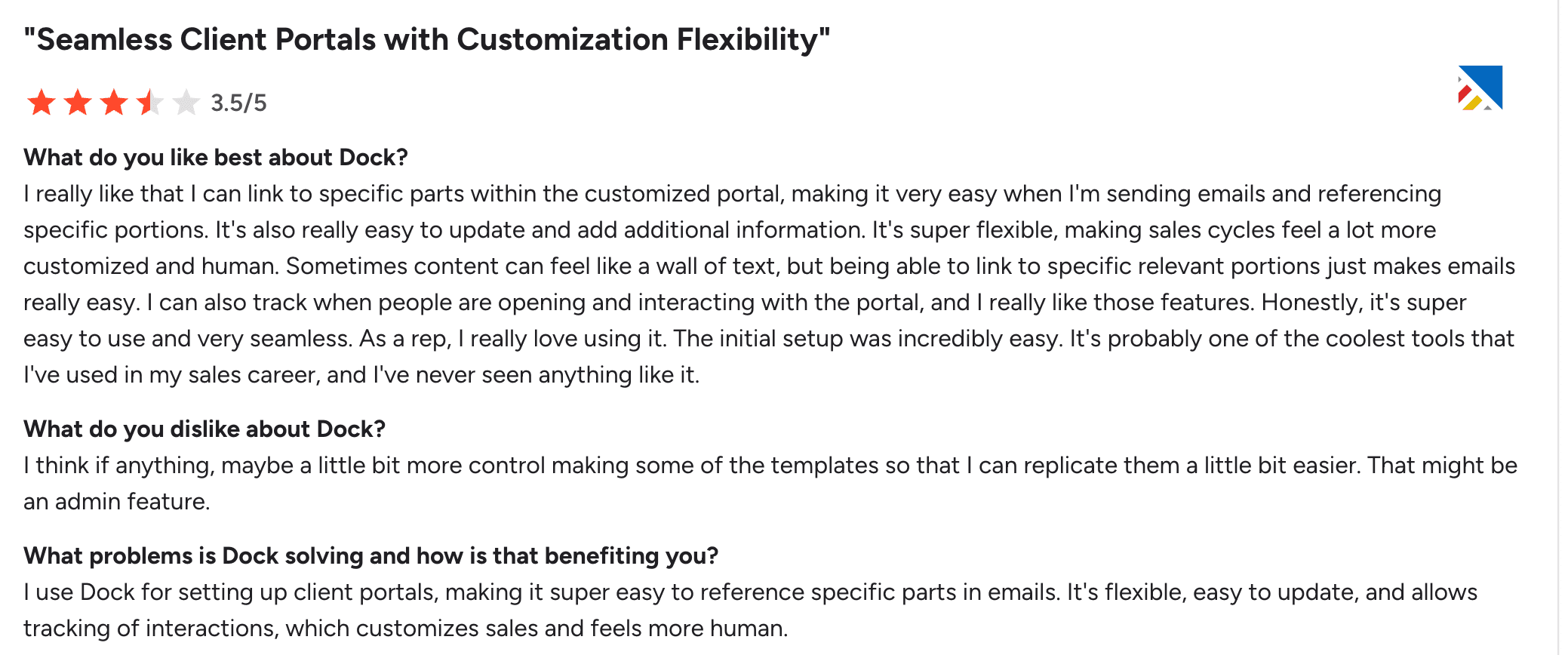
Dock. us: Dock earns strong marks for ease of setup and buyer UX in simpler deal cycles.
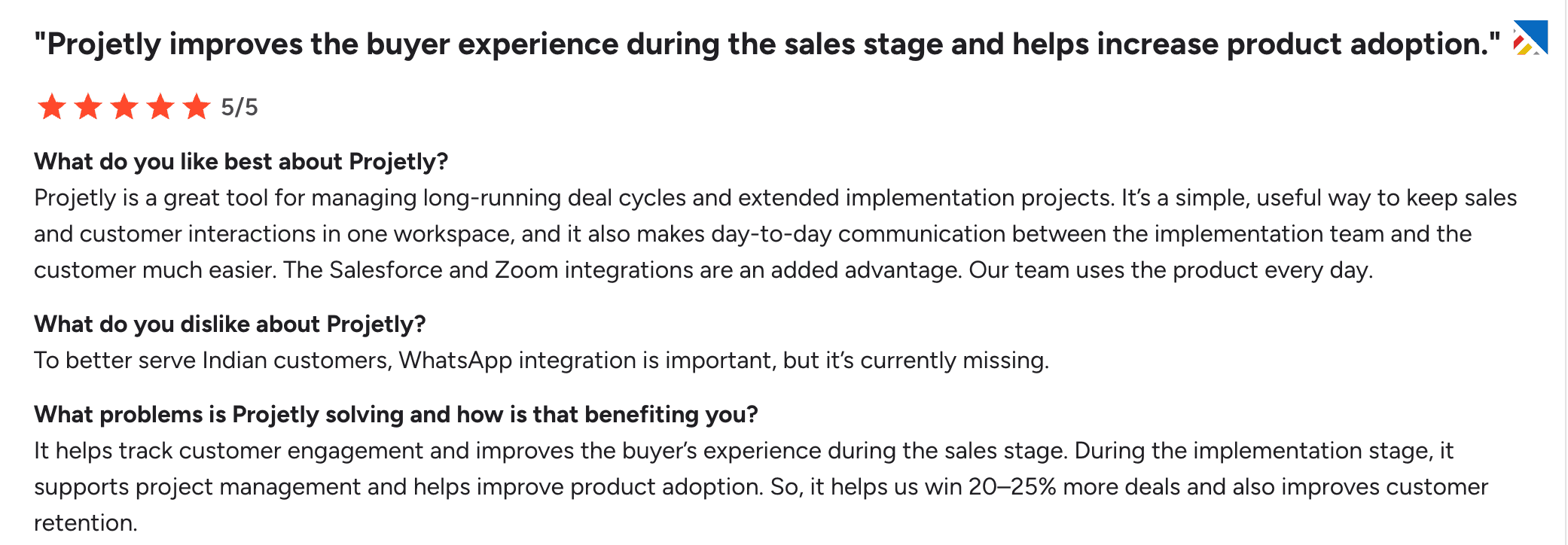
Projetly DSR: Enterprise sales teams running complex, multi-stakeholder cycles consistently rate Projetly highly for AI automation, stakeholder visibility, and onboarding continuity.
Which Should You Choose?
Choose Dock.us if:
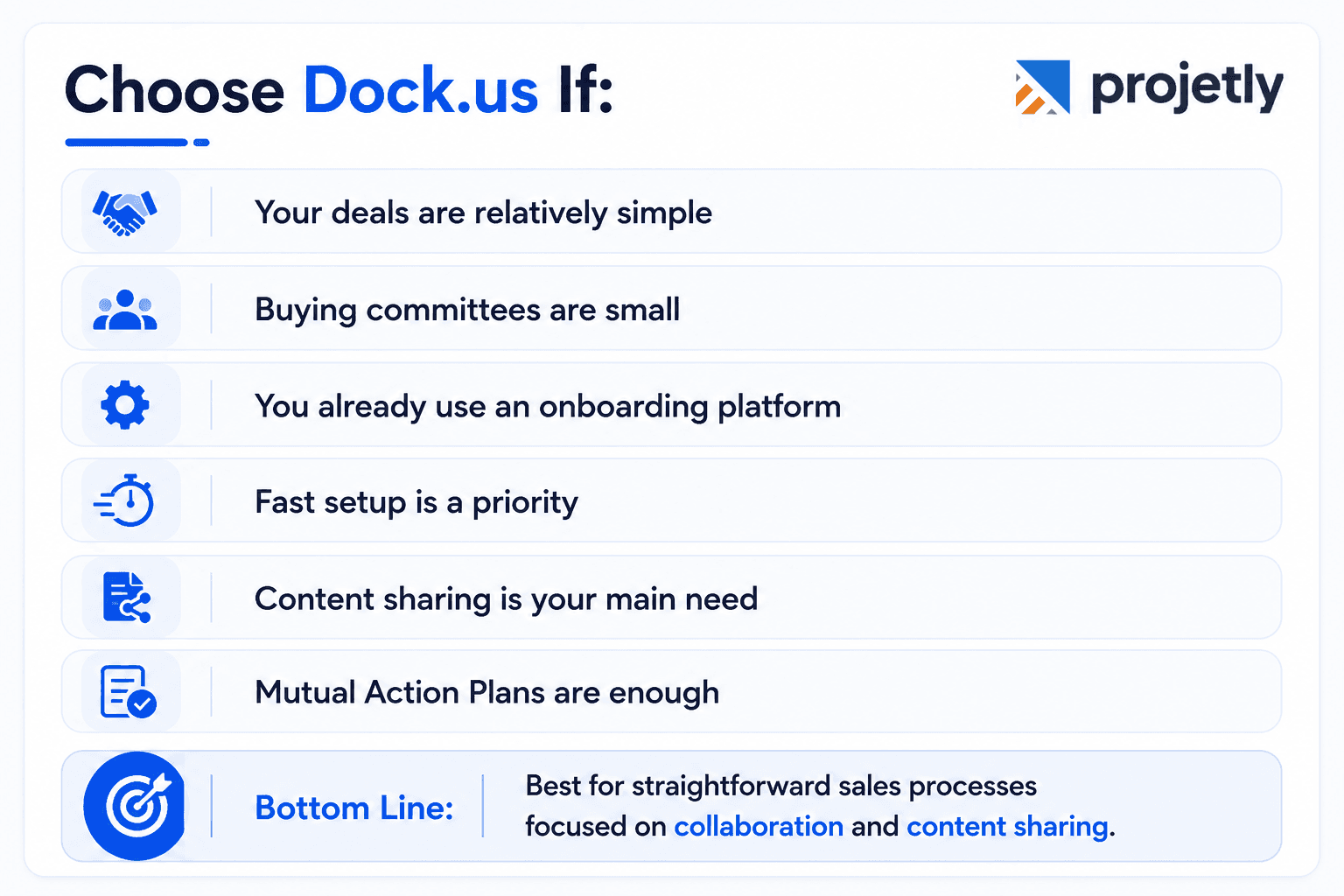
Your deals are relatively simple, with a small stakeholder group
You already have a dedicated onboarding tool and don't need to unify your stack
Fast setup matters more than deep functionality
Content sharing and MAPs are the core of your DSR use case
Choose Projetly DSR if:

You're running complex B2B enterprise deals with multiple stakeholders and competing priorities
You want AI that executes deal tasks, not just helps draft them
You need real-time visibility into who's engaging, who's gone quiet, and what to do next
You want sales and onboarding to live in one platform, so nothing is lost at handoff
You're evaluating a DSR not just to close deals faster, but to retain and expand the customers you close
Frequently Asked Questions
1. What is the biggest difference between Dock.us and Projetly DSR?
Dock is a buyer workspace, great for content sharing and mutual action plans, but limited to the deal itself. Projetly combines AI deal execution, native e-signatures, onboarding portals, and customer success in one platform. Simply put: Dock manages the deal. Projetly wins it and delivers it.
2. Does Projetly DSR have native e-signatures?
Yes, e-signatures are built into all Projetly paid plans, no third-party tool needed. Dock.us has no native signing capability and requires DocuSign or PandaDoc, adding cost and friction at the most critical moment of the deal.
3. Which platform has better AI capabilities, Dock or Projetly?
Projetly, by a wide margin. Its AI Sales Agent joins calls, auto-generates meeting notes and action items, syncs to your CRM, and triggers follow-ups automatically, no rep input required. Dock's AI only generates content on demand; it has no meeting intelligence or autonomous execution.
4. Can Projetly DSR handle customer onboarding after a deal is closed?
Yes, when a deal is marked Closed Won, Projetly automatically creates a dedicated onboarding project and carries over all deal context. Dock offers only a basic lifecycle workspace with no automated handoff, no dedicated onboarding portal, and no post-sale project management.
5. Does Projetly have stakeholder mapping?
Yes, Projetly includes advanced stakeholder mapping and org charts so revenue teams always know who's in the deal and how engaged they are. Dock.us has no stakeholder mapping capability at all, a significant blind spot in complex, multi-stakeholder enterprise deals.
6. Is Projetly DSR suitable for enterprise B2B sales teams?
Projetly is purpose-built for enterprise B2B teams running complex, multi-stakeholder deals, with AI execution, multi-CRM sync, approval workflows, and a unified sales-to-onboarding platform. Dock is better suited to smaller teams with simpler deal cycles where deep functionality isn't required.
7. Does Projetly offer a free plan? How does it compare to Dock's pricing?
Yes, Projetly has a freemium plan so teams can trial it with real deals before committing. Dock.us has no free plan, meaning there's a financial barrier just to evaluate it. For teams comparing both, Projetly is the lower-risk starting point.
TL;DR
Dock.us is a solid Digital Sales Room for buyer collaboration, content sharing, and mutual action plans. For straightforward sales cycles, it's a well-designed tool.
Projetly DSR is built for what comes after "straightforward", complex enterprise deals where AI-driven execution, stakeholder intelligence, seamless onboarding handoffs, and customer lifecycle visibility aren't optional.
The modern B2B revenue question isn't whether you need a Digital Sales Room. It's whether your DSR understands that the deal doesn't end at the signature.
Projetly does. The dock stops at the signature.
→ Running a complex enterprise deal right now? Start your free Projetly DSR trial →
You may also like

A Guide to Project Management Professional Certification

Laugh Your Way to Productivity: 50 Workplace Quotes

50 Funny Workplace Memes That’ll Brighten Your Workday.
What Does a Customer-First Mindset Mean? Explained in 2025

What It Takes to be a Great Customer Success Manager in 2025