Digital Sales Room

By
Avaran

Projetly DSR or Dock.us: Which Should You Choose?
Projetly DSR is a Digital Sales Room built for enterprise B2B deals and onboarding, the only platform in this comparison that unifies deal execution, AI meeting intelligence, onboarding automation, and customer success in one workspace, without stitching together 3–4 separate tools.
Dock.us is a lightweight Digital Sales Room for simpler deal cycles. But the moment a deal closes, Dock's role effectively ends. Projetly's only beginning.
What Makes Projetly DSR Different From Every Other Digital Sales Room?
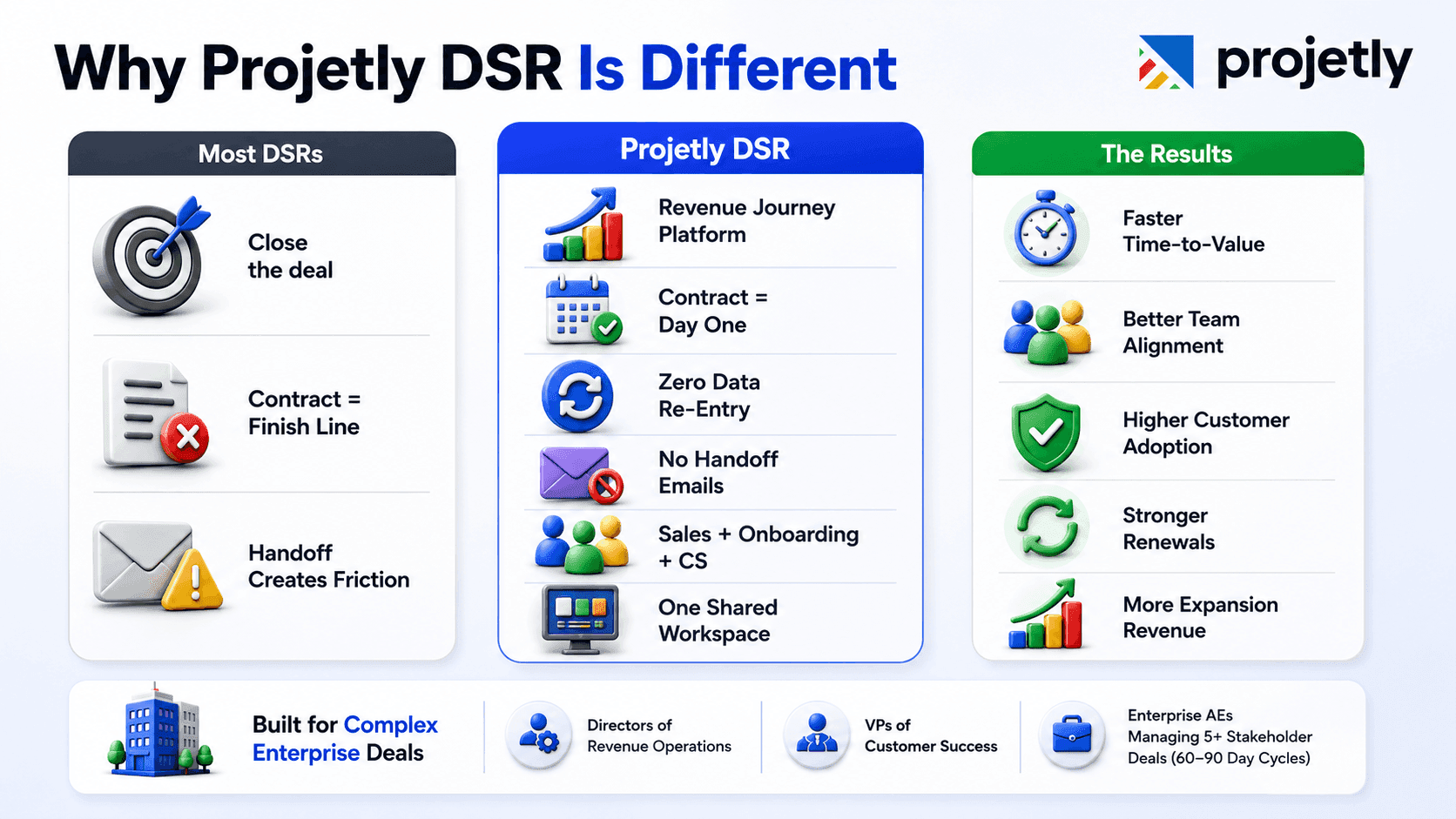
Projetly DSR is the only Digital Sales Room that treats the signed contract as the start of the revenue journey, not the finish line.
Most DSRs, including Dock, are built to win the deal. Projetly is built to win the deal, deliver the promise, and set the conditions for renewal, all inside one platform, with zero data re-entry and no handoff email.
Built for Directors of Revenue Operations, VPs of Customer Success, and Enterprise AEs managing 5+ stakeholder deals across 60–90 day cycles, where losing context at handoff costs real money.
How Does Projetly's Deal Intelligence Outperform Dock's Content AI?
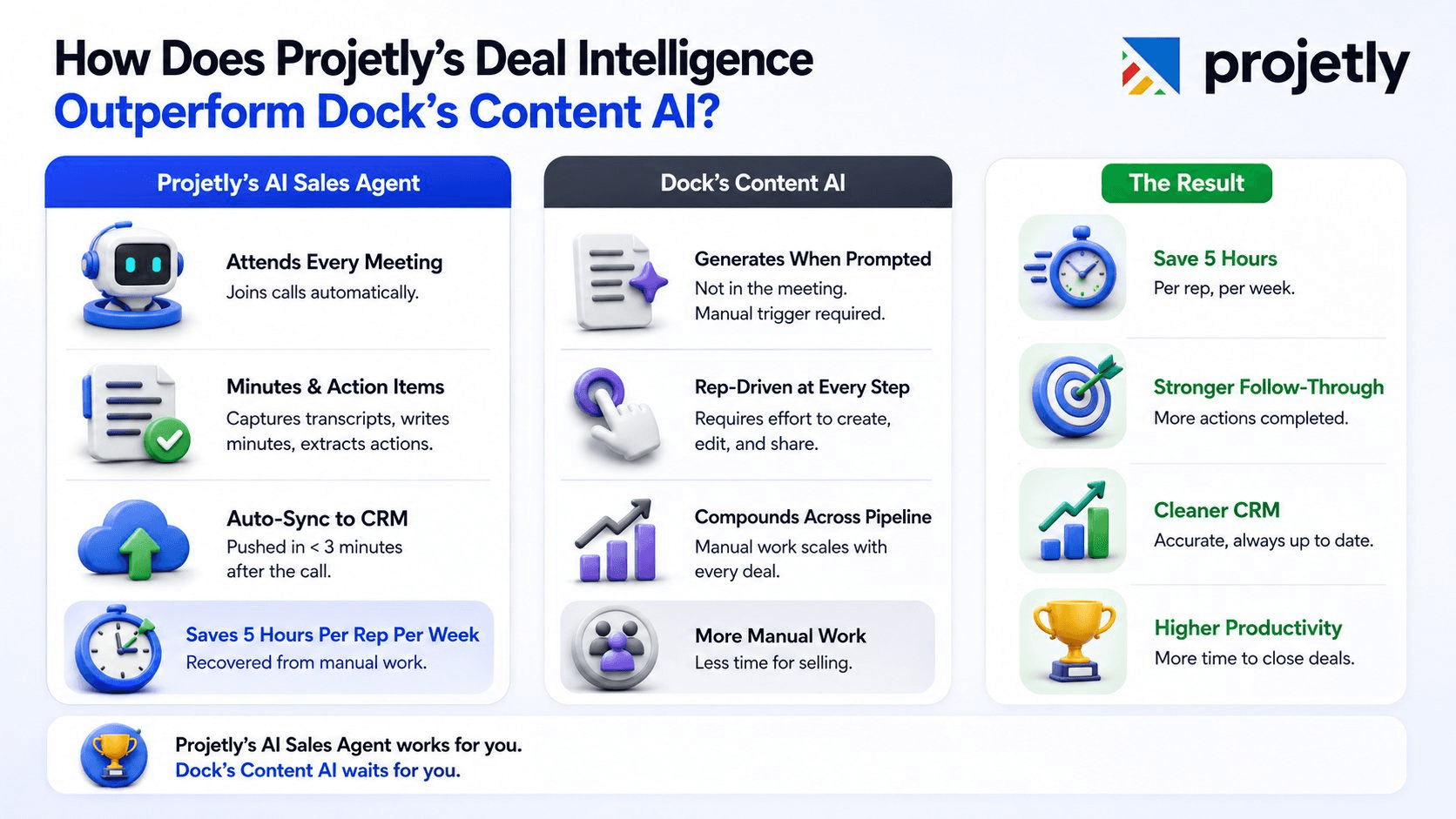
Projetly's AI Sales Agent doesn't wait for a rep to open a browser tab. It attends every meeting, captures full transcripts, writes the Minutes of the meeting, extracts committed action items, and pushes them to your CRM in under 3 minutes after the call ends.
Dock's AI generates documents when prompted, a different category of tool entirely, requiring rep effort at every step, which compounds across a 15-deal pipeline.
According to Projetly customer data, enterprise teams using the AI Sales Agent recover an average of 5 hours per rep per week previously lost to manual note-taking, follow-up drafting, and CRM updates.
→ Download: The Enterprise Revenue Playbook — How Top B2B Teams Run Multi-Stakeholder Deals →
What is Dock.us Actually Good At, and Where Does It Hit Its Ceiling?
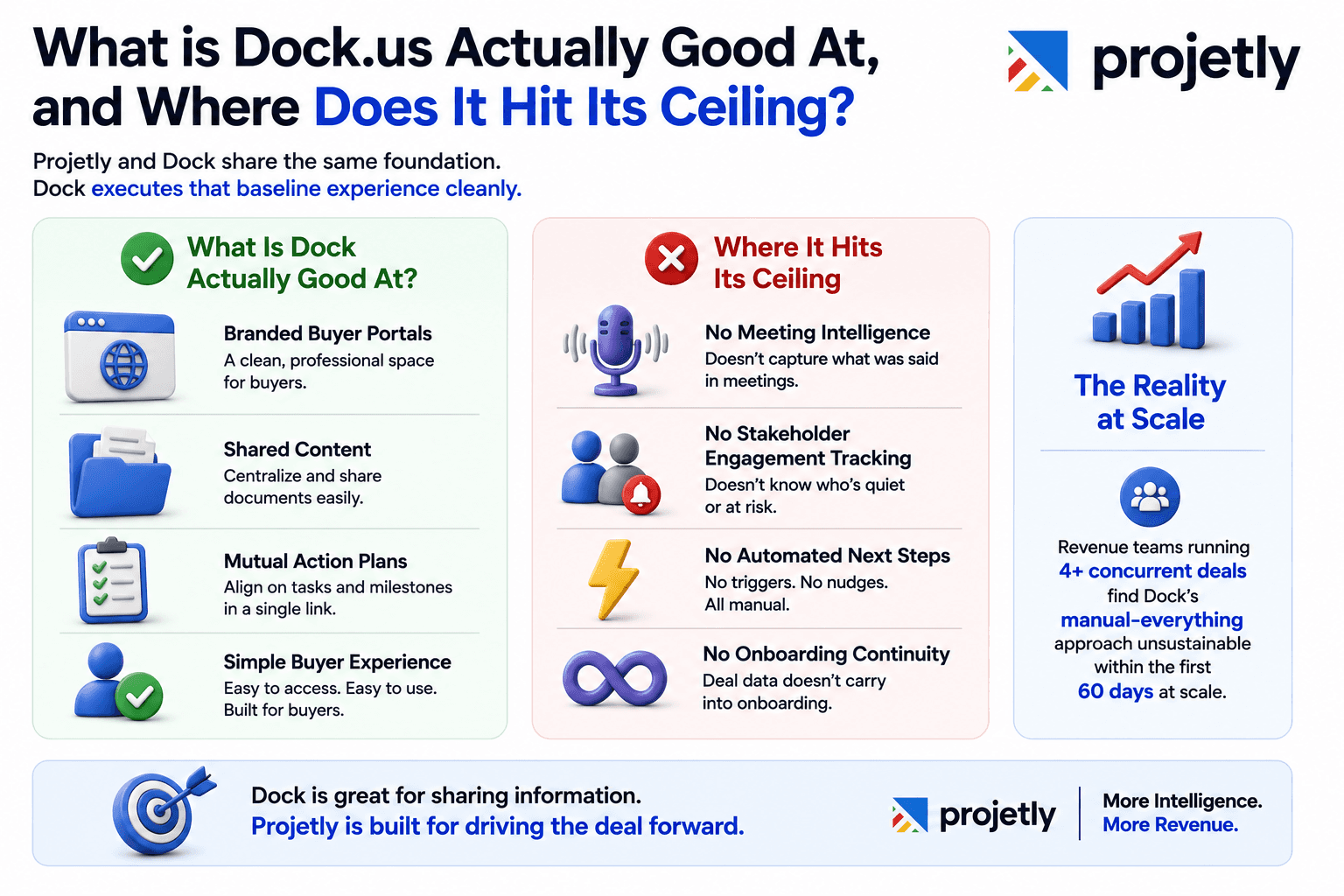
Projetly and Dock share the same foundation: a branded buyer portal, shared content, and a mutual action plan in a single link. Dock executes that baseline experience cleanly.
Where Dock hits its ceiling is everything that happens inside the deal, capturing what was said in meetings, knowing which stakeholder went quiet, automatically triggering next steps, and carrying that intelligence into onboarding. None of that exists in Dock.
Revenue teams running 4+ concurrent deals find Dock's manual-everything approach unsustainable within the first 60 days at scale.
Why Does Projetly's Onboarding Continuity Matter for Enterprise Retention?
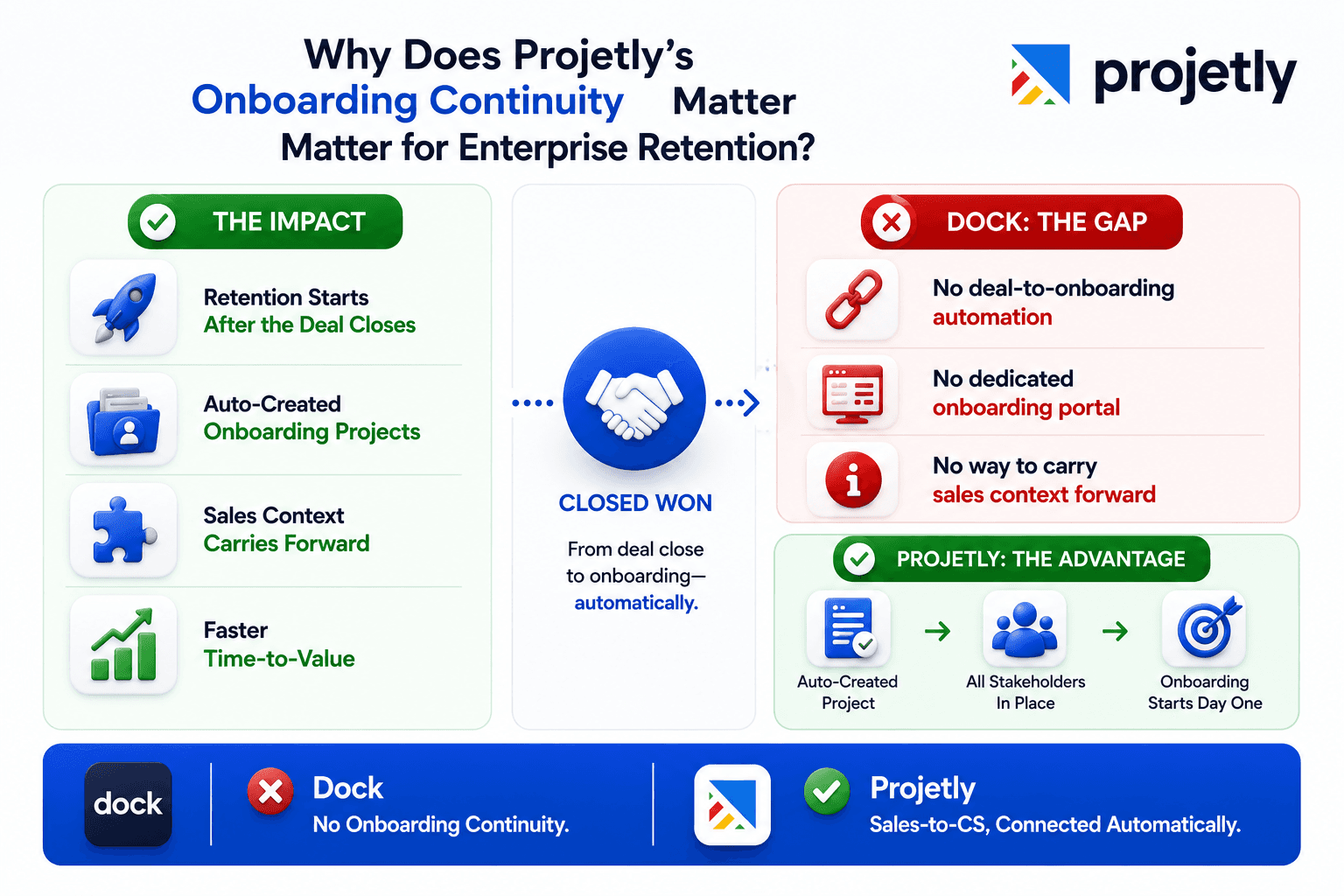
Enterprise retention is won or lost in the first 30 days after a deal closes, and most CS teams start that period with a 3-paragraph handoff email and a blank project board.
Projetly eliminates the blank slate. The moment a deal is marked Closed Won, a fully structured onboarding project is auto-created, pre-populated with every stakeholder, decision, and commitment from the sales cycle.
Dock has no automated deal-to-onboarding trigger, no dedicated onboarding portal, and no mechanism to carry sales context forward. That gap is invisible until it costs a renewal.
What Are the 15 Feature Differences That Change the Outcome of a Deal?
Projetly and Dock are evenly matched on the DSR basics, branded portals, content sharing, mutual action plans, and buyer engagement tracking. The table below covers the 15 capabilities that separate a deal room from a full revenue platform.
# | Feature | Projetly DSR | Dock.us |
|---|---|---|---|
1 | AI Sales Agent (autonomous deal execution) | ✅ | ❌ |
2 | Meeting transcription & MoM generation | ✅ | ❌ |
3 | Action item extraction & CRM sync | ✅ | ❌ |
4 | Deal risk detection & next-best-action | ✅ | ❌ |
5 | Advanced stakeholder mapping & org charts | ✅ | ❌ |
6 | Native e-signatures (no third-party needed) | ✅ | ❌ Via DocuSign / PandaDoc |
7 | Automated Closed Won → Onboarding project | ✅ | ❌ |
8 | Dedicated customer onboarding portal | ✅ Full | ✅ Basic only |
9 | Presentation mode for customer status reviews | ✅ | ❌ |
10 | AI-powered adoption nudges post-onboarding | ✅ | ❌ |
11 | No-code form builder embedded in deal rooms | ✅ | ❌ |
12 | Approvals & change management workflows | ✅ | ❌ |
13 | Sales playbooks connected to deal execution | ✅ | ❌ |
14 | Crypto token rewards for buyer-side champions | ✅ | ❌ |
15 | Freemium plan (no credit card to start) | ✅ | ❌ |
Projetly leads on 14 of 15 features. The one area where Dock holds an edge, dynamic CPQ-style proposal building, matters more in transactional sales cycles than in complex enterprise deals where relationships and context drive decisions.
Which Digital Sales Room Should Enterprise Revenue Teams Commit To?
Choose Projetly DSR if:
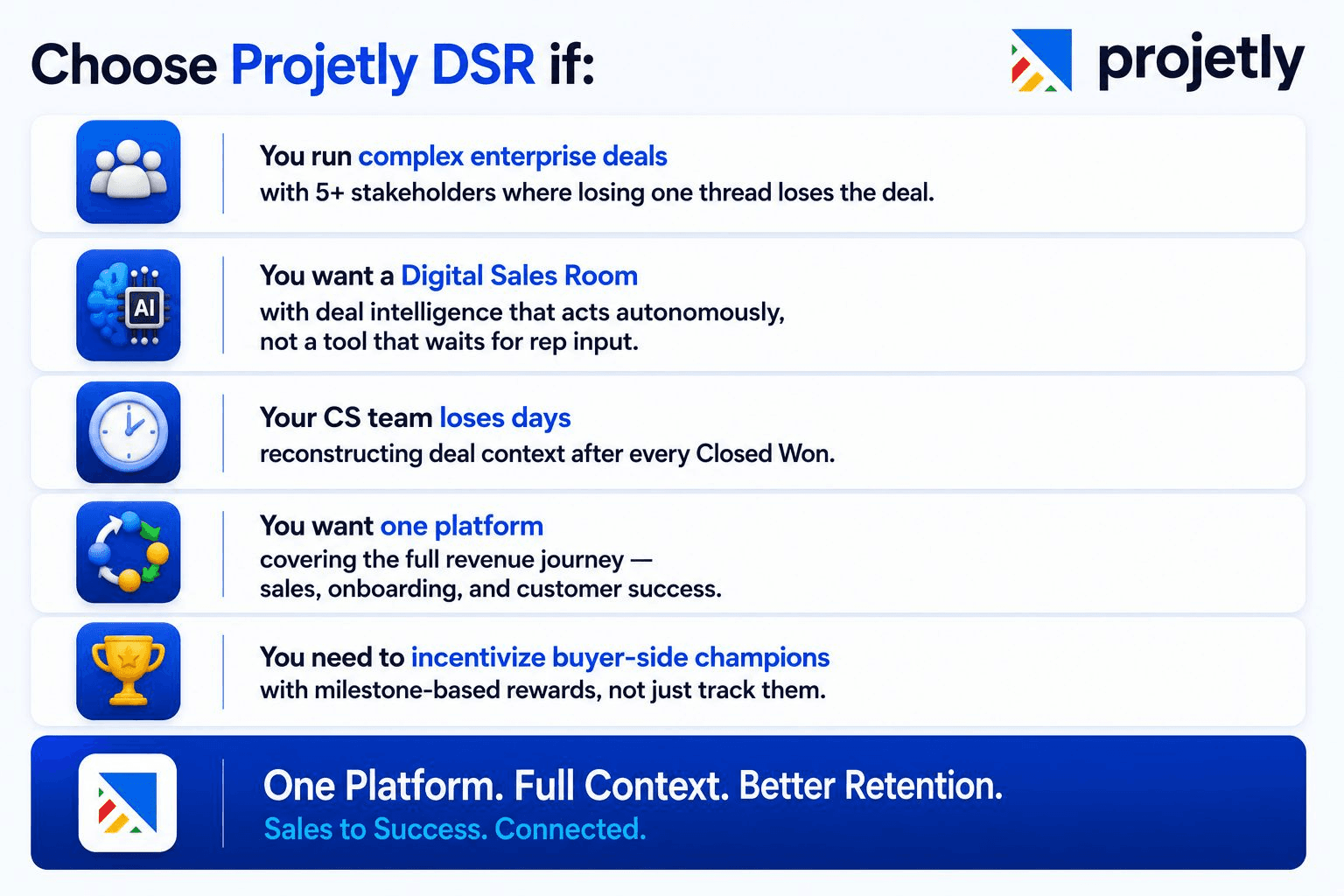
You run complex enterprise deals with 5+ stakeholders, where losing one thread loses the deal
You want a Digital Sales Room with deal intelligence that acts autonomously, not a tool that waits for rep input
Your CS team loses days reconstructing deal context after every Closed Won
You want one platform covering the full revenue journey — sales, onboarding, and customer success
You need to incentivize buyer-side champions with milestone-based rewards, not just track them
Choose Dock.us if:
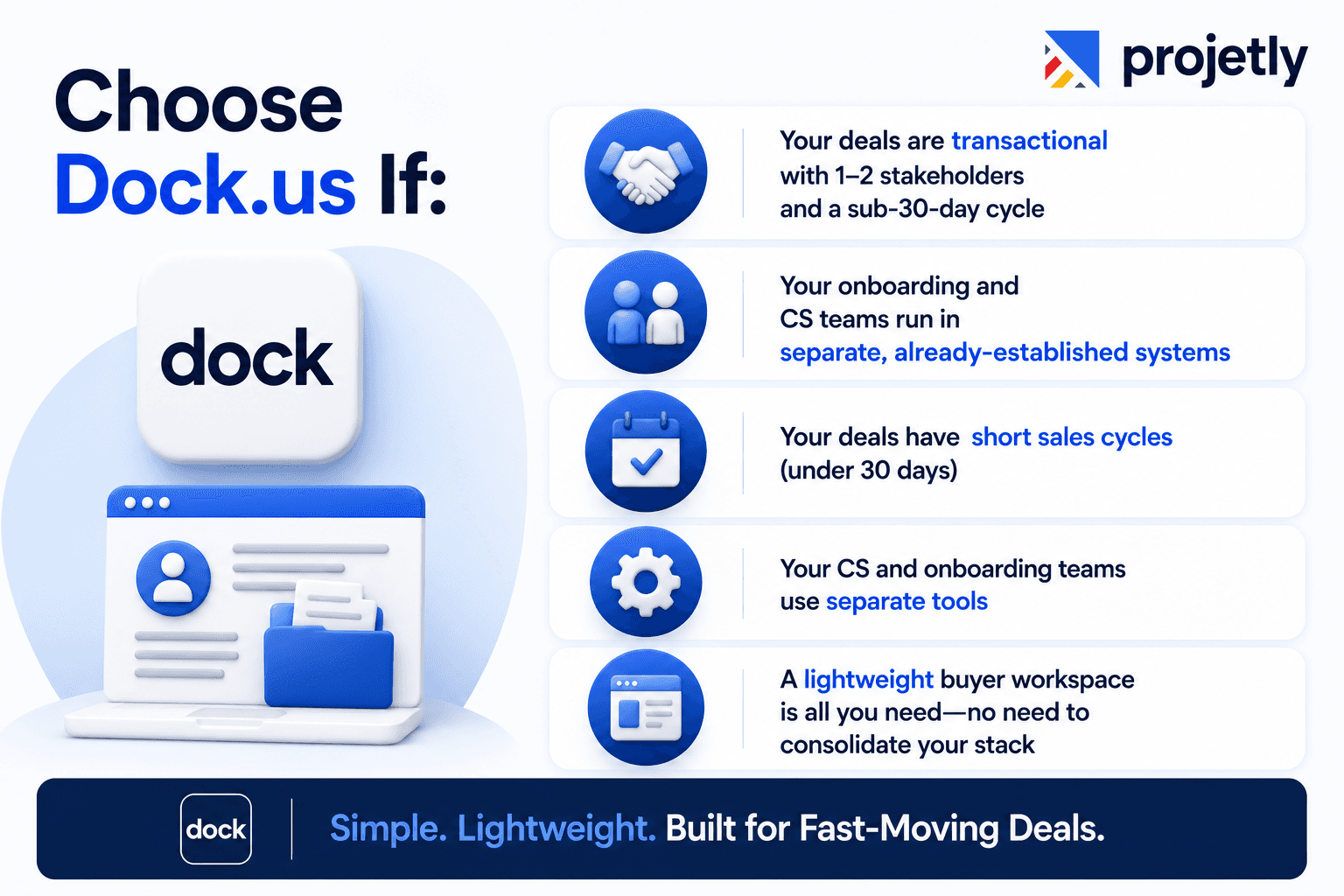
Your deals are transactional, with 1–2 stakeholders and a sub-30-day cycle
Your onboarding and CS teams run in separate, already-established systems
A lightweight buyer workspace is all you need, and you're not looking to consolidate your stack
The right question isn't which Digital Sales Room is easier to set up on day one. It's which platform is still adding value when your customer is 90 days post-signature and heading toward renewal?
TL;DR
Projetly DSR is a Digital Sales Room built for enterprise B2B deals and onboarding, Dock covers the deal room only and stops at the signature.
Projetly's AI Sales Agent recovers an average of 5 hours per rep per week lost to manual note-taking and follow-up drafting; Dock has no autonomous AI execution.
Projetly auto-generates a structured onboarding project at Closed Won with full deal context carried over. Dock has no equivalent handoff mechanism.
Projetly includes stakeholder mapping, deal risk detection, approval workflows, and adoption nudges. Dock offers none of these.
Projetly is free to start with no credit card required, and Dock has no freemium entry point.
Projetly leads on 14 of 15 key differentiating features in this comparison.
Frequently Asked Questions
1. How is Projetly DSR different from Dock.us beyond the feature list?
Projetly DSR is a Digital Sales Room built around the idea that the deal room's job starts, not ends, when a contract is signed. It carries a deal of intelligence, stakeholder context, and commitments into a fully automated onboarding project. Dock's platform becomes largely inactive post-signature, a fundamentally different product philosophy, not just a feature gap.
2. Does Projetly replace tools like Gong or Chorus for meeting intelligence?
For most enterprise sales teams, yes. Projetly's AI Sales Agent captures transcripts, generates MoMs, extracts action items, and syncs to CRM, covering the core use cases teams rely on Gong for, without a separate subscription. Dock has no meeting intelligence capability at any plan level.
3. How does Projetly's crypto token rewards system work in a sales deal?
Projetly lets sales teams assign milestone-based token rewards to buyer-side champions, internal advocates who help move deals forward on the customer's side. Tokens are tied to deal milestones, creating a tangible incentive for buyer engagement. Dock has no mechanism for activating or rewarding buyer-side momentum.
4. Can Projetly DSR handle multi-CRM environments?
Yes, Projetly integrates with Salesforce, HubSpot, SugarCRM, and Pipedrive. Dock's CRM support is limited to Salesforce and HubSpot, creating friction for enterprise teams running multi-tool revenue stacks or migrating CRMs mid-deal cycle.
5. Does Projetly support approval and change management workflows inside a deal room?
Yes, structured approval workflows and change management are built directly into Projetly's deal rooms and onboarding portals, removing the need for DocuSign forms or email-based approval chains. Dock has no approval workflow capability at any pricing tier.
6. How does Projetly's presentation mode help enterprise CS teams?
Projetly's presentation mode lets CS teams run live customer status reviews directly inside the onboarding portal, no PowerPoint or screen share needed. Customers see real-time progress, upcoming milestones, and open actions in one view. Dock has no equivalent, so teams default to slides for every status call.
7. Which Digital Sales Room is better for a team trialling a DSR for the first time?
Projetly's freemium plan lets teams set up their first deal room in under 30 minutes with no credit card required, making it the lower-risk entry point for first-time DSR evaluation. Dock has no free plan, meaning there's a financial commitment before a team can test it on a live deal.
→ See how Projetly DSR performs on your next live deal — start free, no credit card required →
You may also like

A Guide to Project Management Professional Certification

Laugh Your Way to Productivity: 50 Workplace Quotes

50 Funny Workplace Memes That’ll Brighten Your Workday.
What Does a Customer-First Mindset Mean? Explained in 2025

What It Takes to be a Great Customer Success Manager in 2025