BEST PRACTICES

By
Avaran
15 Questions to Ask Any Enterprise Vendor Before Signing a Contract (2026 Guide)
You've done the demos. You've sat through the pitch decks. The vendor's sales rep has been in your inbox every 48 hours. And now someone is pushing a contract in front of you.
This is exactly where enterprise deals go sideways.
Not during the demo, but during due diligence. The questions that should have been asked weren't. The clauses that needed clarification got glossed over. And six months later, your team is locked into a tool that doesn't integrate with your stack, charges you for every seat regardless of usage, and has a support SLA that amounts to "we'll get back to you eventually."
This guide exists to prevent that. Whether you're evaluating a SaaS platform, a software integration partner, or a managed services provider, these 15 questions will surface the risks that vendors rarely volunteer on their own.
Book a demo to see how Projetly helps teams reduce vendor risk and streamline onboarding, collaboration, and execution.
Why Most Vendor Evaluations Miss the Point
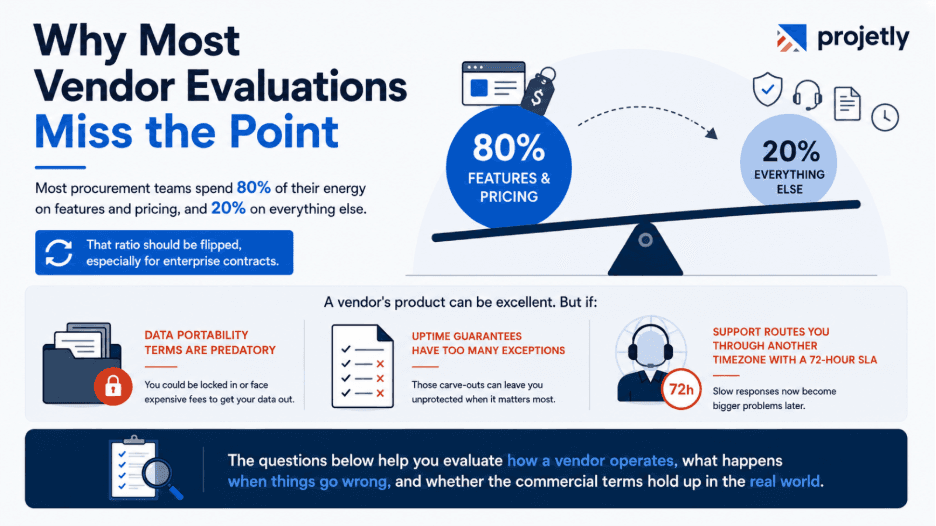
Most procurement teams spend 80% of their energy on features and pricing, and 20% on everything else. That ratio should be flipped, especially for enterprise contracts.
A vendor's product can be excellent. But if their data portability terms are predatory, their uptime guarantees have a dozen carve-outs, or their support model routes your tickets through a helpdesk in a different time zone with a 72-hour SLA, you'll regret the signature.
The questions below are structured to move you from evaluating what a vendor sells to evaluating how they operate, what happens when things go wrong, and whether the commercial terms hold up under real-world conditions.
The 15 Questions: Organized by What's Actually at Risk
Category 1: Ownership, Data, and Exit Rights
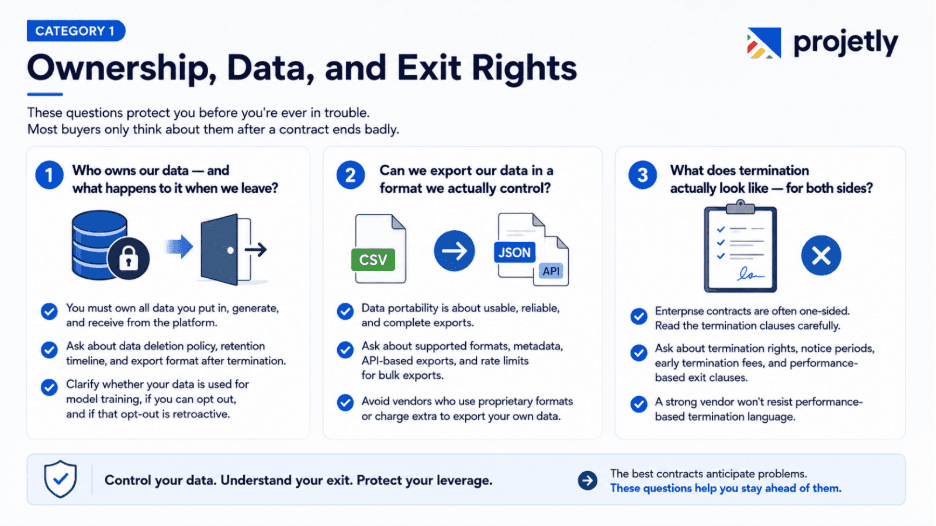
These questions protect you before you're ever in trouble. Most buyers only think about them after a contract ends badly.
1. Who owns our data, and what happens to it when we leave?
This is non-negotiable. You need written clarity that your organization owns all data you put into the system, all data generated from your usage, and all outputs the platform produces on your behalf.
Ask specifically:
What is your data deletion policy post-termination?
How long do you retain our data after the contract ends?
In what format can we export it?
Vendors who hedge on this, with language like "we retain anonymized data for product improvement", deserve a harder look. That "anonymized" clause can include behavioral data, usage patterns, and query logs that are commercially sensitive.
In 2026, with AI-powered enterprise tools proliferating rapidly, this matters even more. Many platforms train models on customer data by default. Ask whether your data is used for model training, whether you can opt out, and whether that opt-out is retroactive.
2. Can we export our data in a format we actually control?
Data portability isn't just about getting a CSV. It's about whether the export is in a format your team can use, import into another system, or archive meaningfully.
Ask for:
Supported export formats, whether exports include metadata,
Whether there are API-based export options, and what rate limits apply to bulk exports.
Vendors who offer only proprietary formats, or who charge a separate "data export fee", are essentially holding your data hostage. Walk into this conversation knowing your non-negotiables.
3. What does termination actually look like, for both sides?
Read the termination clauses before you sign, not after. Most enterprise contracts have asymmetric termination rights: the vendor can exit under a wide range of conditions, while you're locked in for the contract term regardless.
Ask:
Under what conditions can you terminate our contract?
What notice period applies?
What penalties apply if we terminate early?
Is there a performance-based exit clause?
A strong vendor won't shy away from performance-based termination language. If they refuse to include it, that tells you something.
Start your free trial and streamline vendor onboarding with confidence.
Category 2: Security, Compliance, and Risk Posture
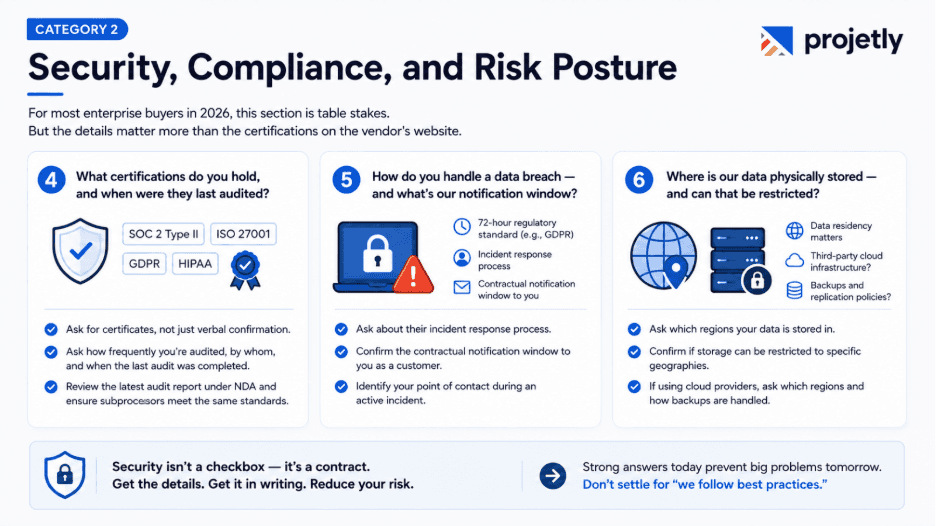
For most enterprise buyers in 2026, this section is table stakes. But the details matter more than the certifications on the vendor's website.
4. What certifications do you hold, and when were they last audited?
SOC 2 Type II, ISO 27001, GDPR compliance, HIPAA if you're in healthcare, ask for the certificates, not just verbal confirmation. Then check the audit dates.
A SOC 2 Type II report from 18 months ago isn't the same as one issued last quarter.
Ask:
How frequently are you audited?
By whom?
Can we review the most recent report under NDA?
If a vendor can't provide their security audit report, that's a serious flag. Even more critical: ask whether their third-party sub-processors (the vendors they rely on) are held to the same standards.
5. How do you handle a data breach, and what's our notification window?
Most vendors will say something reassuring. Dig into the mechanics. Regulatory requirements under GDPR, for example, mandate 72-hour breach notification to authorities. Does your vendor's process align with that?
Ask specifically:
What is your incident response process?
What's the contractual notification window to us as a customer?
Who is our point of contact during an active incident?
The quality of a vendor's answer here reveals a lot about the maturity of their security operations. Vague answers ("we follow best practices") should be followed up with requests for their written incident response policy.
6. Where is our data physically stored, and can that be restricted?
Data residency requirements are real and getting stricter, particularly for regulated industries and cross-border operations. If your organization is subject to European data protection law, U.S. federal compliance requirements, or sector-specific regulations (financial services, healthcare, government), you need contractual guarantees about where data lives.
Ask:
In which regions is data stored?
Can we restrict storage to specific geographies?
Do you use any third-party cloud infrastructure?
And if so, which providers and regions?
"We're on AWS" is not a sufficient answer. You need to know which AWS regions, what data replication policies apply, and whether backups are stored in the same geography.
Category 3: Integration, Implementation, and Technical Fit
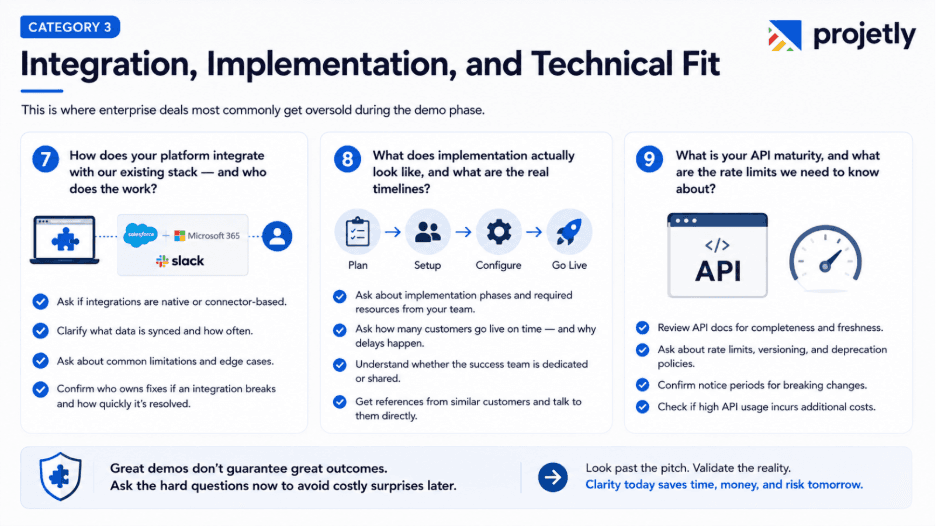
This is where enterprise deals most commonly get oversold during the demo phase.
7. How does your platform integrate with our existing stack, and who does the work?
Every vendor will say they integrate with Salesforce, Microsoft 365, and Slack. The question isn't whether an integration exists; it's how mature it is, what it actually syncs, and who manages it.
Ask:
Are your integrations native or connector-based (e.g., via Zapier/Make)?
What is the scope of data synced?
Is the integration real-time or batched?
What do your customers most hit as integration limitations?
That last question, asking about limitations proactively, is one of the best signals of vendor honesty. A vendor who can clearly articulate what their integrations don't do is more trustworthy than one who says "it just works."
Also, clarify responsibility: if the integration breaks after a platform update, who is accountable for the fix, and within what timeframe?
8. What does implementation actually look like, and what are the real timelines?
Sales timelines and delivery timelines are not the same thing. A vendor might promise a six-week implementation. Ask how many customers have gone live in that window, what percentage hit delays, and what the most common reasons for delay are.
Ask:
What are the implementation phases?
What resources do you need from our side?
What does your customer success team look like?
Are they dedicated or shared?
What is the realistic go-live timeline for an organization of our size and complexity?
Get references from customers with similar tech environments who can speak to their actual onboarding experience, not the polished case study version.
9. What is your API maturity, and what are the rate limits we need to know about?
If your team plans to build on top of the platform, pulling data, pushing workflows, automating tasks, the API is not a feature; it's infrastructure. Treat it that way.
Ask for:
API documentation (check if it's current and maintained), rate limit structures, versioning policy, deprecation notice timelines,
And whether there are additional costs for high API usage.
Vendors who deprecate API versions without adequate notice, or who change rate limits mid-contract, create real operational problems. Ask directly: What is your policy for backwards-incompatible API changes?
Category 4: Support, SLAs, and What Happens When Things Break
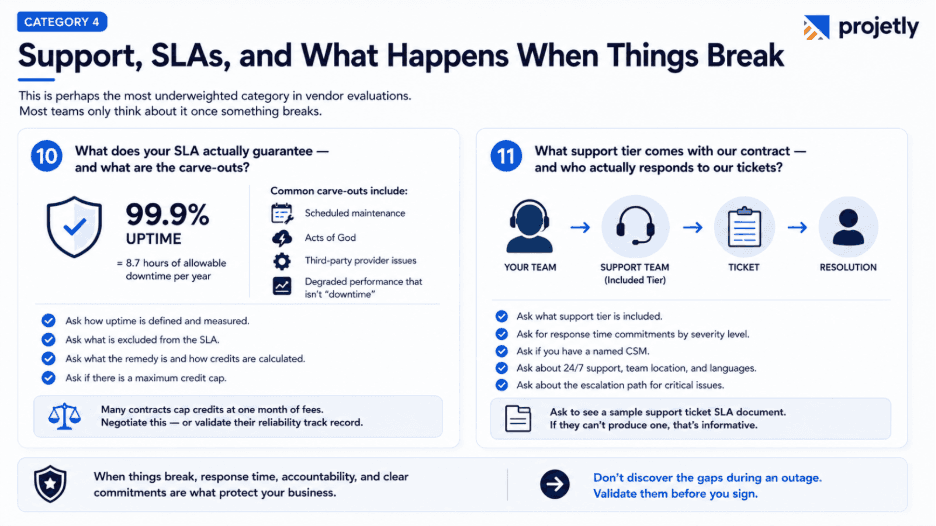
This is perhaps the most underweighted category in vendor evaluations. Most teams only think about it once something breaks.
10. What does your SLA actually guarantee, and what are the carve-outs?
"99.9% uptime" sounds like a lot until you realize that's 8.7 hours of allowable downtime per year. And that's before the carve-outs: scheduled maintenance windows, "acts of God," issues caused by third-party providers, or degraded performance that technically doesn't count as "downtime."
Ask:
How is uptime defined and measured?
What is excluded from your SLA?
What is the remedy, SLA credits?
What is the credit calculation?
Is there a maximum credit cap?
Many enterprise contracts cap SLA credits at one month of fees, regardless of how significant the outage was. If uptime is mission-critical for your operations, negotiate harder here or consider whether the vendor's reliability track record justifies the risk.
11. What support tier comes with our contract, and who actually responds to our tickets?
Enterprise sales reps are not enterprise support. Once the contract is signed, your relationship often shifts entirely to a support function that may or may not be adequately resourced.
Ask:
What is the included support tier?
What are the response time commitments by severity level?
Do we have a named customer success manager?
Is there 24/7 support, and if so, where is the team located?
What is the escalation path for critical issues?
Ask to see a sample support ticket SLA document, not just verbal assurance. If they can't produce one, that's informative.
Explore Digital Sales Rooms With Us
Category 5: Commercial Terms and Contract Risk
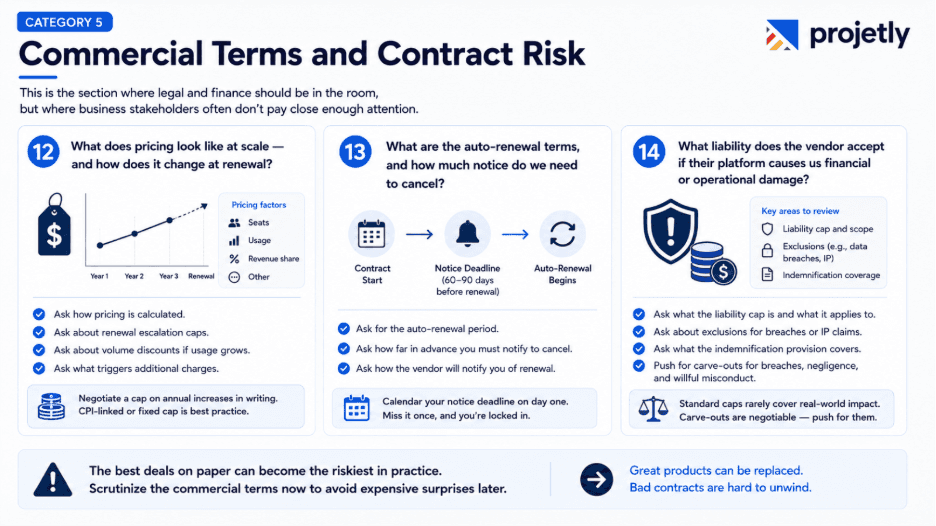
This is the section where legal and finance should be in the room, but where business stakeholders often don't pay close enough attention.
12. What does pricing look like at scale, and how does it change at renewal?
The pricing you see at year one is rarely the pricing you'll face at renewal. Enterprise vendors routinely build in annual escalation clauses (typically 3-7% per year), and usage-based models can surprise you significantly if adoption grows faster than expected.
Ask:
How is pricing calculated, seats, usage, revenue share, or something else?
What are the renewal price escalation caps?
If we expand usage significantly, are there volume discounts?
What triggers additional charges?
If a vendor refuses to cap annual price increases in writing, you're accepting open-ended commercial exposure. Many organizations negotiate a CPI-linked cap or a fixed maximum percentage increase as standard.
13. What are the auto-renewal terms, and how much notice do we need to cancel?
This clause has caught more procurement teams than almost anything else. Enterprise contracts with 60 or 90-day non-renewal notice windows, combined with auto-renewal provisions, mean a missed deadline locks you in for another year automatically.
Ask:
What is the contract auto-renewal period?
How far in advance must we notify you to prevent renewal?
How will you notify us that renewal is approaching?
Best practice: Calendar your notice deadline the day the contract is signed, well before the reminder would ever come from the vendor.
14. What liability does the vendor accept if their platform causes us financial or operational damage?
Most enterprise software contracts include mutual limitation of liability clauses capping damages at the fees paid in the prior 12 months. That sounds reasonable until the vendor's outage costs you ten times that in lost revenue.
Ask:
What is the liability cap, and what does it apply to?
Are there exclusions for data breaches or IP infringement?
What does your indemnification provision cover?
For vendors handling sensitive data or running mission-critical workflows, push for carve-outs from the liability cap for data breaches, negligence, and willful misconduct. These are negotiable in many cases; vendors expect to be pushed here.
Category 6: Roadmap, Stability, and Long-Term Fit
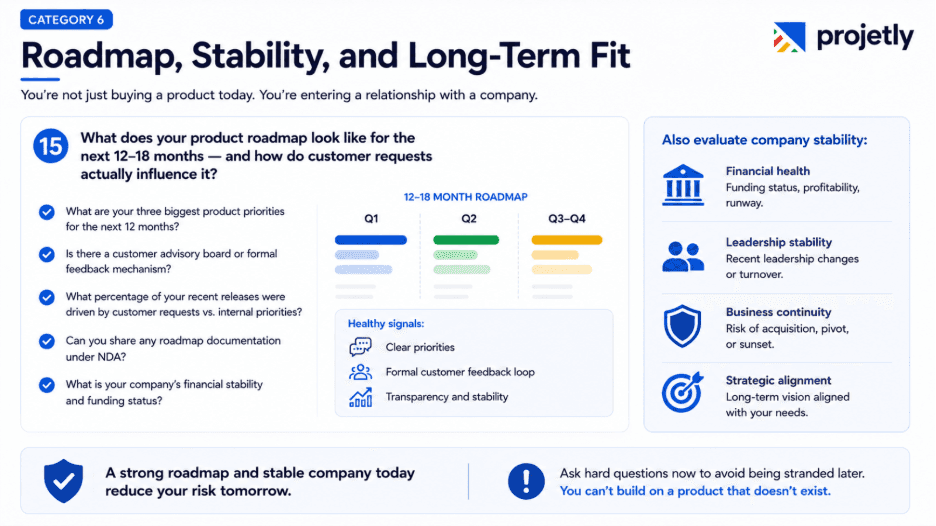
You're not just buying a product today. You're entering a relationship with a company.
15. What does your product roadmap look like for the next 12-18 months, and how do customer requests actually influence it?
Every vendor will tell you your requested feature is "on the roadmap." Ask follow-up questions that require specificity.
Ask:
What are your three biggest product priorities for the next 12 months?
Is there a customer advisory board or formal feedback mechanism?
What percentage of your recent releases were driven by customer requests versus internal priorities?
Can you share any roadmap documentation under NDA?
Also, ask about the company's financial stability, especially for smaller or private vendors. A product you depend on being acquired or sunset mid-contract is a real operational risk. Ask about funding status, profitability, or whether they've had recent leadership changes that might affect strategic direction.
Let’s Streamline Your Sales Process
How to Use These Questions in Practice
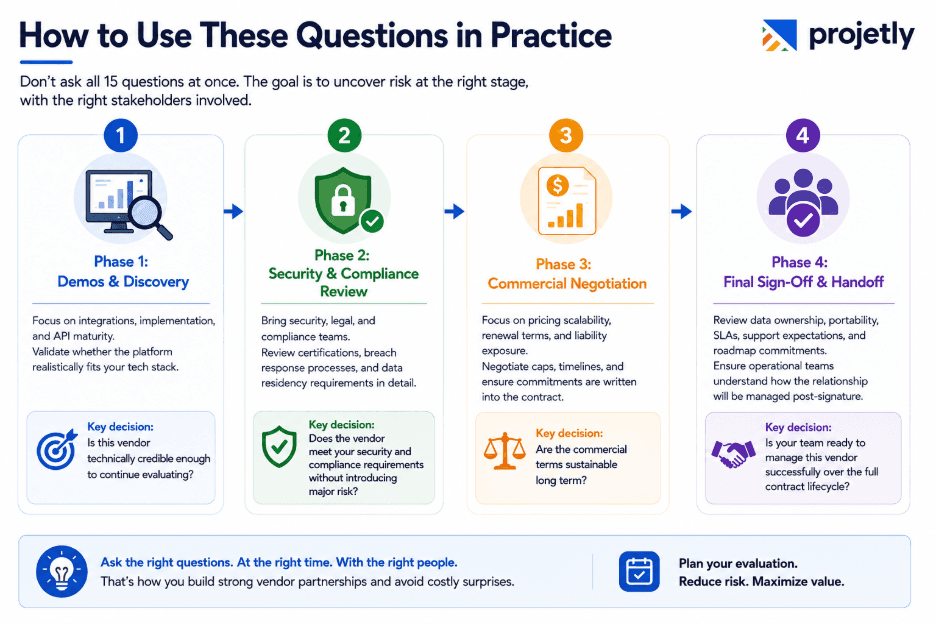
Don't ask all 15 questions in one meeting. Enterprise evaluations work best when questions are asked at the right stage, with the right stakeholders involved. The goal isn't to pressure vendors; it's to uncover risks before signing a contract.
Phase 1: Demos & Discovery
Focus on integration, implementation, and API maturity. Validate whether the platform realistically fits your tech stack before investing deeper evaluation time. Ask for real implementation examples, integration architecture details, and live API documentation reviews with your IT team involved.
Key decision: Is this vendor technically credible enough to continue evaluating?
Phase 2: Security & Compliance Review
Bring security, legal, and compliance teams. Review certifications, breach response processes, and data residency requirements in detail. Request audit reports, sub process or lists, and written answers, not verbal assurances.
Key decision: Does the vendor meet your security and compliance requirements without introducing major risk?
Phase 3: Commercial Negotiation
Focus on pricing scalability, renewal clauses, and liability exposure. Model growth scenarios, negotiate renewal timelines early, and ensure every vendor commitment is reflected in the contract language.
Key decision: Are the commercial terms sustainable in the long term?
Phase 4: Final Sign-Off & Handoff
Review data ownership, portability, SLA expectations, support processes, and roadmap commitments. Ensure operational teams understand how the relationship will be managed after the contract is signed.
Key decision: Is your team prepared to manage this vendor successfully over the full contract lifecycle?
A Quick Checklist Before You Sign
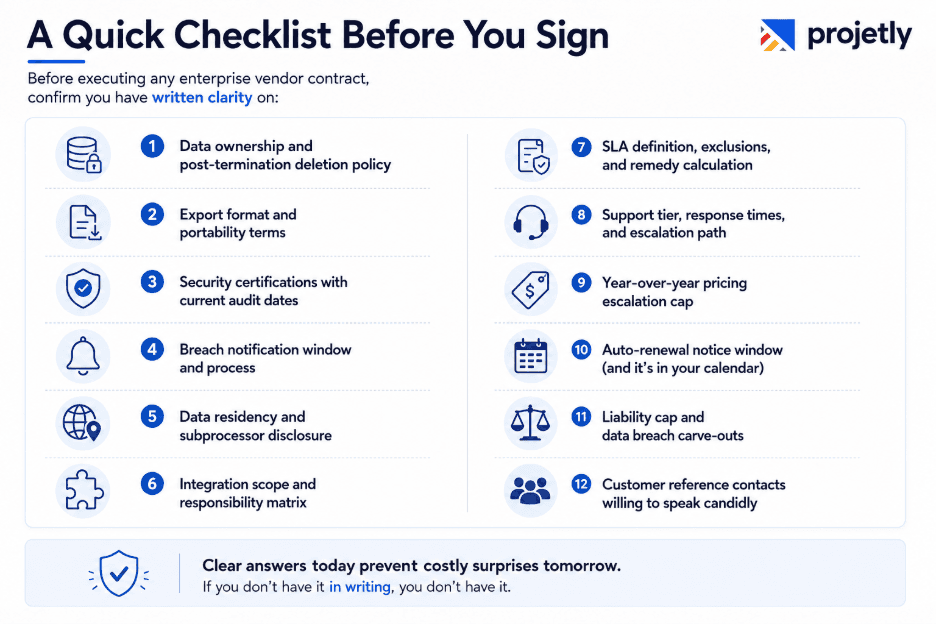
Before executing any enterprise vendor contract, confirm you have written clarity on:
Data ownership and post-termination deletion policy
Export format and portability terms
Security certifications with current audit dates
Breach notification window and process
Data residency and sub-processor disclosure
Integration scope and responsibility matrix
SLA definition, exclusions, and remedy calculation
Support tier, response times, and escalation path
Year-over-year pricing escalation cap
Auto-renewal notice window (and it's in your calendar)
Liability cap and data breach carve-outs
Customer reference contacts willing to speak candidly
Final Thought
The vendors who push back hardest on these questions are often the ones with the most to hide. Strong enterprise vendors, the ones worth your contract, will have clear, documented answers to all of these, and many will appreciate a buyer who asks them.
Due diligence isn't adversarial. It's the foundation of a relationship that actually works. Ask the hard questions before you sign, and you'll spend far less time in difficult conversations after.
Looking to formalize your vendor evaluation process?
This question framework pairs well with a structured RFP template, a security questionnaire, and a defined scoring rubric across technical, commercial, and operational dimensions.
Frequently Asked Questions
Why is vendor due diligence important before signing an enterprise contract?
Vendor due diligence helps uncover operational, security, pricing, and support risks before they become expensive long-term problems. It ensures the vendor fits your technical, compliance, and business requirements beyond just product features.
2. What are the biggest risks organizations overlook during vendor evaluations?
Most teams overlook data ownership, SLA exclusions, pricing escalation clauses, auto-renewal terms, API limitations, and support responsiveness. These issues often surface only after implementation begins.
3. What questions should you ask an enterprise SaaS vendor before signing?
Key questions should cover data ownership, export rights, security certifications, breach response processes, integrations, implementation timelines, SLAs, pricing scalability, liability coverage, and product roadmap stability.
4. How can companies evaluate a vendor's security and compliance posture?
Request current audit reports, security certifications, breach response documentation, subprocessor lists, and data residency details. Written documentation matters far more than verbal assurances during evaluations.
5. Why are SLAs and support terms critical in enterprise contracts?
SLAs define how uptime, outages, response times, and issue escalation are handled. Weak SLA terms can lead to operational disruption, delayed support responses, and limited compensation during critical incidents.
6. What should enterprises look for in vendor pricing and renewal clauses?
Review how pricing scales with usage, annual price increase caps, hidden fees, and auto-renewal notice periods. Many organizations face unexpected cost increases because these terms weren't negotiated up front.
7. How do you know if a vendor is a good long-term fit?
A strong long-term vendor fit depends on product stability, roadmap transparency, financial health, integration maturity, responsive support, and willingness to provide clear contractual commitments.
You may also like

A Guide to Project Management Professional Certification

Laugh Your Way to Productivity: 50 Workplace Quotes

50 Funny Workplace Memes That’ll Brighten Your Workday.
What Does a Customer-First Mindset Mean? Explained in 2025

What It Takes to be a Great Customer Success Manager in 2025