Project Management

By
Dhruv
Best Project Management Software With Client Portals in 2026
Managing client projects without a dedicated portal is a bit like running a restaurant without a menu everyone's guessing, communication breaks down, and trust erodes fast. The right project management software with a built-in client portal changes all of that. It gives your clients real-time visibility, keeps your team aligned, and creates a single source of truth from kickoff to delivery.
This guide covers the top-rated project management platforms in 2026, explains what separates good client portals from great ones, and helps you pick the right fit for your team size, project complexity, and budget.
In This Guide
What is project management software with a client portal?
Why it matters in 2026
Key features to look for
Top 6 platforms reviewed
Side-by-side comparison table
How to choose the right one
FAQs
What is Project Management Software With a Client Portal?
Project management software with a client portal is a platform that combines internal project tracking, tasks, timelines, resources, and budgets with a secure, client-facing layer where stakeholders can log in to view progress, share feedback, and access deliverables.
Unlike standard project tools that keep everything internal, a client portal brings your clients into the workflow without opening up your entire backend. Think of it as a curated window into your project, one that's branded, permission-controlled, and designed to keep clients informed without flooding their inboxes.
These platforms support both agile and traditional project management approaches and are used across industries from construction and consulting to marketing agencies and software development.
Why Client Portals Matter More Than Ever in 2026
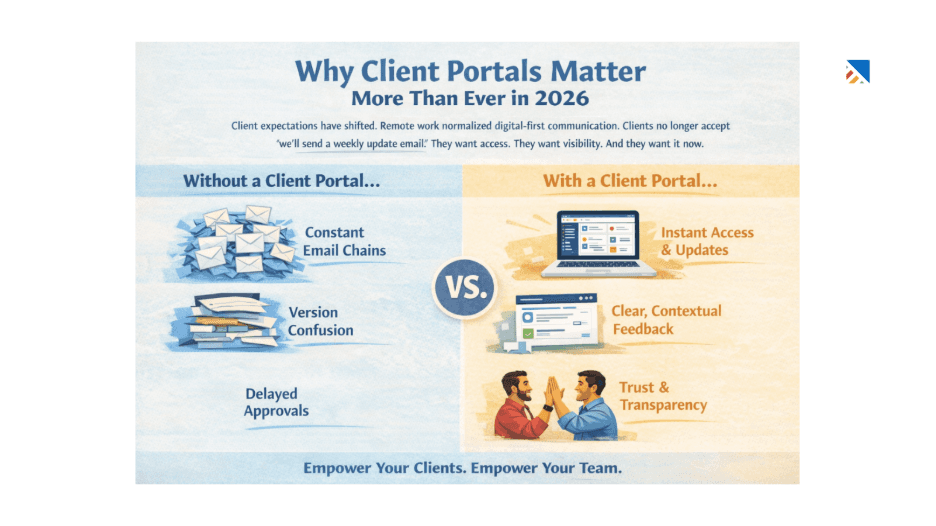
Client expectations have shifted. Remote work normalized digital-first communication. Clients no longer accept 'we'll send a weekly update email.' They want access. They want visibility. And they want it now.
Here's what happens when you don't have a client portal:
Constant email chains asking for status updates
Version confusion on shared documents
Delayed approvals that stall project timelines
Clients feel out of the loop and are losing confidence in your team
And here's what changes when you do:
Clients self-serve answers to 'where are we?' instead of emailing you
Feedback is captured in context, not buried in reply threads
Trust builds through consistent, proactive transparency
Your team spends less time on status updates and more time on actual work
Key Features to Look for in 2026
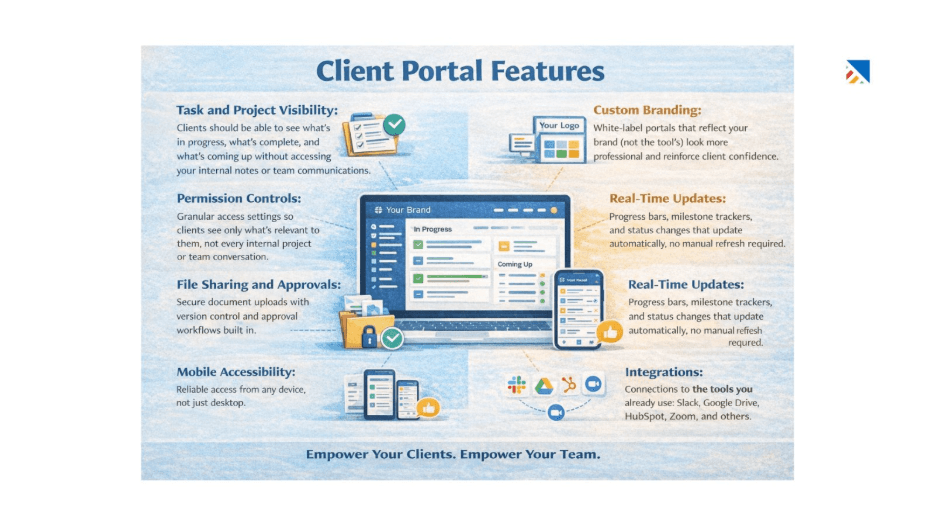
Not all client portals are created equal. When evaluating platforms, these are the features that separate genuinely useful tools from ones that look good on a demo but frustrate you in practice:
Task and project visibility: Clients should be able to see what's in progress, what's complete, and what's coming up without accessing your internal notes or team communications.
Custom branding: White-label portals that reflect your brand (not the tool's) look more professional and reinforce client confidence.
Permission controls: Granular access settings so clients see only what's relevant to them, not every internal project or team conversation.
Real-time updates: Progress bars, milestone trackers, and status changes that update automatically, no manual refresh required.
File sharing and approvals: Secure document uploads with version control and approval workflows built in.
Communication threads: In-context messaging tied to specific tasks or deliverables, reducing email back-and-forth.
Mobile accessibility: Both your team and your clients need reliable access from any device, not just a desktop.
Integrations: Connections to the tools you already use, Slack, Google Drive, HubSpot, Zoom, and others.
Top 7 Project Management Tools with Client Portals in 2026
Here's an honest look at the leading platforms, what they do well, who they're best for, and where they fall short.
Projetly PSA: Beyond Generic PM Tools and Basic Client Portals
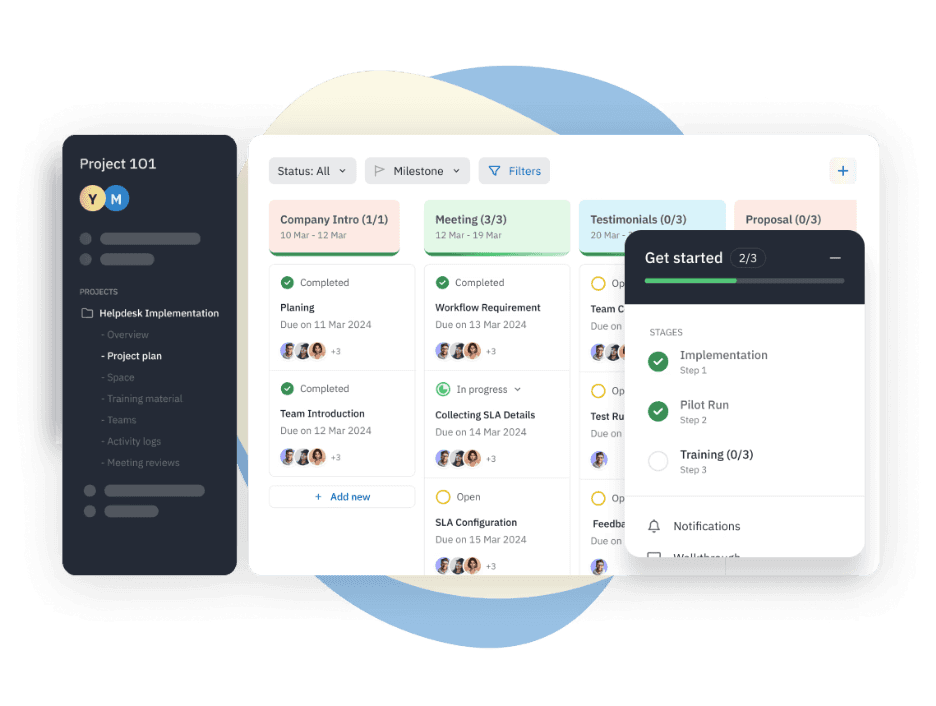
Projetly is a modern Professional Services Automation platform that unifies planning, staffing, execution, collaboration, and performance tracking in one workspace. Connecting projects, people, and finances, it gives service firms better visibility, efficiency, and margin control.
What sets it apart is its AI-assisted delivery engine, which helps automate workflows, surface risks early, and keep teams ahead of project issues while improving operational clarity.
Key Features of Projetly
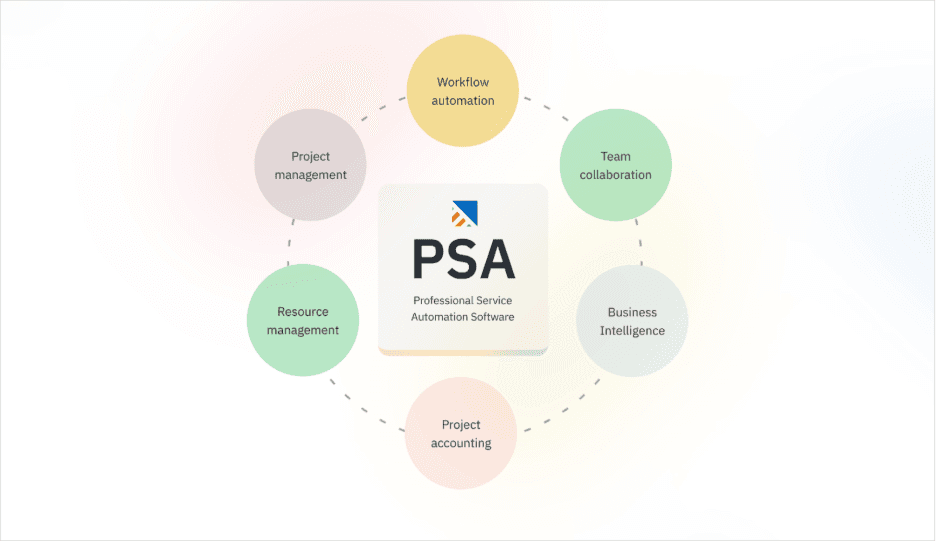
AI-Powered Project Management: Projetly supports structured project planning, scheduling, task assignment, and progress tracking with AI assistance to refine tasks and improve clarity. This helps teams standardize delivery and reduce manual planning overhead.
Resource Optimization and Utilization Tracking: The platform helps match skills to project requirements, balance workloads, and optimize staffing decisions, a core PSA capability that directly impacts delivery speed and profitability.
Time Tracking and Billing Readiness: Projetly tracks billable hours, project costs, and effort automatically, supporting accurate invoicing and revenue protection while reducing manual timesheet friction.
AI-Driven Workflow Automation: Repetitive operational steps, reminders, task transitions, approvals, and status updates can be automated, reducing administrative work and improving process consistency.
AI-Based Risk Detection: Projetly analyzes project signals to identify delays, bottlenecks, or delivery risks early so teams can intervene before timelines or budgets slip.
Collaborative Workspaces and Client Portals: Shared workspaces, document management, and client collaboration tools provide a single place for communication, feedback, and visibility, improving transparency across stakeholders.
Document and Training Management: Projetly centralizes project documentation, onboarding materials, and process knowledge so teams can standardize delivery and reduce repeated effort across projects.
Real-Time Analytics and Performance Insights: Dashboards provide visibility into project health, utilization, profitability, and delivery metrics, helping leaders make data-driven staffing and planning decisions.
Benefits of Using Projetly PSA
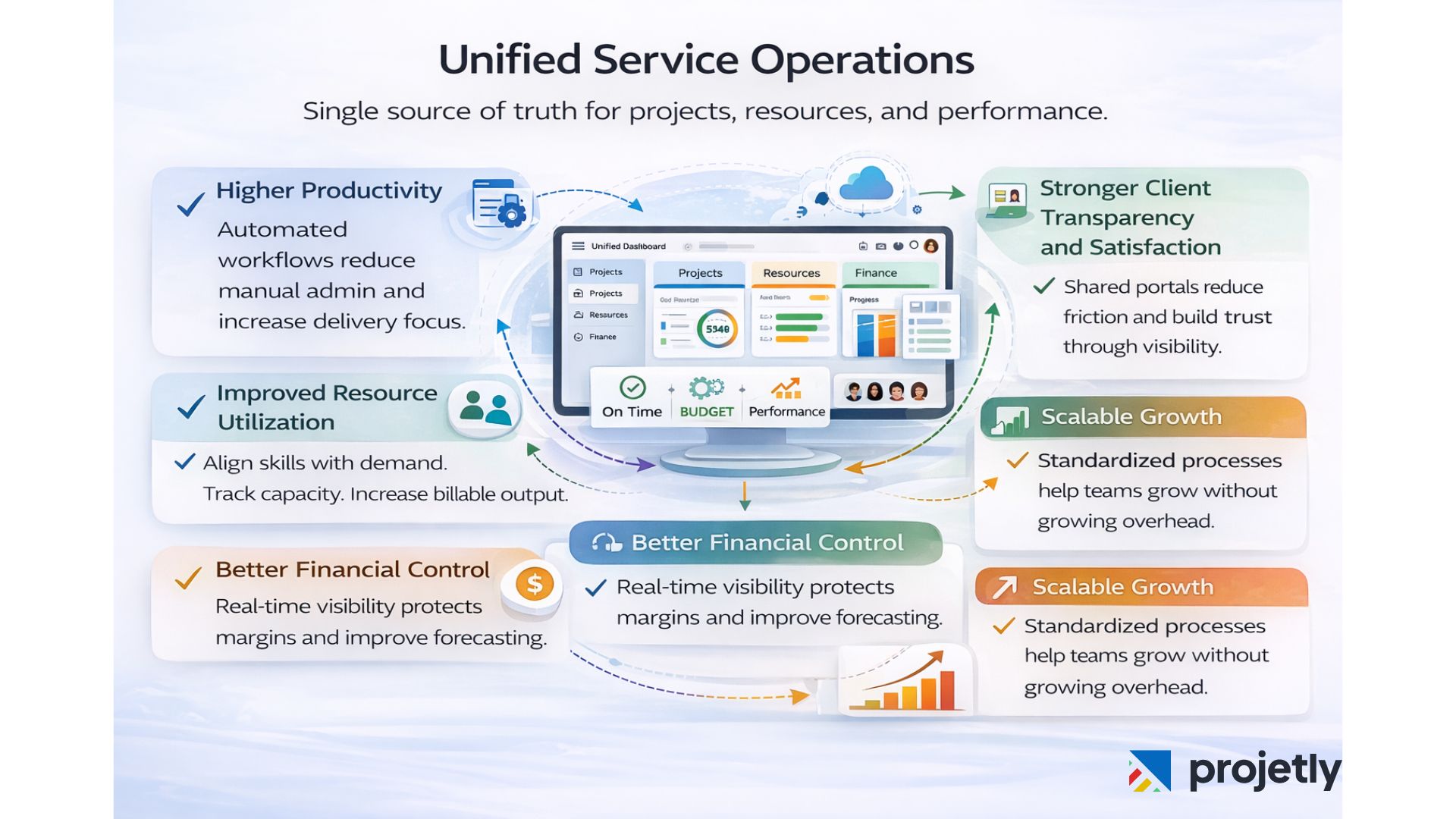
Unified Service Operations: Projetly creates a single source of truth for projects, resources, and delivery performance, replacing fragmented tools and spreadsheets with one connected system.
Higher Productivity and Efficiency: Automation and standardized workflows reduce manual work, allowing teams to spend more time delivering value instead of managing admin tasks.
Improved Resource Utilization: By aligning skills with project needs and tracking capacity, teams can increase billable utilization and reduce staffing inefficiencies.
Better Financial Control and Profitability: Real-time visibility into time, effort, and project performance helps firms protect margins, avoid scope creep, and improve forecasting accuracy.
Stronger Client Transparency and Satisfaction: Client portals and shared workspaces keep customers informed, reduce status-update friction, and build trust through proactive visibility.
Scalability for Growing Service Teams: Because delivery processes are standardized and automated, Projetly helps firms scale operations without scaling administrative overhead at the same rate.
Discover How Delivery Complexity Becomes Manageable. Book a Demo Today
Wrike: Best for Enterprise Teams and Complex Projects
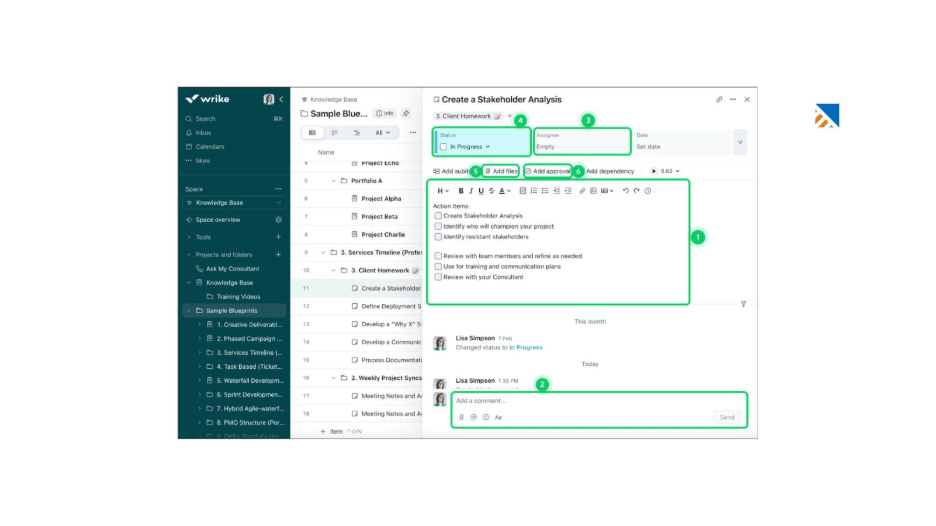
Wrike is a heavyweight in the project management space, and its client portal capabilities reflect that. Built for larger organizations managing multiple workstreams simultaneously, Wrike gives you fine-grained control over what clients see, how projects are structured, and how teams collaborate across departments.
Limitation: Wrike's interface has a steep learning curve. Smaller teams or those with straightforward project needs may find it more than they need.
Key Features:
Fully customizable dashboards and project views
Interactive Gantt charts with dependency mapping
Automated approval workflows and request routing:
Advanced resource management and workload balancing
Proofing and annotation tools for creative deliverables
AI-powered project risk insights (new in 2026)
Smartsheet: Best for Data-Driven Project Teams
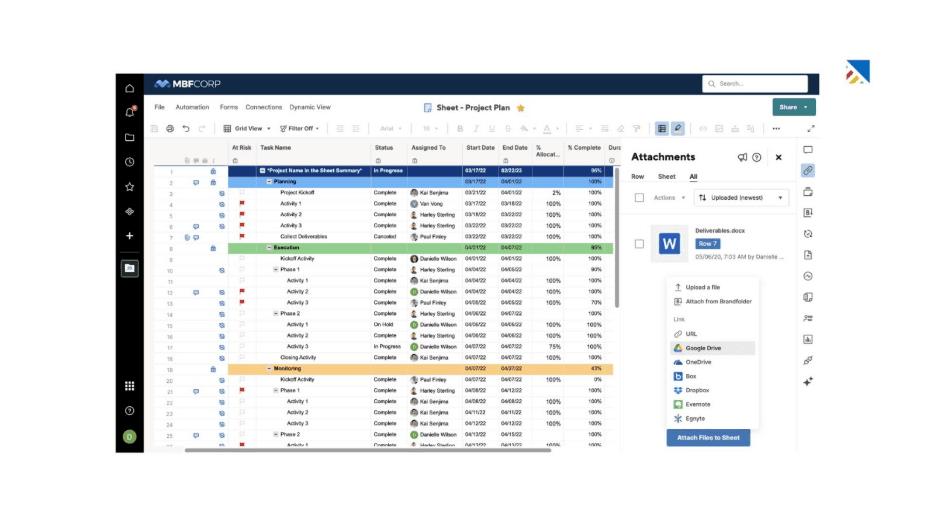
Smartsheet sits at an interesting intersection: it looks like a spreadsheet but functions like a full project management platform. If your team is comfortable with Excel or Google Sheets and wants to upgrade without a complete workflow overhaul, Smartsheet is worth a serious look.
The limitation: it's not the most intuitive platform for non-spreadsheet users, and the interface can feel dense for clients who aren't comfortable with tabular data.
Key Features:
Spreadsheet-style interface with project management functionality
Branded client portals with customizable layouts
Automated workflows, alerts, and approval processes
Gantt and calendar views for timeline management
Dynamic forms for client intake and feedback collection
Integrations with Salesforce, Jira, Google Workspace, and more
Still confused about the PM tool Vs. PSA Tool? Talk to Our Experts Today
Asana: Best for Agile Teams and Cross-Functional Collaboration
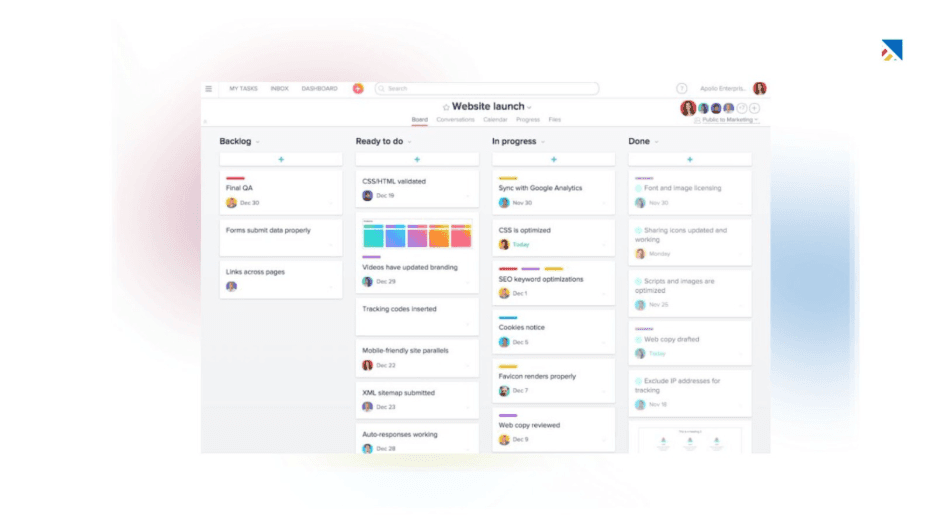
Asana has evolved well beyond its task-list roots. In 2026, it offers a robust suite of project management features alongside a polished client-facing experience. The platform's strength is its flexibility, you can run projects as boards, timelines, lists, or calendars, and clients get a clean, easy-to-navigate view of what matters to them.
Limitation: Asana's time tracking features are limited natively, you'll likely need an integration with Harvest, Toggl, or a similar tool for accurate billing.
Key Features:
Multiple project views: list, board, timeline, calendar, Gantt
Custom templates for fast project setup
Task dependencies, subtasks, and milestone tracking
Goals and portfolio views for program-level oversight
External guest access with permission controls
Trello: Best for Small Teams and Visual Project Management
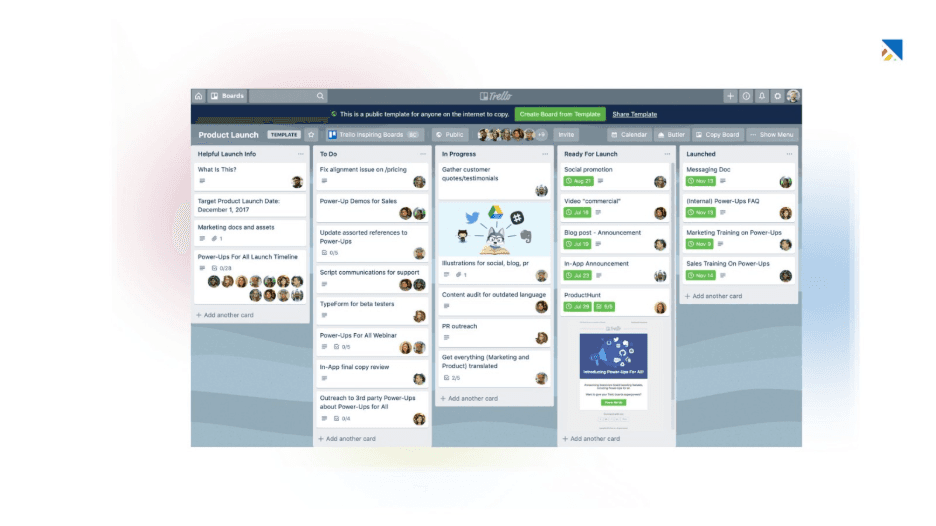
Trello's Kanban-first approach makes it one of the most immediately understandable project management tools on the market. If you're managing straightforward projects with a small team and want clients to quickly grasp where things stand, Trello's card-and-board system is hard to beat for simplicity.
Limitation: Trello lacks native Gantt charts, time tracking, and advanced reporting. Power-ups can extend functionality, but heavily customized Trello setups can become hard to maintain.
Key Features:
Visual Kanban boards with drag-and-drop cards
Custom card fields, checklists, and attachments
Butler automation for repetitive task actions
Calendar and timeline views (via Power-Ups)
Board-level guest access for client collaboration
Generous free plan for small teams
Basecamp: Best for Remote Teams Prioritizing Communication
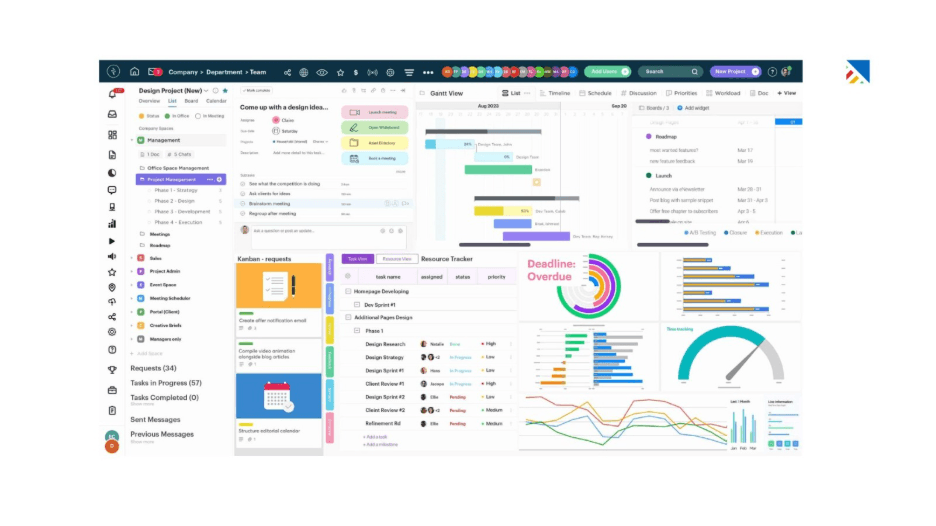
Basecamp takes a different philosophy from most project management tools. It deliberately simplifies rather than adding features. Every project gets the same structure: a message board, a to-do list, a doc and file section, a schedule, and a group chat. Clients are invited into a 'client side' of the project where they see only what you've chosen to share.
Limitation: no Gantt charts, no time tracking, no resource management. If you need these features, you're looking at third-party integrations or a different platform entirely.
Key Features:
Dedicated 'client side' project view with selective sharing
Message boards for organized team and client communication
To-do lists with assignments and due dates
Automatic check-in questions for async status updates
Document and file storage within each project
Fixed pricing (not per-user) advantageous for larger teams
Zoho Projects: Best for SMBs Wanting an All-in-One Solution
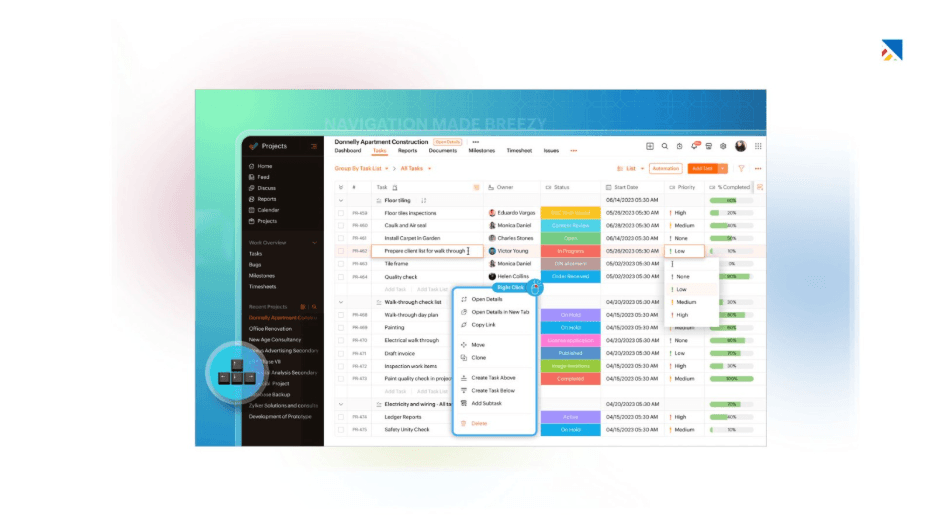
Zoho Projects is part of the broader Zoho ecosystem, an advantage if you're already using Zoho CRM, Zoho Books, or other Zoho products. The platform offers a solid mix of project management features at a price point that's genuinely accessible for small and mid-size businesses.
Limitation: the interface feels less polished than some competitors, and the learning curve is steeper than Trello or Basecamp. But for teams that want comprehensive features without enterprise pricing, it's a compelling option.
Key Features:
Interactive Gantt charts with critical path tracking
Built-in time tracking and resource utilization reports
Issue tracking and bug management
Client portal with document sharing and feedback tools
Deep integration with Zoho CRM, Books, and Analytics
Competitive pricing with a free plan for up to 3 users
See Projetly PSA in Action: Book Your Personalized Demo Today
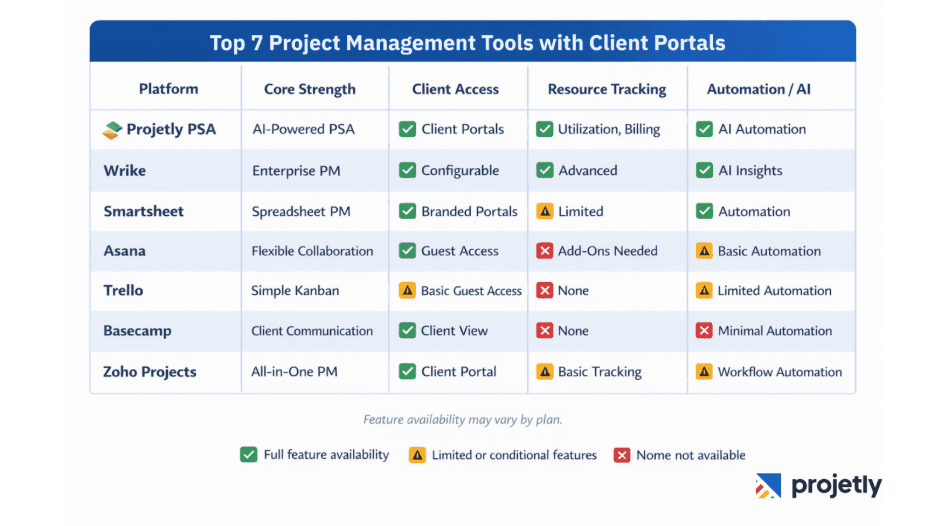
Side-by-Side Comparison: Top Project Management Tools With Client Portals
Use this table to quickly compare the platforms on the features that matter most:
How to Choose the Right Platform for Your Team
The 'best' platform depends entirely on your context. Here's a practical framework for narrowing it down:
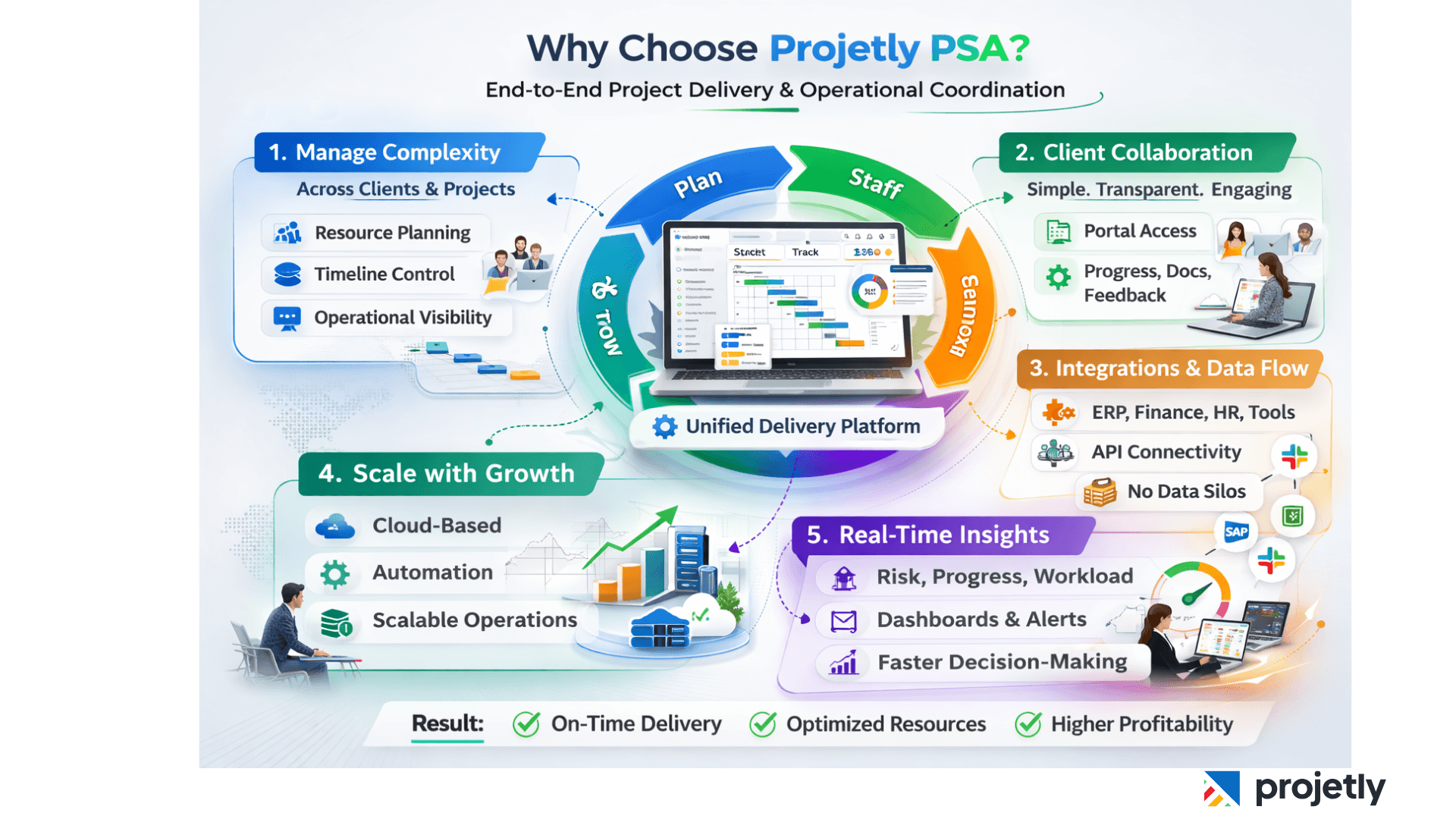
Start with team size and delivery complexity: If your organization manages multiple clients, shared resources, and overlapping timelines, you need more than task tracking, you need operational coordination. Projetly PSA is designed for this reality, connecting planning, staffing, execution, and performance into one delivery system so complexity stays manageable instead of chaotic.
Think about your clients’ comfort with technology: A portal only creates value if clients actually use it. Projetly focuses on clarity and guided collaboration, giving clients visibility into progress, documents, and feedback without overwhelming them with technical interfaces. This keeps engagement high and reduces status-update friction.
Consider your existing workflows and integrations: PSA software works best when it fits into your operational ecosystem. Projetly supports integrations and API connectivity so project, financial, and communication data flow together rather than living in silos, improving accuracy and decision-making across teams.
Plan for growth, not just current needs: As delivery volume increases, manual coordination quickly breaks down. Projetly’s cloud-based architecture and automation capabilities help teams scale operations, workloads, and reporting without multiplying administrative overhead.
Test delivery in real conditions: The real value of PSA software appears when a live project runs through it. Projetly’s dashboards, collaboration spaces, and automated tracking are designed to surface risks, progress, and workload signals in real time, helping teams adjust early rather than react late.
Start Your Free Trial of Projetly PSA
Experience unified delivery, automation, and real-time visibility, and risk-free.
Types of Client Portals: Which Fits Your Use Case?
Client portals aren't one-size-fits-all. Here's how to match the portal type to your project needs:
Collaborative portals: Built for back-and-forth, real-time communication, file co-editing, and shared task tracking. Best for creative and development projects.
Project tracking portals: Focused on milestones, timelines, and progress visibility. Best for construction, engineering, and implementation projects.
Document management portals: Centered on file organization, version control, and approval workflows. Best for legal, compliance, and content-heavy projects.
Reporting and analytics portals: Provide clients with data dashboards and performance insights. Best for ongoing retainers and performance-based engagements.
Client-specific white-label portals: Fully branded, personalized portals for individual clients. Best for agencies managing premium or high-touch accounts.
Real-World Results: What Teams Are Seeing
The case for client portals isn't theoretical. Here's what organizations report when they implement them effectively:
A mid-size construction firm reduced client status call frequency by over 60% after implementing a project tracking portal. Clients could check progress in real time rather than waiting for weekly check-ins.
A software development agency cut approval turnaround time from five days to under 24 hours by routing client sign-offs through an in-portal workflow instead of email chains.
A creative agency managing 30+ client accounts found that white-labeled portals reduced client confusion and increased perceived professionalism more than any other single change to their workflow.
Frequently Asked Questions
What's the difference between a project management tool and a client portal?
A project management tool is primarily internal; it helps your team organize work, track tasks, and manage resources. A client portal is the client-facing layer that sits on top of that: a controlled, curated view of project information designed for stakeholders outside your organization. The best platforms in 2026 combine both in a single system.
Do all project management tools include client portals?
No. Many task management tools, including some popular ones, offer only internal functionality. Client portal features are typically found in more robust project management platforms, and the depth of portal features varies significantly between providers. Always verify portal capabilities before committing to a platform.
Are client portals secure?
Reputable platforms use role-based access controls, encrypted data transmission (SSL/TLS), and audit logs to protect client data. Before choosing a platform, review its security certifications (SOC 2, ISO 27001 are common benchmarks) and confirm it meets any industry-specific compliance requirements you have (HIPAA, GDPR, etc.).
Can I white-label a client portal with my own branding?
Yes, most enterprise and mid-tier platforms support custom branding: your logo, brand colors, and domain. Wrike, Smartsheet, and Zoho Projects all offer white-labeling options, though the depth of customization varies by plan.
What's the most important feature in a client portal?
It depends on your use case, but if we're picking one, it's real-time visibility. The entire value of a client portal is replacing reactive communication (clients asking 'where are we?') with proactive transparency (clients seeing for themselves). If the portal requires manual updates or goes stale, it defeats the purpose.
Final Thoughts
The right project management software with a client portal doesn't just help you stay organized, it changes the dynamic of your client relationships. When clients have visibility, they have confidence. When they have confidence, they're easier to work with, more likely to approve quickly, and more likely to come back.
In 2026, the expectation is transparency. Teams that provide it through well-implemented client portals will have a genuine competitive advantage over those still relying on email updates and weekly calls.
The platforms covered here: Projetly, Wrike, Smartsheet, Asana, Trello, Basecamp, and Zoho Projects, all approach client collaboration differently. Some focus on task visibility, others on communication, and some extend further into full delivery and operational control.
The right choice ultimately comes down to how your team actually works. Align the platform with your real workflows, test it with a live client project, and you’ll learn more in two weeks than any comparison chart can tell you.
Book a demo with Projetly to see how unified delivery visibility can work for your team.
You may also like

A Guide to Project Management Professional Certification

Laugh Your Way to Productivity: 50 Workplace Quotes

50 Funny Workplace Memes That’ll Brighten Your Workday.
What Does a Customer-First Mindset Mean? Explained in 2025

What It Takes to be a Great Customer Success Manager in 2025